Tell me if you have a topic you'd like to see. (Contact: LoiS-sez@LoiS-sez.com .)
Please also let others know about this site.
Showing posts with label French literature. Show all posts

Friday, August 9, 2024

Lang - The Dancing Dog - Keeping the Public in Public Domain

Officially the "Dog Days of Summer" are considered in that link from the Old Farmer's Almanac to be July 3 - August 11. They point out it has variations, but always is tied to summer's Sirius, the Dog Star. It's an interesting article. I also have a love of dogs, so I was eager to once again present a story about them. I recall attending a storytelling conference that wisely put in its schedule a time to tell stories about pets. It was scheduled for one of those times when attendees would probably be running out of steam. It definitely perked up everybody in the group I attended as we all had stories about our pets and loved to tell about them!

Today's story is in two books, Lang's The Animal Story Book and a slightly edited version by Carolyn Sherwin Bailey in her In the Animal World. To be honest I prefer Bailey's version and recommend comparing it with Lang. He doesn't give his source unless it was from a French work, Ménagerie Intime, noted after the title. I chose it both because it's the original and Bailey's book has no illustrations while Lang's has illustrations by H.J. Ford. Beyond that, I'm on the road a lot this week and forced to use a laptop. It was far easier to copy the Project Gutenberg version than to take screenshots and edit Bailey's book which was only at the Internet Archive.

I strongly support both Project Gutenberg and the Internet Archive. If you haven't heard about (and lent your own support to) their fight in the lawsuit by four publishers, I urge you to read the latest in What Happened Last Friday in Hachette v. Internet Archive. The digital rights for libraries and online are at stake and even authors support the archive. That link is just the latest news presuming most readers understand what the case means for internet and library access.

The French setting doesn't hurt this story appearing in a week when the Olympics have taken us to Paris.  Bailey only calls the story "The Dancing Dog" and I've kept that shorter title for today's posting. Beyond all of that, here's a story of a most unusual dog -- but then aren't they all?!?

STILL WATERS RUN DEEP; OR THE DANCING DOG

Ménagerie Intime.

When Little Théophile became Big Théophile, he was as fond as ever of dogs and cats, and he knew more about them than anybody else. After the death of a large white spaniel called Luther, he filled the vacant place on his rug by another of the same breed, to whom he gave the name of Zamore. Zamore was a little dog, as black as ink, except for two yellow patches over his eyes, and a stray patch on his chest. He was not in the least handsome, and no stranger would ever have given him a second thought. But when you came to know him, you found Zamore was not a common dog at all. He despised all women, and absolutely refused to obey them or to follow them, and neither Théophile’s mother nor his sisters could get the smallest sign of friendship from him. If they offered him cakes or sugar, he would accept them in a dignified manner, but never dreamed of saying ‘thank you,’ still less of wagging his tail on the floor, or giving little yaps of delight and gratitude, as well-brought-up dogs should do. Even to Théophile’s father, whom he liked better than anyone else, he was cold and respectful, though he followed him everywhere, and never left his master’s heels when they took a walk. And when they were fishing together, Zamore would sit silent on the bank for hours together, and only allowed himself one bark when the fish was safely hooked.

Now no one could possibly have guessed that a dog of such very quiet and reserved manners was at heart as gay and cheerful as the silliest kitten that ever was born, but so he was, and this was how his family found it out.

One day he was walking as seriously as usual through a broad square in the outskirts of Paris, when he was surprised at meeting a large grey donkey, with two panniers on its back, and in the panniers a troop of dogs, some dressed as Swiss shepherdesses, some as Turks, some in full court costume. The owner of the animals stopped the donkey close to where Zamore was standing, and bade the dogs jump down. Then he cracked his whip; the fife and drum struck up a merry tune, the dogs steadied themselves on their hind legs, and the dance began.

Zamore looked on as if he had been turned into stone. The sight of these dogs, dressed in bright colours, this one with his head covered by a feathered hat, and that one by a turban, but all moving about in time to the music, and making pirouettes and little bows; were they really dogs he was watching or some new kind of men? Anyway he had never seen anything so enchanting or so beautiful, and if it was true that they were only dogs—well, he was a dog too!

With that thought, all that had lain hidden in Zamore’s soul burst forth, and when the dancers filed gracefully before him, he raised himself on his hind legs, and in spite of staggering a little, prepared to join the ring, to the great amusement of the spectators.

The dog-owner, however, whose name was Monsieur Corri, did not see matters in the same light. He raised his whip a second time, and brought it down with a crack on the sides of Zamore, who ran out of the ring, and with his tail between his legs and an air of deep thought, he returned home.
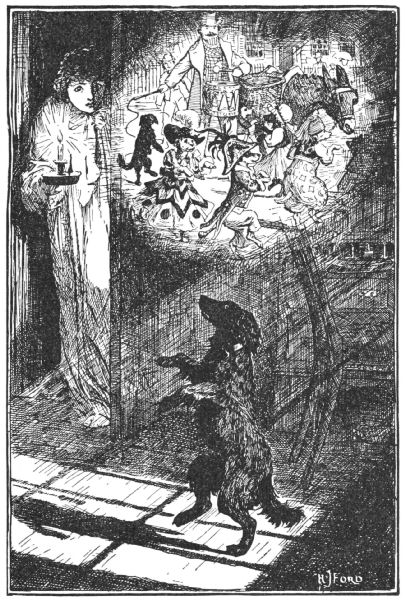
The girl finds Zamore practising his dancing

All that day Zamore was more serious and more gloomy than ever. Nothing would tempt him out, hardly even his favourite dinner, and it was quite plain that he was turning over something in his mind. But during the night his two young mistresses were awakened by a strange noise that seemed to come from an empty room next theirs, where Zamore usually slept. They both lay awake and listened, and thought it was like a measured stamping, and that the mice might be giving a ball. But could little mice feet tread so heavily as that? Supposing a thief had got in? So the bravest of the two girls got up, and stealing to the door softly opened it and looked into the room. And what do you think she saw? Why, Zamore, on his hind legs, his paws in the air, practising carefully the steps that he had been watching that morning!

This was not, as one might have expected, a mere fancy of the moment, which would be quite forgotten the next day. Zamore was too serious a dog for that, and by dint of hard study he became in time a beautiful dancer. As often as the fife and drum were heard in the streets, Zamore rushed out of the house, glided softly between the spectators, and watched with absorbed attention the dancing dogs who were doing their steps: but remembering the blow he had had from the whip, he took care not to join them. He noted their positions, the figures, and the way they held their bodies, and in the night he copied them, though by day he was just as solemn as ever. Soon he was not contented with merely copying what he saw, he invented for himself, and it is only just to say that, in stateliness of step, few dogs could come up to him. Often his dances were witnessed (unknown to himself) by Théophile and his sisters, who watched him through the crack of the door; and so earnest was he, that at length, worn out by dancing, he would drink up the whole of a large basin of water, which stood in the corner of the room.

When Zamore felt himself the equal of the best of the dancing dogs, he began to wish that like them he might have an audience.

Now in France the houses are not always built in a row as they are in England, but sometimes have a square court-yard in front, and in the house where Zamore lived, this court was shut in on one side by an iron railing, which was wide enough to let dogs of a slim figure squeeze through.

One fine morning there met in this court-yard fifteen or twenty dogs, friends of Zamore, to whom the night before he had sent letters of invitation. The object of the party was to see Zamore make his début in dancing, and the ball-room was to be the court-yard, which Zamore had carefully swept with his tail. The dance began, and the spectators were so delighted, that they could not wait for the end to applaud, as people ought always to do, but uttered loud cries of ‘Ouah, ouah,’ that reminded you of the noises you hear at a theatre. Except one old water spaniel who was filled with envy at Zamore’s talents, and declared that no decent dog would ever make an exhibition of himself like that, they all vowed that Zamore was the king of dancers, and that nothing had ever been seen to equal his minuet, jig, and waltz for grace and beauty.

It was only during his dancing moments that Zamore unbent. At all other times he was as gloomy as ever, and never cared to stir from the rug unless he saw his old master take up his hat and stick for a walk. Of course, if he had chosen, he might have joined Monsieur Corri’s troupe, of which he would have made the brightest ornament; but the love of his master proved greater than his love of his art, and he remained unknown, except of his family. In the end he fell a victim to his passion for dancing, and he died of brain fever, which is supposed to have been caused by the fatigue of learning the schottische, the fashionable dance of the day.

***********

As I said earlier I recommend Bailey's lightly edited version and recommend going to https://archive.org/details/inanimalworld00bail/page/136/mode/2up -- it will only take a few minutes for three and a fraction pages.

Because my time on the road required working a bit ahead, I'm writing this on Thursday, August 8. I just learned today is International Cat Day! I find there are even more stories about cats, so I will start prowling for next week's story and make it Caturday!

*********************

This is part of a series of postings of stories under the category, "Keeping the Public in Public Domain."  The idea behind Public Domain was to preserve our cultural heritage after the authors and their immediate heirs were compensated.  I feel strongly current copyright law delays this intent on works of the 20th century.  My own library of folklore includes so many books within the Public Domain I decided to share stories from them.  I hope you enjoy discovering new stories.  


At the same time, my own involvement in storytelling regularly creates projects requiring research as part of my sharing stories with an audience.  Whenever that research needs to be shown here, the publishing of Public Domain stories will not occur that week.  This is a return to my regular posting of a research project here.  (Don't worry, this isn't dry research, my research is always geared towards future storytelling to an audience.)  Response has convinced me that "Keeping the Public in Public Domain" should continue along with my other postings as often as I can manage it.

Other Public Domain story resources I recommend-

  • There are many online resources for Public Domain stories, maybe none for folklore is as ambitious as fellow storyteller, Yoel Perez's database, Yashpeh, the International Folktales Collection.  I have long recommended it and continue to do so.  He has loaded Stith Thompson's Motif Index into his server as a database so you can search the whole 6 volumes for whatever word or expression you like by pressing one key. http://folkmasa.org/motiv/motif.htm

  • You may have noticed I'm no longer certain Dr. Perez has the largest database, although his offering the Motif Index certainly qualifies for those of us seeking specific types of stories.  There's another site, FairyTalez claiming to be the largest, with "over 2000 fairy tales, folktales, and fables" and they are "fully optimized for phones, tablets, and PCs", free and presented without ads.
    Between those two sites, there is much for story-lovers, but as they say in infomercials, "Wait, there's more!"

The email list for storytellers, Storytell, discussed Online Story Sources and came up with these additional suggestions:        

         - David K. Brown - http://people.ucalgary.ca/~dkbrown/stories.html

         - Richard Martin - http://www.tellatale.eu/tales_page.html

         - Spirit of Trees - http://spiritoftrees.org/featured-folktales

         - Story-Lovers - http://www.story-lovers.com/ is now only accessible through the Wayback Machine, described below, but the late Jackie Baldwin's wonderful site lives on there, fully searchable manually (the Google search doesn't work), at https://archive.org/ .  It's not easy, but go to Story-lovers.com snapshot for December 22 2016  and you can click on SOS: Searching Out Stories to scroll down through the many story topics and click on the story topic that interests you.

       - World of Tales - http://www.worldoftales.com/ 

 
           - Zalka Csenge Virag - http://multicoloreddiary.blogspot.com doesn't give the actual stories, but her recommendations, working her way through each country on a continent, give excellent ideas for finding new books and stories to love and tell.

     
You're going to find many of the links on these sites have gone down, BUT go to the Internet Archive Wayback Machine to find some of these old links.  Tim's site, for example, is so huge probably updating it would be a full-time job.  In the case of Story-Lovers, it's great that Jackie Baldwin set it up to stay online as long as it did after she could no longer maintain it.  Possibly searches maintained it.  Unfortunately Storytell list member, Papa Joe is on both Tim Sheppard's site and Story-Lovers, but he no longer maintains his old Papa Joe's Traveling Storytelling Show website and his Library (something you want to see!) is now only on the Wayback Machine.  It took some patience working back through claims of snapshots but finally in December of 2006 it appears!

    Somebody as of this writing whose stories can still be found by his website is the late Chuck Larkin - http://chucklarkin.com/stories.html.  I prefer to list these sites by their complete address so they can be found by the Wayback Machine, a.k.a. Archive.org, when that becomes the only way to find them.

You can see why I recommend these to you. 

Have fun discovering even more stories


Friday, May 14, 2021

Saintine/Skinner - Picciola - Keeping the Public in Public Domain

 Last week I mentioned "my recent acquisition by the Skinner sisters, Ada M. and Eleanor L., The Emerald Story Book; Stories and Legends of Spring, Nature and Easter."  Today's story, of all the many tales and poems in that book, has haunted me.  I'm not alone for even today the novel, Picciola, by French novelist and playwright, X.B. Saintine, from 1836 continues to fascinate readers on Goodreads

But that is a full-length novel and is neither suited to storytelling nor this blog.  Ada Skinner distilled the story to its essence for the "Spring Stories and Legends" section of The Emerald Story Book.  I've not read the novel, so I can only react to her adaptation.  It's simple matching the novel's introduction of "Here are no stirring incidents, no thrilling love tale. And yet there is love in what I am about to relate; but it is only the love of a man for...Shall I tell you? No, read and you will learn". 

There are no illustrations except the ones in your mind, but I will set the mood with this Photo by monkeyoutside on Unsplash

PICCIOLA

Adapted from St. Saintine

Many years ago a good man, who lived in France, was thrown into prison because the King suspected him of having plotted against the government.

Within four grey stone walls, with only one small window through which the little stream of sunshine came, the poor man was kept captive for months and years. He was not allowed to speak to a living soul except his jailer who at best was but a cross old fellow. He had no work to do. There were no books to read, and his only source of amusement during many long tedious hours was drawing pictures with a bit of charcoal on the bare stone walls of his prison cell.

Fortunately, however, the poor captive was permitted to leave his cell for one hour each morning and go up a narrow winding stairway which led him into a small courtyard on all sides of which rose high, strong prison walls. There was no roof overhead. Here the prisoner could breathe the fresh air and feel the warm sun and by looking up he could see a bit of the blue sky above.

Day after day the prison life went on in the same round without any change or hope of change. The bitterness and loneliness of the poor man’s lot grew upon him as months and years passed without a word from his family or friends and without hope of ever seeing one of them again. And by and by a time came when he could no longer even find amusement in sketching upon the walls of his cell, for not one vacant spot was left in all that space where he could draw a picture. He was a very unhappy man indeed, and it is hard to say how it might have ended. But one day a new interest came into his life—an interest which changed the poor fellow from an unhappy bitter man who had come to hate everybody and everything, into one who forgot all wrong and who learned to see only the good and the beautiful in all around him. And this interest came about through the growing up of a tiny stray seed which had been blown into the courtyard by the wind and had taken root between two of the great stones with which the courtyard was paved.

It happened that one day as the prisoner was taking his daily walk his eyes caught sight of the bright green of the little seedling just in time to save it from being crushed beneath his foot. He stopped and looked closer. Then he saw how a little plant had sent down its rootlets into the crevice between the stones and had struggled to push its head up where its green leaves might catch what they could of the scant sunshine. He thought how wonderful it was that the little seed had found courage to take root and struggle for life in the dark and gloomy courtyard of the prison. “Brave little plant,” he said. “You deserve to live. I shall watch over you and guard you, for the wind and the hail are hard enemies.”

Day by day he noticed how bravely it grew higher and higher and unfolded one leaf after another to the dull sunshine. He became more and more interested in the little nursling which in time was like a dear friend and companion to him. He called it Picciola, which means, “little one,” and before many days had passed, it had taken root and grown in his own heart so that there was no longer room for bitterness or memory of any wrongs.

At one time when a great hailstorm sent its cruel hail into the courtyard, the prisoner bent over Picciola to protect it and the driving hailstones fell upon his own head until the storm was over.

“My poor little Picciola,” he said, “I shall not always be here to guard you from harm. Much can happen to my little plant when I am in my cell. I will build a little fence around you, then the wind cannot blow you down nor the hail cut you with sharp stones.”

The cross jailer, too, took an interest in Picciola when he saw how happy the prisoner had become and he was glad to help take care of the little plant. Somehow, the jailer did not seem to be such a cross fellow as before; indeed he seemed to be quite a gentle and kind hearted man.

Now the prisoner was very happy and the days were no longer weary and without interest for Picciola was always waiting for him in the courtyard and he was sure to see something new about the little plant each morning he visited it. And Picciola grew and grew and in time put forth two beautiful blossoms and sent perfume to make glad the heart of her friend.

But one morning alas! when the prisoner went to look at Picciola he found that, in spite of all his care, she had begun to droop and wither. What could be the matter? In a moment he was on the ground examining the little plant to find out what was causing all the trouble. He soon discovered that Picciola had grown so large that there was no longer room enough for it to grow in the crevice between the stones. The sharp edges of the stones cut into the delicate stem and the poor prisoner could see that his little companion would die unless the stones could be lifted.

He was in great distress. He tried with all the strength he had to lift the stones himself; but he could not move them. He begged the jailer to help him.

“I can do nothing for you,” said the jailer. “You must ask the King; he alone has the power to say that the stones should be lifted.”

“But the King is far away,” said the prisoner. “There is but one way to reach him—I must write.”

The poor fellow in despair sent a letter to the King begging him to save the life of his little friend, Picciola. The letter was written on a white handkerchief with a bit of charcoal. He begged the King, not for his own freedom and life, but for the life of Picciola. As soon as the King finished reading the prisoner’s letter he said:

“This man is not really wicked at heart or he could not care so much for a little plant. The stones shall be raised that the little plant may live, and I will pardon this prisoner because of his great love and sacrifice for so helpless a thing as Picciola.” So the prisoner was released and when he left his lonely prison cell he took Picciola with him, for she had been the beginning for him of a new happiness.


Photo by Valentin Salja on Unsplash


Initially trying to find more about this story, Skinner led us astray by claiming it was originally by "St. Saintine."  A typo?  Wikipedia gives us the basics on X.B. Saintine, hinting at the popularity of the novel, but while they mention it being "translated into many European languages", Project Gutenberg only offers it in the original French.  Google Books has a free eBook also in French, but with the mainly English introduction by A.C. Clapin telling us of the book's popularity not only in winning the highest award by the French Academy, but :

Picciola was a great literary success.  Music, painting, the stage, even fashion, in all its frivolities, borrowed in turn from the Author of Picciola either the sentiment or the title of his book.  There was a time when the flower of the Fenestrelle prisoner blossomed everywhere; on the piano as a musical reverie; on the easel as a painting; those who in the evening saw Picciola on the stage, might have contemplated, in the morning, Picciola, a real living flower at a flower show.

Can you think of any modern novel that is a similar sensation everywhere?

The introduction goes on to say "Saintine was not dazzled by the great renown of his book."  This is further shown by its sparking a letter (unfortunately given only in French) in 1843 by Napoleon III telling of it bringing comfort in his own imprisonment.  Saintine sent a copy of the book to him and received back a blossom of the Heliotrope the prisoner cultivated on the terrace of his prison.

As the French might sigh, "Alas!" it takes some prowling to find the book in English.  Archive.org will let you read an English translation online.  There are several, but skip the first one as it's the version offered by Google I mentioned earlier and is mainly in French.  Beyond that there are several translations, including ones with illustrations.

(You even can find at Archive.org a pair of those "musical reveries.")

For myself, I find Skinner's adaptation sufficient, but, as I said earlier, haunting.

*****************

This is part of a series of postings of stories under the category, "Keeping the Public in Public Domain."  The idea behind Public Domain was to preserve our cultural heritage after the authors and their immediate heirs were compensated.  I feel strongly current copyright law delays this intent on works of the 20th century.  My own library of folklore includes so many books within the Public Domain I decided to share stories from them.  I hope you enjoy discovering new stories.  


At the same time, my own involvement in storytelling regularly creates projects requiring research as part of my sharing stories with an audience.  Whenever that research needs to be shown here, the publishing of Public Domain stories will not occur that week.  This is a return to my regular posting of a research project here.  (Don't worry, this isn't dry research, my research is always geared towards future storytelling to an audience.)  Response has convinced me that "Keeping the Public in Public Domain" should continue along with my other postings as often as I can manage it.
Other Public Domain story resources I recommend-
  • There are many online resources for Public Domain stories, maybe none for folklore is as ambitious as fellow storyteller, Yoel Perez's database, Yashpeh, the International Folktales Collection.  I have long recommended it and continue to do so.  He has loaded Stith Thompson's Motif Index into his server as a database so you can search the whole 6 volumes for whatever word or expression you like by pressing one key. http://folkmasa.org/motiv/motif.htm
  • You may have noticed I'm no longer certain Dr. Perez has the largest database, although his offering the Motif Index certainly qualifies for those of us seeking specific types of stories.  There's another site, FairyTalez claiming to be the largest, with "over 2000 fairy tales, folktales, and fables" and they are "fully optimized for phones, tablets, and PCs", free and presented without ads.

    Between those two sites, there is much for story-lovers, but as they say in infomercials, "Wait, there's more!"
The email list for storytellers, Storytell, discussed Online Story Sources and came up with these additional suggestions:            
         - David K. Brown - http://people.ucalgary.ca/~dkbrown/stories.html
         - Richard Martin - http://www.tellatale.eu/tales_page.html
         - Spirit of Trees - http://spiritoftrees.org/featured-folktales
         - Story-Lovers - http://www.story-lovers.com/ is now only accessible through the Wayback Machine, described below, but the late Jackie Baldwin's wonderful site lives on there, fully searchable manually (the Google search doesn't work), at https://archive.org/ .  It's not easy, but go to Story-lovers.com snapshot for October 22 2016  and you can click on SOS: Searching Out Stories to scroll down through the many story topics and click on the story topic that interests you.
       - World of Tales - http://www.worldoftales.com/ 
           - Zalka Csenge Virag - http://multicoloreddiary.blogspot.com doesn't give the actual stories, but her recommendations, working her way through each country on a continent, give excellent ideas for finding new books and stories to love and tell.
     
You're going to find many of the links on these sites have gone down, BUT go to the Internet Archive Wayback Machine to find some of these old links.  Tim's site, for example, is so huge probably updating it would be a full-time job.  In the case of Story-Lovers, it's great that Jackie Baldwin set it up to stay online as long as it did after she could no longer maintain it.  Possibly searches maintained it.  Unfortunately Storytell list member, Papa Joe is on both Tim Sheppard's site and Story-Lovers, but he no longer maintains his old Papa Joe's Traveling Storytelling Show website and his Library (something you want to see!) is now only on the Wayback Machine.  It took some patience working back through claims of snapshots but finally in December of 2006 it appears!
    Somebody as of this writing whose stories can still be found by his website is the late Chuck Larkin - http://chucklarkin.com/stories.html.  I prefer to list these sites by their complete address so they can be found by the Wayback Machine, a.k.a. Archive.org, when that becomes the only way to find them.
You can see why I recommend these to you. Have fun discovering even more stories!

Saturday, June 20, 2020

Lang/Caylus - Fairy Gifts - Keeping the Public in Public Domain

Sometimes finding one story leads to discovering another story I love even more.  Today's story is a perfect example.  Last week I found several interesting stories about fairies because I wanted something to go with my Quarantine project of a fairy house.  Here's that house now in place.
Andrew Lang produced a rainbow of books under a variety of colors.  This story is found in The Green Fairy Book and at the end is attributed to the Comte de Caylus, but Caylus both wrote original stories and collected French fairy tales and "oriental fantasies."  Britannica gives slightly dubious information about Caylus as the only son of the Marquise de Caylus, but both Wikipedia and Catholic Encyclopedia assert he was the eldest of two sons.  All agree the count went from a youthful military career to world travels exposing him to early archaeology and world cultures which influenced him when back in France for his work in the arts and literature in pre-revolutionary times.  This story isn't found in the two volume English translation of Les Contes Orientaux (Oriental Tales), so it seems to have been his original work.  

That bit of idle curiosity satisfied, I really want to let the story stand on its own.
I didn't want to give the Wikipedia link for the story before the story itself.    Ever since 1915 they have complained about a lack of sources for the story's article.  That article calls it a literary tale, but credits Lang with reworking it.  I know I've never seen it in any other source pre-dating Lang's 1892 edition.  If Lang reworked the story, he gave it folkloric style.

Bet you saw eventually where Sylvia's choice would go.  Whether you sing "You Can't Always Get What You Want" or think "Be careful what you wish for", I find myself thinking about King Solomon's wish for Wisdom.  Even with all his wisdom he still managed to go astray.  Perhaps a "quiet spirit" or at least letting our best self show is the best we can want.


Here's a close-up of mine as shown on Etsy.   Search for "fairy playing flute" to find two Pixies playing flute or a flute-playing gnome on a mushroom.  Beyond that there are flute-playing animals. My fairy told me her name is Alyssa.  I've no idea where that idea originated, so it must be from her.  With my love of the Native American flute, I sought her out and can't reject either her name or the fact it is a more classical flute.

Choose fairies and their gifts with care.

**************
This is part of a series of postings of stories under the category, "Keeping the Public in Public Domain."  The idea behind Public Domain was to preserve our cultural heritage after the authors and their immediate heirs were compensated.  I feel strongly current copyright law delays this intent on works of the 20th century.  My own library of folklore includes so many books within the Public Domain I decided to share stories from them.  I hope you enjoy discovering new stories.  


At the same time, my own involvement in storytelling regularly creates projects requiring research as part of my sharing stories with an audience.  Whenever that research needs to be shown here, the publishing of Public Domain stories will not occur that week.  This is a return to my regular posting of a research project here.  (Don't worry, this isn't dry research, my research is always geared towards future storytelling to an audience.)  Response has convinced me that "Keeping the Public in Public Domain" should continue along with my other postings as often as I can manage it.
Other Public Domain story resources I recommend-
  • There are many online resources for Public Domain stories, maybe none for folklore is as ambitious as fellow storyteller, Yoel Perez's database, Yashpeh, the International Folktales Collection.  I have long recommended it and continue to do so.  He has loaded Stith Thompson's Motif Index into his server as a database so you can search the whole 6 volumes for whatever word or expression you like by pressing one key. http://folkmasa.org/motiv/motif.htm
  • You may have noticed I'm no longer certain Dr. Perez has the largest database, although his offering the Motif Index certainly qualifies for those of us seeking specific types of stories.  There's another site, FairyTalez claiming to be the largest, with "over 2000 fairy tales, folktales, and fables" and they are "fully optimized for phones, tablets, and PCs", free and presented without ads.

    Between those two sites, there is much for story-lovers, but as they say in infomercials, "Wait, there's more!"
The email list for storytellers, Storytell, discussed Online Story Sources and came up with these additional suggestions:            
         - David K. Brown - http://people.ucalgary.ca/~dkbrown/stories.html
         - Richard Martin - http://www.tellatale.eu/tales_page.html
         - Spirit of Trees - http://spiritoftrees.org/featured-folktales
         - Story-Lovers - http://www.story-lovers.com/ is now only accessible through the Wayback Machine, described below, but Jackie Baldwin's wonderful site lives on there, fully searchable manually (the Google search doesn't work), at https://archive.org/ .  It's not easy, but go to Story-lovers.com snapshot for October 22 2016  and you can click on SOS: Searching Out Stories to scroll down through the many story topics and click on the story topic that interests you.
       - World of Tales - http://www.worldoftales.com/ 
           - Zalka Csenge Virag - http://multicoloreddiary.blogspot.com doesn't give the actual stories, but her recommendations, working her way through each country on a continent, give excellent ideas for finding new books and stories to love and tell.
     
You're going to find many of the links on these sites have gone down, BUT go to the Internet Archive Wayback Machine to find some of these old links.  Tim's site, for example, is so huge probably updating it would be a full-time job.  In the case of Story-Lovers, it's great that Jackie Baldwin set it up to stay online as long as it did after she could no longer maintain it.  Possibly searches maintained it.  Unfortunately Storytell list member, Papa Joe is on both Tim Sheppard's site and Story-Lovers, but he no longer maintains his old Papa Joe's Traveling Storytelling Show website and his Library (something you want to see!) is now only on the Wayback Machine.  It took some patience working back through claims of snapshots but finally in December of 2006 it appears!
    Somebody as of this writing whose stories can still be found by his website is the late Chuck Larkin - http://chucklarkin.com/stories.html.  I prefer to list these sites by their complete address so they can be found by the Wayback Machine, a.k.a. Archive.org, when that becomes the only way to find them.
You can see why I recommend these to you. Have fun discovering even more stories!