Tell me if you have a topic you'd like to see. (Contact: LoiS-sez@LoiS-sez.com .)
Please also let others know about this site.
Showing posts with label Hans Christian Andersen. Show all posts

Friday, March 22, 2024

Andersen - The Loveliest Rose in the World - Keeping the Public in Public Domain

This week opens with Palm Sunday.

by Brady Leavell on Unsplash

Our church every year puts all of us into that crowd waving palms and shouting "Hosannah!  Hosanna in the highest!" before we turn to shouting those horrible words "Crucify him!"  Surely as you do it you can't help feeling your own part in what led to all of this.  

I found Brady Leavell's photo perfect for the event, but am not surprised there doesn't seem to be a story of Palm Sunday beyond the gospels.

Last week's stories for St. Patrick's Day came from Francis Jenkins Olcott's The Wonder Garden; Nature Myths and Tales...  Olcott was the first librarian to head and develop a program for Children's Librarians at the 20th century innovative Carnegie Library of Pittsburgh.  When she left there in 1911, she went on to write and edit 24 books that earned more than half a million dollars during her lifetime!  Is it any wonder  her anthologies are edited to make them tellable?  Today's story, while in a trio of Easter stories is the closest fit for this week, known as Holy Week.  It comes from Good Stories from Great Holidays. 

Next week on Easter Sunday we'll return to The Wonder Garden.

THE LOVELIEST ROSE IN THE WORLD

BY HANS CHRISTIAN ANDERSEN (ADAPTED)

Once there reigned a queen, in whose garden were found the most glorious flowers at all seasons and from all the lands of the world. But more than all others she loved the roses, and she had many kinds of this flower, from the wild dog-rose with its apple-scented green leaves to the most splendid, large, crimson roses. They grew against the garden walls, wound themselves around the pillars and wind-frames, and crept through the windows into the rooms, and all along the ceilings in the halls. And the roses were of many colors, and of every fragrance and form.

But care and sorrow dwelt in those halls. The queen lay upon a sick-bed, and the doctors said she must die.

“There is still one thing that can save her,” said the wise man. “Bring her the loveliest rose in the world, the rose that is the symbol of the purest, the brightest love. If that is held before her eyes ere they close, she will not die.”

Then old and young came from every side with roses, the loveliest that bloomed in each garden, but they were not of the right sort. The flower was to be plucked from the Garden of Love. But what rose in all that garden expressed the highest and purest love?

And the poets sang of the loveliest rose in the world,—of the love of maid and youth, and of the love of dying heroes.

“But they have not named the right flower,” said the wise man. “They have not pointed out the place where it blooms in its splendor. It is not the rose that springs from the hearts of youthful lovers, though this rose will ever be fragrant in song. It is not the bloom that sprouts from the blood flowing from the breast of the hero who dies for his country, though few deaths are sweeter than his, and no rose is redder than the blood that flows then. Nor is it the wondrous flower to which man devotes many a sleepless night and much of his fresh life,—the magic flower of science.”

“But I know where it blooms,” said a happy mother, who came with her pretty child to the bedside of the dying queen. “I know where the loveliest rose of love may be found. It springs in the blooming cheeks of my sweet child, when, waking from sleep, it opens its eyes and smiles tenderly at me.”

“Lovely is this rose, but there is a lovelier still,” said the wise man.

“I have seen the loveliest, purest rose that blooms,” said a woman. “I saw it on the cheeks of the queen. She had taken off her golden crown. And in the long, dreary night she carried her sick child in her arms. She wept, kissed it, and prayed for her child.”

“Holy and wonderful is the white rose of a mother's grief,” answered the wise man, “but it is not the one we seek.”

“The loveliest rose in the world I saw at the altar of the Lord,” said the good Bishop, “the young maidens went to the Lord's Table. Roses were blushing and pale roses shining on their fresh cheeks. A young girl stood there. She looked with all the love and purity of her spirit up to heaven. That was the expression of the highest and purest love.”

“May she be blessed,” said the wise man, “but not one of you has yet named the loveliest rose in the world.”

Then there came into the room a child, the queen's little son.

“Mother,” cried the boy, “only hear what I have read.”

And the child sat by the bedside and read from the Book of Him who suffered death upon the cross to save men, and even those who were not yet born. “Greater love there is not.”

And a rosy glow spread over the cheeks of the queen, and her eyes gleamed, for she saw that from the leaves of the Book there bloomed the loveliest rose, that sprang from the blood of Christ shed on the cross.

“I see it!” she said, “he who beholds this, the loveliest rose on earth, shall never die.” 

*************************************

This is part of a series of postings of stories under the category, "Keeping the Public in Public Domain."  The idea behind Public Domain was to preserve our cultural heritage after the authors and their immediate heirs were compensated.  I feel strongly current copyright law delays this intent on works of the 20th century.  My own library of folklore includes so many books within the Public Domain I decided to share stories from them.  I hope you enjoy discovering new stories.  


At the same time, my own involvement in storytelling regularly creates projects requiring research as part of my sharing stories with an audience.  Whenever that research needs to be shown here, the publishing of Public Domain stories will not occur that week.  This is a return to my regular posting of a research project here.  (Don't worry, this isn't dry research, my research is always geared towards future storytelling to an audience.)  Response has convinced me that "Keeping the Public in Public Domain" should continue along with my other postings as often as I can manage it.

Other Public Domain story resources I recommend-

  • There are many online resources for Public Domain stories, maybe none for folklore is as ambitious as fellow storyteller, Yoel Perez's database, Yashpeh, the International Folktales Collection.  I have long recommended it and continue to do so.  He has loaded Stith Thompson's Motif Index into his server as a database so you can search the whole 6 volumes for whatever word or expression you like by pressing one key. http://folkmasa.org/motiv/motif.htm

  • You may have noticed I'm no longer certain Dr. Perez has the largest database, although his offering the Motif Index certainly qualifies for those of us seeking specific types of stories.  There's another site, FairyTalez claiming to be the largest, with "over 2000 fairy tales, folktales, and fables" and they are "fully optimized for phones, tablets, and PCs", free and presented without ads.
    Between those two sites, there is much for story-lovers, but as they say in infomercials, "Wait, there's more!"

The email list for storytellers, Storytell, discussed Online Story Sources and came up with these additional suggestions:        

         - David K. Brown - http://people.ucalgary.ca/~dkbrown/stories.html

         - Richard Martin - http://www.tellatale.eu/tales_page.html

         - Spirit of Trees - http://spiritoftrees.org/featured-folktales

         - Story-Lovers - http://www.story-lovers.com/ is now only accessible through the Wayback Machine, described below, but the late Jackie Baldwin's wonderful site lives on there, fully searchable manually (the Google search doesn't work), at https://archive.org/ .  It's not easy, but go to Story-lovers.com snapshot for December 22 2016  and you can click on SOS: Searching Out Stories to scroll down through the many story topics and click on the story topic that interests you.

       - World of Tales - http://www.worldoftales.com/ 

 
           - Zalka Csenge Virag - http://multicoloreddiary.blogspot.com doesn't give the actual stories, but her recommendations, working her way through each country on a continent, give excellent ideas for finding new books and stories to love and tell.

     
You're going to find many of the links on these sites have gone down, BUT go to the Internet Archive Wayback Machine to find some of these old links.  Tim's site, for example, is so huge probably updating it would be a full-time job.  In the case of Story-Lovers, it's great that Jackie Baldwin set it up to stay online as long as it did after she could no longer maintain it.  Possibly searches maintained it.  Unfortunately Storytell list member, Papa Joe is on both Tim Sheppard's site and Story-Lovers, but he no longer maintains his old Papa Joe's Traveling Storytelling Show website and his Library (something you want to see!) is now only on the Wayback Machine.  It took some patience working back through claims of snapshots but finally in December of 2006 it appears!

    Somebody as of this writing whose stories can still be found by his website is the late Chuck Larkin - http://chucklarkin.com/stories.html.  I prefer to list these sites by their complete address so they can be found by the Wayback Machine, a.k.a. Archive.org, when that becomes the only way to find them.

You can see why I recommend these to you. 

Have fun discovering even more stories


Saturday, June 15, 2019

Andersen - What (Father) Does Is Always Right - Keeping the Public in Public Domain

Andersen's statue in New York city's Central Park
For this Sunday's celebration of Father's Day I wanted a bit of whimsy and found the perfect story only to discover I posted it last year!  "The Seventh Father of the House" by the Norwegian collectors, Asbjornsen and Moe is a lot of fun and I still recommend it, but today's story is also Scandinavian, although some debate calling the works of Hans Christian Andersen folklore.  He is an excellent creative writer, but many of his stories draw upon folk roots and Andersen's introductory sentence to the story makes that clear.

Then there's the problem translating from the Danish Andersen's title or lead character.  Two excellent Danish authors, Erik Blegvad and Erik Christian Haugaard, each included the story in their anthologies of Andersen and translate it as Father.  Haugaard's book is Andersen's complete works, including Andersen's own notes to his published "booklets", as the stories came out in small collections and in 1861 the author called it a "Danish folk tale that I heard as a child and have retold in my own way." Those same notes give some interesting views by Andersen on the critical response to that collection:
It has been both said and written that this collection was the poorest I have yet produced, and yet among its pages are to be found two of my best fairy tales: WHAT FATHER DOES IS ALWAYS RIGHT and THE SNOWMAN.
(The Snowman was given here five years ago.)

Unlike Blegvad and Haugaard, other authors give the title and lead character as either The Old Man or as The Good Man so, when I ran across it as "Father", I was surprised as I'd known the story for a long time.   However you translate it, the tale is about a rather foolish man with a wife who clearly loves him unconditionally.  His swapping for progressively less valuable items puts it in the category of being a "Noodlehead" tale.  (For people wanting to attribute gender characteristics, be sure to look at the two earlier Noodlehead stories given here.)  My own husband sometimes complains about how film and television make fathers always appear stupid.  I wonder if this is to counteract the old television show, "Father Knows Best"?  The Noodleheads in this story are both male and female, but the story's gentle touch moves us bouncing along to the end.

Excellent as the Blegvad and Haugaard translations are, they're not public domain.  The 19th century translations by Mrs. H.B. Paull, were chosen by Lily Owens for her 1984 complete collection of Andersen because she "found it the most pleasurably readable."  Unfortunately only one illustration is given and the artist's signature is hard to decipher, but may be Hans Richter, even though the style is not typical of his better known more avant-garde work.  On a blog that is no longer active, http://hans-christian-andersens.blogspot.com/, but saved by a site called Encyclopedian Dictionary, many illustrations are given, including the large one possibly by Richter.  Unfortunately even the illegible artist signature is not given.  That blog dating back to 2012, however, does the story a great service, so I, too, want to insert them into the story.
Here are two versions of that ending


or
All of those, and Mrs. Paull's translation, definitely have him as an Old Man, but I'd recommend borrowing Twelve Tales / Hans Christian Andersen by Erik Blegvad as he not only translated, but did a loving job of illustrating the story and both Father and Mother show good natured Noodleheads, but also show age is not a factor in being called a "noodlehead."

By the way, for all those lovers of Hans Christian Andersen, while prowling for this article I found a very interesting site, Hans Christian Andersen: Annotated Web-o-graphy with lots of links to visit.

The story is so good natured, the storyteller needs to bounce it along in a similar way.  This illustration gives you a visual reminder of all the swaps.
Swap your stories wisely by Keeping the Public in Public Domain, whether it be Father's Day or any day, since it's always a good day for a story.
*********************
This is part of a series of postings of stories under the category, "Keeping the Public in Public Domain."  The idea behind Public Domain was to preserve our cultural heritage after the authors and their immediate heirs were compensated.  I feel strongly current copyright law delays this intent on works of the 20th century.  My own library of folklore includes so many books within the Public Domain I decided to share stories from them.  I hope you enjoy discovering new stories.  


At the same time, my own involvement in storytelling regularly creates projects requiring research as part of my sharing stories with an audience.  Whenever that research needs to be shown here, the publishing of Public Domain stories will not occur that week.  This is a return to my regular posting of a research project here.  (Don't worry, this isn't dry research, my research is always geared towards future storytelling to an audience.)  Response has convinced me that "Keeping the Public in Public Domain" should continue along with my other postings as often as I can manage it.
Other Public Domain story resources I recommend-
  • There are many online resources for Public Domain stories, maybe none for folklore is as ambitious as fellow storyteller, Yoel Perez's database, Yashpeh, the International Folktales Collection.  I have long recommended it and continue to do so.  He has loaded Stith Thompson's Motif Index into his server as a database so you can search the whole 6 volumes for whatever word or expression you like by pressing one key. http://folkmasa.org/motiv/motif.htm
  • You may have noticed I'm no longer certain Dr. Perez has the largest database, although his offering the Motif Index certainly qualifies for those of us seeking specific types of stories.  There's another site, FairyTalez claiming to be the largest, with "over 2000 fairy tales, folktales, and fables" and they are "fully optimized for phones, tablets, and PCs", free and presented without ads.

    Between those two sites, there is much for story-lovers, but as they say in infomercials, "Wait, there's more!"
The email list for storytellers, Storytell, discussed Online Story Sources and came up with these additional suggestions:            
         - David K. Brown - http://people.ucalgary.ca/~dkbrown/stories.html
         - Richard Martin - http://www.tellatale.eu/tales_page.html
         - Spirit of Trees - http://spiritoftrees.org/featured-folktales
         - Story-Lovers - http://www.story-lovers.com/ is now only accessible through the Wayback Machine, described below, but Jackie Baldwin's wonderful site lives on there, fully searchable manually (the Google search doesn't work), at https://archive.org/ .  It's not easy, but go to Story-lovers.com snapshot for October 22 2016  and you can click on SOS: Searching Out Stories to scroll down through the many story topics and click on the story topic that interests you.
       - World of Tales - http://www.worldoftales.com/ 
           - Zalka Csenge Virag - http://multicoloreddiary.blogspot.com doesn't give the actual stories, but her recommendations, working her way through each country on a continent, give excellent ideas for finding new books and stories to love and tell.
     
You're going to find many of the links on these sites have gone down, BUT go to the Internet Archive Wayback Machine to find some of these old links.  Tim's site, for example, is so huge probably updating it would be a full-time job.  In the case of Story-Lovers, it's great that Jackie Baldwin set it up to stay online as long as it did after she could no longer maintain it.  Possibly searches maintained it.  Unfortunately Storytell list member, Papa Joe is on both Tim Sheppard's site and Story-Lovers, but he no longer maintains his old Papa Joe's Traveling Storytelling Show website and his Library (something you want to see!) is now only on the Wayback Machine.  It took some patience working back through claims of snapshots but finally in December of 2006 it appears!
    Somebody as of this writing whose stories can still be found by his website is the late Chuck Larkin - http://chucklarkin.com/stories.html.  I prefer to list these sites by their complete address so they can be found by the Wayback Machine, a.k.a. Archive.org, when that becomes the only way to find them.
You can see why I recommend these to you. Have fun discovering even more stories!

Saturday, March 16, 2019

A Miscellany of Ideas for "A Universe of Stories"

Brace yourself, today's going to be a long wrap-up of ideas and stories because I really need to move on to other topics.

This is my program for the Collaborative Summer Library Program theme of "A Universe of Stories."  Because librarians and storytellers are planning toward this summer I've been sharing my review of an astronomy-related program from the past.  In some cases I will still include stories used in the past like a delightful Korean tale attributing eclipses to "A Dog Named Fireball."  It's not Public Domain, so I couldn't reproduce it here.  I also plan to continue telling my own version of the origin of the Pleiades, as mentioned a little over a month ago when I began this series.  Beyond existing stories, I have my Mad Libs book of story starters to create a space story with audiences, as well as the space jokes -- yes, I confess fourth grade humor is about my level.  

From What the Moon Saw and Other Tales
by Hans Christian Andersen 
Illustrator: A. W. Bayes and Brothers Dalziel (engravers)
This has been a time beyond reviewing past stories and exploring what else is out there.  For example some situations might be able to use a story I published here shortly before Halloween in 2017, Joseph Jacobs' story, "The Buried Moon".  It's a beautiful haunting story, but needs the right setting and audience, possibly middle school and teens.  Another story for that level, but not the younger readers, is Hans Christian Andersen's little known tale of "The Comet."  To find the story you could go to either of two books of translations of his complete works still easily located (and in copyright).  The most recent is by Erik Haugaard, The complete fairy tales and stories, (1974) -- be careful as it's not in an abridged version of his translation (illustrated by Michael Foreman called Hans Andersen, his classic fairy tales). There's also an older translation reissued in 2014 by Jean Hersholt called Hans Christian Andersen, the complete fairy tales.  I own The complete Hans Christian Andersen fairy tales edited by Lily Owens and my copy didn't say she used the Hersholt version.  Further research found two older pdf versions.  Stories and tales / by Hans Christian Andersen ; illustrated by M. L. Stone and V. Pedersen (1870) and Fairy tales and other stories / by Hans Christian Andersen ; rev. and in part newly tr. by W.A. & J.K. Craigie, with ninety-five illustrations (1914):

https://hdl.handle.net/2027/njp.32101071957110?urlappend=%3Bseq=289
https://hdl.handle.net/2027/uva.x000457775?urlappend=%3Bseq=1038 
Those are from the HathiTrust Digital Library and you may download pdfs or even the entire book.
When I was tracking down the Hersholt version I called a library with a copy and the librarian fell in love with the story of a man born when the comet appears (and the superstitions about that) and dies the next time it appears.  An older group could appreciate that Halley's Comet appeared in 1986 and will reappear in 2062 and all that happens in the 75 or 76 years between.  It's a discussion starter for adults and teens and many libraries have Summer Reading Programs for more than just elementary school readers.
Beyond just stories I like to have handouts whenever possible for my audience to take home.  I found this great picture from Simple Simon and Company:  https://www.simplesimonandco.com/2012/03/craft-stick-puppets-perfect-for-something-on-a-stick-day.html/  Simple Simon and Company is a blog from two former teachers named Elizabeth sharing all manner of projects.  Since the puppets aren't for sale and that link introduces you to their work, it's reasonable to offer it here.  My own copy here is the result of my editing out the extra wording.
My full-size handout works either as stick puppets or finger puppets.  Perfect for young storytellers and puppeteers. 

I've often included Cherokee stories from James Mooney's Myths of the Cherokee and it's available online at Project Gutenberg.  It includes another version of that Pleiades story -- it's very popular and many versions exist among the different Native American nations.  There's also a very brief origin tale of the Milky Way and why they call it "Where the dog ran."  Both are among the book's first group of stories, including some other astronomical stories, in a section called Cosmogonic Myths.  Both the origin of the Pleiades and the Milky Way have been told in other cultures beyond North America.  I included a Wikipedia link to help you if you want to learn about the Milky Way since I haven't included it here.  Some might call the Cherokee idea "corny", but this dog-lover enjoys it the best of all.  Maybe you have a different preference. 

Obviously there are many pourquois tales beyond our many Native American ones.  Here's a video of friend and colleague, Richard Martin, telling a Swedish version of the Pleiades.  Since Blogger has a preference for their own YouTube videos and this is from Vimeo, I just give the link and encourage you to prowl Richard's many wonderful resources on his site.  His Swedish version is quite enjoyable, but I still plan to use the Iroquois version. 

Another story from my past astronomical tales came up in a different version on the email list for storytellers, Storytell.  Darrin Crow posted: They That Chase After the Bear is a very cool one about the big dipper.
They That Chase After The Bear

This version of the legend comes from William Jones' 1907 collection

of Mesquakie stories, Fox Texts.

It is said that once on a time long ago in the winter, at the

beginning of the season of snow after the first fall of snow, three

men went on a hunt for game early on a morning. Upon a hillside into

a place where the bush was thick a bear they trailed. One of the men

went in following the trail of the bear. And then he started it up

running. "Towards the place whence comes the cold is he speeding

away!" he said to his companions.

He that headed off on the side which lay towards the source of the

cold,"In the direction of the place of the noonday sky is he running!"

he said.

Back and forth amongst themselves they kept the bear fleeing. They

say that after a while he that was coming up behind chanced to look

down at the ground. Behold, green was the surface of the earth lying

face up! Now of a truth up into the sky were they conveyed by the

bear! When round about the bush they were chasing it then truly was

the time that up into the sky they went. And then he that came up

behind cried out to him that was next ahead: "O River-that-joins-

Another, let us go back! We are being carried up into the sky!" Thus

said he to River-that-joins-Another. But by him was he not heeded.

Now River-that-joins-Another was he who ran in between the two, and a
little puppy Hold-Tight he had for a pet.

In the autumn they overtook the bear, then they slew it. After they

had slain it, then boughs of the oak they cut, likewise boughs of the

sumac, then laying the bear on top of the leaves they flayed and cut

up the bear; after they had flayed and cut it up, then they began

slinging and scattering the meat in every direction. Towards the

place of the coming of the morning they flung the head; in the winter-

time when the morning is about to appear some stars usually rise; it

is said that they came from the head of the bear. And also his

backbone, towards the place of the morning they flung it too. They

too are commonly seen in the winter-time; they are stars that lie

huddled close together; it is said that they came from the backbone.

And they say that these four stars in the lead were the bear, and the

three stars at the rear were they who were chasing after the bear. In

between two of them is a tiny little star, it hangs near by another;

they say that it was the puppy, the pet Hold-Tight of River-that-

joins-Another.

Every autumn the oaks and sumacs redden in the leaf because it is

then that the hunters lay the bear on top of the leaves and flay and

cut it up; then red with blood become the leaves. Such is the reason

why every autumn red become the leaves of the oaks and sumacs.

That is the end of the story.

**** I replied:
There's a Pacific Northwest version from the Snohomish called

"Pushing Up the Sky" in Ella E. Clark's Indian Legends of the Pacific

Northwest that I've been unable to find a version in Public Domain.

In that version the people lift the sky shouting "Ya-hoh!" over and

over, but a few hunters missed the message about when it would happen

and wound up in the sky, too. The Fox were originally from the Great

Lakes area, so they are of interest here in Michigan even though the

largest number, along with the Sauk were relocated to Oklahoma

(that's definitely "a 'nother story!"), but you'll see they have

strong Midwestern roots. Stories travel and change a bit. I like to

start the story by getting the audience ready to lift the sky with a

"Ya-hoh!" and, now will explain it's told in two ways in two places

traveling just as happens in this story.

I follow the sky lifting story with the Iroquois story about the

Pleiades who dance into the sky. Like the Anne F. Rockwell picture

book version in The Dancing Stars, I have the mother bear welcome

them. I made a lullaby for her to sing. In each case I explain

this is my version after studying and falling in love with a story

as originating with those particular nations.


Here's something a bit different.  Award-winning author, Aaron Shepard offers on his website something he rightly calls "Gifts of Story."  There are stories from all over the world, often in reader's theater scripts, printable color posters, photo features, audio recordings, extended author notes, fun writing exercises, and alternate story versions.  Back in 1996 he wrote "How Frog Went to Heaven; A Tale of Angola" for Australia's School Magazine and later adapted it for reader's theater (Gift of Story #28) complete with music.  The story's fun for the audience and any young readers acting it out, but imagine my shock to find on his "Extras" , giving  more information about the story, he said:

The song can be found with additional lyrics and music in full arrangement in Echoes of Africa in Folk Songs of the Americas, by Beatrice Landeck, David McKay Company, New York, 1961. My thanks to Lois Sprengnether for calling it to my attention.

! ! !

All right that clearly dates back to the time before I "found my Keel in life", but it was great to email chat a bit with him after seeing that story, which also fits well in with these thematic offerings.

Beyond all of this I want to recommend Flint Public Library's Ring a Ring o' Roses.  Now in its 12th edition!  bookorders@fpl.info will let you buy it from the library or ask any questions.  I don't go back through their full 35 years of publishing, but have recommended it for most of that time.  While it is planned for preschoolers, there are ways to adapt for school-age.

Here's one from the book.  Finger Play motions are given in italics.

Moon Ride

Do you want to go up with me to the moon?
Point to friend, self, then to sky.
Let's get in our rocket ship and blast off soon!
Pretend to climb in ship.  Swish hands quickly.
Faster and faster we reach to the sky,
Jump and reach.
Isn't it fun to be able to fly?
We're on the moon, now all take a look,
Look down,
And gently sit down and I'll show you a book.
Sit down gently.


I often recommend Jackie Baldwin's Story-Lovers website now only reached through Archive.org's "Wayback Machine."  People sometimes find the Wayback Machine a bit confusing, but you can get directly to suggestions of Sun, Moon, and Star Stories plus her book suggestions from back in 2009 at

https://web.archive.org/web/20160419211008/http://www.story-lovers.com/listssunmoonstarsstories.html.  Most originated on the Storytell email list.  Nowadays that list continues through the National Storytelling Network's sponsoring it, complete with an archive from when in 2013 they began hosting it.

So now it's time to BLAST OFF to warmer weather 

(I hope)

and look forward to Summer Reading!

Saturday, September 27, 2014

Djurklo - Twigmuntus, Cowbelliantus, Perchnosius - Keeping the Public in Public Domain

Stories Travel!  As a storyteller I'm delighted they did.  The collection by G. Djurklo and translated by H.L. Braekstad called Fairy Tales from the Swedish has many stories showing such traveling, but do you recognize "Twigmuntus, Cowbelliantus, Perchnosius" as originating anywhere else?  I recognized a tale that took its idea . . .  more on that after the story.  First I hope you enjoy "Twigmuntus, Cowbelliantus, Perchnosius" at least as much as that strange title!
So did you recognize another story using this same idea?

If you want to see more Fairy Tales from the Swedish it's online.  I had great fun looking to see how many of those stories were ones I recognized in other versions.

Now for the answer: If you love that "Great Dane", Hans Christian Andersen you may recognize "Hans Clodhopper"!  There are many translations of Andersen and the tale of "Hans Clodhopper" is one of my favorites.  Is it the same?  DUNBERIDICULOUS!  Andersen is not usually placed in the folktale section, but you can trace many of his tales to his obvious love of folklore.

Speaking of folklore and stories that have traveled or been around a long time . . .

This is part of a series of postings of stories under the category, "Keeping the Public in Public Domain."  The idea behind Public Domain was to preserve our cultural heritage after the authors and their immediate heirs were compensated.  I feel strongly current copyright law delays this intent on works of the 20th century.  My own library of folklore includes so many books within the Public Domain I decided to share stories from them.  I hope you enjoy discovering new stories. 

At the same time, my own involvement in storytelling regularly creates projects requiring research as part of my sharing stories with an audience.  Whenever that research needs to be shown here, the publishing of Public Domain stories will not occur that week.  This is a return to my normal monthly posting of a research project here.  Response has convinced me that "Keeping the Public in Public Domain" should continue along with my monthly postings as often as I can manage it.    


There are many online resources for Public Domain stories, none for folklore is as ambitious as fellow storyteller, Yoel Perez's database, Yashpeh, the International Folktales Collection.  I recommended it earlier and want to continue to do so.  Have fun discovering even more stories!

Saturday, June 21, 2014

Andersen - The Snow Man - Keeping the Public in Public Domain

I did NOT like this story that much -- even if it does talk of Snow now that the weather is hot, BUT found another translation also in Public Domain a bit better AND a puppet production that expands it in a more entertaining way.  I know Hans Christian Andersen often wrote sad endings to his stories.  I don't mind those endings, they often are needed and do tend to regret Disneyfication of those stories.  The crucial problem is the audience needs a reason to identify with the story and its characters, even if we know it won't end well for them. 

Last week the issue of translation was mentioned and even included a bit of academic criticism of the 1872 translation by Mrs. Paull.  I was delighted to find the livelier 20th century translation by Jean Hersholt apparently is available.  This is based upon finding it online.  If this is incorrect I'll have to insert the 19th century version here, but it's a perfect example of why it's important to check several translations to get the flavor of a story.  My own copy's illustration isn't used since I'm uncertain if my 1948 illustrated edition of Hersholt's translations is still under copyright.

Stan the Lovesick Snowman with the Moose Mailman

Instead I will insert a picture from the production of Stan the Lovesick Snowman based on "The Snow Man" by Andersen by Center for Puppetry Arts.  The website of Stan the Lovesick Snowman does an outstanding job of explaining why they fell in love with Andersen's original story because of the "wide-eyed innocence" of the newly made snowman and how the family dog takes it upon herself to "explain the world to him - albeit from a decidedly canine point of view. Their relationship is like a slightly older child interpreting the world to a younger child. It is Stan’s innocence that gets him into trouble when he falls in love with a wood stove. There is a lot of humor in this potentially disastrous infatuation. Everyone but Stan can see that the stove is too 'hot' for him."


They also appreciated the wintry setting of the story, with its "dreamy snow-laden countryside complete with snowflakes, icicles, and cold starry nights without ever having to leave the relatively mild Georgia winter."
CPA is in Georgia and developed the program back in 2008. This show is still in their repertory, but has gone through a few changes. You can still find their original study guide for teachers along with school performance standards from kindergarten through 6th grade. You will notice that originally Stan was called Sam.  This was to avoid confusion with another "Sam the Snowman" in yet another show they offer.

Be sure to also look further down on the web page of Stan the Lovesick Snowman for information on the style of puppetry.  It gives a great explanation of this very professional use of rod puppetry, a puppetry form students can easily use in a simplified introduction to puppetry.  There is a teacher's eye view of rod puppetry in the study guide.

The CPA study guide includes biographical information on Andersen, including his own growing up producing puppet shows and a brief glimpse of some of the difficulties in his life.  There's also one of Andersen's many elaborate paper cuttings. The one in the guide doesn't specifically accompany the story, but does mention how Andersen would cut while telling his stories to children, only to end by unfolding it and showing how it fit the story's theme.  I don't know if he ever did one of this story, but such artistry certainly gives ordinary cut paper snowflakes quite a challenge!


Of course the guide includes an explanation of how the CPA production uses rod and shadow puppets.  It also mentions their show was expanded by adding a young snowwoman interested in the Lovesick Snowman, even as he's falling in love with the stove to make a "hilarious and heartwarming story perfect for the holiday season!"  There are hints that, just as in the Andersen tale, this "seems like a romance destined to fail."  The guide's bibliography and internet listings cover a range of topics: Andersen, snow,  snowflakes, snowmen, paper cutting, and more since it's intended to serve classes from kindergarten through sixth grade. 


Stan and Alice the Dog


Stan and the kids
Doesn't that leave you wanting to see how the Center for Puppetry Arts handled the story?  The guide gives us enough clues we can tell it ends with the Snow Man melting, but both their production and Hersholt's more modern translation show a story that shouldn't melt away...or at least we might have yet another look at it when winter returns.  Based upon the way they caught the story's appealing innocence and, yes, even their appreciation for winter -- (BRRRRRRR!  I'm enjoying its end right now here in Michigan!) -- I'm ready to revise my view of the story, it might even be a great way to counteract those rare Michigan days when it seems too hot.

I also hope you will turn to the start of this month when I featured the coming Great Lakes Regional Festival,

held at the Detroit Institute of Arts.

The festival information -- as well as my own workshop which will give ideas for using puppets with storytelling, teaching, or other ways beyond the traditional puppet show -- can be found at "A-to-Z Puppets Are Easy" earlier this month.

Next week I'll return with yet another posting that's puppet-related.  Say that 10 times fast!

In the meantime . . .
**********
This is part of a series of postings of stories under the category, "Keeping the Public in Public Domain."  The idea behind Public Domain was to preserve our cultural heritage after the authors and their immediate heirs were compensated.  I feel strongly current copyright law delays this intent on works of the 20th century.  My own library of folklore includes so many books within the Public Domain I decided to share stories from them.  I hope you enjoy discovering new stories. 

At the same time, my own involvement in storytelling regularly creates projects requiring research as part of my sharing stories with an audience.  Whenever that research needs to be shown here, the publishing of Public Domain stories will not occur that week.  This is a return to my normal monthly posting of a research project here.  Response has convinced me that "Keeping the Public in Public Domain" should continue along with my monthly postings as often as I can manage it. 


There are many online resources for Public Domain stories, none for folklore is as ambitious as fellow storyteller, Yoel Perez's database, Yashpeh, the International Folktales Collection.  I recommended it earlier and want to continue to do so.  Have fun discovering even more stories!

Friday, June 13, 2014

Andersen - Puppet-Show Man - Keeping the Public in Public Domain

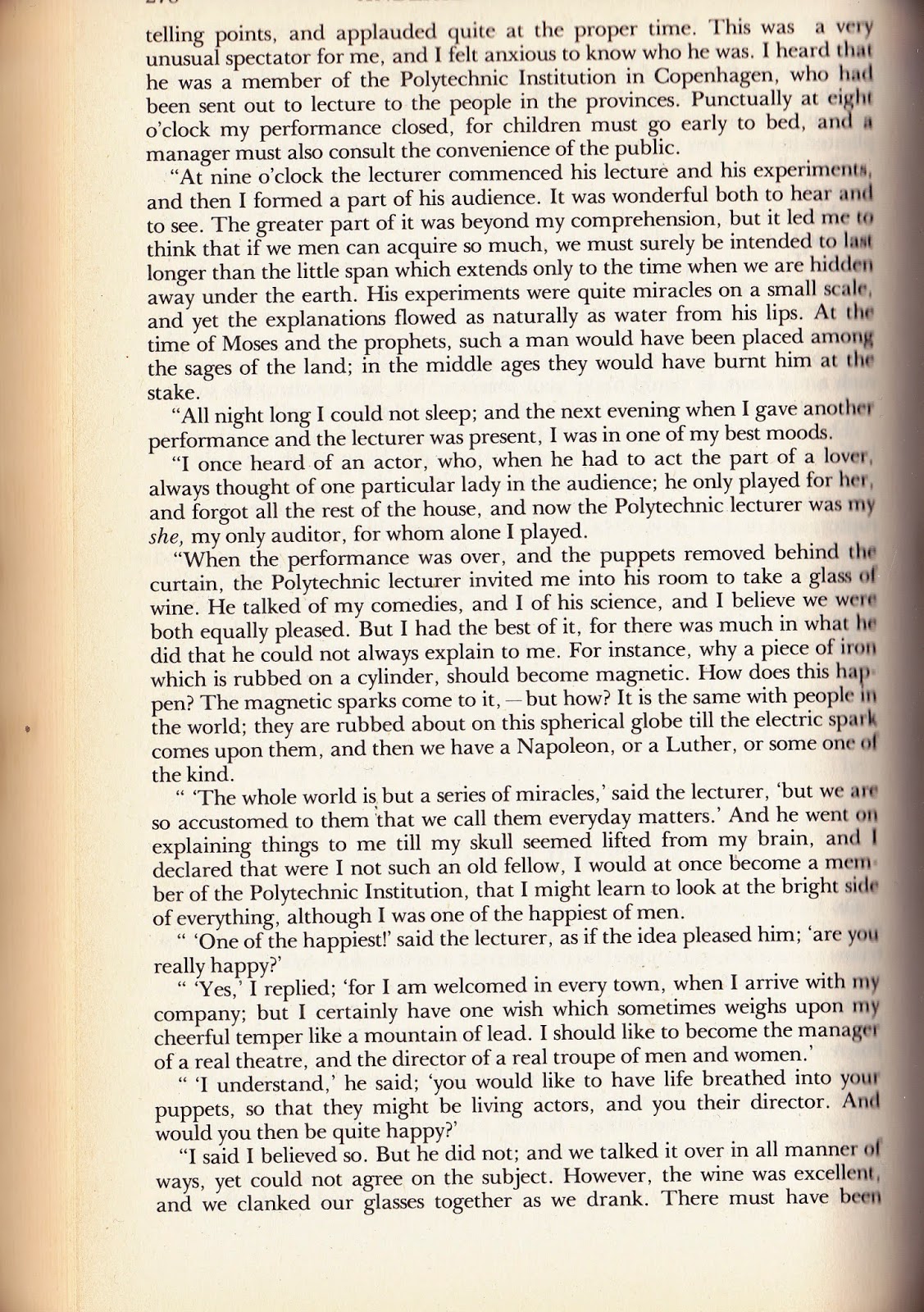
Hans Christian Andersen's theatre fascination began with an introduction using the puppet stage his father made.  At the risk of revealing too much from today's story, theatre directors will appreciate the Puppet-Show Man's choice of a suitcase full of puppets over actors.

Because the Great Lakes Regional Festival, Motor City Puppet Blast, is next month at the Detroit Institute of Arts, this month looks at PUPPETS!  To include stories in this blog's Keeping the Public in Public Domain, I'm convinced the best story on the topic is Andersen's "The Puppet-Show Man."  While children can follow the simpler outline of the story's basics, like so many of his writings there is much for adults in the work, including autobiographical elements.

Illustrator: A. W. Bayes, and Brothers Dalziel (Engravers)


The stories depend on translation to bring the Danish author to English speaking audiences, whether reading or hearing the stories.  Amazon books have 101 pages of Andersen books.  My favorite interpretations are by the actress Eva Le Gallienne, but she only translated seven of his more than 150 stories.  Added to that, while Andersen died in 1875, the translations I must show here need to be in the Public Domain for more than just my usual desire to keep older stories alive.  As I mentioned nearly a year ago when featuring an Andersen story, I encourage you to compare many of them before telling something by him.

Just as I did then, I turn to the translation by Mrs. H.B. Paull because her work is safely within the Public Domain and covers the largest number of his stories.  At the same time even her first and middle name is debated, as Susannah Mary Paull or as Margaret Agnes Paull.  While her work interpreting both Andersen and Grimm is well known, she wrote much more that now is nearly as obscure as her name.  Modern scholarship examines her work in the book, Voices in Translation: Bridging Cultural Divides edited by Gunilla Anderman.  The chapter, "Little Snowdrop and the Magic Mirror: Two Approaches to Creating a 'Suitable' Translation in 19th Century England" by Niamh Chapelle and Jenny Williams contrasts Paull with the popular Victorian writer, Dinah Mulock, who was later known as Mrs. Craik.  The story of "Little Snowdrop and the Magic Mirror" is from the Brothers Grimm.  Chapelle and Williams analysis of the two translators faults Paull for being moralistic both in her choice of words and omissions.  They aren't looking at her work with Andersen, but  still would probably have a similar opinion.

Unfortunately "Puppet-Show Man" is not one of Andersen's better known works with a large number of versions to compare.  When I did look at others, the differences felt minor.
Andersen's statue in Central Park
Would Andersen as a writer agree?  Because so many of his fairy tales began orally, I would like to think when I tell them he would understand.  After all, he said (essentially the same in all translations) through his Puppet-Show Man: "I can arrange my pieces just as I please. I choose out of every comedy what I like best, and no one is offended. Plays that are neglected now-a-days by the great public were ran after thirty years ago, and listened to till the tears ran down the cheeks of the audience. These are the pieces I bring forward. I place them before the little ones, who cry over them as papa and mamma used to cry thirty years ago. But I make them shorter, for the youngsters don’t like long speeches; and if they have anything mournful, they like it to be over quickly.”

By the way, blogs place the most recent article first, but all this month, if you haven't yet read the start of this month my article "A to Z, Puppets Are Easy", which began this month, be sure to catch it.
**********
This is part of a series of postings of stories under the category, "Keeping the Public in Public Domain."  The idea behind Public Domain was to preserve our cultural heritage after the authors and their immediate heirs were compensated.  I feel strongly current copyright law delays this intent on works of the 20th century.  My own library of folklore includes so many books within the Public Domain I decided to share stories from them.  I hope you enjoy discovering new stories. 

At the same time, my own involvement in storytelling regularly creates projects requiring research as part of my sharing stories with an audience.  Whenever that research needs to be shown here, the publishing of Public Domain stories will not occur that week.  This is a return to my normal monthly posting of a research project here.  Response has convinced me that "Keeping the Public in Public Domain" should continue along with my monthly postings as often as I can manage it.