Next week on July 29 is World Tiger Day. This beautiful but dangerous creature has a long history with people. World Wildlife Fund has an interesting quiz worth taking to learn more about them. There also are many stories about them including today's tale said to have more than a hundred variants! If you start with what is probably the oldest, the Panchatantra, it would be about 28 or 29 THOUSAND! years old.
Obviously it is a story worth telling. The question becomes where to start?
Joseph Jacobs is excellent at handling something with such a varied history. (He's the one noting more than a hundred variants when he discussed it in Europa's Fairy Book.) There's no room here to give a hundred versions for comparison, but I do want to mention Sara Cone Bryant's version in Stories to Tell Children because she can always be depended on to offer a tellable story. In it she explains, " Do you know what a Brahmin is? A Brahmin is a very good and gentle kind of man who lives in India, and who treats all the beasts as if they were his brothers. There is a great deal more to know about Brahmins, but that is enough for the story." Later in the story she uses the Banyan Tree for the tree in the story, saying "(A banyan tree is a kind of fruit tree.)" Jacobs uses a "pipal tree" which is probably more accurate given its religious importance to India, but in telling the story I find Bryant's use and explanation of the banyan tree easier to keep the flow of the story. Since the banyan is also considered a Hindu sacred plant, that is what I would use.
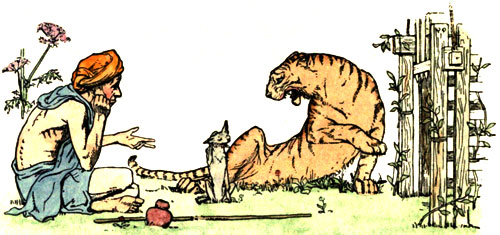
One further reason why I chose to post the Jacobs version is, once again in Indian Fairy Tales he has John D. Batten's illustrations. The two worked together on almost all of the Jacobs' folktale anthologies. Batten's work always adds to the enjoyment and understanding. Bryant lets stories stand on their own merits without illustrations. I do have one complaint with Batten's illustration, the jackal is not easy to picture. Neither Jacobs nor Bryant tell anything about jackals, keeping his words and actions the focus.
The Tiger, the Brahman, and the Jackal
nce upon a time, a tiger was caught in a trap. He tried in vain to get out through the bars, and rolled and bit with rage and grief when he failed.
By chance a poor Brahman came by. "Let me out of this cage, oh pious one!" cried the tiger.
"Nay, my friend," replied the Brahman mildly, "you would probably eat me if I did."
"Not at all!" swore the tiger with many oaths; "on the contrary, I should be for ever grateful, and serve you as a slave!"
Now when the tiger sobbed and sighed and wept and swore, the pious Brahman's heart softened, and at last he consented to open the door of the cage. Out popped the tiger, and, seizing the poor man, cried, "What a fool you[67] are! What is to prevent my eating you now, for after being cooped up so long I am just terribly hungry!"
In vain the Brahman pleaded for his life; the most he could gain was a promise to abide by the decision of the first three things he chose to question as to the justice of the tiger's action.
So the Brahman first asked a pipal tree what it thought of the matter, but the pipal tree replied coldly, "What have you to complain about? Don't I give shade and shelter to every one who passes by, and don't they in return tear down my branches to feed their cattle? Don't whimper—be a man!"
Then the Brahman, sad at heart, went further afield till he saw a buffalo turning a well-wheel; but he fared no better from it, for it answered, "You are a fool to expect gratitude! Look at me! Whilst I gave milk they fed me on cotton-seed and oil-cake, but now I am dry they yoke me here, and give me refuse as fodder!"
The Brahman, still more sad, asked the road to give him its opinion.
"My dear sir," said the road, "how foolish you are to expect anything else! Here am I, useful to everybody, yet all, rich and poor, great and small, trample on me as they go past, giving me nothing but the ashes of their pipes and the husks of their grain!"
On this the Brahman turned back sorrowfully, and on the way he met a jackal, who called out, "Why, what's the matter, Mr. Brahman? You look as miserable as a fish out of water!"
The Brahman told him all that had occurred. "How very confusing!" said the jackal, when the recital[68] was ended; "would you mind telling me over again, for everything has got so mixed up?"
The Brahman told it all over again, but the jackal shook his head in a distracted sort of way, and still could not understand.
"It's very odd," said he, sadly, "but it all seems to go in at one ear and out at the other! I will go to the place where it all happened, and then perhaps I shall be able to give a judgment."
So they returned to the cage, by which the tiger was waiting for the Brahman, and sharpening his teeth and claws.
"You've been away a long time!" growled the savage beast, "but now let us begin our dinner."
"Our dinner!" thought the wretched Brahman, as his knees knocked together with fright; "what a remarkably delicate way of putting it!"
"Give me five minutes, my lord!" he pleaded, "in order that I may explain matters to the jackal here, who is somewhat slow in his wits."
The tiger consented, and the Brahman began the whole story over again, not missing a single detail, and spinning as long a yarn as possible.
"Oh, my poor brain! oh, my poor brain!" cried the jackal, wringing its paws. "Let me see! how did it all begin? You were in the cage, and the tiger came walking by——"
"Pooh!" interrupted the tiger, "what a fool you are! I was in the cage."
"Of course!" cried the jackal, pretending to tremble with fright; "yes! I was in the cage—no I wasn't—dear![69] dear! where are my wits? Let me see—the tiger was in the Brahman, and the cage came walking by——no, that's not it, either! Well, don't mind me, but begin your dinner, for I shall never understand!"
"Yes, you shall!" returned the tiger, in a rage at the jackal's stupidity; "I'll make you understand! Look here—I am the tiger——"
"Yes, my lord!"
"And that is the Brahman——"
"Yes, my lord!"
"And that is the cage——"
"Yes, my lord!"
"And I was in the cage—do you understand?"
"Yes—no—— Please, my lord——"
"Well?" cried the tiger impatiently.
"Please, my lord!—how did you get in?"
"How!—why in the usual way, of course!"
"Oh, dear me!—my head is beginning to whirl again! Please don't be angry, my lord, but what is the usual way?"
At this the tiger lost patience, and, jumping into the cage, cried, "This way! Now do you understand how it was?"
"Perfectly!" grinned the jackal, as he dexterously shut the door, "and if you will permit me to say so, I think matters will remain as they were!"
***
The endangered status of Tigers is part of the quiz mentioned at the start. Here are several World Wildlife Fund articles about them. I particularly want to recommend their Teaching Tools About Wildlife and Forests.
**********************************
This is part of a series of postings of stories under the category, “Keeping the Public in Public Domain.” The idea behind Public Domain was to preserve our cultural heritage after the authors and their immediate heirs were compensated. I feel strongly current copyright law delays this intent on works of the 20th century. My own library of folklore includes so many books within the Public Domain I decided to share stories from them. I hope you enjoy discovering them.
At the same time, my own involvement in storytelling regularly creates projects requiring research as part of my sharing stories with an audience. Whenever that research needs to be shown here, the publishing of Public Domain stories will not occur that week. This is a return to my regular posting of a research project here. (Don't worry, this isn't dry research, my research is always geared towards future storytelling to an audience.) Response has convinced me that "Keeping the Public in Public Domain" should continue along with my other postings as often as I can manage it.
See the sidebar for other Public Domain story resources I recommend on the page “Public Domain Story Resources."



.jpg)


.jpg)