The only rule for weather predictions for most locations is that it will change. . . and it definitely has!
We may not have received the nation's worst, but Michigan, especially the west and north, is bad enough. Erie Pennsylvania, your residents must love winter. Since winter and cold are my least favorite time of year, anybody there who doesn't love winter has my sympathy.
We had been having above normal weather and I was foolish enough to think that was a trend!
Julia Darrow Cowles and her book Indian Nature Myths hasn't been here in years -- their posting here spans from 2013 - 2017. That first story back in 2013 was before I found ways to reproduce pages better than a simple scan of my own books. That first story was her retelling of the Schoolcraft tale, "How the Seasons Came to Be." Definitely appropriate now. I suggest going to the book listed above at Project Gutenberg as the entire book is a treat for nature lovers.
Cowles notes the nations responsible for her stories, often the Anishinaabe (listing as Ojibwa or Chippewa) but several, including today's story, are merely attributed to the Algonquian. Our area's native people are part of that larger group and stories do travel. For more about the Algonquian peoples go to that link to understand this most populous and widespread North American indigenous North American group. Cowles briefly mentioned such story traveling in her Preface.
Wind chills have made the weather transition particularly brutal, so this Algonquin story is on my mind as the wind howls or it invisibly tries to beat me.
WHY THE WIND WAILS
(Algonquin)
WHEN the pale moon looks down from the
sky, and when the wind cries mournfully
around the wigwam, this is the story that the
old man of the tribe tells to the Indian children:
Many, many moons ago the great chief of
our tribe had a very beautiful daughter.
“She shall marry a great warrior,” said the
Chief, “and a mighty hunter. Then she will
be well cared for, and I shall be happy.”
So the great Chief kept watch of the young
men of the tribe, to see which one would prove
worthy of his daughter.
One day, as the Chief sat in the door of his
lodge, there came a sudden rushing sound, and
a young man stood before him. It was the
Wind, who had made himself visible that he
might talk with the Chief.
When he had saluted, he said, “Great Chief,
I love your daughter. May I carry her away
to my lodge, and make her my wife?”
The Chief looked at the Wind, and he answered,
“No. My daughter is not for such as
you. You are no warrior. You are no hunter.
You love to play pranks. You cannot marry
my daughter.”
So the Wind went away sorrowing, for he
loved the Indian maiden.
The next day the maiden came to her father
and said, “Father, I love the Wind better than
any young warrior of our tribe. May I go to
his lodge, and be his wife?”
The Chief looked at his daughter and said,
“No. The Wind is no mate for you. He is
no warrior. He is no hunter. He loves only
to play pranks. You cannot marry him.”
The maiden went away sorrowing, for she
loved the Wind.
The next day when the maiden went out to
gather sweet marsh grass for her basket weaving,
she heard a sudden rushing sound above
her head. She looked up, and as she looked
the Wind swept down and carried her in his
arms far away to his lodge.
There they lived happily together, for the
maiden became his wife. But the great Chief
was full of wrath. He hunted through all the
land for the lodge of the Wind, but he could
not find it for many moons. Still he would not
give up the search, for his heart was hot with
wrath.
One day the Wind heard a great crashing
sound among the trees near his lodge, and his
heart stood still.
“It is your father,” he cried, and he hid the
Chief’s daughter in a thicket, while he made
himself invisible, that he might stay close beside
her.
The great Chief looked inside the lodge of
the Wind, but he found it empty. Then he
went through the brush, striking to right and
left with his heavy club, and calling, “My
daughter: my daughter!”
And when the Wind’s wife heard her father’s
voice, she answered, “Oh, my father, strike not!
We are here.”
But before her words could reach him, the
Chief swung his great club once more, and it
fell upon the head of the invisible Wind, who,
without a sound, dropped unconscious upon the
ground. And because he was invisible, neither
the Chief nor his daughter knew what had
happened.
Then the Chief took his daughter in his arms
and hastened back to his tribe. But each day
she grew more and more sorrowful, and longed
for her husband, the Wind.
For many hours the Wind lay unconscious
beside his lodge. When he awakened, the Chief
and his daughter had gone. Sorrowfully he set
out in search of his wife. He traveled to her
father’s tribe, and there at last he found her.
But she was in a canoe with her father, far out
upon the lake.
Then the Wind cried, “Come to me, my loved
one,” and his voice swept out over the water.
The Chief said, “The winds are blowing,”
but his daughter knew her husband’s voice.
She could not see him, for he was still invisible,
but she lifted herself up in the canoe and
stretched out her hands toward the shore. As
she did so a breeze stirred the water, and the
canoe overturned.
The Chief’s daughter threw up her arms,
and the Wind tried to catch her in his embrace,
but he was too late. The Great Spirit bore her
far up into the sky, and there he gave her a
home where she would live
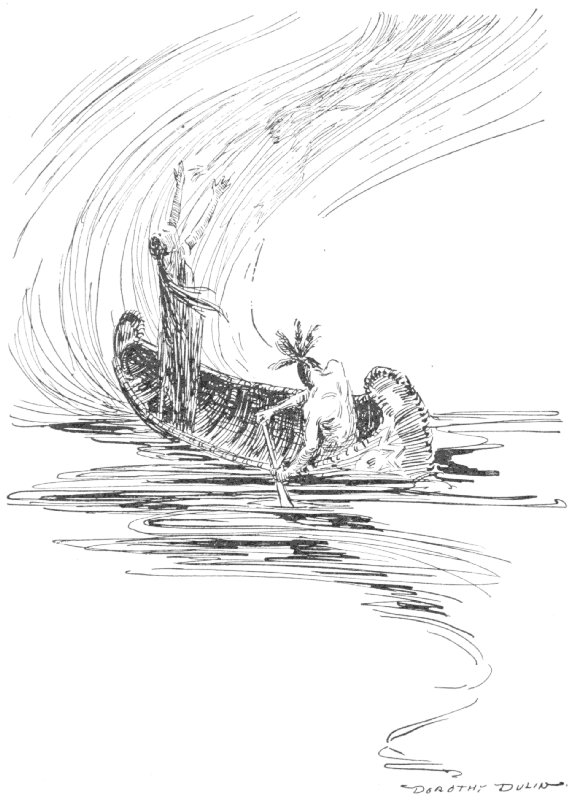
“THE WIND TRIED TO CATCH HER IN HIS EMBRACE”
The great Chief was drowned in the waters
of the lake.
Night after night his daughter looks down
upon the earth, hoping for a sight of her lost
lover. But though the Wind still roams about
the earth in search of his bride, he has never,
since the Chief’s blow fell upon his head, had
the power to become visible to men.
And now you will understand why the voice
of the Wind is so mournful as it wails about
the wigwam; and why the Moon Maiden’s pale
face is always turned downward toward the
earth.
***
The book ends with another Algonquin wind tale, "Keepers of the Winds", but it's best saved for a warmer time.
For my fellow storytellers I want to repeat Cowles' note that appeared right before the stories:
Before reading or telling the Indian Nature
Myths to the children, it is best to explain that
just as they love to wonder and imagine about
the new and strange sights and sounds of the
world, so the early races of men, the children
of time, loved to wonder and imagine. And
so these stories of nature grew out of their
imaginings; and some of the stories are so
beautiful, and some of them are so odd, that
men have repeated them from one generation
to another, ever since,—for even when they no
longer believed them to be true, they loved
them.
Other anthologies title this story "Bride of the Wind." Florence Holbrook's The Book of Nature Myths and Mary F. Nixon-Roulet's Indian Folk Tales are two Public Domain books with that title.
******************
This is part of a
series of postings of stories under the category, “Keeping the
Public in Public Domain.” The idea behind Public Domain was to
preserve our cultural heritage after the authors and their immediate
heirs were compensated. I feel strongly current copyright law delays
this intent on works of the 20th century. My own library
of folklore includes so many books within the Public Domain I decided
to share stories from them. I hope you enjoy discovering them.
At
the same time, my own involvement in storytelling regularly creates
projects requiring research as part of my sharing stories with an
audience. Whenever that research needs to be shown here, the
publishing of Public Domain stories will not occur that week.
This is a return to my regular posting of a research project here.
(Don't worry, this isn't dry research, my research is always geared
towards future storytelling to an audience.) Response has
convinced me that "Keeping the Public in Public Domain"
should continue along with my other postings as often as I can manage
it.
See the sidebar for other Public
Domain story resources I recommend on the page “PublicDomain Story Resources."


 enabozho, the great land manitou, did not like the water manitous or spirits. One
day he saw the chief of the water manitous asleep on a rock, and he shot and killed
him with a magic arrow; then the little water manitous called the big rivers to help
them and chased Menabozho up a high hill.
enabozho, the great land manitou, did not like the water manitous or spirits. One
day he saw the chief of the water manitous asleep on a rock, and he shot and killed
him with a magic arrow; then the little water manitous called the big rivers to help
them and chased Menabozho up a high hill.


.png)

.jpg)


.jpg)
.png)
.png)
.png)
