Tell me if you have a topic you'd like to see. (Contact: LoiS-sez@LoiS-sez.com .)
Please also let others know about this site.
Showing posts with label student storytellers. Show all posts

Saturday, September 21, 2013

Cooper - An Argosy of Fables - Keeping the Public in Public Domain

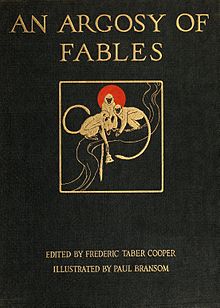
Oh boy, here I go again!  Didn't plan on developing a new research project, but I have a fascinating book which might be considered, if not a Public Domain encyclopedia of fables, certainly a great introductory resource to a major type of storytelling literature.  I started the Keeping the Public in Public Domain series with two very different books of Aesop's fables.  This isn't all I own using that ancient pedagogue's fables, but they were the only two pre-dating 1923, thus safely in Public Domain.  Frederic Taber Cooper in 1921 also saw the value of fables, not just those attributed to Aesop, but their value in classical and modern times and as a view into ethnic literature. The book's subtitle declares it's "A Representative Selection From the Fable Literature of Every Age and Land."
His book is so large, 485 pages, he divided it into three books: Classical Fables; Oriental Fables; and Modern Fables.  In trying to choose one or even one fable from each "book" I felt like Alice having fallen down the rabbit hole into Wonderland. 

I've often recommended going to Project Gutenberg to read the rest of a book featured here, but Wikisource did a loving reproduction of this book, complete with the beautiful Paul Bransom illustrations.  When I go to Project Gutenberg I'm so text-oriented I usually omit the illustrations for a swifter download.  From the cover illustration above, you can see that would be a shame.  They may have used a different edition as I find slight illustration differences from my book.  Their site also is not always as intuitive to search for a book, but once you find it, the reproduction is well done.  I suggest clicking those illustrations to enlarge them.  They were full-size in the original book and deserve a larger look to appreciate them.

The value of fables comes from their taking the wisdom of a culture and putting it in very brief form.  (Brevity...always a trick for a storyteller!)  Animals often are the characters, illustrating human traits, but they aren't the only possible actors.  Wikipedia points out they also can be mythical creatures, plants, inanimate objects or forces of nature.  (That Wikipedia article is worth visiting for its large listing of their many articles on classical and modern fabulists -- way more recent than Cooper's "modern" fabulists, as well as "notable fable collections."  As an example of what I mean, the list of modern fabulists includes people like George Orwell, Dr. Seuss, and James Thurber.)

As a storytelling teaching device, fables are perfect for student storytellers and writers.  I like to create fables starting with a proverb as fables teach a lesson.  Something worth considering is whether that lesson is stated or not.  Cooper seems to prefer stating the moral, especially for Classical Fables.  Modern thinking tends to consider stating the moral at the end too didactic.  That view prefers to let the audience or reader draw their own conclusions without hitting them over the head with a stated moral.

If Cooper calls his anthology three books, who am I to disagree?  It deserves at least three postings here, so starting tomorrow I will post a bit of the Classical Fables.  Aesop will be omitted since he's been covered earlier.  Tomorrow will be a bonus posting since today was spent discussing fables and specifically An Argosy of Fables.  Following my new schedule for the Keeping the Public in Public Domain series, I will post one story a week unless other research needs to interrupt the schedule.    That schedule is explained in the following new series summary.
******************
This is part of a series of weekly posting of stories under the category, "Keeping the Public in Public Domain."  I will post on Saturdays in the series unless that week I have other research articles.  I hope this will satisfy all who have found these stories worthwhile.  I include myself in that audience.  The idea behind Public Domain was to preserve our cultural heritage after the authors and their immediate heirs were compensated.  I feel strongly current copyright law delays this intent on works of the 20th century.  I hope you enjoy discovering new stories. 

At the same time, I'm returning to involvement in projects requiring research as part of my sharing stories with an audience.  Whenever that research needs to be shown here, the publishing of Public Domain stories will not occur that week.  This is a return to my normal monthly posting of a research project here.  Response has convinced me that "Keeping the Public in Public Domain" should continue along with my monthly postings as often as I can manage it.  

Friday, July 22, 2011

Oral Literacy Starts with Storytelling

This month's post started after I was contacted by a teacher in Egypt working with new mothers.  I've changed it a bit to fit (mainly) U.S. readers -- teachers, librarians, and parents -- interested in starting children on the road to oral literacy.

One of the best aids to literacy is the use of "nursery rhymes."  There are short simple rhymes meant for very young children in many languages.  I know such rhymes exist in Spanish and Chinese, but I've no idea if there's anything comparable in the children's literature of other cultures.  I expect there is as such verbal play is important for toddlers.  The benefit of such rhymes has less to do with story and more to do with predictability of the rhyme and the creative use of language.  
Dr. Betsy Diamant Cohen,  http://www.mgol.org/ , offers ideas on the many ways to use nursery rhymes.  She travels a good deal, but you can email her at info@mgol.org or call  443-928-3915.  She's a very creative educator used to working with parents and teachers of preschool children.  There are various resources on her website and she has an occasional e-newsletter.

After such rhymes, I like to make up stories telling more about what may have happened before, during, or after the rhyme.  A similar resource might be songs meant for young children.  As the children get a bit older, they can help make up such stories.  L. Frank Baum, the author of the Oz books, did a similar book, Mother Goose in Prose.  It's interesting to see another side of his creativity.

When teaching storytelling I find many beginners do well with these steps I learned years ago in Wordweaving training as a simple way to learn stories quickly and easily.  As a children's librarian I needed to learn new programs with several stories weekly.

1. Select a story you want to tell.
2. Learn the structure and block the story.
3. Visualize the settings and characters.
4. See the action as if you’re watching a silent movie.
5. Tell the story aloud, using your voice to project the images you visualized.
6. Learn the story by heart, not word for word.
7.  Practice telling the story until it comes naturally.
#2 mentions learning the structure of a story and "blocking" it.  You may think of this as "outlining" the minimum things that must happen.  Some people like to make a visual outline or "storyboard" by folding a paper in 1/2 lengthwise, then take the folded paper and fold it twice again so it has a total of 6 boxes.  (It forms 2 columns of 3 boxes each.)  Drawing stick figures of what happens in the 6 boxes gives a visual outline of the story which helps, too.

I found this idea from storyteller, Caren Niele, a bit ironic for a class in Egypt to use.  English speaking students love to use acronyms to help learn and remember concepts.  In the National Storytelling Network's small (80 pages) inexpensive ($5 US) book, A Beginner's Guide to Storytelling, in the segment called "Developing Your Story" she uses the acronym "CAMELS."  It stands for: Characters -- getting to understand the characters in a story and beyond the story; Audience -- tailoring your telling to your listeners; Message -- the purpose of the story; Energy -- matching it to your listeners; Language -- repetition, opening and closing of a story, and other important or unusual words; Setting. 
Some of her method was covered also in the Wordweaving steps, but they all combine to add a special flavor to a story.
Margaret Read MacDonald's book, The Parent's Guide to Storytelling; How to Make Up New Stories and Retell Old Favorites, would be useful for students as a textbook.  I also have heard good things about Sean Buvala's, Daddyteller, but haven't read it myself.  I know Sean and trust him.  He's passionate about getting fathers to feel at home with storytelling, but I expect much of what he says would also work for mothers.  There are other books for parents as their children get older, especially when they are school age, but those 2 would be a good starting point for telling to the youngest.
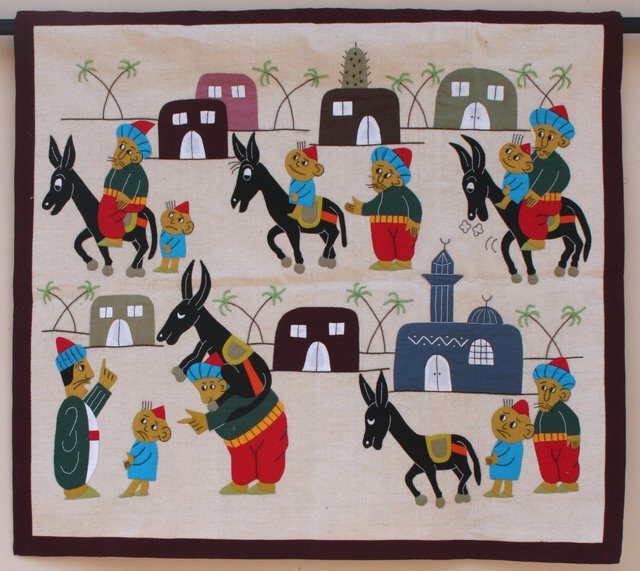
From http://jennybowker.blogspot.com/2007/10/goha-and-donkey-walk.html
Students should think back to simple folktales recalled from childhood.  Those stories especially need to be passed along for cultural literacy.  In talking about Egypt, my personal favorites are stories about Goha in Egypt as well as those with his other names in other countries.  They teach while having humor.  On the internet many sites re-tell some of the simplest most basic tales from around the world.  Some have various versions differing from country to country, but keep their underlying plot and theme, changing only enough to fit the culture of their homelands.  The Egyptian Cinderella story of Rhodopis is a good example of this.  It also is fun to take a basic story and make it an Egyptian story where there wasn't one before.

Here's a page, Parent Connection (on The Story Connection), which explains both why parents should tell stories and gives a few tips for storytelling.  At the bottom of the page Dianne De Las Casas gives both websites and a bibliography.  Some of this is aimed at much older children, but your students will be able to grow in their storytelling with the other resources.

***
That's a lot to absorb, so I'll stop there.  Please stay in touch and let me know what you might like to discuss after this.