There have been a variety of medical matters affecting my family so that is on my mind while looking for stories. It led me to a most unusual tale dating back to old imperial China, when the emperor was called "The Son of Heaven."
THE STRANGE TALE OF DOCTOR DOG
ar up in the mountains of the Province of Hunan in the central part of China, there once lived in a small village a rich gentleman who had only one child. This girl, like the daughter of Kwan-yu in the story of the Great Bell, was the very joy of her father's life.
Now Mr. Min, for that was this gentleman's name, was famous throughout the whole district for his learning, and, as he was also the owner of much property, he spared no effort to teach Honeysuckle the wisdom of the sages, and to give her everything she craved. Of course this was enough to spoil most children, but Honeysuckle was not at all like other children. As sweet as the flower from which she took her name, she listened to her father's slightest command, and obeyed without ever waiting to be told a second time.
Her father often bought kites for her, of every kind and shape. There were fish, birds, butterflies, lizards and huge dragons, one of which had a tail more than thirty feet long. Mr. Min was very skilful in flying these kites for little Honeysuckle, and so naturally did his birds and butterflies circle round and hover about in the air that almost any little western boy would have been deceived and said, "Why, there is a real bird, and not a kite at all!" Then again, he would fasten a queer little instrument to the string, which made a kind of humming noise, as he waved his hand from side to side. "It is the wind singing, Daddy," cried Honeysuckle, clapping her hands with joy; "singing a kite-song to both of us." Sometimes, to teach his little darling a lesson if she had been the least naughty, Mr. Min would fasten queerly twisted scraps of paper, on which were written many Chinese words, to the string of her favourite kite.
"What are you doing, Daddy?" Honeysuckle would ask. "What can those queer-looking papers be?"
"On every piece is written a sin that we have done."
"What is a sin, Daddy?"
"Oh, when Honeysuckle has been naughty; that is a sin!" he answered gently. "Your old nurse is afraid to scold you, and if you are to grow up to be a good woman, Daddy must teach you what is right."
Then Mr. Min would send the kite up high—high over the house-tops, even higher than the tall Pagoda on the hillside. When all his cord was let out, he would pick up two sharp stones, and, handing them to Honeysuckle, would say, "Now, daughter, cut the string, and the wind will carry away the sins that are written down on the scraps of paper."
"But, Daddy, the kite is so pretty. Mayn't we keep our sins a little longer?" she would innocently ask.
"No, child; it is dangerous to hold on to one's sins. Virtue is the foundation of happiness," he would reply sternly, choking back his laughter at her question. "Make haste and cut the cord."
So Honeysuckle, always obedient—at least with her father—would saw the string in two between the sharp stones, and with a childish cry of despair would watch her favourite kite, blown by the wind, sail farther and farther away, until at last, straining her eyes, she could see it sink slowly to the earth in some far-distant meadow.
"Now laugh and be happy," Mr. Min would say, "for your sins are all gone. See that you don't get a new supply of them."
Honeysuckle was also fond of seeing the Punch and Judy show, for, you must know, this old-fashioned amusement for children was enjoyed by little folks in China, perhaps three thousand years before your great-grandfather was born. It is even said that the great Emperor, Mu, when he saw these little dancing images for the first time, was greatly enraged at seeing one of them making eyes at his favourite wife. He ordered the showman to be put to death, and it was with difficulty the poor fellow persuaded his Majesty that the dancing puppets were not really alive at all, but only images of cloth and clay.
No wonder then Honeysuckle liked to see Punch and Judy if the Son of Heaven himself had been deceived by their queer antics into thinking them real people of flesh and blood.
But we must hurry on with our story, or some of our readers will be asking, "But where is Dr. Dog? Are you never coming to the hero of this tale?" One day when Honeysuckle was sitting inside a shady pavilion that overlooked a tiny fish-pond, she was suddenly seized with a violent attack of colic. Frantic with pain, she told a servant to summon her father, and then without further ado, she fell over in a faint upon the ground.
When Mr. Min reached his daughter's side, she was still unconscious. After sending for the family physician to come post haste, he got his daughter to bed, but although she recovered from her fainting fit, the extreme pain continued until the poor girl was almost dead from exhaustion.
Now, when the learned doctor arrived and peered at her from under his gigantic spectacles, he could not discover the cause of her trouble. However, like some of our western medical men, he did not confess his ignorance, but proceeded to prescribe a huge dose of boiling water, to be followed a little later by a compound of pulverized deer's horn and dried toadskin.
Poor Honeysuckle lay in agony for three days, all the time growing weaker and weaker from loss of sleep. Every great doctor in the district had been summoned for consultation; two had come from Changsha, the chief city of the province, but all to no avail. It was one of those cases that seem to be beyond the power of even the most learned physicians. In the hope of receiving the great reward offered by the desperate father, these wise men searched from cover to cover in the great Chinese Cyclopedia of Medicine, trying in vain to find a method of treating the unhappy maiden. There was even thought of calling in a certain foreign physician from England, who was in a distant city, and was supposed, on account of some marvellous cures he had brought to pass, to be in direct league with the devil. However, the city magistrate would not allow Mr. Min to call in this outsider, for fear trouble might be stirred up among the people.
Mr. Min sent out a proclamation in every direction, describing his daughter's illness, and offering to bestow on her a handsome dowry and give her in marriage to whoever should be the means of bringing her back to health and happiness. He then sat at her bedside and waited, feeling that he had done all that was in his power. There were many answers to his invitation. Physicians, old and young, came from every part of the Empire to try their skill, and when they had seen poor Honeysuckle and also the huge pile of silver shoes her father offered as a wedding gift, they all fought with might and main for her life; some having been attracted by her great beauty and excellent reputation, others by the tremendous reward.
But, alas for poor Honeysuckle! Not one of all those wise men could cure her! One day, when she was feeling a slight change for the better, she called her father, and, clasping his hand with her tiny one said, "Were it not for your love I would give up this hard fight and pass over into the dark wood; or, as my old grandmother says, fly up into the Western Heavens. For your sake, because I am your only child, and especially because you have no son, I have struggled hard to live, but now I feel that the next attack of that dreadful pain will carry me away. And oh, I do not want to die!"
Here Honeysuckle wept as if her heart would break, and her old father wept too, for the more she suffered the more he loved her.
Just then her face began to turn pale. "It is coming! The pain is coming, father! Very soon I shall be no more. Good-bye, father! Good-bye; good——." Here her voice broke and a great sob almost broke her father's heart. He turned away from her bedside; he could not bear to see her suffer. He walked outside and sat down on a rustic bench; his head fell upon his bosom, and the great salt tears trickled down his long grey beard.
As Mr. Min sat thus overcome with grief, he was startled at hearing a low whine. Looking up he saw, to his astonishment, a shaggy mountain dog about the size of a Newfoundland. The huge beast looked into the old man's eyes with so intelligent and human an expression, with such a sad and wistful gaze, that the greybeard addressed him, saying, "Why have you come? To cure my daughter?"
The dog replied with three short barks, wagging his tail vigorously and turning toward the half-opened door that led into the room where the girl lay.
By this time, willing to try any chance whatever of reviving his daughter, Mr. Min bade the animal follow him into Honeysuckle's apartment. Placing his forepaws upon the side of her bed, the dog looked long and steadily at the wasted form before him and held his ear intently for a moment over the maiden's heart. Then, with a slight cough he deposited from his mouth into her outstretched hand, a tiny stone. Touching her wrist with his right paw, he motioned to her to swallow the stone.
"Yes, my dear, obey him," counselled her father, as she turned to him inquiringly, "for good Dr. Dog has been sent to your bedside by the mountain fairies, who have heard of your illness and who wish to invite you back to life again."
Without further delay the sick girl, who was by this time almost burned away by the fever, raised her hand to her lips and swallowed the tiny charm. Wonder of wonders! No sooner had it passed her lips than a miracle occurred. The red flush passed away from her face, the pulse resumed its normal beat, the pains departed from her body, and she arose from the bed well and smiling.
Flinging her arms about her father's neck, she cried out in joy, "Oh, I am well again; well and happy; thanks to the medicine of the good physician."
The noble dog barked three times, wild with delight at hearing these tearful words of gratitude, bowed low, and put his nose in Honeysuckle's outstretched hand.
Mr. Min, greatly moved by his daughter's magical recovery, turned to the strange physician, saying, "Noble Sir, were it not for the form you have taken, for some unknown reason, I would willingly give four times the sum in silver that I promised for the cure of the girl, into your possession. As it is, I suppose you have no use for silver, but remember that so long as we live, whatever we have is yours for the asking, and I beg of you to prolong your visit, to make this the home of your old age—in short, remain here for ever as my guest—nay, as a member of my family."
The dog barked thrice, as if in assent. From that day he was treated as an equal by father and daughter. The many servants were commanded to obey his slightest whim, to serve him with the most expensive food on the market, to spare no expense in making him the happiest and best-fed dog in all the world. Day after day he ran at Honeysuckle's side as she gathered flowers in her garden, lay down before her door when she was resting, guarded her Sedan chair when she was carried by servants into the city. In short, they were constant companions; a stranger would have thought they had been friends from childhood.
One day, however, just as they were returning from a journey outside her father's compound, at the very instant when Honeysuckle was alighting from her chair, without a moment's warning, the huge animal dashed past the attendants, seized his beautiful mistress in his mouth, and before anyone could stop him, bore her off to the mountains. By the time the alarm was sounded, darkness had fallen over the valley and as the night was cloudy no trace could be found of the dog and his fair burden.
Once more the frantic father left no stone unturned to save his daughter. Huge rewards were offered, bands of woodmen scoured the mountains high and low, but, alas, no sign of the girl could be found! The unfortunate father gave up the search and began to prepare himself for the grave. There was nothing now left in life that he cared for—nothing but thoughts of his departed daughter. Honeysuckle was gone for ever.
"Alas!" said he, quoting the lines of a famous poet who had fallen into despair:
"My whiting hair would make an endless rope,
Yet would not measure all my depth of woe."
Several long years passed by; years of sorrow for the ageing man, pining for his departed daughter. One beautiful October day he was sitting in the very same pavilion where he had so often sat with his darling. His head was bowed forward on his breast, his forehead was lined with grief. A rustling of leaves attracted his attention. He looked up. Standing directly in front of him was Dr. Dog, and lo, riding on his back, clinging to the animal's shaggy hair, was Honeysuckle, his long-lost daughter; while standing near by were three of the handsomest boys he had ever set eyes upon!
"Ah, my daughter! My darling daughter, where have you been all these years?" cried the delighted father, pressing the girl to his aching breast. "Have you suffered many a cruel pain since you were snatched away so suddenly? Has your life been filled with sorrow?"
"Only at the thought of your grief," she replied, tenderly, stroking his forehead with her slender fingers; "only at the thought of your suffering; only at the thought of how I should like to see you every day and tell you that my husband was kind and good to me. For you must know, dear father, this is no mere animal that stands beside you. This Dr. Dog, who cured me and claimed me as his bride because of your promise, is a great magician. He can change himself at will into a thousand shapes. He chooses to come here in the form of a mountain beast so that no one may penetrate the secret of his distant palace."
"Then he is your husband?" faltered the old man, gazing at the animal with a new expression on his wrinkled face.
"Yes; my kind and noble husband, the father of my three sons, your grandchildren, whom we have brought to pay you a visit."
"And where do you live?"
"In a wonderful cave in the heart of the great mountains; a beautiful cave whose walls and floors are covered with crystals, and encrusted with sparkling gems. The chairs and tables are set with jewels; the rooms are lighted by a thousand glittering diamonds. Oh, it is lovelier than the palace of the Son of Heaven himself! We feed of the flesh of wild deer and mountain goats, and fish from the clearest mountain stream. We drink cold water out of golden goblets, without first boiling it, for it is purity itself. We breathe fragrant air that blows through forests of pine and hemlock. We live only to love each other and our children, and oh, we are so happy! And you, father, you must come back with us to the great mountains and live there with us the rest of your days, which, the gods grant, may be very many."
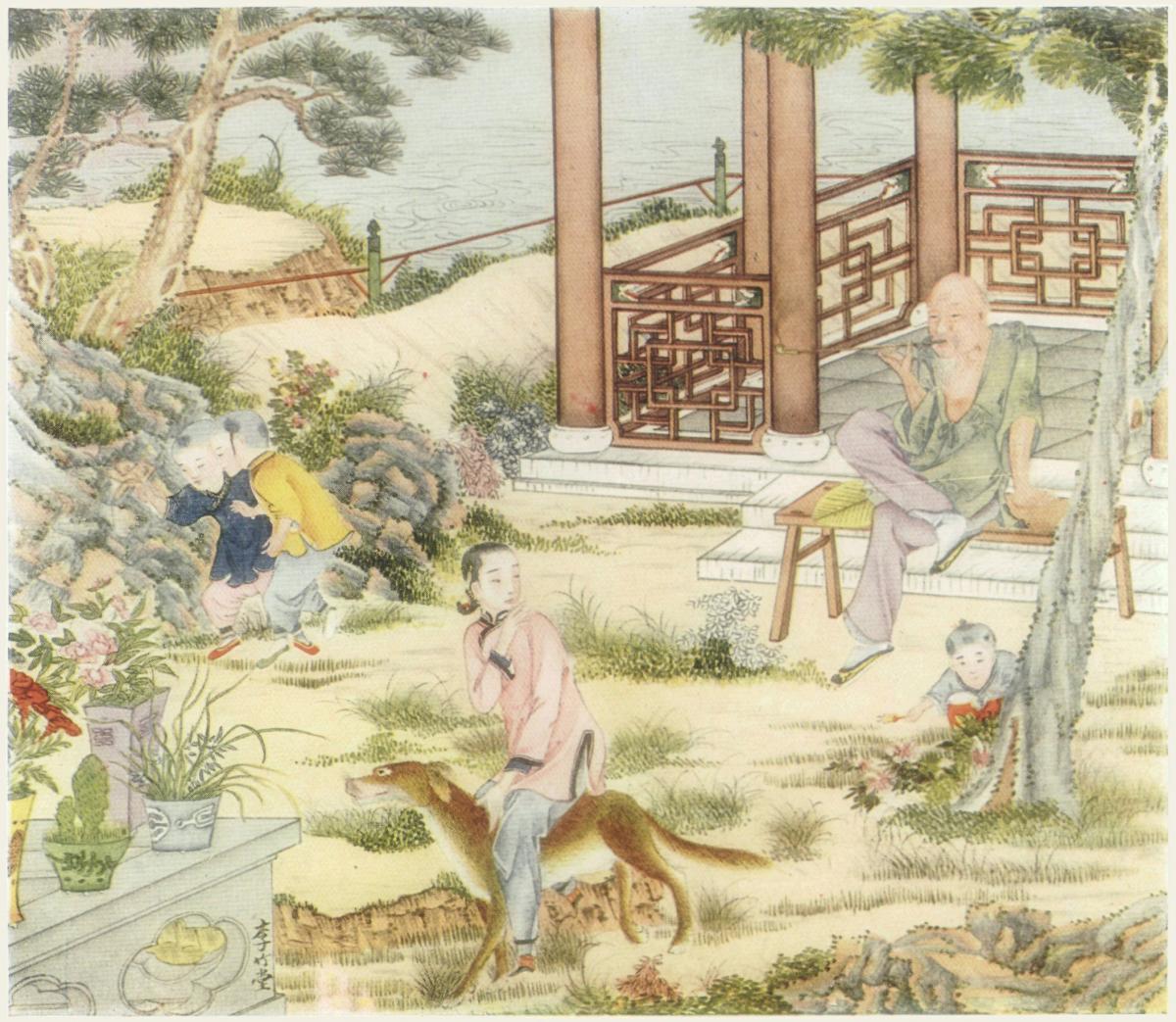
'CLINGING TO THE ANIMAL'S SHAGGY HAIR WAS HONEYSUCKLE'
The old man pressed his daughter once more to his breast and fondled the children, who clambered over him rejoicing at the discovery of a grandfather they had never seen before.
From Dr. Dog and his fair Honeysuckle are sprung, it is said, the well-known race of people called the Yus, who even now inhabit the mountainous regions of the Canton and Hunan provinces. It is not for this reason, however, that we have told the story here, but because we felt sure every reader would like to learn the secret of the dog that cured a sick girl and won her for his bride.
*************
While having a dog is supposed to be good for our health, somehow I doubt they are able to match Doctor Dog!
*******************************
This is part of a series of postings of stories under the category, “Keeping the Public in Public Domain.” The idea behind Public Domain was to preserve our cultural heritage after the authors and their immediate heirs were compensated. I feel strongly current copyright law delays this intent on works of the 20th century. My own library of folklore includes so many books within the Public Domain I decided to share stories from them. I hope you enjoy discovering them.
At the same time, my own involvement in storytelling regularly creates projects requiring research as part of my sharing stories with an audience. Whenever that research needs to be shown here, the publishing of Public Domain stories will not occur that week. This is a return to my regular posting of a research project here. (Don't worry, this isn't dry research, my research is always geared towards future storytelling to an audience.) Response has convinced me that "Keeping the Public in Public Domain" should continue along with my other postings as often as I can manage it.
See the sidebar for other Public Domain story resources I recommend on the page “Public Domain Story Resources."