Tell me if you have a topic you'd like to see. (Contact: LoiS-sez@LoiS-sez.com .)
Please also let others know about this site.
Showing posts with label Hutchinson Family Singers. Show all posts

Friday, September 11, 2015

Civil War Days + Browne - Union War Songs and Confederate Officers - Keeping the Public in Public Domain

The Bicentennial of the United States Civil War is still being celebrated in many places including the annual celebration of the Historic Fort Wayne Coalition.
http://www.historicfortwaynecoalition.com/cwdays.html
Please notice Historic Fort Wayne is in Detroit.  From 1701 through World War II the location was an active military location.  Today the Historic Fort Wayne Coalition is working to preserve as much of the fort's heritage as possible.  Toward that, I'm proud to continue being part of the annual celebration.  While portraying Liberetta Lerich Green I will talk, among other things, about how her brothers, Will and Isaac, mustered in and out of the fort for the Michigan Fifth Infantry and later Isaac returned when the Third Infantry was reconstituted.  I will also tell of her family's abolition and Underground Railroad work and life on the homefront.  In addition, Liberetta joins General Grant's widow, Governor Blair's wife, and Sarah Edmonds in the Commanding Officer's house.  All of these women have fascinating stories worth hearing.

Music is a great way to recall these events.  In telling Liberetta's story I use the abolition song, "Roll on the Liberty Ball", which was written by the Hutchinson Family Singers to the tune of "Old Rosin the Beau", then used again as the election song, "Lincoln and Liberty, Too" .  The YouTube video above merges the two songs.  It comes from ex-Weaver, Ronnie Gilbert, and gives a lively amalgamation of both while incorporating pictures from the era.

Today's story is a remembrance by Richard Wentworth Browne in The Century Magazine, from January 1888.  The Online Books Page has an archive of the magazine from its origins in 1881 up through Volume 97 on April 1919, although the magazine didn't cease operation until 1930.  It's always worth checking periodicals of a period for a time travel experience.  The story was part of a larger article, "Memoranda on the Civil War."  Browne also explains he was inspired to write after reading Brander Matthews in The Century Magazine, August 1887, article "The Songs of the Civil War."  That article isn't a story, but may interest lovers of Civil War music, a topic occasionally discussed here.  After the story I'll give links to the songs mentioned by Browne.


The many treasuries by Benjamin A.Botkin overflow with such interesting bits.  My copy was in his A Civil War Treasury of Tales, Legends and Folklore.  It only omitted Browne's introductory paragraph about the earlier article by Brander Matthews influencing him.  I strongly recommend at least reading the Wikipedia article on this "Father of Public Folklore" I hotlinked at the start of this paragraph to show his philosophy on folklore and his work at the Library of Congress in the Archive of American Folk Song.  You might even want to read the book, America's Folklorist: B.A.Botkin and American Culture, edited by Lawrence Rodgers and Jerrold Hirsch.


Songs mentioned in the story

Each of these songs has background information, so the titles are hotlinked to Wikipedia.  Space and time limitations meant it's the only source given here for quick background information.  I encourage checking even further because more exists for each song.   I try to give at least the melody line and, when available, the chords.  I leave it up to you to see if a midi file or video of the song exists to help you learn the songs.

Along the way I discovered the wonderful Civil War Song Book pdf from the Kit Carson's 1st New Mexico Volunteer Infantry String Band, a reenactment group.  They have a good list of sources in their introduction to this 82 page book by Joe Dietrich and David Poulin.  Their book is specifically chords + lyrics, so I rarely had to worry about chords, just being sure to locate the melody lines on songs. 8 Notes.com was another good resource, but since these are all Public Domain, I made sure the links skipped paid sheet music.  For other chords beyond the Civil War Song Book, another resource is Ultimate-Guitar.com.


Battle Hymn of theRepublic the melody is given in Wikipedia and see the Civil War Song Book about chords
John Brown’s Body (same melody as above was eventually used, but read the article on it)
We’re Coming, Father Abraham (Lyrics used by 8 different composers, including Stephen Foster and the Hutchinson Family Singers!  Darned if I know what version to use.  Check the article by Irwin Silber in Songs of the Civil War.)
Tramp, Tramp, Tramp the Boys Are Marching find chords in the Civil War Song Book and the melody at 8 Notes.com/scores/6670.asp
Rally ‘Round the Flag,Boys (or Battle Cry of Freedom -- the title used in Civil War Song Book for chords) either melody alone or guitar tab at 8 Notes.com
Dixie for the melody choose Dixie's Land and Dixie for guitar tab at 8 Notes; in Civil War Song Book chords use Dixie's Land as the title
Maryland, My Maryland (set to the tune of Lauriger Horatius as Browne mentions, but best known as O Tannenbaum or Oh Christmas Tree) with melody at 8 Notes.com
Dead March in Saul this was only mentioned as it is often played at state funerals, including during the trip by Lincoln's body back to Springfield.

Serendipity often helped in finding resources. Research tends to go that way, with serendipity ruling!  In the meantime may this bit of time traveling through history encourage your own research.

Saturday, August 16, 2014

Finding Old-Time Music

Stephen Foster
I do many historical programs and often include music. I need to find resources guaranteeing when a song was sung. Music, like literature, accumulates like a snowball.  Some older songs die out, but many remain and new songs are added to the repertoire.  Here on this site, Civil War music includes a list of songbooks primarily war related, but the popular exception comes with Stephen Foster's songs, which avoid the focus of that conflict and Foster died near the war's end. Their timing and continued popularity cannot be overlooked.  Richard Jackson created for Dover the Stephen Foster Song Book.

Another Dover book mentioned in my article was Theodore Raph's  American Song Treasury listing 100 songs with brief introduction.  The contents are praised in Amazon reviews, but not its layout if you wished to perform directly from it.   It's a paperback now with a Kindle edition, so that might change the complaint.


Maymie R. Krythe's Sampler of American Songs is a hardback which is less a songbook, although the music is given, but the subtitle reveals its true value: Background and Lore Connected with 18 of Our Most Famous and Beloved American Songs.  They aren't all old songs, but 14 of them are, including some of that war material to give information about songs.  Although she only gives a few songs, Krythe goes into more background on songs than is mentioned in song anthologies.


A similar book, but covering far more songs, is Frank Luther's Americans and Their Songs.  He chronologically covers from earliest colonial times up to 1900, listing year written and published, the period when popular, and association with a period or group, or with a famous person, place, or event in American history throughout the 19th century and into the present. 

Earlier I also mentioned Ballads & Songs of the Civil War by Jerry Silverman as it is generally well-regarded, but revised my opinion after I discovered an interesting contradictory view from a music historian who noted the book would be better labeled "arrangements." His review states, "I once owned a copy of Silverman's CW songbook, but threw it away after noting the number of times it re-worded lyrics.  It is a secondary source at best, and should not be used if you are going for detailed authenticity."  He sited the two books from Dover Publications which opened this article.  He further noted, "For their books they actually photographed original sheet music specimens, qualifying them as primary sources for research."

In talking about the situation of arrangements versus primary sources the Library of Congress came up.  Their Music page can take you to a wide assortment of downloadable "old-time" sheet music of Public Domain songs at the bottom of the Music page.  Lyrics are also given in addition to photocopies of the original covers.  If you are trying to location the actual music, use "notated music" for your search term and then search within that.  Civil War music was often Marches and Military Music.  That section is just up from the bottom of the page.  Notice also "We'll Sing to Abe Our Song" among the sheet music as it's part of the Alfred Whital Stern Collection of Lincolniana which is also online. Later I'll mention a Lomax book.  The John and Ruby Lomax 1939 Southern States Recording Trip is online, too, but the book by Alan Lomax covers all regions. 
Don't you love that the library is open 24/7 online?!?  If I was to choose the spot where my taxes went, it would be the Library of Congress and maybe also the museum collections online.

Yet another resource can be Google Images, but you need to note the song you are seeking.  Here are only 2 of my results when I requested "Bicycle Built for Two." 


Among instruments I play are the guitar and dulcimer.  They might have been played by a schoolteacher due to relative affordability and portability.  Some schools even managed pump organs or an upright piano, but those were more likely in well-established communities and not for the pioneers.  Mark Nelson's Favorite Old-Time American Songs for Dulcimer and Albert Gamse's The Best Dulcimer Method--Yet! give dulcimer tablature and also the chords, so they can work for guitar, too.

Three other good basic works are Alan Lomax's Folk Songs of North America which groups over 300 songs by region and topically within a region. Poet Carl Sandburg's American Songbag is nearly as large, but is only grouped topically, making it less easy to find by period.  Lomax's regional grouping is slightly better due to the way regions were settled.  The Fireside series from Simon and Schuster has editor Margaret Bradford Boni grouping 131 songs from 1890 back to colonial times in Fireside Book of Favorite American Songs.

It's great to know a bit about historical songs when creating a historical program.  It's a requirement to know IF a song fits the era you are doing and IF any changes have been made.  Songs of the past use the folk process and so changes can be especially tricky to discover.   In that October 19, 2011 article on Civil War music I mentioned one such change: how the Hutchinson Family Singers took "Old Rosin the Beau" and made it an Abolition movement song, "Roll on the Liberty Ball" and later Lincoln's campaign song, "Lincoln and Liberty, Too."  Would that all changes were so easily traced!  Still the books listed above give some good basic resources.

May old-time music enrich your life and any storytelling.  In the meantime I'm looking ahead to my next segment of Keeping the Public in Public Domain.  (Those Dover books are a perfect example of the value of Public Domain.)

Wednesday, October 19, 2011

Civil War Music

There's an excellent group, the Fifth Michigan Regiment Band performing the songs of the era, but what if you want to know or use some songs yourself?  First of all music from Civil War days are safely in Public Domain, so you are free to perform them without fear of royalties.  Using a recorded version, however, would be something you should work out permission with the artist performing it, although schools, libraries, and other nonprofit educational settings may be covered by Fair Use.

A popular composer of the times was Stephen Foster.  As Wikipedia notes, he was:  the pre-eminent songwriter in the United States of the 19th century. His songs — such as "Oh! Susanna", "Camptown Races", "Old Folks at Home" ("Swanee River"), "Hard Times Come Again No More", "My Old Kentucky Home", "Old Black Joe", "Jeanie with the Light Brown Hair", and "Beautiful Dreamer" — remain popular over 150 years after their composition. 

If you want to set a mood of the Civil War days, this composer who died at the start of 1864 is an easy choice, especially if you include minstrel shows set in the pre-war South, but are not looking for patriotic war songs.  Actual songs about the Civil War, however, are definitely not a part of his work.

In contrast to the blackface minstrel shows, a whole group of gospel songs seemed innocent, but were often coded to give messages about the Underground Railroad.  Several sites discuss this:
  •  Negrospirituals.com/
  •  Owen Sound's Black History - Songs of Freedom (gives 5 songs, but many would eliminate Follow the Drinking Gourd and say it is about the Underground Railroad, but came after slavery ended)
  • Spiritual (music) even cautions that the whole idea of coded messages lacks primary support material.  That lack of primary support material isn't surprising, but the case of Follow the Drinking Gourd and the popularity of the Fisk Jubilee Singers after the War means this is an area, at least, where you should check carefully to be sure of the dates of any song.

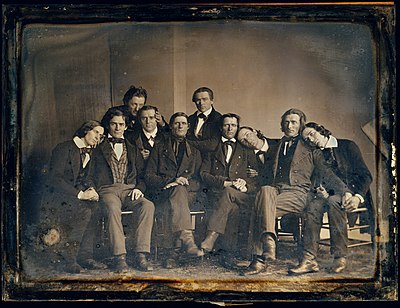
A photograph of the Hutchinson brothers. Jesse, Jr., (third from the left) is standing with a hand on a brother's head.  Thanks to George Fullerton of Goffstown, New Hampshire, for this image of the Hutchinson family.

There are online articles about the Hutchinson Family Singers and at Wikipedia.org. (Be sure to read the Discussion following the Wikipedia article for added information.) They started 20 years before the war with such controversial topics as abolition, temperance, and women's rights, even traveling with Frederick Douglass through England in 1845 and performed in prisons and almshouses.  The abolition of slavery led them to write many songs and support the election of Abraham Lincoln.  A perfect example of this is their use of the well-known folksong "Old Rosin the Beau."  Jesse Hutchinson wrote to it the lyrics for the abolition song,"Roll on the Liberty Ball", and later the subsequent Civil War song, "Lincoln and Liberty, Too", putting a developmental spin on how the war came about.  Find the words at Roll on the Liberty Ball. and Lincoln and Liberty, Too .

Altogether there were 13 Hutchinson Family Singers and by 1859 they split into two groups each called the Hutchinson Family Singers.  They popularized "The Battle Cry of Freedom",  (the Confederates took that song and wrote their own lyrics, too), "Tenting on the Old Camp Ground" and other songs.  "The Battle Cry of Freedom" has many citations on YouTube and Google as does "Tenting on the Old Camp Ground"

Isaac and William Lerich
There's more to the Hutchinson Family story, but I've found the two songs I use give shape to a story not as tidy as fiction. As noted in other posts at my website, http://www.LoiS-sez.com/Historical.html, music ties together lives and events as dramatic as fiction, but less easily organized.  "Roll on the Liberty Ball" is used for my Underground Railroad program about the Lerich family, based upon oral history.  For the Civil War I use "Lincoln and Liberty, Too" plus excerpts from letters by or sometimes about the two sons, Will and Isaac,  who joined the "Fighting Fifth" Infantry of Michigan during the War of Rebellion, as it was called here in the North at that time.


Other songs can be found in the Fifth Michigan Regiment Band's bibliography.

Here are some sources I found useful, many are also on the Fifth Michigan Regiment Band's bibliography.  

* Crawford, Richard, The Civil War Songbook, Dover Publications, Inc., New York, 1977.

* Currie, Stephen, Music in the Civil War, Betterway Books, Cincinnati, 1992.

* Glass, Paul, Singing Soldiers, Da Capo Press, Inc., New York, 1968.

* Hill, Lois, Poems and Songs of the Civil War, Fairfax Press, New York, 1990.

* Jackson, Richard, Stephen Foster Song Book, Dover Publications, Inc., New York, 1974.

* Krythe, Maymie R., Sampler of American Songs, Harper & Row Publishers, New York, 1969.

* McNeil, Keith and Rusty, Civil War Songbook; with Historical Commentary, WEM Records, Riverside, CA, 1999.

* Raph, Theodore, American Song Treasury, The, Dover Publications, Inc., Mineola, NY, 1964.

* Silber, Irwin, Songs of the Civil War, Dover Publications, Inc., New York, 1995.

* Silverman, Jerry, Ballads & Songs of the Civil War, Mel Bay Publications, Inc., Pacific, MO, 1993.
If you are looking for stories behind a dozen songs, Silverman also wrote Songs and Stories of the Civil War, Twenty-First Century Books, Brookfield, CT, 2002.

I omit recordings as they are more difficult to guarantee availability, format, and the ability to interlibrary loan.  These books give the music in print to permit performance.

LoiS(inging "For Lincoln and Liberty, Too")