Tell me if you have a topic you'd like to see. (Contact: LoiS-sez@LoiS-sez.com .)
Please also let others know about this site.
Showing posts with label bears. Show all posts

Friday, April 24, 2026

Bailey - Stories from The Tale of Cuffy Bear - Keeping the Public in Public Domain

For those in southeastern Michigan, Sunday, April 26, is the National Day of Puppetry. Come to the Clarkston Independence District Library for a free workshop at 3:00 p.m. on "Puppets from Dollar Store Items" with Brad Lowe. Make a puppet and learn tips on using this inexpensive addition to storytimes.  The Detroit Puppeteers Guild will hold a brief meeting open to the public after the workshop.  Registration is at https://events.getlocalhop.com/detroit-puppeteers-guild/event/OXSPafBRTz/ .

Puppets are such a great addition to storytelling. I once had a campground that wanted stories about bears. Prowling some of the stories by Arthur Scott Bailey about Cuffy Bear easily turned up many adventures I shared with a puppet bear. Bailey wrote more than forty children's books. Cuffy was Bailey's first book with The Tale of Cuffy Bear and so popular he wound up writing four more about the mischievous bear, but I counted 42 other books about a wide variety of animals and insects. Plenty of facts and adventures can be found in his nature stories for whatever puppet you might have.

Because it's spring I'm going to give the second adventure Cuffy had. Telling it, I would omit the comments about the porcupine and Cuffy's injuries from it. The book I have is battered and obviously well-loved by its first owner. It includes on the cover  this illustration about the porcupine.


(The story said: Cuffy Gave It One Good, Hard Cuff.) 

III

CUFFY AND THE WONDERFUL SPRING

The pricks of the porcupine's quills made Cuffy Bear's paws so sore that it was several days before he could run about again. And during all that time Cuffy was a very good little bear. He did not cuff his sister Silkie once. You see, he knew it would hurt his sore paws if he did.

The days were still fine. Cuffy loved to feel the bright sunshine upon his black coat. It warmed him through and through and he did not care at all if his feet did get wet in the melting snow.

At last one afternoon when his paws were quite well again Cuffy strayed some distance down the side of Blue Mountain, He was alone, because Silkie was asleep. You know, she was younger than Cuffy and still had to take naps. Cuffy had slid and tumbled down the mountainside until he was further from home than he knew. It did seem good to be able to put his paws upon the ground again without whimpering with pain. And coming to a short, steep place, Cuffy felt so glad that he actually turned a somersault and landed in a heap at the foot of the bank. He sat there for a moment, brushing the soft snow out of his face, when a flash of light dazzled his eyes. It came from a tree right in front of him. And Cuffy at once jumped up and ran to see what it was. He found that some one had fastened a shiny, new tin bucket to the trunk of the tree.

Cuffy felt that he must have that bucket to play with. He knew that he could have heaps of fun rolling it about on the ground. And he was just going to knock it off the hook that held it when he noticed that a small spout had been driven into the tree just above the bucket. And as Cuffy stood there on his hind legs, reaching up as high as he could, he saw a tiny drop fall from the spout and go splash! into the bucket. Then, as he watched, another drop fell; and another and another and another. Cuffy wondered where they came from. It must be—he thought—that there was a spring inside that tree. Yes! he was sure of it, for the bucket was half full of water. He felt thirsty, for he had not had a drink since lunch-time. And so Cuffy stuck his head into the pail and took a good, big swallow.

The next instant he squealed with joy. It was the nicest water he had ever tasted in all his life, for it was quite sweet—just as if somebody had left a heap of honey in the bottom of the bucket. But when Cuffy licked the end of the spout with his little red tongue he found that that tasted sweet too. Yes! it certainly was a wonderful spring. Cuffy was very glad that he had found it. And he decided that he would drink all he could of the delicious, sweet water and leave the pail hanging there. Then he could come back the next day and there would be more of that wonderful water all ready and waiting for him to drink up.


IV

CUFFY LEARNS SOMETHING

After leaving the wonderful spring Cuffy Bear was so long getting home that he decided he would not say anything to his father and mother about what he had found. You see—he was afraid they would tell him not to go so far away from home again. But Cuffy had not been long in the snug little house before he had a terrible stomach-ache. He stood the pain as long as he could without saying anything. But he simply had to hang onto his little fat stomach with both his front paws. And at last he began to cry softly. Then Mrs. Bear asked him what he had been doing; and before Cuffy knew it he had told all about finding the delicious, sweet water.

"How much did you drink?" asked his mother.

"Oh—only a little," Cuffy answered faintly.

Then Mrs. Bear nodded her head three times. She was very wise—was Mrs. Bear. And she knew quite well that Cuffy had drunk a great deal too much of that nice-tasting water. So she made Cuffy lie down and gave him some peppermint leaves to chew. In a little while he began to feel so much better that before he knew it he had fallen asleep.

When Cuffy waked up he found that his father had come home. And soon Mr. Bear had Cuffy on one knee, and Silkie on the other, and he was telling them all about maple-sugar. For of course you knew all the time that what Cuffy had found was not a spring at all—but a sugar-maple tree, which Farmer Green had tapped so that he might gather the sap and boil it until it turned to maple-sugar. If Cuffy had gone further down the mountainside he would have found a great many other trees, each—like the one he discovered—with a tin bucket hanging on it to catch the sweet sap.

"So you see there are many things for little bears to learn," Mr. Bear said, when he had finished. "And the one big lesson you must learn is to keep away from men. Farmer Green visits those trees every day to gather the sap. So you must not go down there again."

A cold shiver went up and down Cuffy's back at these words. Farmer Green! Cuffy had heard a great deal about Farmer Green and he certainly did not want to meet him all alone and far from home. But as soon as the tickle of that shiver stopped, Cuffy forgot all about his fright.

"This maple-sugar—does it taste as good as the sweet sap?" he asked his father.

"Yes, my son—a hundred times better!" Mr. Bear replied. "I ate some once And I shall never forget it."

A hundred times better! After he had gone to bed that night the words kept ringing in Cuffy's ears. A hundred times better! A hundred times better!... A hundred—And now Cuffy was fast asleep and—I am sorry to say it—sucking one of his paws for all the world as if it was a piece of Farmer Green's maple-sugar.

****

In case you are considering more about Cuffy, Project Gutenberg gave the book this introduction:

"The Tale of Cuffy Bear" by Arthur Scott Bailey is a children's storybook written in the early 20th century. This charming tale follows the antics of a young bear named Cuffy as he explores the woods around Blue Mountain, encounters various animals, and learns valuable lessons about behavior and the world. With its engaging storytelling and whimsical adventures, the book captures the innocence and curiosity of childhood. The story begins with Cuffy waking up after a long winter's sleep and enjoying the arrival of spring. His adventures include finding a porcupine, discovering a sugar-maple tree, and learning to swim with the help of his father, Mr. Bear. Throughout the tale, Cuffy's mischief often leads him into trouble, such as trying to capture a pig from Farmer Green's farm and getting chased by hornets. These humorous escapades, mixed with moments of reflection and growth, reveal Cuffy's character development as he learns about friendship, family, and the dangers of the wild. All of these experiences culminate in heartwarming lessons for both Cuffy and the readers, making the book an enjoyable read for children and adults alike. 

With so many books by Bailey, Project Gutenberg provides a great service providing 44 of the books. For those extra four about Cuffy, go to Internet Archive.

************ 

This is part of a series of postings of stories under the category, “Keeping the Public in Public Domain.” The idea behind Public Domain was to preserve our cultural heritage after the authors and their immediate heirs were compensated. I feel strongly current copyright law delays this intent on works of the 20th century. My own library of folklore includes so many books within the Public Domain I decided to share stories from them. I hope you enjoy discovering them.

At the same time, my own involvement in storytelling regularly creates projects requiring research as part of my sharing stories with an audience.  Whenever that research needs to be shown here, the publishing of Public Domain stories will not occur that week.  This is a return to my regular posting of a research project here.  (Don't worry, this isn't dry research, my research is always geared towards future storytelling to an audience.)  Response has convinced me that "Keeping the Public in Public Domain" should continue along with my other postings as often as I can manage it.

See the sidebar for other Public Domain story resources I recommend on the page “Public Domain Story Resources."


Friday, July 11, 2025

Jacobs - Reynard and Bruin - Keeping the Public in Public Domain

July truly is a month for nations celebrating, starting with Canada Day on the first, then our own 4th of July, and it's almost time for France to celebrate Bastille Day on the 14th. I went looking for something appropriately French and think Reynard the trickster fox deserves a storytelling visit. While the crafty fox stories did travel around Europe, the French liked him so well their word for "fox" became "Renard."

Joseph Jacobs was clearly taken with him and did an entire book, The Most Delectable History of Reynard the Fox .  Unlike much of Jacobs' work, it's too flowery and I don't find it tells well, although the adventures can be simplified and retold.  The year Jacobs died (1916) his final book, Europa's Fairy Book  -- sometimes called European Folk and Fairy Tales came out with a few easily retold adventures where the fox outwits the bear. It does, however, let this unrepentant trickster be appropriately punished. Jacobs long-time collaboration continued with illustrations by John D. Batten. I'll say a bit more about the sources after Reynard has his tale (or perhaps I should say "tail").

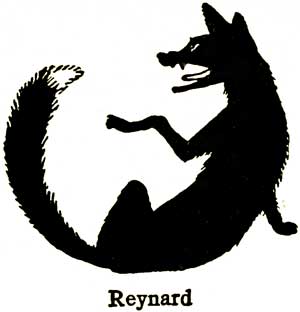
Reynard

REYNARD AND BRUIN

You must know that once upon a time Reynard the Fox and Bruin the Bear went into partnership and kept house together. Would you like to know the reason? Well, Reynard knew that Bruin had a beehive full of honeycomb, and that was what he wanted; but Bruin kept so close a guard upon his honey that Master Reynard didn't know how to get away from him and get hold of the honey. So one day he said to Bruin, "Pardner, I have to go and be gossip—that means god-father, you know—to one of my old friends." "Why, certainly," said Bruin. So off Reynard goes into the woods, and after a time he crept back and uncovered the beehive and had such a feast of honey. Then he went back to Bruin, who asked him what name had been given to the child. Reynard had forgotten all about the christening and could only say, "Just-begun." "What a funny name," said Master Bruin.

A little while after Reynard thought he would like another feast of honey. So he told Bruin that he had to go to another christening; and off he went. And when he came back and Bruin asked him what was the name given to the child Reynard said, "Half-eaten." The third time the same thing occurred, and this time the name given by Reynard to the child that didn't exist was "All-gone,"—you can guess why.

A short time afterwards Master Bruin thought he would like to eat up some of his honey and asked Reynard to come and join him in the feast. When they got to the beehive Bruin was so surprised to find that there was no honey left; and he turned round to Reynard and said, "Just-begun, Half-eaten, All-gone—so that is what you meant; you have eaten my honey." "Why no," said Reynard, "how could that be? I have never stirred from your side except when I went a-gossiping, and then I was far away from here. You must have eaten the honey yourself, perhaps when you were asleep; at any rate we can easily tell; let us lie down here in the sunshine, and if either of us has eaten the honey, the sun will soon sweat it out of us." No sooner said than done, and the two lay side by side in the sunshine. Soon Master Bruin commenced to doze, and Mr. Reynard took some honey from the hive and smeared it round Bruin's snout; then he woke him up and said, "See, the honey is oozing out of your snout; you must have eaten it when you were asleep."

Some time after this Reynard saw a man driving a cart full of fish, which made his mouth water. So he ran and he ran and he ran till he got far away in front of the cart and lay down in the road as still as if he were dead. When the man came up to him and saw him lying there dead, as he thought, he said to himself, "Why, that will make a beautiful red fox scarf and muff for my wife Ann." And he got down and seized hold of Reynard and threw him into the cart all along with the fish, and then he went driving on as before. Reynard began to throw the fish out till there were none left, and then he jumped out himself without the man noticing it, who drove up to his door and called out, "Ann, Ann, see what I have brought you." And when his wife came to the door she looked into the cart and said, "Why, there is nothing there."

Reynard in the meantime had brought all his fish together and began eating some when up comes Bruin and asked for a share. "No, no," said Reynard, "we only share food when we have shared work. I fished for these, you go and fish for others."

"Why, how could you fish for these? the water is all frozen over," said Bruin.

"I'll soon show you," said Reynard, and brought him down to the bank of the river, and pointed to a hole in the ice and said, "I put my tail in that, and the fish were so hungry I couldn't draw them up quick enough. Why do you not do the same?"

So Bruin put his tail down and waited and waited but no fish came. "Have patience, man," said Reynard; "as soon as one fish comes the rest will follow."

"Ah, I feel a bite," said Bruin, as the water commenced to freeze round his tail and caught it in the ice.

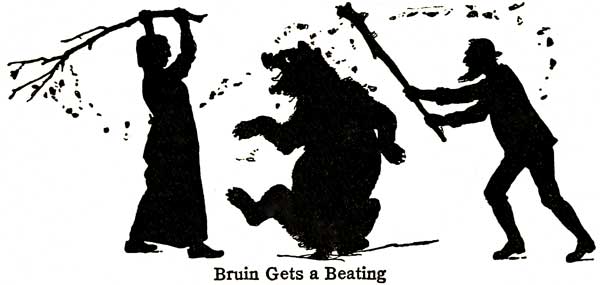
Bruin Gets a Beating

"Better wait till two or three have been caught and then you can catch three at a time. I'll go back and finish my lunch."

And with that Master Reynard trotted up to the man's wife and said to her, "Ma'am, there's a big black bear caught by the tail in the ice; you can do what you like with him." So the woman called her husband and they took big sticks and went down to the river and commenced whacking Bruin who, by this time, was fast in the ice. He pulled and he pulled and he pulled, till at last he got away leaving three quarters of his tail in the ice, and that is why bears have such short tails up to the present day.

Meanwhile Master Reynard was having a great time in the man's house, golloping everything he could find till the man and his wife came back and found him with his nose in the cream jug. As soon as he heard them come in he tried to get away, but not before the man had seized hold of the cream jug and thrown it at him, just catching him on the tail, and that is the reason why the tips of foxes' tails are cream white to this very day.

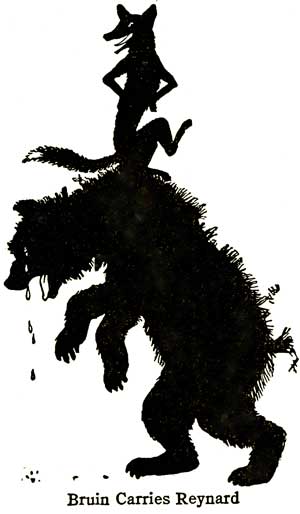
Bruin Carries Reynard

Well, Reynard crept home and found Bruin in such a state, who commenced to grumble and complain that it was all Reynard's fault that he had lost his tail. So Reynard pointed to his own tail and said, "Why, that's nothing; see my tail; they hit me so hard upon the head my brains fell out upon my tail. Oh, how bad I feel; won't you carry me to my little bed." So Bruin, who was a good-hearted soul, took him upon his back and rolled with him towards the house. And as he went on Reynard kept saying, "The sick carries the sound, the sick carries the sound."

"What's that you are saying?" asked Bruin.

"Oh, I have no brains left, I do not know what I am saying," said Reynard but kept on singing, "The sick carries the sound, ha, ha, the sick carries the sound."

Then Bruin knew that he had been done and threw Reynard down upon the ground, and would have eaten him up but that the fox slunk away and rushed into a briar bush. Bruin followed him closely into the briar bush and caught Reynard's hind leg in his mouth. Then Reynard called out, "That's right, you fool, bite the briar root, bite the briar root."

Bruin thinking that he was biting the briar root, let go Reynard's foot and snapped at the nearest briar root. "That's right, now you've got me,

don't hurt me too much,"

called out Reynard, and slunk away.

"Don't hurt me too much, don't hurt me too much."

When Bruin heard Reynard's voice dying away in the distance he knew that he had been done again, and that was the end of their partnership.

Some time after this a man was plowing in the field with his two oxen, who were very lazy that day. So the man called out at them, "Get a move on or I'll give you to the Bear"; and when they didn't quicken their pace he tried to frighten them by calling out, "Bear, Bear, come and take these lazy oxen." Sure enough, Bruin heard him and came out of the woods and said, "Here I am, give me the oxen, or else it'll be worse for you." The man was in despair but said, "Yes, yes, of course they are yours, but please let me finish my morning's plowing so I may finish this acre." Bruin could not say "No" to that, and sat down licking his chops and waiting for the oxen. The man went on plowing, thinking what he should do, when just at the corner of the field Reynard came up to him and said, "If you will give me two geese, I'll help you out of this fix and deliver the Bear into your hands." The man agreed and he told him what to do and went away into the woods. Soon after, the Bear and the man heard a noise like "Bow-wow, Bow-wow"; and the Bear came to the man and said, "What's that?" "Oh, that must be the lord's hounds out hunting for bears." "Hide me, hide me," said Bruin, "and I will let you off the oxen." Then Reynard called out from the wood, "What's that black thing you've got there?" And the Bear said, "Say it's the stump of a tree." So when the man had called this out to the Fox, Reynard called out, "Put it in the cart; fix it with the chain; cut off the boughs, and drive your axe into the stump." Then the Bear said to the man, "Pretend to do what he bids you; heave me into the cart; bind me with the chain; pretend to cut off the boughs, and drive the axe into the stump." So the man lifted Bruin into the cart, bound him with the chain, then cut off his limbs and buried the axe in his head.

Then Reynard came forward and asked for his reward, and the man went back to his house to get the pair of geese that he had promised.

"Wife, wife," he called out, as he neared the house, "get me a pair of geese, which I have promised the Fox for ridding me of the Bear."

"I can do better than that," said his wife Ann, and brought him out a bag with two struggling animals in it.

"Give these to Master Reynard," said she; "they will be geese enough for him." So the man took the bag and went down to the field and gave the bag to Reynard; but when he opened it out sprang two hounds, and he had great trouble in running away from them to his den.

When he got to his den the Fox asked each of his limbs, how they had helped him in his flight. His nose said, "I smelt the hounds"; his eyes said, "We looked for the shortest way"; his ears said, "We listened for the breathing of the hounds"; and his legs said, "We ran away with you." Then he asked his tail what it had done, and it said, "Why, I got caught in the bushes or made your leg stumble; that is all I could do." So, as a punishment, the Fox stuck his tail out of his den, and the hounds saw it and caught hold of it, and dragged the Fox out of his den by it and ate him all up. So that was the end of Master Reynard, and well he deserved it. Don't you think so?


Several familiar folktales were transformed into Reynard tales. The first is the Grimm collected tale of "The Cat and Mouse Who Shared a House." The story of why the bear is stumpy-tailed is a Norse tale that also traveled to Canada. Scholars have used it to show the Vikings did indeed land there because it is told by their First Nations. I don't know if Jacobs knew the story of "Br'er Rabbit in the Briar Patch", but it certainly fits Bear trying to get Reynard in the briar patch. As for the wife putting two dogs in a bag for Reynard, there probably are other stories using that, but it reminds me of the ending of "The Hobyahs."

************************

This is part of a series of postings of stories under the category, “Keeping the Public in Public Domain.” The idea behind Public Domain was to preserve our cultural heritage after the authors and their immediate heirs were compensated. I feel strongly current copyright law delays this intent on works of the 20th century. My own library of folklore includes so many books within the Public Domain I decided to share stories from them. I hope you enjoy discovering them.

At the same time, my own involvement in storytelling regularly creates projects requiring research as part of my sharing stories with an audience.  Whenever that research needs to be shown here, the publishing of Public Domain stories will not occur that week.  This is a return to my regular posting of a research project here.  (Don't worry, this isn't dry research, my research is always geared towards future storytelling to an audience.)  Response has convinced me that "Keeping the Public in Public Domain" should continue along with my other postings as often as I can manage it.

See the sidebar for other Public Domain story resources I recommend on the page “Public Domain Story Resources."
 

Friday, May 12, 2023

Wiggin and Smith - The Disappointed Bear - Keeping the Public in Public Domain

Sisters Kate Douglas Wiggin and Nora Archibald Smith together edited 16 books packed with wonderful stories.  Each wrote on their own beyond those anthologies and both Wiggin and Smith were strong leaders in the Kindergarten movement.  While it's easy to think of their books as being for children, the anthologies include folklore for all.  I prowled Tales of Laughter with just the key word of "mother" for Mother's Day.  It right away turned up this little gem from Russian folklore.  It matches a common theme found again and again in stories whether in history, folklore, or nature about mothers. . . mothers will do whatever it takes to protect their young.  Of course it helps if she's clever, too. 

Tales of Laughter carries the series subtitle of A Third Fairy Book, but there's not a fairy to be found in this tale.


The Disappointed Bear

Once upon a time a little old woman, who was walking in the forest, climbed up into a wild-cherry tree to gather cherries. Now, a bear espied her, and he came under the tree and cried, “Come down, old woman, that I may eat you!”

“Go along with you!” answered the old woman. “Why should you eat a scrawny old woman like me. Here, gnaw upon my shoe till I come down, and I will take you to my house; I have two little children there, named Janko and Mirko; they will make you a right savory dish. So have patience till you get them.”

So said the little old woman, and threw down one of her shoes. Master Bruin gnawed and gnawed upon it, but the more he gnawed the hungrier he grew. Greatly enraged, he screamed up to the old woman:

“Come down, you old wench, and let me eat you!”

“Just wait a little longer, till the old wench has gathered enough cherries,” she answered. “Here, gnaw this other shoe a while; she’ll soon come down and show you the way to her house.” So saying, she threw down the other shoe.

When Bruin found that the second shoe was no juicier than the first, he made no further effort, but contented himself with thinking of the fat little children at the old woman’s house. When she had gathered cherries enough, down she came and went home, the bear tramping along behind her.

When they reached the house the old woman said: “I’ll tell you what; first let me give the children a good supper, that they may be all the fatter; and meanwhile do you run about till evening to get up a better appetite.”

So Bruin went away and ran about in the woods all the rest of the day, and at evening he came back to the hut.

“Here I am, little mother!” he cried; “now bring out Janko and Mirko, and see me polish them off. I am starving to death!”

“Oho!” answered the little old woman from within; “Janko has made the door fast with bolts, and I have just put Mirko to sleep. I couldn’t think of waking him. And the little mother is so old and weak that she can’t unbolt the door alone. Come some other day!”

Then Master Bruin perceived that he had been fooled, and he walked reluctantly away, with drooping snout and an empty stomach.

*****

May your Mother's Day enjoy this little story over some delicious food!  (May that food also be cooked by anybody BUT mother!)

******************


This is part of a series of postings of stories under the category, "Keeping the Public in Public Domain."  The idea behind Public Domain was to preserve our cultural heritage after the authors and their immediate heirs were compensated.  I feel strongly current copyright law delays this intent on works of the 20th century.  My own library of folklore includes so many books within the Public Domain I decided to share stories from them.  I hope you enjoy discovering new stories.  


At the same time, my own involvement in storytelling regularly creates projects requiring research as part of my sharing stories with an audience.  Whenever that research needs to be shown here, the publishing of Public Domain stories will not occur that week.  This is a return to my regular posting of a research project here.  (Don't worry, this isn't dry research, my research is always geared towards future storytelling to an audience.)  Response has convinced me that "Keeping the Public in Public Domain" should continue along with my other postings as often as I can manage it.

Other Public Domain story resources I recommend-

  • There are many online resources for Public Domain stories, maybe none for folklore is as ambitious as fellow storyteller, Yoel Perez's database, Yashpeh, the International Folktales Collection.  I have long recommended it and continue to do so.  He has loaded Stith Thompson's Motif Index into his server as a database so you can search the whole 6 volumes for whatever word or expression you like by pressing one key. http://folkmasa.org/motiv/motif.htm

  • You may have noticed I'm no longer certain Dr. Perez has the largest database, although his offering the Motif Index certainly qualifies for those of us seeking specific types of stories.  There's another site, FairyTalez claiming to be the largest, with "over 2000 fairy tales, folktales, and fables" and they are "fully optimized for phones, tablets, and PCs", free and presented without ads.
    Between those two sites, there is much for story-lovers, but as they say in infomercials, "Wait, there's more!"

The email list for storytellers, Storytell, discussed Online Story Sources and came up with these additional suggestions:        

         - David K. Brown - http://people.ucalgary.ca/~dkbrown/stories.html

         - Richard Martin - http://www.tellatale.eu/tales_page.html

         - Spirit of Trees - http://spiritoftrees.org/featured-folktales

         - Story-Lovers - http://www.story-lovers.com/ is now only accessible through the Wayback Machine, described below, but the late Jackie Baldwin's wonderful site lives on there, fully searchable manually (the Google search doesn't work), at https://archive.org/ .  It's not easy, but go to Story-lovers.com snapshot for December 22 2016  and you can click on SOS: Searching Out Stories to scroll down through the many story topics and click on the story topic that interests you.

       - World of Tales - http://www.worldoftales.com/ 

 
           - Zalka Csenge Virag - http://multicoloreddiary.blogspot.com doesn't give the actual stories, but her recommendations, working her way through each country on a continent, give excellent ideas for finding new books and stories to love and tell.

     
You're going to find many of the links on these sites have gone down, BUT go to the Internet Archive Wayback Machine to find some of these old links.  Tim's site, for example, is so huge probably updating it would be a full-time job.  In the case of Story-Lovers, it's great that Jackie Baldwin set it up to stay online as long as it did after she could no longer maintain it.  Possibly searches maintained it.  Unfortunately Storytell list member, Papa Joe is on both Tim Sheppard's site and Story-Lovers, but he no longer maintains his old Papa Joe's Traveling Storytelling Show website and his Library (something you want to see!) is now only on the Wayback Machine.  It took some patience working back through claims of snapshots but finally in December of 2006 it appears!

    Somebody as of this writing whose stories can still be found by his website is the late Chuck Larkin - http://chucklarkin.com/stories.html.  I prefer to list these sites by their complete address so they can be found by the Wayback Machine, a.k.a. Archive.org, when that becomes the only way to find them.

You can see why I recommend these to you. 

Have fun discovering even more stories


Friday, October 2, 2020

Powers - Why Leaves Turn Red and Yellow - Keeping the Public in Public Domain

Photo by Annie Spratt on Unsplash

Last week I said even though I saw autumn leaves change along the roadside and lakes, deep in the woods it was all green here in southeastern Michigan.  Temperatures have dropped considerably and now the woods have a bit of color sprinkled around with a rare tree in the distance flaming up against that "green screen."

I'm not a hunter, but our state's recreation areas are open to hunting so I stay on official horse trails with my "Alaskan Husky" combination of husky and malamute.  I hope they don't see him in the distance and, like some who have asked, wonder if he's a wolf.  (He's not scruffy enough, I hope, to be mistaken for a coyote.)  I can wear hunter orange, but he's unhappy wearing safety vests.  Today's story includes hunters.  It's an Iroquois tale retold by Mabel Powers.  Her telling was endorsed by the Iroquois Confederation.  The Seneca adopted her and named her Yehsennohwehs which means She Who Carries and Tells the Stories. The hotlink for her name takes you to two other stories by her here.

Here in Michigan saying "the chase is on" goes back to the Anishinaabe tale of a race that explains how temperatures fluctuate at this time until finally the cold wins, but that's yet another story.

I just learned September 30 to October 6 is Fat Bear Week.  Go to that link and you may still have time to vote for your choice.  It includes a bit of learning more about how bears fatten up for the winter.  It's a fun and safe way to see some Alaskan bears.  Also they probably already have lost their leaves up there by now!

Here in my state, Michigan's Department of Natural Resources has a site with Fall Color Tours letting you discover where to "Leaf Peep", breaking it down by the Upper Peninsula, "Tip of the Mitt", Northern Lower, Mid-Michigan, Southern Lower areas.  We're a colorful state, especially now, so even with "social distancing" you can see it from your car or hiking on the trail

***************** 

This is part of a series of postings of stories under the category, "Keeping the Public in Public Domain."  The idea behind Public Domain was to preserve our cultural heritage after the authors and their immediate heirs were compensated.  I feel strongly current copyright law delays this intent on works of the 20th century.  My own library of folklore includes so many books within the Public Domain I decided to share stories from them.  I hope you enjoy discovering new stories.  


At the same time, my own involvement in storytelling regularly creates projects requiring research as part of my sharing stories with an audience.  Whenever that research needs to be shown here, the publishing of Public Domain stories will not occur that week.  This is a return to my regular posting of a research project here.  (Don't worry, this isn't dry research, my research is always geared towards future storytelling to an audience.)  Response has convinced me that "Keeping the Public in Public Domain" should continue along with my other postings as often as I can manage it.
Other Public Domain story resources I recommend-
  • There are many online resources for Public Domain stories, maybe none for folklore is as ambitious as fellow storyteller, Yoel Perez's database, Yashpeh, the International Folktales Collection.  I have long recommended it and continue to do so.  He has loaded Stith Thompson's Motif Index into his server as a database so you can search the whole 6 volumes for whatever word or expression you like by pressing one key. http://folkmasa.org/motiv/motif.htm
  • You may have noticed I'm no longer certain Dr. Perez has the largest database, although his offering the Motif Index certainly qualifies for those of us seeking specific types of stories.  There's another site, FairyTalez claiming to be the largest, with "over 2000 fairy tales, folktales, and fables" and they are "fully optimized for phones, tablets, and PCs", free and presented without ads.

    Between those two sites, there is much for story-lovers, but as they say in infomercials, "Wait, there's more!"
The email list for storytellers, Storytell, discussed Online Story Sources and came up with these additional suggestions:            
         - David K. Brown - http://people.ucalgary.ca/~dkbrown/stories.html
         - Richard Martin - http://www.tellatale.eu/tales_page.html
         - Spirit of Trees - http://spiritoftrees.org/featured-folktales
         - Story-Lovers - http://www.story-lovers.com/ is now only accessible through the Wayback Machine, described below, but the late Jackie Baldwin's wonderful site lives on there, fully searchable manually (the Google search doesn't work), at https://archive.org/ .  It's not easy, but go to Story-lovers.com snapshot for October 22 2016  and you can click on SOS: Searching Out Stories to scroll down through the many story topics and click on the story topic that interests you.
       - World of Tales - http://www.worldoftales.com/ 
           - Zalka Csenge Virag - http://multicoloreddiary.blogspot.com doesn't give the actual stories, but her recommendations, working her way through each country on a continent, give excellent ideas for finding new books and stories to love and tell.
     
You're going to find many of the links on these sites have gone down, BUT go to the Internet Archive Wayback Machine to find some of these old links.  Tim's site, for example, is so huge probably updating it would be a full-time job.  In the case of Story-Lovers, it's great that Jackie Baldwin set it up to stay online as long as it did after she could no longer maintain it.  Possibly searches maintained it.  Unfortunately Storytell list member, Papa Joe is on both Tim Sheppard's site and Story-Lovers, but he no longer maintains his old Papa Joe's Traveling Storytelling Show website and his Library (something you want to see!) is now only on the Wayback Machine.  It took some patience working back through claims of snapshots but finally in December of 2006 it appears!
    Somebody as of this writing whose stories can still be found by his website is the late Chuck Larkin - http://chucklarkin.com/stories.html.  I prefer to list these sites by their complete address so they can be found by the Wayback Machine, a.k.a. Archive.org, when that becomes the only way to find them.
You can see why I recommend these to you. Have fun discovering even more stories!

Saturday, May 4, 2019

Swanton - 2 Tlingit tales - Keeping the Public in Public Domain

 recording for B.A.E. of a Blackfoot chief
For the next several weeks I expect to be quite busy, so I want to work ahead.  Public Domain stories from two recent acquisitions let me easily offer storytelling here.  I'm a fan of Better World Books for their prices, selection, environmental responsibility, and funding world literacy.  There always seems to be a sale on their horizon, some better than others, and recently I went prowling.  More and more the books I want are being replaced by reprint publishing.  Unfortunately not all do a faithful job, so when I found used original editions of Tlingit Myths and Texts by John R. Swanton for the Bureau of American Ethnology , (later B.A.E. fully merged with the Smithsonian Institution), I bought it and a little known book by Carolyn Sherwin Bailey -- who was always a dependable author and anthologist.

While I have some books of Alaskan folklore, the Tlingit people weren't as familiar to me as some of the other people of the Northwest coast of the U.S. and Canada.  Besides Alaska, the Tlingit also are among Canada's First Nations. There's an excellent site, Native Languages of the Americas, a HUGE effort by Orrin Lewis, who is Cherokee with a dash of Muskogee, aided by Laura Redish, that works to protect and preserve Native American languages and culture.  I suggest starting there with the Facts for Kids: Tlingit Indians for an easy but thorough overview.  From there, the adult page of Tlingit Indian Culture and History is a page of link resources if you want even more.

Another page, unrelated to Orrin's site, you might check for an overview is The Indians of American Northwest Coast.  It covers the entire coastal area, starting with the Columbia River (which forms most of the border between Oregon and Washington).  The article comes from  http://www.historynotes.info/ .  The site never explains its origin nor provide its sources, but the article shows the variety of the many cultures indigenous to the northwestern coast of our two countries.  The site itself seems to provide depth to a wide assortment of historical topics, as well as genealogical articles and historical book reviews.

The B.A.E. stories were collected in Alaska's Sitka and Wrangell in 1904.  Each area opens with a lengthy cycle of stories about the Northwest's trickster figure, Raven, who is always interesting, but I chose today's stories because here in Michigan winter is trying to end and bears are starting to wake up.  I'm going to give two versions of the same story, first the shorter Sitka tale and then the other from Wrangell.
Tlingit man outside a traditional house and totem pole
The back of the book gives abstracts of each story and adds something not in the story, but probably implied in footnote "b": Since that time the Grass people have owned Iceberg House.

So far, nowhere in the book have I found anything more about the "Grass people."

The other footnote tells us to: See story 64.  It's the Wrangell version, which is a little longer and more fleshed out.
Next week I have a story from Wrangell that might interest adults following this year's Library Summer Reading Program's astronomical theme.  After that I'll give two stories from the Carolyn Sherwin Bailey book I purchased with this Bureau of American Ethnology book.

In the meantime I don't advise inviting any bears into your house.  They might think you are the feast.
*******************
This is part of a series of postings of stories under the category, "Keeping the Public in Public Domain."  The idea behind Public Domain was to preserve our cultural heritage after the authors and their immediate heirs were compensated.  I feel strongly current copyright law delays this intent on works of the 20th century.  My own library of folklore includes so many books within the Public Domain I decided to share stories from them.  I hope you enjoy discovering new stories.  


At the same time, my own involvement in storytelling regularly creates projects requiring research as part of my sharing stories with an audience.  Whenever that research needs to be shown here, the publishing of Public Domain stories will not occur that week.  This is a return to my regular posting of a research project here.  (Don't worry, this isn't dry research, my research is always geared towards future storytelling to an audience.)  Response has convinced me that "Keeping the Public in Public Domain" should continue along with my other postings as often as I can manage it.
Other Public Domain story resources I recommend-
  • There are many online resources for Public Domain stories, maybe none for folklore is as ambitious as fellow storyteller, Yoel Perez's database, Yashpeh, the International Folktales Collection.  I have long recommended it and continue to do so.  He has loaded Stith Thompson's Motif Index into his server as a database so you can search the whole 6 volumes for whatever word or expression you like by pressing one key. http://folkmasa.org/motiv/motif.htm
  • You may have noticed I'm no longer certain Dr. Perez has the largest database, although his offering the Motif Index certainly qualifies for those of us seeking specific types of stories.  There's another site, FairyTalez claiming to be the largest, with "over 2000 fairy tales, folktales, and fables" and they are "fully optimized for phones, tablets, and PCs", free and presented without ads.

    Between those two sites, there is much for story-lovers, but as they say in infomercials, "Wait, there's more!"
The email list for storytellers, Storytell, discussed Online Story Sources and came up with these additional suggestions:            
         - David K. Brown - http://people.ucalgary.ca/~dkbrown/stories.html
         - Richard Martin - http://www.tellatale.eu/tales_page.html
         - Spirit of Trees - http://spiritoftrees.org/featured-folktales
         - Story-Lovers - http://www.story-lovers.com/ is now only accessible through the Wayback Machine, described below, but Jackie Baldwin's wonderful site lives on there, fully searchable manually (the Google search doesn't work), at https://archive.org/ .  It's not easy, but go to Story-lovers.com snapshot for October 22 2016  and you can click on SOS: Searching Out Stories to scroll down through the many story topics and click on the story topic that interests you.
       - World of Tales - http://www.worldoftales.com/ 
           - Zalka Csenge Virag - http://multicoloreddiary.blogspot.com doesn't give the actual stories, but her recommendations, working her way through each country on a continent, give excellent ideas for finding new books and stories to love and tell.
     
You're going to find many of the links on these sites have gone down, BUT go to the Internet Archive Wayback Machine to find some of these old links.  Tim's site, for example, is so huge probably updating it would be a full-time job.  In the case of Story-Lovers, it's great that Jackie Baldwin set it up to stay online as long as it did after she could no longer maintain it.  Possibly searches maintained it.  Unfortunately Storytell list member, Papa Joe is on both Tim Sheppard's site and Story-Lovers, but he no longer maintains his old Papa Joe's Traveling Storytelling Show website and his Library (something you want to see!) is now only on the Wayback Machine.  It took some patience working back through claims of snapshots but finally in December of 2006 it appears!
    Somebody as of this writing whose stories can still be found by his website is the late Chuck Larkin - http://chucklarkin.com/stories.html.  I prefer to list these sites by their complete address so they can be found by the Wayback Machine, a.k.a. Archive.org, when that becomes the only way to find them.
You can see why I recommend these to you. Have fun discovering even more stories!

Saturday, November 24, 2018

Riley - The Bear Story - Keeping the Public in Public Domain (AND "translated" from the dialect)

I confess to mixed feelings about today's posting.  It's great for people who can memorize something like The Bear Story as James Whitcomb Riley wrote it, with or without dialect.  I do think the YouTube version I posted with the article about the original poem back on November 17 shows listening to it is probably easier than reading it.  Personally I prefer taking the story, which is an excellent example of a tall tale and re-telling it (as opposed to a memorized version) with a hint of the style of Riley's original.  For example, my translation today omits saying "purt' nigh" and substitutes "pretty near", but I think the listener can follow it.  That phrase also gives a sense of the teller, in this case the Little Boy.  I also find myself feeling sorry for the two bears.  They are a real threat to humans in their territory, but the Little Boy sets out specifically to kill them.

Last week I told so much about the poem and Riley that I only linked to the original.  For your convenience I'm giving it right after my "translation."  I also found so many great bear picture to start the story, but will stop once they have set the stage for the action which clearly keeps the Little Boy thinking his way through his story as he is telling it.

Bear Story (translated from the dialect)                         


Why once there was a Little Boy went out
In the woods to shoot a Bear. So, he went out
Away in the great-big woods – he did. – And he
Was going along – and going along, you know,
And pretty soon he heard something go “Wooh!”
It's that way – “Woo-ooh!” And he was scared,
He was. And so he ran and climbed a tree –
A great-big tree, he did, a sycamore tree.
And then he heard it again: and he looked around,
And it was a Bear! – a great big sure enough Bear!
No: it was two Bears, it was – two great-big Bears –
One of them was – this one's a great-big Bear. –
But they both went “Wooh!” – And here they came
To climb the tree and get the Little Boy
And eat him up!

And then the Little Boy                                                  

He was scared worse than ever! And here came
The great-big Bear climbing the tree to get
The Little Boy and eat him up – Oh, no! –
It wasn't the Big Bear that climbed the tree –
It was the Little Bear. So here he came
Climbing the tree – and climbing the tree! Then when
He got right close to the Little Boy, why then
The Little Boy he just pulled up his gun
And shot the Bear, he did, and killed him dead!
And then the Bear he fell clean on down out of
The tree – way clean to the ground, he did –
Spling-splung! He fell plumb down, and killed him, too!
And lit right beside where the Big Bear's at.


And then the Big Bear was awfully mad, you bet! –
Because – because the Little Boy he shot his gun
And killed the Little Bear. – Because the Big Bear
He – he was the Little Bear's Papa. – And so here
He came to climb the big old tree and get
The Little Boy and eat him up! And when
The Little Boy saw the great-big Bear
Coming, he was worse scared, he was,
Than any time! And so he thought he'd climb
Up higher – way up higher in the tree
Than the old Bear could climb, you know. – But he –
He can't climb higher than old Bears can climb, –
Because Bears can climb up higher in the trees
Than any little Boys in all the Wo-r-r-ld!

And so here came the great-big-Bear, he did, –                    

Climbing up – and up the tree, to get
The Little Boy and eat him up! And so
The Little Boy, he climbed on higher, and higher,
And higher up the tree – and higher – and higher –
And higher than this here house is! And here came
The old Bear – closer to him all the time! –
And then – first thing you know, when the old Big Bear
Was right close to him – then the Little Boy
Just jabbed his gun right in the old Bear's mouth
And shot and killed him dead! – No; I forgot, –
He didn't shoot the great-big Bear at all –
Because there was no load in the gun, you know –
Because when he shot the Little Bear, why, then
No load was anymore in the gun!

But the Little Boy climbed higher up, he did –
He climbed lots higher – and on up higher – and higher
And higher – until he just can't climb any higher,
Because then the limbs were all so little, away
Up in the teeny-weeny tip-top of
The tree, they'd break down with him if he didn't
he Be careful! So he stopped and thought: And then
He looked around – And here came the old Bear!

And so the Little Boy made his mind
He's got to just get out of there some way! –
Because here came the old Bear! – so close, his breath's
Pretty near so he could feel how hot it was
Against his bare feet – just like old “Ring's” breath
When he's been out hunting and is all tired.
So when the old Bear's so close – the Little Boy
Just gave a great-big jump for another tree –
No! – no, he didn't do that! – I'll tell you what
The Little Boy did: – Why, then – why, he – Oh, yes--
The Little Boy he found a hole up there
That's in the tree – and climbs in there and hides –
And then the old Bear can't find the Little Boy
At all! – But, pretty soon the old Bear finds
The Little Boy's gun that's up there – because the gun
It's too tall to take with him in the hole.
So, when the old Bear found the gun, he knew
The Little Boy was hidden around somewhere there, –
And the old Bear began to snuff and sniff around,
And sniff and snuff around – so he could find
Out where the Little Boy was hidden. – And then – then –
Oh, yes! – Why, pretty soon the old Bear climbed
Away out on a big limb – a great-long limb, –
And then the Little Boy climbed out of the hole
And took his ax and chopped the limb off! . . . Then
The old Bear fell k-splunge! clean to the ground
And busted and killed himself plumb dead, he did!

And then the Little Boy he got his gun
And commenced climbing down the tree again –
No! – no, he didn't get his gun – because when
The Bear fell, then the gun fell, too – And broke
It all to pieces, too! – And the nicest gun –
His Pa just bought it! – And the Little Boy
Just cried, he did; and went on climbing down
The tree – and climbing down – and climbing down! –
And sir! When he was pretty near down, – why, then
The old Bear he jumped up again – and he
Wasn't dead at all – just pretending that way,
So he could get the Little Boy and eat
Him up! But the Little Boy, he was too smart
To climb clean down the tree. – And the old Bear
He can't climb up the tree any more – because when
He fell, he broke one of his – he broke all
His legs! – and then he couldn't climb! But he
Just won't go away and let the Little Boy
Come down out of the tree. And the old Bear-Story
Just growled around there, he did – just growls and went
”Wooh! – woo-ooh!” all the time! And the Little Boy
He had to stay up in the tree – all night –
And without any supper either! – Only there
Were apples on the tree! – And the Little Boy
Ate apples – just all night – and cried – and cried!
Then when it was morning the old Bear went “Wooh!”
Again, and tried to climb up in the tree
And get the Little Boy. – But he couldn't
Climb to save his soul, he couldn't! – And oh! he was mad! –
He just tore up the ground! And went “Woo-ooh!”
And – Oh, yes! – pretty soon, when morning came
All light – so you can see, you know, – why, then
The old Bear found the Little Boy's gun, you know,
That's on the ground. – (And it isn't broken at all –
I just said that!) And so the old Bear thought
He'd take the gun and shoot the Little Boy: –
But Bears they don't know much about shooting guns;
So when he went to shoot the Little Boy,
The old Bear got the other end of the gun
Against his shoulder, instead of the other end –
So when he tried to shoot the Little Boy,
It shot the Bear, it did – and killed him dead!
And then the Little Boy climbed down the tree
And chopped his old wooly head off: – Yes, and kille
The other Bear again, he did – and killed
Both the bears, he did – and took them home
And cooked them, too, and ate them! 

And that's all.

I still think bears have the right idea about winter, whether in "torpor" or so-called hibernation (see last week)

The following is the complete original text of James Whitcomb Riley's "The Bear Story."
THE BEAR STORY
BY JAMES WHITCOMB RILEY
W'y, wunst they wuz a Little Boy went out
In the woods to shoot a Bear. So, he went out
'Way in the grea'-big woods—he did.—An' he
Wuz goin' along—an' goin' along, you know,
An' purty soon he heerd somepin' go "Wooh!"—
Ist thataway—"Woo-ooh!" An' he wuz skeered,
He wuz. An' so he runned an' clumbed a tree—
A grea'-big tree, he did,—a sicka-more tree.
An' nen he heerd it ag'in: an' he looked round,
An' 't'uz a Bear!—a grea'-big shore-nuff Bear!—
No: 't'uz two Bears, it wuz—two grea'-big Bears—
One of 'em wuz—ist one's a grea'-big Bear.—
But they ist boff went "Wooh!"—An' here they come
To climb the tree an' git the Little Boy
An' eat him up!
          An' nen the Little Boy
He 'uz skeered worse'n ever! An' here come
The grea'-big Bear a-climbin' th' tree to git
The Little Boy an' eat him up—Oh, no!—
It 'uzn't the Big Bear 'at clumb the tree—
It 'uz the Little Bear. So here he come
Climbin' the tree—an' climbin' the tree! Nen when
He git wite clos't to the Little Boy, w'y nen
The Little Boy he ist pulled up his gun
An' shot the Bear, he did, an' killed him dead!
An' nen the Bear he falled clean on down out
The tree—away clean to the ground, he did—
Spling-splung! he falled plum down, an' killed him, too!
An' lit wite side o' where the Big Bear's at.
An' nen the Big Bear's awful mad, you bet!—
'Cause—'cause the Little Boy he shot his gun
An' killed the Little Bear.—'Cause the Big Bear
He—he 'uz the Little Bear's Papa.—An' so here
He come to climb the big old tree an' git
The Little Boy an' eat him up! An' when
The Little Boy he saw the grea'-big Bear
A-comin', he uz badder skeered, he wuz,
Than any time! An' so he think he'll climb
Up higher—'way up higher in the tree
Than the old Bear kin climb, you know.—But he—
He can't climb higher 'an old Bears kin climb,—
'Cause Bears kin climb up higher in the trees
Than any little Boys in all the Wo-r-r-ld!
An' so here come the grea'-big-Bear, he did,—
A-climbin' up—an' up the tree, to git
The Little Boy an' eat him up! An' so
The Little Boy he clumbed on higher, an' higher,
An' higher up the tree—an' higher—an' higher—
An' higher'n iss-here house is!—An' here come
Th' old Bear—clos'ter to him all the time!—
An' nen—first thing you know,—when th' old Big Bear
Wuz wite clos't to him—nen the Little Boy
Ist jabbed his gun wite in the old Bear's mouf
An' shot an' killed him dead!—No; I fergot,—
He didn't shoot the grea'-big Bear at all—
'Cause they 'uz no load in the gun, you know—
'Cause when he shot the Little Bear, w'y, nen
No load 'uz anymore nen in the gun!
But th' Little Boy clumbed higher up, he did—
He clumbed lots higher—an' on up higher—an' higher
An' higher—tel he ist can't climb no higher,
'Cause nen the limbs 'uz all so little, 'way
Up in the teeny-weeny tip-top of
The tree, they'd break down wiv him ef he don't
Be keerful! So he stop an' think: An' nen
He look around—An' here come th' old Bear!
An' so the Little Boy make up his mind
He's got to ist git out o' there some way!—
'Cause here come the old Bear!—so clos't, his bref's
Purt 'nigh so's he kin feel how hot it is
Ag'inst his bare feet—ist like old "Ring's" bref
When he's ben out a-huntin' an's all tired.
So when th' old Bear's so clos't—the Little Boy
Ist gives a grea'-big jump fer 'nother tree—
No!—no he don't do that!—I tell you what
The Little Boy does:—W'y, nen—w'y, he—Oh, yes—
The Little Boy he finds a hole up there
'At's in the tree
—an' climbs in there an' hides—
An' nen th' old Bear can't find the Little Boy
At all!—But, purty soon th' old Bear finds
The Little Boy's gun 'at's up there—'cause the gun
It's too tall to tooked wiv him in the hole.
So, when the old Bear fin' the gun, he knows
The Little Boy's ist hid 'round somers there,—
An' th' old Bear 'gins to snuff an' sniff around,
An' sniff an' snuff around—so's he kin find
Out where the Little Boy's hid at.—An' nen—nen—
Oh, yes!—W'y, purty soon the old Bear climbs
'Way out on a big limb—a grea'-long limb,—
An' nen the Little Boy climbs out the hole
An' takes his ax an' chops the limb off!… Nen
The old Bear falls k-splunge! clean to the ground
An' bust an' kill hisse'f plum dead, he did!
An' nen the Little Boy he git his gun
An' 'menced a-climbin' down the tree ag'in—
No!—no, he didn't git his gun—'cause when
The Bear falled, nen the gun falled, too—An' broked
It all to pieces, too!—An' nicest gun!—
His Pa ist buyed it!—An' the Little Boy
Ist cried, he did; an' went on climbin' down
The tree—an' climbin' down—an' climbin' down!—
An'-sir! when he 'uz purt'-nigh down,—w'y, nen
The old Bear he jumped up ag'in—an' he
Ain't dead at all—ist 'tendin' thataway,
So he kin git the Little Boy an' eat
Him up! But the Little Boy he 'uz too smart
To climb clean down the tree.—An' the old Bear
He can't climb up the tree no more—'cause when
He fell, he broke one of his—he broke all
His legs!—an' nen he couldn't climb! But he
Ist won't go'way an' let the Little Boy
Come down out of the tree. An' the old Bear
Ist growls 'round there, he does—ist growls an' goes
"Wooh!—woo-ooh!" all the time! An' Little Boy
He haf to stay up in the tree—all night—
An' 'thout no supper neether!—On'y they
Wuz apples on the tree!—An' Little Boy
Et apples—ist all night—an' cried—an' cried!
Nen when 'tuz morning th' old Bear went "Wooh!"
Ag'in, an' try to climb up in the tree
An' git the Little Boy.—But he can't
Climb t'save his soul, he can't!—An' oh! he's mad!—
He ist tear up the ground! an' go "Woo-ooh!"
An'—Oh, yes!—purty soon, when morning's come
All light—so's you kin see, you know,—w'y, nen
The old Bear finds the Little Boy's gun, you know,
'At's on the ground.—(An' it ain't broke at all—
I ist said that!) An' so the old Bear think
He'll take the gun an' shoot the Little Boy:—
But Bears they don't know much 'bout shootin' guns;
So when he go to shoot the Little Boy,
The old Bear got the other end the gun
Ag'in' his shoulder, 'stid o' th' other end—
So when he try to shoot the Little Boy,
It shot the Bear, it did—an' killed him dead!
An' nen the Little Boy clumb down the tree
An' chopped his old woolly head off:—Yes, an' killed
The other Bear ag'in, he did—an' killed
All boff the bears, he did—an' tuk 'em home
An' cooked 'em, too, an' et 'em!
                    —An' that's all.

By the way, Riley also wrote “A Bear Family” in his TheBook of Joyous Children which I might post here sometime, but that link lets you find it in Project Gutenberg's many Public Domain books.  I hope you go there often and also donate to their wonderful resource for Keeping The Public in Public Domain.
*********************** 
This is part of a series of postings of stories under the category, "Keeping the Public in Public Domain."  The idea behind Public Domain was to preserve our cultural heritage after the authors and their immediate heirs were compensated.  I feel strongly current copyright law delays this intent on works of the 20th century.  My own library of folklore includes so many books within the Public Domain I decided to share stories from them.  I hope you enjoy discovering new stories.  


At the same time, my own involvement in storytelling regularly creates projects requiring research as part of my sharing stories with an audience.  Whenever that research needs to be shown here, the publishing of Public Domain stories will not occur that week.  This is a return to my regular posting of a research project here.  (Don't worry, this isn't dry research, my research is always geared towards future storytelling to an audience.)  Response has convinced me that "Keeping the Public in Public Domain" should continue along with my other postings as often as I can manage it.
Other Public Domain story resources I recommend-
  • There are many online resources for Public Domain stories, maybe none for folklore is as ambitious as fellow storyteller, Yoel Perez's database, Yashpeh, the International Folktales Collection.  I have long recommended it and continue to do so.  He has loaded Stith Thompson's Motif Index into his server as a database so you can search the whole 6 volumes for whatever word or expression you like by pressing one key. http://folkmasa.org/motiv/motif.htm
  • You may have noticed I'm no longer certain Dr. Perez has the largest database, although his offering the Motif Index certainly qualifies for those of us seeking specific types of stories.  There's another site, FairyTalez claiming to be the largest, with "over 2000 fairy tales, folktales, and fables" and they are "fully optimized for phones, tablets, and PCs", free and presented without ads.

    Between those two sites, there is much for story-lovers, but as they say in infomercials, "Wait, there's more!"
The email list for storytellers, Storytell, discussed Online Story Sources and came up with these additional suggestions:            
         - David K. Brown - http://people.ucalgary.ca/~dkbrown/stories.html
         - Richard Martin - http://www.tellatale.eu/tales_page.html
         - Spirit of Trees - http://spiritoftrees.org/featured-folktales
         - Story-Lovers - http://www.story-lovers.com/ is now only accessible through the Wayback Machine, described below, but Jackie Baldwin's wonderful site lives on there, fully searchable manually (the Google search doesn't work), at https://archive.org/ .  It's not easy, but go to Story-lovers.com snapshot for October 22 2016  and you can click on SOS: Searching Out Stories to scroll down through the many story topics and click on the story topic that interests you.
       - World of Tales - http://www.worldoftales.com/ 
     
You're going to find many of the links on these sites have gone down, BUT go to the Internet Archive Wayback Machine to find some of these old links.  Tim's site, for example, is so huge probably updating it would be a full-time job.  In the case of Story-Lovers, it's great that Jackie Baldwin set it up to stay online as long as it did after she could no longer maintain it.  Possibly searches maintained it.  Unfortunately Storytell list member, Papa Joe is on both Tim Sheppard's site and Story-Lovers, but he no longer maintains his old Papa Joe's Traveling Storytelling Show website and his Library (something you want to see!) is now only on the Wayback Machine.  It took some patience working back through claims of snapshots but finally in December of 2006 it appears!
    Somebody as of this writing whose stories can still be found by his website is the late Chuck Larkin - http://chucklarkin.com/stories.html.  I prefer to list these sites by their complete address so they can be found by the Wayback Machine, a.k.a. Archive.org, when that becomes the only way to find them.
You can see why I recommend these to you. Have fun discovering even more stories!