Tell me if you have a topic you'd like to see. (Contact: LoiS-sez@LoiS-sez.com .)
Please also let others know about this site.
Showing posts with label trees. Show all posts

Friday, October 17, 2025

Cowles - The Beginning of Birds - Keeping the Public in Public Domain

Sometimes serendipity brings what you need while looking for something else! I was looking to see if a story existed that might be a dimly seen tale of how flying creatures like pterodactyls evolved into birds. My search took me to early Twentieth Century storyteller and folklorist, Julia Darrow Cowles, It's been a long time (2013) since I posted something by her and there's still little more known about her except for online copies of her seventeen books. Once again I find her Indian Nature Myths is calling to me.  

Photo by Man from Forest on Unsplash 

It didn't give the prehistoric story I hoped to find, BUT I've also been eager to find a story about leaves changing colors -- this does it beautifully! Every year I'm always flabbergasted to think those gorgeous colors lurk all season long under the chlorophyll keeping them green until now! ! ! Yes, it's great to have green trees, but oh how incredible it is that such reds, oranges, and even yellow were there all along. 

Yes, it's sad when those leaves come down. I call it God's Confetti. I confess here in Michigan we have what I consider too long a time when all those bare branches show us the true shape of a tree. What few birds remain until spring do indeed tend to be the color of any oak leaves clinging to the trees. . . except for the cardinal which I dearly love and they don't seem to fit this story. Still that's no reason to skip a good story. Maybe in Montana and other areas where the Blackfeet Nation live there are no cardinals. If so, may all the other birds hurry back.

THE BEGINNING OF BIRDS

(Blackfeet)

IN very early times, the Red Children believe, there were no birds. And this is the way they account for their beginning:

All summer the trees had been full of leaves, shaking, whispering, dancing, as the winds blew upon them. “I wish I might fly,” said one little leaf. “I would go sailing straight up into the heavens. But the tree holds me tightly; I cannot get away.”

“If the tree should let you go, you would only fall to the ground and die,” said a bigger leaf. “It is better to be content as you are.”

So the leaves fluttered and danced and whispered one to another, day after day.

One morning the wind was cold, and the leaves had to dance fast to keep warm. Then the old tree said, “It is the breath of Po-poon-o-ki. He lives in the ice lodge of the far North. He will soon visit us, with his war paints. I must hold you tightly, little leaves, as long as I can.” But the little leaves did not understand what the tree meant.

Then, one still night, Po-poon-o-ki came. He went from tree to tree, and over each one he splashed his war paints, till the leaves were no longer green, but dashed with red, and brown, and yellow, and crimson.

“How beautiful the trees are!” cried the Indian children the next morning. “See their bright colors.”

For a few days the leaves danced and whispered, laughing over their beautiful hues. Then Po-poon-o-ki came back, and with his swift, cold breath, he blew against the trees, and the little leaves were tossed and torn from the friendly branches. They did not fly up into the heavens, but frightened and sobbing they dropped to the earth.

“We shall die!” they cried. “We shall die!”

Then a strange thing happened. The guardian spirit of the tree whispered, “No, little leaves, you shall not die. You shall be changed into living forms. I will give you breath and life.” And instantly there arose from the earth where the leaves had dropped, a great flock of winged birds, red, and brown, and yellow, and crimson,  all the beautiful colors that Po-poon-o-ki had given the leaves. Then they flew away to the South Land, where winter’s breath could not reach them.
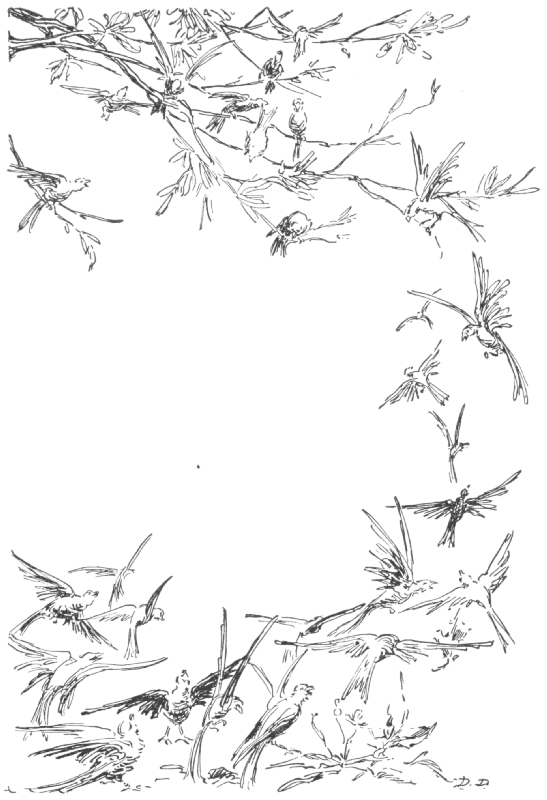

“THERE AROSE A GREAT FLOCK OF WINGED BIRDS”

But in the spring, when Ni-poon-o-ki, the spirit of summer, came stealing up from the South, and Po-poon-o-ki went back to his ice lodge in the far North, then the birds came back, too. There were new leaves on the trees, but the birds flew straight to the branches which had been their home, and there, safely sheltered by the new leaves, they built their nests.

And after awhile, when there were eggs in all the home nests, the hearts of the birds became so full of joy that they could no longer be silent. Their throats swelled, and opening wide their little mouths, they filled all the air with bursts of happy song.

************** 

This is part of a series of postings of stories under the category, “Keeping the Public in Public Domain.” The idea behind Public Domain was to preserve our cultural heritage after the authors and their immediate heirs were compensated. I feel strongly current copyright law delays this intent on works of the 20th century. My own library of folklore includes so many books within the Public Domain I decided to share stories from them. I hope you enjoy discovering them.

At the same time, my own involvement in storytelling regularly creates projects requiring research as part of my sharing stories with an audience.  Whenever that research needs to be shown here, the publishing of Public Domain stories will not occur that week.  This is a return to my regular posting of a research project here.  (Don't worry, this isn't dry research, my research is always geared towards future storytelling to an audience.)  Response has convinced me that "Keeping the Public in Public Domain" should continue along with my other postings as often as I can manage it.

See the sidebar for other Public Domain story resources I recommend on the page “Public Domain Story Resources."

Friday, December 20, 2024

Rydingsvard - The Christmas Spruce Tree - Keeping the Public in Public Domain

Old reader textbooks are a view into the childhood of our grandparents and those however many "great" grandparents. Some of it is too dated to tell now, but The Wide Awake Third Reader  by Clara Murray in 1912 has a story worth remembering, "The Christmas Spruce Tree" by Anna von Rydingsvard. The "a" in Rydingsvard has an umlaut over it, but I'm not using a keyboard able to give it.

I sometimes feel sad seeing trees cut down for Christmas, but maybe I should remember this little tale. Yes, it's anthropomorphic, giving human characteristics to a tree, but science has proven even trees have feelings and thoughts of a sort, so maybe this could happen.

THE CHRISTMAS SPRUCE TREE

Among the tall trees in the forest grew a little spruce tree. It was no taller than a man, and that is very short for a tree.

The other trees near it grew so tall and had such large branches that the poor little tree could not grow at all.

She liked to listen when the other trees were talking, but it often made her sad.

“I am king of the forest,” said the oak. “Look at my huge trunk and my branches. How they reach up toward heaven! I furnish planks for men from which they build their ships. Then I defy the storm on the ocean as I did the thunder in the forest.”

“And I go with you over the foaming waves,” said the tall straight pine. “I hold up the flapping sails when the ships fly over the ocean.”

“And we warm the houses when winter comes and the cold north wind drives the snow before him,” said the birches.

“We have the same work to do,” said a tall fir tree, and she bowed gracefully, drooping her branches toward the ground.

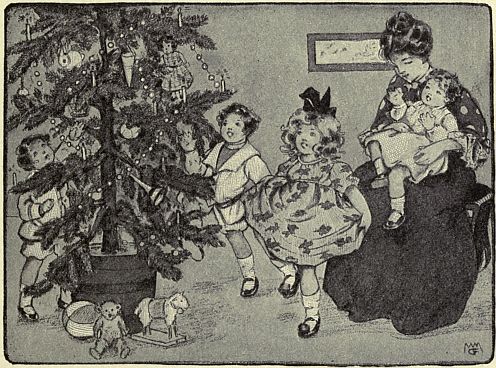
mother and children around the Christmas tree

The little spruce tree heard the other trees talking about their work in the world. This made her sad, and she thought, “What work can I do? What will become of me?”

But she could not think of any way in which she could be useful. She decided to ask the other trees in the forest.

So she asked the oak, the pine and the fir, but they were so proud and stately they did not even hear her.

Then she asked the beautiful white birch that stood near by. “You have no work to do,” said the birch, “because you can never grow large enough. Perhaps you might be a Christmas tree, but that is all.”

“What is a Christmas tree?” asked the little spruce.

“I do not know exactly,” replied the birch. “Sometimes when the days are short and cold, and the ground is covered with snow, men come out here into the forest. They look at all the little spruce trees and choose the prettiest, saying, ‘This will do for a Christmas tree.’

“Then they chop it down and carry it away. What they do with it I cannot tell.”

The little spruce asked the rabbit that hopped over the snow, the owls that slept in the pines, and the squirrels that came to find nuts and acorns.

But no one knew more than the birch tree. No one could tell what men did with the Christmas trees.

Then the little spruce tree wept because she had no work to do and could not be of any use in the world.

The tears hardened into clear, round drops, which we call gum.

At last a boy came into the forest with an axe in his hand. He looked the little tree all over. “Perhaps this will do for a Christmas tree,” he said. So he chopped it down, laid it on a sled, and dragged it home.

The next day the boy sold the tree, and it was taken into a large room and dressed up with pop corn and gilded nuts and candles. Packages of all sizes and shapes, and tiny bags filled with candy, were tied on its branches.

The tree was trembling with the excitement, but she stood as still as she could. “What if I should drop some of this fruit,” she thought.

When it began to grow dark, every one left the room and the tree was alone. It began to feel lonely and to think sad thoughts.

Soon the door opened and a lady came in. She lighted all the candles.

How light and glowing it was then!

The tree had never even dreamed of anything so beautiful!

Then the children came and danced about the tree, singing a Christmas song. The father played on his violin, and the baby sat in her mother’s arms, smiling and cooing.

“Now I know what I was made for,” thought the spruce tree; “I was intended to give joy to the little ones, because I, myself, am so small and humble.”

******

Whether you choose a live tree or an artificial one, I hope your holiday is able to give the joy this story describes and whatever you may need from it.

***

This is part of a series of postings of stories under the category, “Keeping the Public in Public Domain.” The idea behind Public Domain was to preserve our cultural heritage after the authors and their immediate heirs were compensated. I feel strongly current copyright law delays this intent on works of the 20th century. My own library of folklore includes so many books within the Public Domain I decided to share stories from them. I hope you enjoy discovering them.

At the same time, my own involvement in storytelling regularly creates projects requiring research as part of my sharing stories with an audience.  Whenever that research needs to be shown here, the publishing of Public Domain stories will not occur that week.  This is a return to my regular posting of a research project here.  (Don't worry, this isn't dry research, my research is always geared towards future storytelling to an audience.)  Response has convinced me that "Keeping the Public in Public Domain" should continue along with my other postings as often as I can manage it.
See the sidebar for other Public Domain story resources I recommend on the page “PublicDomain Story Resources."


Friday, June 2, 2023

Beckwith - The Boy Who Hated Trees - Keeping the Public in Public Domain


Photo by Amir Kalhor on Unsplash
I'm blessed in my area by woods for hiking with my dog. . . state recreation area, county and metro parks, a nearby golf course when it's not wanted by golfers, and even more.  Even with all of those areas every year I plant ten trees as they come with my annual membership to the Arbor Day Foundation.  (My membership card says I've been a member since 2011!)  They also offer the option: Send me no trees - Plant 10 trees in one of America's forests devastated by fires, insects, disease, and deforestation.

At least the option of having trees planted gets past the objection a former late brother-in-law had to trees requiring mowing around them and also coping with any leaves or branches on the ground.  I was shocked to learn he cut down century-old trees.

I'm not sure it's fair to say he hated trees, nor do I think the following story would have changed his mind.  I do hope telling it to younger listeners, might etch the importance of trees in their minds so they support the goal of the Arbor Day Foundation "to plant 500 million trees by 2027 in areas where they’re needed most. With a strong network of global partners, a science-based approach, and more than 50 years of planting trees all over the world, we know what it takes to make it happen."

This story comes from the Jewel Series originally published in the early 20th century by Duffield & Company.  The sisters Ada M. and Eleanor L. Skinner did several in the series, including one for each season.  This is from their editing The Turquoise Story Book; Stories and Legends of Summer and Nature now found on Gutenberg.org  as well as in a reprinted paperback by Forgotten Books in their Classic Reprint Series.  The reprinted book omits the frontispiece by Maxfield Parish (included in the Gutenberg version), but is otherwise a good reprint.  That can be hard to verify when ordering reprints unseen.  I've regretted the quality of some, but not those by Forgotten Books.  The Skinner sisters, in their acknowledgements say the story was first published by the Educational Company.

THE BOY WHO HATED TREES
 
Alice L. Beckwith

"Good night, Dick. Remember, now, to wake up with the robins so that you may be ready to help me set out our new trees."

"Good night," answered Dick in a sulky tone, for Dick was cross.

"Trees, trees, trees!" he mumbled to himself, as he began to undress. "I'm so sick of hearing about trees. And now father has bought some old twigs to set out to-morrow, and I want to go fishing.

"I wish I lived in a land where there were no trees. We could get along well enough without them." And with this thought he jumped into bed.

Dick had been asleep perhaps an hour or more when he heard a queer, rustling noise, and then a voice called out: "Here he is—the boy who hates trees!"

There was the strangest procession coming toward him. It was made up of trees of all kinds. The Pine and Elm came first; the Maple and Oak followed: the Maple's leaves were flushed scarlet, she was so excited. The Willow was weeping, and the Poplar was trembling all over.

Next came all the fruit trees, led by the Cherry, while the Walnut, the White Birch, and the Palm were behind.

What did it all mean? Dick was frightened for a moment. It seemed as if every tree of which he had ever heard was there, and he wondered how the room could hold them all.

When they had all grown quiet, the Pine said: "Dear brothers and sisters, here is a boy who hates trees; he cannot see that we are of any use. It is more than I can stand, and I have called this meeting to see what can be done about it. Has anyone anything to say?"

The Cherry looked very sour. "I cannot see that boys are of any use," she said. "Many years ago, when cherry trees were scarce in this country, a boy named George cut down my great-grandfather just to try his new hatchet."

"And boys know so little," said the White Birch; "they are always hacking me with knives, and taking off my coat, no matter how cold the weather is. I loved a boy once, but it was many years ago. He was a little Indian boy. He loved trees. I remember how he stood beside me one day and said:
"'Give me of your bark, O Birch Tree!
For the summer time is coming,
And the sun is warm in heaven,
And you need no white skin wrapper.'

"Then he took off my bark so carefully that he did not hurt me a bit. But he is not living now. This boy is not like him."

"I don't like boys, either," spoke up the Apple. "One day a boy climbed up into my branches and broke off one of my limbs. He was a very silly boy, for he wanted green apples. Had my fruit been ripe, I would have tossed one down to him. How happy we should be if it were not for boys!"

The Maple was very angry. "This boy said we were of no use, but it was only this morning that I heard him tease his grandfather for a cake of my sugar."

"He ate it as if he liked it, too," said the Palm. "I saw him; he was fanning himself with one of my leaves."

The Willow wiped her eyes. "Boys, boys, boys!" she said. "I'm so sick of boys! This same boy made a whistle out of one of my children this very night, when he went for the cows."

Then a queer tree in the corner spoke in a thick voice: "We are of no use, are we? If it were not for me, where would he get the tires for his bicycle? There are his rubber boots, too. Why, he uses me every day about something. But I've thought of a plan."

The trees crowded around him, talking together excitedly. "But how shall we do it?" Dick heard them say. "Oh," said the Elm, "the Wind will help us. He is our friend."

Before Dick could cry out, he found himself being carried away by the Wind.

"Where am I going?" he called.

"To the land of no trees," they answered; and they bowed and smiled. Even the Willow held up her head long enough to call, "Good-by!" and then home and trees were left far behind.

How fast the Wind traveled! On and on they rushed, until suddenly the Wind dropped him and went whistling away.

Dick felt really frightened when he found himself all alone.

"Oh, I'm so hot!" he exclaimed. "Where am I?"

Certainly he had never before been in such a place.

There were no trees nor green grass anywhere in sight. As far as he could see, there was only sand—white sand, hot and scorching.

"It seems to me I've seen pictures in my geography like this," he said to himself. "I can't stay here. What shall I do?"

All at once he noticed a tiny speck far away in the distance. Now it looked larger. He brushed away something that looked very much like a tear, though he told himself that it was only because he was so warm.

Yes, that speck surely moved, and was coming nearer. What if it were a bear!

"There is no tree to climb, and I cannot run—I am so tired, and it is very hot."

Nearer and nearer it came, moving slowly. Dick watched it with a beating heart. At last he saw that it was not a single animal, but a great many in line.

"Oh, they are camels!" he cried. "Yes, I know they are. Once at a circus I saw some that looked just like them—but what queer-looking men are on them!"

They were now very near him, and one of the men beckoned with his hand and said something.

"I can't understand him," said Dick to himself, "but I suppose he meant he'll give me a ride."

The man helped him up and they journeyed on. After a time Dick grew very tired even of riding.

"The camel joggles me so," he said, "and I am so thirsty I shall die. If they would only stop a minute!"

What was the matter? What were they saying? Each man was bowing himself toward the ground and waving his hands.

"I don't see what they are making all that fuss about. I can't see anything; the sun hurts my eyes so." And Dick covered his eyes with his hand.

Suddenly there was a shout, and the camels stood still. Dick lifted his head. Could he believe his eyes? Right before him was a little spot of green grass, a spring of cool water, and one of those things he hated—a tree.

Hate a tree? He thought that he had never seen anything so beautiful in his life.

He fairly tumbled off the camel in his haste to reach it. The tears ran down his face as he threw his arms around its trunk.

"Dear tree!" he cried.

"Dick, Dick, are you going to help me plant the new trees?" called his father.

Opening his eyes, Dick found himself in his own little room, both hands clasping his pillow.

Dick was soon dressed and downstairs, and so anxious was he to plant trees that he could hardly eat his breakfast.
In just one night he had learned to see
The wonderful beauty there is in a tree.
 

****************** 

If that story seems improbable, look to Lebanon.  Wikipedia does an excellent job of summarizing what deforestation can do. 

In ancient times, Lebanon was covered by large forests of cedar trees, the national emblem of the country.[171] Millennia of deforestation have altered the hydrology in Mount Lebanon and changed the regional climate adversely.[172] As of 2012, forests covered 13.4% of the Lebanese land area;[173] they are under constant threat from wildfires caused by the long dry summer season.[174]

As a result of longstanding exploitation, few old cedar trees remain in pockets of forests in Lebanon, but there is an active program to conserve and regenerate the forests.

Flag of Lebanon  The cedar is Lebanon's national emblem and on the national flag.  May it replace the deserts.

*** One last comment: Arbor Day members also can purchase all kinds of trees far less expensively and trees come with a one year guarantee.  Now I really need to get back to my newly planted trees.

*******************


Friday, September 9, 2022

Bailey - The Three Apples - Keeping the Public in Public Domain

Apple Orchards are turning into cider mills complete with all manner of activities, crowds, and yellow jackets!  Just because they are yellow with black stripes doesn't make them bees!  They are members of the WASP family . . . read Bees and the Anishinaabe for a story from 2014 about this irritable and irritating cousin of the useful bee.

But whether you have any of the above, the apple trees should be drawing our attention as autumn starts bringing the apple into the spotlight. Carolyn Sherwin Bailey from her Tell Me Another Story has a story worth remembering and a bit of talking about afterwards.

THE THREE APPLES

The old apple tree stood in the orchard with the other trees, and all summer long it had stretched out its branches wide to catch the rain and the sun to make its apples grow round and ripe. Now it was fall, and on the old apple tree were three great apples as yellow as gold and larger than any other apples in the whole orchard. The apple tree stretched and reached as far as it could, until the branch on which the three gold apples grew hung over the orchard wall. There were the three great apples, waiting for some one to pick them, and as the wind blew through the leaves of the apple tree it seemed to sing:

"Here in the orchard are apples three, Who uses one well shall a treasure see."

And one morning Gerald came down the lane that passed by the orchard wall. He looked longingly at the three gold apples, wishing, wishing that he might have one. Just then the wind sang its song again in the leaves of the apple tree and, plump, down to the ground, right at Gerald's feet, fell one of the three gold apples.

He picked it up and turned it round and round in his hands. How sweet it smelled, and how mellow and juicy it was! Gerald could think of nothing so good to do with such a beautiful ripe apple as to eat it. He put it to his mouth and took a great bite of it, then another bite, and another. Soon there was nothing left of the apple but the core, which Gerald threw away. He smacked his lips and went on his way, but the wind in the apple trees sang, sorrowfully, after him:

"Here in the orchard are apples two, But gone is the treasure that fell for you."

And after a while Hilda came down the lane that passed by the orchard wall. She looked up at the two beautiful gold apples that hung on the branch of the old apple tree, and she listened to the wind as it sang in the branches to her:

"Here in the orchard are apples two, A treasure they hold for a child like you."

Then the wind blew harder and, plump, an apple fell in the lane right in front of Hilda.

She picked it up joyfully. She had never seen so large and so golden an apple. She held it carefully in her clasped hands and thought what a pity it would be to eat it, because then it would be gone.

"I will keep this gold apple always," Hilda said, and she wrapped it up in the clean handkerchief that was in her pocket. Then Hilda went home, and there she laid away in a drawer the gold apple that the old apple tree had given her, closing the drawer tightly. The apple lay inside, in the dark, and all wrapped up, for many days, until it spoiled. And when Hilda next went down the lane and past the orchard, the wind in the apple tree sang to her:

"Only one apple where once there were two, Gone is the treasure I gave to you."

Last of all, Rudolph went down the lane one fine fall morning when the sun was shining warm and the wind was out. There, hanging over the orchard wall, he saw just one great gold apple that seemed to him the most beautiful apple that he had ever seen. As he stood looking up at it, the wind in the apple tree sang to him, and it said:

"Round and gold on the apple tree, A wonderful treasure, hanging, see!"

Then the wind blew harder, and down fell the last gold apple of the three into Rudolph's waiting hands.

He held it a long time and looked at it as Gerald and Hilda had, thinking how good it would be to eat, and how pretty it would be to look at if he were to save it. Then he decided not to do either of these things. He took his jack-knife out of his pocket and cut the gold apple in half, straight across, and exactly in the middle between the blossom and the stem.

Oh, the surprise that waited for Rudolph inside the apple! There was a star, and in each point of the star lay a small black seed. Rudolph carefully took out all the seeds and climbed over the orchard wall, holding them in his hand. The earth in the orchard was still soft, for the frost had not yet come. Rudolph made holes in the earth and in each hole he dropped an apple seed. Then he covered up the seeds and climbed back over the wall to eat his apple, and then go on his way.

But as Rudolph walked down the lane, the orchard wind followed him, singing to him from every tree and bush,

"A planted seed is a treasure won.

The work of the apple is now well done."


Or as another site in thinking about philosophy reminds us "There's a Brilliant Star Inside of Every Apple."


Have you taken the apple cores and at least tossed them into a field, especially in an area unlikely to be mowed?  I love to do that.  Maybe a deer will find that apple core and plant it somewhere else along with its own fertilizer.  

Similarly I love the story of how the Granny Smith apple came to be.  A site called Culinary Lore says there are various versions of the story, but 

The most common origin story of Granny Smith apples (Some folks just call them granny apples) is that, around 1868 in New South Wales, Mrs. Smith had dumped a crate of old rotten apples French Crab Apples from Tasmania in her garden and then later found an apple sapling growing there. The tree grew to produce green tart apples “that had never grown before.” They subsequently became famous not only in Australia but were shipped all over the world, including the U.S.

It helps to have other apple trees near enough to fertilize your "planted" tree, but even old untended apple trees can produce crops.  Our apple trees furnish treats for neighbors' donkeys and horses and we're happy to have them appreciated.


The apple in this story is probably the popular Golden Delicious.

My favorite apple is the Ida Red, but I enjoy Granny Smith apples, too.  That's the great thing about apples, there's so many varieties.  Enjoy! --  (and maybe toss it in a field after you eat it.)

******************

This is part of a series of postings of stories under the category, "Keeping the Public in Public Domain."  The idea behind Public Domain was to preserve our cultural heritage after the authors and their immediate heirs were compensated.  I feel strongly current copyright law delays this intent on works of the 20th century.  My own library of folklore includes so many books within the Public Domain I decided to share stories from them.  I hope you enjoy discovering new stories.  


At the same time, my own involvement in storytelling regularly creates projects requiring research as part of my sharing stories with an audience.  Whenever that research needs to be shown here, the publishing of Public Domain stories will not occur that week.  This is a return to my regular posting of a research project here.  (Don't worry, this isn't dry research, my research is always geared towards future storytelling to an audience.)  Response has convinced me that "Keeping the Public in Public Domain" should continue along with my other postings as often as I can manage it.

Other Public Domain story resources I recommend-

  • There are many online resources for Public Domain stories, maybe none for folklore is as ambitious as fellow storyteller, Yoel Perez's database, Yashpeh, the International Folktales Collection.  I have long recommended it and continue to do so.  He has loaded Stith Thompson's Motif Index into his server as a database so you can search the whole 6 volumes for whatever word or expression you like by pressing one key. http://folkmasa.org/motiv/motif.htm

  • You may have noticed I'm no longer certain Dr. Perez has the largest database, although his offering the Motif Index certainly qualifies for those of us seeking specific types of stories.  There's another site, FairyTalez claiming to be the largest, with "over 2000 fairy tales, folktales, and fables" and they are "fully optimized for phones, tablets, and PCs", free and presented without ads.
    Between those two sites, there is much for story-lovers, but as they say in infomercials, "Wait, there's more!"

The email list for storytellers, Storytell, discussed Online Story Sources and came up with these additional suggestions:        

         - David K. Brown - http://people.ucalgary.ca/~dkbrown/stories.html

         - Richard Martin - http://www.tellatale.eu/tales_page.html

         - Spirit of Trees - http://spiritoftrees.org/featured-folktales

         - Story-Lovers - http://www.story-lovers.com/ is now only accessible through the Wayback Machine, described below, but the late Jackie Baldwin's wonderful site lives on there, fully searchable manually (the Google search doesn't work), at https://archive.org/ .  It's not easy, but go to Story-lovers.com snapshot for October 22 2016  and you can click on SOS: Searching Out Stories to scroll down through the many story topics and click on the story topic that interests you.

       - World of Tales - http://www.worldoftales.com/ 

 
           - Zalka Csenge Virag - http://multicoloreddiary.blogspot.com doesn't give the actual stories, but her recommendations, working her way through each country on a continent, give excellent ideas for finding new books and stories to love and tell.

     
You're going to find many of the links on these sites have gone down, BUT go to the Internet Archive Wayback Machine to find some of these old links.  Tim's site, for example, is so huge probably updating it would be a full-time job.  In the case of Story-Lovers, it's great that Jackie Baldwin set it up to stay online as long as it did after she could no longer maintain it.  Possibly searches maintained it.  Unfortunately Storytell list member, Papa Joe is on both Tim Sheppard's site and Story-Lovers, but he no longer maintains his old Papa Joe's Traveling Storytelling Show website and his Library (something you want to see!) is now only on the Wayback Machine.  It took some patience working back through claims of snapshots but finally in December of 2006 it appears!

    Somebody as of this writing whose stories can still be found by his website is the late Chuck Larkin - http://chucklarkin.com/stories.html.  I prefer to list these sites by their complete address so they can be found by the Wayback Machine, a.k.a. Archive.org, when that becomes the only way to find them.

You can see why I recommend these to you. 

Have fun discovering even more stories

Friday, April 22, 2022

Shannon - The Last of the Leprechauns - Keeping the Public in Public Domain

With Earth Day this year on Friday, April 22, spilling over into the weekend, today's title sounds like it belongs nearer Saint Patrick's Day.  I'll add a bit about the author, Monica Shannon, later, but first the story and then its connection to Earth Day.


This story comes from a book that just entered the Public Domain with the unlikely title of California Fairy Tales, but with no explanation of sources.  Face it, in 1926 unless an author wanted to stress their sources, that information wasn't given.  If we understand the author, Monica Shannon, we can see her own family roots in Ireland combined with a love of California, as explained in the link to Encyclopedia.com in this article's opening:

 In these tales, elements of several cultures—California Spanish, Irish, Native American—are combined in original fairy tales taking place in a land of bean fields, redwood forests, deserts, and droughts. Eyes for the Dark (1928) and More Tales from California (1935) are collections similar to California Fairy Tales in tone and subject.

I list in my labels "Irish folklore" just to catch the Irish elements, but these are "original fairy tales."  Whether you snub them as "fakelore" or "literary", they still are true to their California roots.  

For those not in California, you might read about Eucalyptus and have your doubts.  I know I thought first about Australia, but this KQED news article, "Eucalyptus: How California's Most Hated Tree Took Root" tells they do indeed grow in eucalyptus forests, are tall (100 feet) and early 20th century U.S. Forest Service worries that there would be a timber famine led to investors choosing the fast growing trees for plantations.  Today this non-native plant is considered "moderately invasive" and possibly plays a role in California's wildfire damage.  

In contrast the sequoia and the redwood are California giants which some say are threatened by global warming.  The redwoods live in the foggy coastal areas while the sequoias are more at risk if these mountain trees depend on melting snow and rain.  There are some who predict both species will eventually require watering to keep them alive.  For those of us unfamiliar with either, redwoods are the younger upstarts compared to sequoias.  The tallest redwood is 379 feet and "only" live 2,200 years, while the tallest giant sequoia is 311 feet, but they tend to live about 3,200 years.  

For now both the redwoods and the sequoias are protected at least from logging.  The California state flag features a Golden Grizzly.  The California golden bear or California grizzly (Ursus arctos californicus) is an extinct subspecies of the brown bear.  It disappeared from the state of California in 1922 when the last one was shot in Tulare County.  One of the important things to remember about Earth Day is Extinct means there are no more.  

******************

This is part of a series of postings of stories under the category, "Keeping the Public in Public Domain."  The idea behind Public Domain was to preserve our cultural heritage after the authors and their immediate heirs were compensated.  I feel strongly current copyright law delays this intent on works of the 20th century.  My own library of folklore includes so many books within the Public Domain I decided to share stories from them.  I hope you enjoy discovering new stories.  


At the same time, my own involvement in storytelling regularly creates projects requiring research as part of my sharing stories with an audience.  Whenever that research needs to be shown here, the publishing of Public Domain stories will not occur that week.  This is a return to my regular posting of a research project here.  (Don't worry, this isn't dry research, my research is always geared towards future storytelling to an audience.)  Response has convinced me that "Keeping the Public in Public Domain" should continue along with my other postings as often as I can manage it.
Other Public Domain story resources I recommend-
  • There are many online resources for Public Domain stories, maybe none for folklore is as ambitious as fellow storyteller, Yoel Perez's database, Yashpeh, the International Folktales Collection.  I have long recommended it and continue to do so.  He has loaded Stith Thompson's Motif Index into his server as a database so you can search the whole 6 volumes for whatever word or expression you like by pressing one key. http://folkmasa.org/motiv/motif.htm
  • You may have noticed I'm no longer certain Dr. Perez has the largest database, although his offering the Motif Index certainly qualifies for those of us seeking specific types of stories.  There's another site, FairyTalez claiming to be the largest, with "over 2000 fairy tales, folktales, and fables" and they are "fully optimized for phones, tablets, and PCs", free and presented without ads.

    Between those two sites, there is much for story-lovers, but as they say in infomercials, "Wait, there's more!"
The email list for storytellers, Storytell, discussed Online Story Sources and came up with these additional suggestions:            
         - David K. Brown - http://people.ucalgary.ca/~dkbrown/stories.html
         - Richard Martin - http://www.tellatale.eu/tales_page.html
         - Spirit of Trees - http://spiritoftrees.org/featured-folktales
         - Story-Lovers - http://www.story-lovers.com/ is now only accessible through the Wayback Machine, described below, but the late Jackie Baldwin's wonderful site lives on there, fully searchable manually (the Google search doesn't work), at https://archive.org/ .  It's not easy, but go to Story-lovers.com snapshot for October 22 2016  and you can click on SOS: Searching Out Stories to scroll down through the many story topics and click on the story topic that interests you.
       - World of Tales - http://www.worldoftales.com/ 
           - Zalka Csenge Virag - http://multicoloreddiary.blogspot.com doesn't give the actual stories, but her recommendations, working her way through each country on a continent, give excellent ideas for finding new books and stories to love and tell.
     
You're going to find many of the links on these sites have gone down, BUT go to the Internet Archive Wayback Machine to find some of these old links.  Tim's site, for example, is so huge probably updating it would be a full-time job.  In the case of Story-Lovers, it's great that Jackie Baldwin set it up to stay online as long as it did after she could no longer maintain it.  Possibly searches maintained it.  Unfortunately Storytell list member, Papa Joe is on both Tim Sheppard's site and Story-Lovers, but he no longer maintains his old Papa Joe's Traveling Storytelling Show website and his Library (something you want to see!) is now only on the Wayback Machine.  It took some patience working back through claims of snapshots but finally in December of 2006 it appears!
    Somebody as of this writing whose stories can still be found by his website is the late Chuck Larkin - http://chucklarkin.com/stories.html.  I prefer to list these sites by their complete address so they can be found by the Wayback Machine, a.k.a. Archive.org, when that becomes the only way to find them.
You can see why I recommend these to you. Have fun discovering even more stories!

Friday, April 8, 2022

Parker - How the Conifers Flaunt the Promise of Spring - Keeping the Public in Public Domain

Anthropologist and museum director, Arthur C. Parker, was from an important Seneca family on his father's side and wrote over the years about the Seneca along with the rest of the Iroquois Confederacy.  He was one of the founders of the Society of American Indians, the first national organization run by and for Native Americans and it also aimed to "educate the public about Native Americans."  I have long enjoyed three of his books, Seneca Myths & Folk Tales and Skunny Wundy; Seneca Indian Tales (both now in Public Domain); and Rumbling Wings and Other Indian Tales (which won't yet enter Public Domain for another two years).  As a children's librarian I first discovered him through his highly approachable Skunny Wundy, and think of it and today's story as I watch my oak trees begin to bud.  I also find it an interesting allegory of resistance to what seems like overwhelming attack.

Photo by Ira Huz on Unsplash

I confess it, I hate seeing the oak's brown leaves of winter, so while this gives the hope of spring, the story also explains their drab, stubborn leaves that cling through that long season.


I found myself wondering about the Tamarack.  There are various Michigan places named Tamarack, including the Tamarack District Library in Lakeview, Michigan, where I've presented two of my historical programs.  But I wasn't sure I knew what a Tamarack looked like.  It's always good research to start with the simple overview on Wikipedia.  There I learned it was also called a larch and the wood is so good for making snowshoes that "The word akemantak is an Algonquian name for the species and means 'wood used for snowshoes'."  Looking at the article's photos I still didn't know enough to identify it, although I began to realize it may be more often grown north of my metro Detroit location.  The Arborsmith LTD's tree of the month article was far more helpful, showing it in spring, telling of its color change in autumn, and a photo of it bare in winter in addition to explaining more about the tree.  

A further resource is "Get to Know Your Buds" from the Overton Park Conservancy.

Personally I'm delighted to see my oak trees budding and find the story of the two trees also a good allegory with the resilience of the Oak showing its determination to withstand attacks.

Overton Park photo of Red Oak buds
******************
This is part of a series of postings of stories under the category, "Keeping the Public in Public Domain."  The idea behind Public Domain was to preserve our cultural heritage after the authors and their immediate heirs were compensated.  I feel strongly current copyright law delays this intent on works of the 20th century.  My own library of folklore includes so many books within the Public Domain I decided to share stories from them.  I hope you enjoy discovering new stories.  


At the same time, my own involvement in storytelling regularly creates projects requiring research as part of my sharing stories with an audience.  Whenever that research needs to be shown here, the publishing of Public Domain stories will not occur that week.  This is a return to my regular posting of a research project here.  (Don't worry, this isn't dry research, my research is always geared towards future storytelling to an audience.)  Response has convinced me that "Keeping the Public in Public Domain" should continue along with my other postings as often as I can manage it.
Other Public Domain story resources I recommend-
  • There are many online resources for Public Domain stories, maybe none for folklore is as ambitious as fellow storyteller, Yoel Perez's database, Yashpeh, the International Folktales Collection.  I have long recommended it and continue to do so.  He has loaded Stith Thompson's Motif Index into his server as a database so you can search the whole 6 volumes for whatever word or expression you like by pressing one key. http://folkmasa.org/motiv/motif.htm
  • You may have noticed I'm no longer certain Dr. Perez has the largest database, although his offering the Motif Index certainly qualifies for those of us seeking specific types of stories.  There's another site, FairyTalez claiming to be the largest, with "over 2000 fairy tales, folktales, and fables" and they are "fully optimized for phones, tablets, and PCs", free and presented without ads.

    Between those two sites, there is much for story-lovers, but as they say in infomercials, "Wait, there's more!"
The email list for storytellers, Storytell, discussed Online Story Sources and came up with these additional suggestions:            
         - David K. Brown - http://people.ucalgary.ca/~dkbrown/stories.html
         - Richard Martin - http://www.tellatale.eu/tales_page.html
         - Spirit of Trees - http://spiritoftrees.org/featured-folktales
         - Story-Lovers - http://www.story-lovers.com/ is now only accessible through the Wayback Machine, described below, but the late Jackie Baldwin's wonderful site lives on there, fully searchable manually (the Google search doesn't work), at https://archive.org/ .  It's not easy, but go to Story-lovers.com snapshot for October 22 2016  and you can click on SOS: Searching Out Stories to scroll down through the many story topics and click on the story topic that interests you.
       - World of Tales - http://www.worldoftales.com/ 
           - Zalka Csenge Virag - http://multicoloreddiary.blogspot.com doesn't give the actual stories, but her recommendations, working her way through each country on a continent, give excellent ideas for finding new books and stories to love and tell.
     
You're going to find many of the links on these sites have gone down, BUT go to the Internet Archive Wayback Machine to find some of these old links.  Tim's site, for example, is so huge probably updating it would be a full-time job.  In the case of Story-Lovers, it's great that Jackie Baldwin set it up to stay online as long as it did after she could no longer maintain it.  Possibly searches maintained it.  Unfortunately Storytell list member, Papa Joe is on both Tim Sheppard's site and Story-Lovers, but he no longer maintains his old Papa Joe's Traveling Storytelling Show website and his Library (something you want to see!) is now only on the Wayback Machine.  It took some patience working back through claims of snapshots but finally in December of 2006 it appears!
    Somebody as of this writing whose stories can still be found by his website is the late Chuck Larkin - http://chucklarkin.com/stories.html.  I prefer to list these sites by their complete address so they can be found by the Wayback Machine, a.k.a. Archive.org, when that becomes the only way to find them.
You can see why I recommend these to you. Have fun discovering even more stories!

Friday, August 13, 2021

Field - The Oak Tree and the Ivy - Keeping the Public in Public Domain

How often do we learn to value something only after it leaves our life!  I'm aware this applies to both trees (which continue to be affected by storms) and to my own personal roots in Saint Louis.  If that seems like a strange combination...storytellers may make unusual combinations when it comes to finding stories.

I confess I rarely use poetry in my storytelling.  Perhaps if I were so inclined I'd use Joyce Kilmer's poem, "Trees."  Nope, not my style.  (Although the parody by Ogden Nash in that Wikipedia article is definitely more my style!)  As a result I guess it's not surprising that while growing up in Saint Louis (Missouri, not Saint Louis, Michigan) I never felt the urge to visit the Field House.

Field House Museum with the new expansion, 2017, by Efhmuseum

The Field House Museum struck me as a 19th century house of someone who didn't interest me beyond his poems of "Wynken, Blynken, and Nod" and "The Duel" (which is perhaps better known as "The Gingham Dog and the Calico Cat").  While I liked and acknowledged his St. Louis connections, I was even less interested in his sentimental "Little Boy Blue".  Fortunately I eventually discovered he had much more that might interest me.  The Wikipedia article on Eugene Field gives a hint of his personality, talking of his college pranks.  The Eugene Field Book: Verses, Stories, and Letters, however, contains "Ä Chapter of Autobiography" revealing his nature in ways interesting me way more than the "Just the facts"style of Wikipedia.  The expansion to the museum wasn't available when I was living in St. Louis.  It's style at first had me believe it was a library branch.  That architecture fits its contents including his collection of dolls and toys, a library, and also about his father.  O.k. my awareness of the Dred Scott decision also grew after I moved away and began to tell about abolition and the Underground Railroad.  Eugene's father, Roswell Field, represented Dred Scott.  

Prowling books I owned by him feels oh so appropriate as the sound of chainsaws continue to cope with area tree damage.  The following story from A Little Book of Profitable Tales will stay with me as I see some trees continuing after damage.  The story is definitely "literary" and I'd re-tell it, then suggest the audience look up the original to allow Field's story to speak in his own voice.

THE OAK-TREE AND THE IVY.

In the greenwood stood a mighty oak. So majestic was he that all who came that way paused to admire his strength and beauty, and all the other trees of the greenwood acknowledged him to be their monarch.

Now it came to pass that the ivy loved the oak-tree, and inclining her graceful tendrils where he stood, she crept about his feet and twined herself around his sturdy and knotted trunk. And the oak-tree pitied the ivy.

"Oho!" he cried, laughing boisterously, but good-naturedly,—"oho! so you love me, do you, little vine? Very well, then; play about my feet, and I will keep the storms from you and will tell you pretty stories about the clouds, the birds, and the stars."

The ivy marvelled greatly at the strange stories the oak-tree told; they were stories the oak-tree heard from the wind that loitered about his lofty head and whispered to the leaves of his topmost branches. Sometimes the story was about the great ocean in the East, sometimes of the broad prairies in the West, sometimes of the ice-king who lived in the North, and sometimes of the flower-queen who dwelt in the South. Then, too, the moon told a story to the oak-tree every night,—or at least every night that she came to the greenwood, which was very often, for the greenwood is a very charming spot, as we all know. And the oak-tree repeated to the ivy every story the moon told and every song the stars sang.

"Pray, what are the winds saying now?" or "What song is that I hear?" the ivy would ask; and then the oak-tree would repeat the story or the song, and the ivy would listen in great wonderment.

Whenever the storms came, the oak-tree cried to the little ivy: "Cling close to me, and no harm shall befall you! See how strong I am; the tempest does not so much as stir me—I mock its fury!"

Then, seeing how strong and brave he was, the ivy hugged him closely; his brown, rugged breast protected her from every harm, and she was secure.

The years went by; how quickly they flew,—spring, summer, winter, and then again spring, summer, winter,—ah, life is short in the greenwood as elsewhere! And now the ivy was no longer a weakly little vine to excite the pity of the passer-by. Her thousand beautiful arms had twined hither and thither about the oak-tree, covering his brown and knotted trunk, shooting forth a bright, delicious foliage and stretching far up among his lower branches. Then the oak-tree's pity grew into a love for the ivy, and the ivy was filled with a great joy. And the oak-tree and the ivy were wed one June night, and there was a wonderful celebration in the greenwood; and there was the most beautiful music, in which the pine-trees, the crickets, the katydids, the frogs, and the nightingales joined with pleasing harmony.

The oak-tree was always good and gentle to the ivy. "There is a storm coming over the hills," he would say. "The east wind tells me so; the swallows fly low in the air, and the sky is dark. Cling close to me, my beloved, and no harm shall befall you."

Then, confidently and with an always-growing love, the ivy would cling more closely to the oak-tree, and no harm came to her.

"How good the oak-tree is to the ivy!" said the other trees of the greenwood. The ivy heard them, and she loved the oak-tree more and more. And, although the ivy was now the most umbrageous and luxuriant vine in all the greenwood, the oak-tree regarded her still as the tender little thing he had laughingly called to his feet that spring day, many years before,—the same little ivy he had told about the stars, the clouds, and the birds. And, just as patiently as in those days he had told her of these things, he now repeated other tales the winds whispered to his topmost boughs,—tales of the ocean in the East, the prairies in the West, the ice-king in the North, and the flower-queen in the South. Nestling upon his brave breast and in his stout arms, the ivy heard him tell these wondrous things, and she never wearied with the listening.

"How the oak-tree loves her!" said the ash. "The lazy vine has naught to do but to twine herself about the arrogant oak-tree and hear him tell his wondrous stories!"

The ivy heard these envious words, and they made her very sad; but she said nothing of them to the oak-tree, and that night the oak-tree rocked her to sleep as he repeated the lullaby a zephyr was singing to him.

"There is a storm coming over the hills," said the oak-tree one day. "The east wind tells me so; the swallows fly low in the air, and the sky is dark. Clasp me round about with thy dear arms, my beloved, and nestle close unto my bosom, and no harm shall befall thee."

"I have no fear," murmured the ivy; and she clasped her arms most closely about him and nestled unto his bosom.

The storm came over the hills and swept down upon the greenwood with deafening thunder and vivid lightning. The storm-king himself rode upon the blast; his horses breathed flames, and his chariot trailed through the air like a serpent of fire. The ash fell before the violence of the storm-king's fury, and the cedars groaning fell, and the hemlocks and the pines; but the oak-tree alone quailed not.

"Oho!" cried the storm-king, angrily, "the oak-tree does not bow to me, he does not tremble in my presence. Well, we shall see."

With that, the storm-king hurled a mighty thunderbolt at the oak-tree, and the brave, strong monarch of the greenwood was riven. Then, with a shout of triumph, the storm-king rode away.

"Dear oak-tree, you are riven by the storm-king's thunderbolt!" cried the ivy, in anguish.

"Ay," said the oak-tree, feebly, "my end has come; see, I am shattered and helpless."

"But I am unhurt," remonstrated the ivy, "and I will bind up your wounds and nurse you back to health and vigor."

And so it was that, although the oak-tree was ever afterward a riven and broken thing, the ivy concealed the scars upon his shattered form and covered his wounds all over with her soft foliage.

"I had hoped, dear one," she said, "to grow up to thy height, to live with thee among the clouds, and to hear the solemn voices thou didst hear. Thou wouldst have loved me better then?"

But the old oak-tree said: "Nay, nay, my beloved; I love thee better as thou art, for with thy beauty and thy love thou comfortest mine age."

Then would the ivy tell quaint stories to the old and broken oak-tree,—stories she had learned from the crickets, the bees, the butterflies, and the mice when she was an humble little vine and played at the foot of the majestic oak-tree, towering in the greenwood with no thought of the tiny shoot that crept toward him with her love. And these simple tales pleased the old and riven oak-tree; they were not as heroic as the tales the winds, the clouds, and the stars told, but they were far sweeter, for they were tales of contentment, of humility, of love.

So the old age of the oak-tree was grander than his youth.

And all who went through the greenwood paused to behold and admire the beauty of the oak-tree then; for about his seared and broken trunk the gentle vine had so entwined her graceful tendrils and spread her fair foliage, that one saw not the havoc of the years nor the ruin of the tempest, but only the glory of the oak-tree's age, which was the ivy's love and ministering.

********


All right it's definitely anthropomorphic and the "thees and thous" come from back in 1886, but recent scientific research may support the theory of communication by trees and plants.  Even if that theory is yet to be proven, it's certainly memorable while walking among the trees. 

In addition to all the weather attacking trees right now (not even mentioning the wildfires), I have started to see a bit of leaf color changing.  At first I thought it was stress, but it's definitely beginning on trees and vines that normally are the first to change.  If you want to learn a related story, go back to the Iroquois story from last year,  "Why leaves turn red and yellow.html."  Oaks are some of the last to change, so maybe the little vine of Field's story also adds a bit of color to her love.


While looking further into Eugene Field, I found he has memorials in many places where he lived, possibly near you?  Something else that didn't exist when I lived there is the St. Louis Walk of Fame.  I grew up in that very neighborhood, but this addition started in 1989 and has been designated “One of the 10 Great Streets in America” by the American Planning Association.  I knew some, but certainly not all, of the famous people with St. Louis connections.  A virtual way to see it lets you click on the inductees' photos to learn a bit about each.  As for "Just the facts", the Wikipedia article tells more about the St. Louis Walk of Fame history than the actual Walk of Fame website listed earlier.        

I certainly don't expect ever to have a star there, but I do have memories and friends still back in St. Louis.  It's wonderful that the internet and Public Domain lets me add Eugene and his father, Roswell, to my love of my hometown even after I've settled here in the "pleasant peninsula"of Michigan.


*****************

This is part of a series of postings of stories under the category, "Keeping the Public in Public Domain."  The idea behind Public Domain was to preserve our cultural heritage after the authors and their immediate heirs were compensated.  I feel strongly current copyright law delays this intent on works of the 20th century.  My own library of folklore includes so many books within the Public Domain I decided to share stories from them.  I hope you enjoy discovering new stories.  


At the same time, my own involvement in storytelling regularly creates projects requiring research as part of my sharing stories with an audience.  Whenever that research needs to be shown here, the publishing of Public Domain stories will not occur that week.  This is a return to my regular posting of a research project here.  (Don't worry, this isn't dry research, my research is always geared towards future storytelling to an audience.)  Response has convinced me that "Keeping the Public in Public Domain" should continue along with my other postings as often as I can manage it.
Other Public Domain story resources I recommend-
  • There are many online resources for Public Domain stories, maybe none for folklore is as ambitious as fellow storyteller, Yoel Perez's database, Yashpeh, the International Folktales Collection.  I have long recommended it and continue to do so.  He has loaded Stith Thompson's Motif Index into his server as a database so you can search the whole 6 volumes for whatever word or expression you like by pressing one key. http://folkmasa.org/motiv/motif.htm
  • You may have noticed I'm no longer certain Dr. Perez has the largest database, although his offering the Motif Index certainly qualifies for those of us seeking specific types of stories.  There's another site, FairyTalez claiming to be the largest, with "over 2000 fairy tales, folktales, and fables" and they are "fully optimized for phones, tablets, and PCs", free and presented without ads.

    Between those two sites, there is much for story-lovers, but as they say in infomercials, "Wait, there's more!"
The email list for storytellers, Storytell, discussed Online Story Sources and came up with these additional suggestions:            
         - David K. Brown - http://people.ucalgary.ca/~dkbrown/stories.html
         - Richard Martin - http://www.tellatale.eu/tales_page.html
         - Spirit of Trees - http://spiritoftrees.org/featured-folktales
         - Story-Lovers - http://www.story-lovers.com/ is now only accessible through the Wayback Machine, described below, but the late Jackie Baldwin's wonderful site lives on there, fully searchable manually (the Google search doesn't work), at https://archive.org/ .  It's not easy, but go to Story-lovers.com snapshot for October 22 2016  and you can click on SOS: Searching Out Stories to scroll down through the many story topics and click on the story topic that interests you.
       - World of Tales - http://www.worldoftales.com/ 
           - Zalka Csenge Virag - http://multicoloreddiary.blogspot.com doesn't give the actual stories, but her recommendations, working her way through each country on a continent, give excellent ideas for finding new books and stories to love and tell.
     
You're going to find many of the links on these sites have gone down, BUT go to the Internet Archive Wayback Machine to find some of these old links.  Tim's site, for example, is so huge probably updating it would be a full-time job.  In the case of Story-Lovers, it's great that Jackie Baldwin set it up to stay online as long as it did after she could no longer maintain it.  Possibly searches maintained it.  Unfortunately Storytell list member, Papa Joe is on both Tim Sheppard's site and Story-Lovers, but he no longer maintains his old Papa Joe's Traveling Storytelling Show website and his Library (something you want to see!) is now only on the Wayback Machine.  It took some patience working back through claims of snapshots but finally in December of 2006 it appears!
    Somebody as of this writing whose stories can still be found by his website is the late Chuck Larkin - http://chucklarkin.com/stories.html.  I prefer to list these sites by their complete address so they can be found by the Wayback Machine, a.k.a. Archive.org, when that becomes the only way to find them.
You can see why I recommend these to you. Have fun discovering even more stories!