Tell me if you have a topic you'd like to see. (Contact: LoiS-sez@LoiS-sez.com .)
Please also let others know about this site.
Showing posts with label Chinese folklore. Show all posts

Friday, January 9, 2026

National Appreciate a Dragon Day (Mackenzie - Story of Wu and the Thunder Dragon - Keeping the Public in Public Domain)

January the 16th is National Appreciate a Dragon Day. I always appreciate dragons, so the day is one I love to promote. While the European version of the dragon tends to stress its power as malevolent, I prefer the Asian view of it being powerful, but in ways that can be benevolent. I went prowling for Asian dragon stories in the Public Domain for today.
   
This is me on a slide on Baldwin Road in Auburn Hills, Michigan just north of I-75
 

Myths of China and Japan by Donald A. Mackenzie tends to get a bit dry and academic, but Chapter 7, "Dragon Folk Stories" gives a few Chinese tales with a hint of why the dragon is respected. There's also more later in the book, including Japanese dragons.

"Story of Wu and the Thunder Dragon" 

To those who win their favour, the dragons are preservers even when they come forth as destroyers. The story is told of how Wu, the son of a farmer named Yin, won the favour of a dragon and rose to be a great man in China. When he was a boy of thirteen, he was sitting one day at the garden gate, looking across the plain which is watered by a winding river that flows from the mountains. He was a silent, dreamy boy, who had been brought up by his grandmother, his mother having died when he was very young, and it was his habit thus to sit in silence, thinking and observing things. Along the highway came a handsome youth riding a white horse. He was clad in yellow garments and seemed to be of high birth. Four man-servants accompanied him, and one held an umbrella to shield him from the sun’s bright [89]rays. The youth drew up his horse at the gate and, addressing Wu, said: “Son of Yin, I am weary. May I enter your father’s house and rest a little time?”

The boy bowed and said: “Enter.”

Yin then came forward and opened the gate. The noble youth dismounted and sat on a seat in the court, while his servants tethered the horse. The farmer chatted with his visitor, and Wu gazed at them in silence. Food was brought, and when the meal was finished, the youth thanked him for his hospitality and walked across the courtyard. Wu noticed that before one of the servants passed through the gate, he turned the umbrella upside down. When the youth had mounted his horse, he turned to the silent, observant boy and said: “I shall come again to-morrow.”

Wu bowed and answered: “Come!”

The strangers rode away, and Wu sat watching them until they had vanished from sight.

When evening came on, the farmer spoke to his son regarding the visitors, and said: “The noble youth knew my name and yet I have never set eyes on him before.”

Wu was silent for a time. Then he said: “I cannot say who the youth is or who his attendants are.”

“You watched them very closely, my son. Did you note anything peculiar about them?”

Said Wu: “There were no seams in their clothing; the white horse had spots of five colours and scaly armour instead of hair. The hoofs of the horse and the feet of the strangers did not touch the ground.”19

Yin rose up with agitation and exclaimed: “Then they are not human beings, but spirits.” [90]

Said Wu: “I watched them as they went westward. Rain-clouds were gathering on the horizon, and when they were a great distance off they all rose in the air and vanished in the clouds.”20

Yin was greatly alarmed to hear this, and said: “I must ask your grandmother what she thinks of this strange happening.”

The old woman was fast asleep, and as she had grown very deaf it was difficult to awaken her. When at length she was thoroughly roused, and sat up with head and hands trembling with palsy,21 Yin repeated to her in a loud voice all that Wu had told him.

Said the woman: “The horse, spotted with five colours, and with scaly armour instead of hair, is a dragon-horse. When spirits appear before human beings they wear magic garments. That is why the clothing of your visitors had no seams. Spirits tread on air. As these spirits went westward, they rose higher and higher in the air, going towards the rain-clouds. The youth was the Yellow Dragon. He is to raise a storm, and as he had four followers, the storm will be a great one. May no evil befall us.”

Then Yin told the old woman that one of the strangers had turned the umbrella upside down before passing through the garden gate. “That is a good omen,” she said. Then she lay down and closed her eyes. “I have need of sleep,” she murmured; “I am very old.”22 [91]

Heavy masses of clouds were by this time gathering in the sky, and Yin decided to sit up all night. Wu asked to be permitted to do the same, and his father consented. Then the boy lit a yellow lantern, put on a yellow robe that his grandmother had made for him, burned incense, and sat down reading charms from an old yellow book.23

The storm burst forth in fury just when dawn was breaking dimly. Wu then closed his yellow book and went to a window. The thunder bellowed, the lightning flamed, and the rain fell in torrents, and swollen streams poured down from the mountains. Soon the river rose in flood and swept across the fields. Cattle gathered in groups on shrinking mounds that had become islands surrounded by raging water.

Yin feared greatly that the house would be swept away, and wished he had fled to the mountains.

At night the cottage was entirely surrounded by the flood. Trees were cast down and swept away. “We cannot escape now,” groaned Yin.

Wu sat in silence, displaying no signs of emotion. “What do you think of it all?” his father asked.

Wu reminded him that one of the strangers had turned the umbrella upside down, and added: “Before the dragon youth went away he spoke and said: ‘I shall come again to-morrow’.”

“He has come indeed,” Yin groaned, and covered his face with his hands.

Said Wu: “I have just seen the dragon. As I looked towards the sky he spread out his great hood above our home. He is protecting us now.”

“Alas! my son, you are dreaming.” [92]

“Listen, father, no rain falls on the roof.”

Yin listened intently. Then he said: “You speak truly, my son. This is indeed a great marvel.”

“It was well,” said Wu, “that you welcomed the dragon yesterday.”

“He spoke to you first, my son; and you answered, ‘Enter’. Ah, you have much wisdom. You will become a great man.”

The storm began to subside, and Wu prevailed upon his father to lie down and sleep.24

Much damage had been done by storm and flood, and large numbers of human beings and domesticated animals had perished. In the village, which was situated at the mouth of the valley, only a few houses were left standing.

The rain ceased to fall at midday. Then the sun came out and shone brightly, while the waters began to retreat.

Wu went outside and sat at the garden gate, as was his custom. In time he saw the yellow youth returning from the west, accompanied by his four attendants. When he came nigh, Wu bowed and the youth drew up his horse and spoke, saying: “I said I should return to-day.”

Wu bowed.

“But this time I shall not enter the courtyard,” the youth added.

“As you will,” Wu said reverently.

The dragon youth then handed the boy a single scale which he had taken from the horse’s neck, and said: “Keep this and I shall remember you.”

Then he rode away and vanished from sight.

The boy re-entered the house. He awoke his father [93]and said: “The storm is over and the dragon has returned to his pool.”25

Yin embraced his son, and together they went to inform the old woman. She awoke, sat up, and listened to all that was said to her. When she learned that the dragon youth had again appeared and had spoken to Wu, she asked: “Did he give you ought before he departed?”

Wu opened a small wooden box and showed her the scale that had been taken from the neck of the dragon horse.

The woman was well pleased, and said: “When the Emperor sends for you, all will be well.”

Yin was astonished to hear these words, and exclaimed: “Why should the Emperor send for my boy?”

“You shall see,” the old woman made answer as she lay down again.

Before long the Emperor heard of the great marvel that had been worked in the flooded valley. Men who had taken refuge on the mountains had observed that no rain fell on Yin’s house during the storm. So His Majesty sent couriers to the valley, and these bade Yin to accompany them to the palace, taking Wu with him.

On being brought before the Emperor, Yin related everything that had taken place. Then His Majesty asked to see the scale of the dragon horse.

It was growing dusk when Wu opened the box, and the scale shone so brightly that it illumined the throne-room so that it became as bright as at high noon.

Said the Emperor: “Wu shall remain here and become one of my magicians. The yellow dragon has imparted to him much power and wisdom.”

Thus it came about that Wu attained high rank in [94]the kingdom. He found that great miracles could be worked with the scale of the dragon horse. It cured disease, and it caused the Emperor’s army to win victories. Withal, Wu was able to foretell events, and he became a renowned prophet and magician.

The farmer’s son grew to be very rich and powerful. A great house was erected for him close to the royal palace, and he took his grandmother and father to it, and there they lived happily until the end of their days.

Thus did Wu, son of Yin, become a great man, because of the favour shown to him by the thunder-dragon, who had wrought great destruction in the river valley and taken toll of many lives.

It will be gathered from this story that the Chinese dragon is not always a “beneficent deity”, as some writers put it. Like certain other gods, he is a destroyer and preserver in one. 

The appearance of four servants (the gods of the four quarters) with the dragon-god, indicates that the coming storm is to be one of exceptional violence. 

21 The deep slumberer in a folk-tale is usually engaged “working a spell”. As will be gathered from the story, the boy received his knowledge and power from his grandmother. She resembles the Norse Vala and the Witch of Endor. 

22 The Norse Vala makes similar complaint when awakened by Odin. It looks as if this Chinese story is based on one about consulting a spirit of a “wise woman” who sleeps in her tomb. 

23 An interesting glimpse of the connection between colour symbolism and magic. Everything is yellow because a yellow dragon is being invoked. 

24 This sleep appears to be as necessary as that of the grandmother. 

25 The latest spell had been worked, and it was not necessary that the father should sleep any longer. 

***

I hope you'll return to the Appreciate a dragon day page for more information on these wonderful creatures. . . and tell about them, too!

**************


This is part of a series of postings of stories under the category, “Keeping the Public in Public Domain.” The idea behind Public Domain was to preserve our cultural heritage after the authors and their immediate heirs were compensated. I feel strongly current copyright law delays this intent on works of the 20th century. My own library of folklore includes so many books within the Public Domain I decided to share stories from them. I hope you enjoy discovering them.

At the same time, my own involvement in storytelling regularly creates projects requiring research as part of my sharing stories with an audience.  Whenever that research needs to be shown here, the publishing of Public Domain stories will not occur that week.  This is a return to my regular posting of a research project here.  (Don't worry, this isn't dry research, my research is always geared towards future storytelling to an audience.)  Response has convinced me that "Keeping the Public in Public Domain" should continue along with my other postings as often as I can manage it.

See the sidebar for other Public Domain story resources I recommend on the page “Public Domain Story Resources."


Friday, October 3, 2025

Davis & Chow-Leung - How the Moon Became Beautiful - Keeping the Public in Public Domain

It's bigger! It's brighter! It's culturally significant! The Super Harvest Moon this year occurs on October 6. To learn more about it go to https://astrophotons.com/super-harvest-moon to understand why it's so rare.  

" On average, you'll see 3-4 supermoons a year. But a Super Harvest Moon (when the supermoon aligns with the harvest timing) happens less often - sometimes only once a decade."

That page also gives facts, history, its cultural significance and even how to photograph it. 

The moon will always fascinate us, so a good story about it is worth knowing, ready to tell. All around the world there are many stories about seeing people in the moon. I think the most beautiful and worth telling is this Chinese story. Mary Hayes and Reverend Chow-Leung in 1908 published Chinese Tables and Folk Stories, opening with today's tale. No credit is given for the illustrations.

HOW THE MOON BECAME BEAUTIFUL

月何以美

The Moon is very beautiful with his round, bright face which shines with soft and gentle light on all the world of man. But once there was a time when he was not so beautiful as he is now. Six thousand years ago the face of the Moon became changed in a single night. Before that time his face had been so dark and gloomy that no one liked to look at him, and for this reason he was always very sad.

One day he complained to the flowers and to the stars—for they were the only things that would ever look in his face.

He said, “I do not like to be the Moon. I wish I were a star or a flower. If I were a star, even the smallest one, some great general would care for me; but alas! I am only the Moon and no one likes me. If I could only be a flower and grow in a garden where the beautiful earth women come, they would place me in their hair and praise my fragrance and beauty. Or, if I could even grow in the wilderness where no one could see, the birds would surely come and sing sweet songs for me. But I am only the Moon and no one honors me.”

The stars answered and said, “We can not help you. We were born here and we can not leave our places. We never had any one to help us. We do our duty, we work all the day and twinkle in the dark night to make the skies more beautiful.—But that is all we can do,” they added, as they smiled coldly at the sorrowful Moon.

Then the flowers smiled sweetly and said, “We do not know how we can help you. We live always in one place—in a garden near the most beautiful maiden in all the world. As she is kind to every one in trouble we will tell her about you. We love her very much and she loves us. Her name is Tseh-N’io.”

Still the Moon was sad. So one evening he went to see the beautiful maiden Tseh-N’io. And when he saw her he loved her at once. He said, “Your face is very beautiful. I wish that you would come to me, and that my face would be as your face. Your motions are gentle and full of grace. Come with me and we will be as one—and perfect. I know that even the worst people in all the world would have only to look at you and they would love you. Tell me, how did you come to be so beautiful?”

“I have always lived with those who were gentle and happy, and I believe that is the cause of beauty and goodness,” answered Tseh-N’io.

And so the Moon went every night to see the maiden. He knocked on her window, and she came. And when he saw how gentle and beautiful she was, his love grew stronger, and he wished more and more to be with her always.

One day Tseh-N’io said to her mother, “I should like to go to the Moon and live always with him. Will you allow me to go?”

Her mother thought so little of the question that she made no reply, and Tseh-N’io told her friends that she was going to be the Moon’s bride.

In a few days she was gone. Her mother searched everywhere but could not find her. And one of Tseh-N’io’s friends said,—“She has gone with the Moon, for he asked her many times.”

A year and a year passed by and Tseh-N’io, the gentle and beautiful earth maiden, did not return. Then the people said, “She has gone forever. She is with the Moon.”


The face of the Moon is very beautiful now. It is happy and bright and gives a soft, gentle light to all the world. And there are those who say that the Moon is now like Tseh-N’io, who was once the most beautiful of all earth maidens.

 ***

Shine on, shine on Harvest Moon, and happy storytelling about how it came to be so beautiful. 

Friday, February 16, 2024

Martens - The Disowned Princess - Keeping the Public in Public Domain

Last week I promised a dragon story for the Lunar New Year of the Dragon.  It seems appropriate to hunt for an Asian version for this very Asian celebration.

Usually a book's editor is credited with authorship, but translator, Frederick H. Martens, is often listed for today's story.  The original 1921 book edited by Dr. Richard Wilhelm is indexed in the reference classic Index to Fairy Tales, Myths and Legends as being by Martens.  Added to that the Dover Children's Thrift Classics adaptation of the book, renamed Chinese Fairy Tales, lists Martens as the author.

The original book merely says Martens "TRANSLATED AFTER ORIGINAL SOURCES" going on to list "WITH SIX ILLUSTRATIONS IN COLOR BY GEORGE W. HOOD." (The Dover version omits Hood's illustrations, substituting their own copyrighted black and white illustrations.)

Gutenberg gives the full original book.  Dragons are throughout the book, but especially in the section called NATURE AND ANIMAL TALES.  Within that section the dragon stories start with the 43d brief little story of "The Dragon After His Winter Sleep." I was particularly drawn to the final story (number 47) there of "The Disowned Princess."  It is one of two dragon tales in the Dover book.  I find it an interesting view of dragon society, a society mirroring the old imperial China.

THE DISOWNED PRINCESS

AT the time that the Tang dynasty was reigning there lived a man named Liu I, who had failed to pass his examinations for the doctorate. So he traveled home again. He had gone six or seven miles when a bird flew up in a field, and his horse shied and ran ten miles before he could stop him. There he saw a woman who was herding sheep on a hillside. He looked at her and she was lovely to look upon, yet her face bore traces of hidden grief. Astonished, he asked her what was the matter.

The woman began to sob and said: “Fortune has forsaken me, and I am in need and ashamed. Since you are kind enough to ask I will tell you all. I am the youngest daughter of the Dragon-King of the Sea of  Dungting, and was married to the second son of the Dragon-King of Ging Dschou. Yet my husband ill-treated and disowned me. I complained to my step-parents, but they loved their son blindly and did nothing. And when I grew insistent they both became angry, and I was sent out here to herd sheep.” When she had done, the woman burst into tears and lost all control of herself. Then she continued: “The Sea of Dungting is far from here; yet I know that you will have to pass it on your homeward journey. I should like to give you a letter to my father, but I do not know whether you would take it.”

Liu I answered: “Your words have moved my heart. Would that I had wings and could fly away with you. I will be glad to deliver the letter to your father. Yet the Sea of Dungting is long and broad, and how am I to find him?”

“On the southern shore of the Sea stands an orange-tree,” answered the woman, “which people call the tree of sacrifice. When you get there you must loosen your girdle and strike the tree with it three times in succession. Then some one will appear whom you must follow. When you see my father, tell him in what need you found me, and that I long greatly for his help.”

Then she fetched out a letter from her breast and gave it to Liu I. She bowed to him, looked toward the east and sighed, and, unexpectedly, the sudden tears rolled from the eyes of Liu I as well. He took the letter and thrust it in his bag.

Then he asked her: “I cannot understand why you have to herd sheep. Do the gods slaughter cattle like men?”

“These are not ordinary sheep,” answered the woman; “these are rain-sheep.”

“But what are rain-sheep?”

"They are the thunder-rams,” replied the woman.

And when he looked more closely he noticed that these sheep walked around in proud, savage fashion, quite different from ordinary sheep.

Liu I added: “But if I deliver the letter for you, and you succeed in getting back to the Sea of Dungting in safety, then you must not use me like a stranger.”

The woman answered: “How could I use you as a stranger? You shall be my dearest friend.”

And with these words they parted.

In course of a month Liu I reached the Sea of Dungting, asked for the orange-tree and, sure enough, found it. He loosened his girdle, and struck the tree with it three times. At once a warrior emerged from the waves of the sea, and asked: “Whence come you, honored guest?”

Liu I said: “I have come on an important mission and want to see the King.”

The warrior made a gesture in the direction of the water, and the waves turned into a solid street along which he led Liu I. The dragon-castle rose before them with its thousand gates, and magic flowers and rare grasses bloomed in luxurious profusion. The warrior bade him wait at the side of a great hall.

Liu I asked: “What is this place called?”

“It is the Hall of the Spirits,” was the reply.

Liu I looked about him: all the jewels known to earth were there in abundance. The columns were of white quartz, inlaid with green jade; the seats were made of coral, the curtains of mountain crystal as clear as water, the windows of burnished glass, adorned with rich lattice-work. The beams of the ceiling, ornamented with amber, rose in wide arches. An exotic fragrance filled the hall, whose outlines were lost in darkness.

Liu I had waited for the king a long time. To all his questions the warrior replied: “Our master is pleased at this moment to talk with the priest of the sun up on the coral-tower about the sacred book of the fire. He will, no doubt, soon be through.”

Liu I went on to ask: “Why is he interested in the sacred book of the fire?”

The reply was: “Our master is a dragon. The dragons are powerful through the power of water. They can cover hill and dale with a single wave. The priest is a human being. Human beings are powerful through fire. They can burn the greatest palaces by means of a torch. Fire and water fight each other, being different in their nature. For that reason our master is now talking with the priest, in order to find a way in which fire and water may complete each other.”

Before they had quite finished there appeared a man in a purple robe, bearing a scepter of jade in his hand.

The warrior said: “This is my master!”

Liu I bowed before him.

The king asked: “Are you not a living human being? What has brought you here?”

Liu I gave his name and explained: “I have been to the capital and there failed to pass my examination. When I was passing by the Ging Dschou River, I saw your daughter, whom you love, herding sheep in the wilderness. The winds tousled her hair, and the rain drenched her. I could not bear to see her trouble and spoke to her. She complained that her husband had cast her out and wept bitterly. Then she gave me a letter for you. And that is why I have come to visit you, O King!”

With these words he fetched out his letter and handed it to the king. When the latter had read it, he hid his face in his sleeve and said with a sigh: “It is my own fault. I picked out a worthless husband for her. Instead of securing her happiness I have brought her to shame in a distant land. You are a stranger and yet you have been willing to help her in her distress, for which I am very grateful to you.” Then he once more began to sob, and all those about him shed tears. Thereupon the monarch gave the letter to a servant who took it into the interior of the palace; and soon the sound of loud lamentations rose from the inner rooms.

The king was alarmed and turned to an official: “Go and tell them within not to weep so loudly! I am afraid that Tsian Tang may hear them.”

“Who is Tsian Tang?” asked Liu I.

“He is my beloved brother,” answered the king. “Formerly he was the ruler of the Tsian-Tang River, but now he has been deposed.”

Liu I asked: “Why should the matter be kept from him?”

“He is so wild and uncontrollable,” was the reply, “that I fear he would cause great damage. The deluge which covered the earth for nine long years in the time of the Emperor Yau was the work of his anger. Because he fell out with one of the kings of heaven, he caused a great deluge that rose and covered the tops of five high mountains. Then the king of heaven grew angry with him, and gave him to me to guard. I had to chain him to a column in my palace.”

Before he had finished speaking a tremendous turmoil arose, which split the skies and made the earth tremble, so that the whole palace began to rock, and smoke and clouds rose hissing and puffing. A red dragon, a thousand feet long, with flashing eyes, blood-red tongue, scarlet scales and a fiery beard came surging up. He was dragging along through the air the column to which he had been bound, together with its chain. Thunders and lightnings roared and darted around his body; sleet and snow, rain and hail-stones whirled about him in confusion. There was a crash of thunder, and he flew up to the skies and disappeared.

Liu I fell to earth in terror. The king helped him up with his own hand and said: “Do not be afraid! That is my brother, who is hastening to Ging Dschou in his rage. We will soon have good news!”

Then he had food and drink brought in for his guest. When the goblet had thrice made the rounds, a gentle breeze began to murmur and a fine rain fell. A youth clad in a purple gown and wearing a lofty hat entered. A sword hung at his side. His appearance was manly and heroic. Behind him walked a girl radiantly beautiful, wearing a robe of misty fragrance. And when Liu I looked at her, lo, it was the dragon-princess whom he had met on his way! A throng of maidens in rosy garments received her, laughing and giggling, and led her into the interior of the palace. The king, however, presented Liu I to the youth and said: “This is Tsian Tang, my brother!”

Tsian Tang thanked him for having brought the message. Then he turned to his brother and said: “I have fought against the accursed dragons and have utterly defeated them!”

“How many did you slay?”

“Six hundred thousand.”

“Were any fields damaged?”

“The fields were damaged for eight hundred miles around.”

“And where is the heartless husband?”

“I ate him alive!”

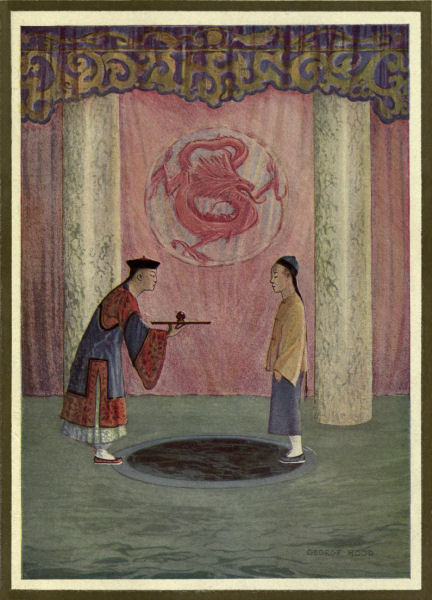
Tsian Tang holds out the platter

“TSIAN TANG BROUGHT OUT A PLATTER OF RED AMBER ON WHICH LAY A CARBUNCLE.”

Then the king was alarmed and said: “What the fickle boy did was not to be endured, it is true. But [157] still you were a little too rough with him; in future you must not do anything of the sort again.” And Tsian Tang promised not to.

That evening Liu I was feasted at the castle. Music and dancing lent charm to the banquet. A thousand warriors with banners and spears in their hands stood at attention. Trombones and trumpets resounded, and drums and kettledrums thundered and rattled as the warriors danced a war-dance. The music expressed how Tsian Tang had broken through the ranks of the enemy, and the hair of the guest who listened to it rose on his head in terror. Then, again, there was heard the music of strings, flutes and little golden bells. A thousand maidens in crimson and green silk danced around. The return of the princess was also told in tones. The music sounded like a song of sadness and plaining, and all who heard it were moved to tears. The King of the Sea of Dungting was filled with joy. He raised his goblet and drank to the health of his guest, and all sorrow departed from them. Both rulers thanked Liu I in verses, and Liu I answered them in a rimed toast. The crowd of courtiers in the palace-hall applauded. Then the King of the Sea of Dungting drew forth a blue cloud-casket in which was the horn of a rhinoceros, which divides the water. Tsian Tang brought out a platter of red amber on which lay a carbuncle. These they presented to their guest, and the other inmates of the palace also heaped up embroideries, brocades and pearls by his side. Surrounded by shimmer and light Liu I sat there, smiling, and bowed his thanks to all sides. When the banquet was ended he slept in the Palace of Frozen Radiance.

On the following day another banquet was held. Tsian Tang, who was not quite himself, sat carelessly on his seat and said: “The Princess of the Dungting Sea is handsome and delicately fashioned. She has had the misfortune to be disowned by her husband, and to-day her marriage is annulled. I should like to find another husband for her. If you were agreeable it would be to your advantage. But if you were not willing to marry her, you may go your way, and should we ever meet again we will not know each other.”

Liu I was angered by the careless way in which Tsian Tang spoke to him. The blood rose to his head and he replied: “I served as a messenger, because I felt sorry for the princess, but not in order to gain an advantage for myself. To kill a husband and carry off a wife is something an honest man does not do. And since I am only an ordinary man, I prefer to die rather than do as you say.”

Tsian Tang rose, apologized and said: “My words were over-hasty. I hope you will not take them ill!” And the King of the Dungting Sea also spoke kindly to him, and censured Tsian Tang because of his rude speech. So there was no more said about marriage.

On the following day Liu I took his leave, and the Queen of the Dungting Sea gave a farewell banquet in his honor.

With tears the queen said to Liu I: “My daughter owes you a great debt of gratitude, and we have not had an opportunity to make it up to you. Now you are going away and we see you go with heavy hearts!”

Then she ordered the princess to thank Liu I.

The princess stood there, blushing, bowed to him and said: “We will probably never see each other again!” Then tears choked her voice.

It is true that Liu I had resisted the stormy urging of her uncle, but when he saw the princess standing before him in all the charm of her loveliness, he felt sad at heart; yet he controlled himself and went his way. The treasures which he took with him were incalculable. The king and his brother themselves escorted him as far as the river.

When, on his return home, he sold no more than a hundredth part of what he had received, his fortune already ran into the millions, and he was wealthier than all his neighbors. He decided to take a wife, and heard of a widow who lived in the North with her daughter. Her father had become a Taoist in his later years and had vanished in the clouds without ever returning. The mother lived in poverty with the daughter; yet since the girl was beautiful beyond measure she was seeking a distinguished husband for her.

Liu I was content to take her, and the day of the wedding was set. And when he saw his bride unveiled on the evening of her wedding day, she looked just like the dragon-princess. He asked her about it, but she merely smiled and said nothing.

After a time heaven sent them a son. Then she told her husband: “To-day I will confess to you that I am truly the Princess of Dungting Sea. When you had rejected my uncle’s proposal and gone away, I fell ill of longing, and was near death. My parents wanted to send for you, but they feared you might take exception to my family. And so it was that I married you disguised as a human maiden. I had not ventured to tell you until now, but since heaven has sent us a son, I hope that you will love his mother as well.”

Then Liu I awoke as though from a deep sleep, and from that time on both were very fond of each other.

One day his wife said: “If you wish to stay with me eternally, then we cannot continue to dwell in the world of men. We dragons live ten thousand years, and you shall share our longevity. Come back with me to the Sea of Dungting!”

Ten years passed and no one knew where Liu I, who had disappeared, might be. Then, by accident, a relative went sailing across the Sea of Dungting. Suddenly a blue mountain rose up out of the water.

The seamen cried in alarm: “There is no mountain on this spot! It must be a water-demon!”

While they were still pointing to it and talking, the mountain drew near the ship, and a gaily-colored boat slid from its summit into the water. A man sat in the middle, and fairies stood at either side of him. The man was Liu I. He beckoned to his cousin, and the latter drew up his garments and stepped into the boat with him. But when he had entered the boat it turned into a mountain. On the mountain stood a splendid castle, and in the castle stood Liu I, surrounded with radiance, and with the music of stringed instruments floating about him.

They greeted each other, and Liu I said to his cousin: “We have been parted no more than a moment, and your hair is already gray!”

His cousin answered: “You are a god and blessed: I have only a mortal body. Thus fate has decreed.”

Then Liu I gave him fifty pills and said: “Each pill will extend your life for the space of a year. When you have lived the tale of these years, come to me and dwell no longer in the earthly world of dust, where there is nothing but toil and trouble.”

Then he took him back across the sea and disappeared.

His cousin, however, retired from the world, and fifty years later, and when he had taken all the pills, he disappeared and was never seen again.

Note: The outcast princess is represented as “herding sheep.” In Chinese the word sheep is often used as an image for clouds. (Sheep and goats are designated by the same word in Chinese.) Tsian Tang is the name of a place used for the name of the god of that place. The deluge is the flood which the great Yu regulated as minister of the Emperor Yau. It is here represented in an exaggerated sense, as a deluge.

****

Like many literary and older stories, I might simplify telling this story getting to the essence of dragons and their society as seen by Chinese of long ago.  Dragons were so commonly a part of their thinking that when early paleontologists sought dinosaur bones, people took them to "dragon bones."  Dragons in Asia are identified with the weather and especially water.  Other aspects also show in this tale, along with my mentioning dragon society was a parallel of the imperial Chinese royal family.  This means it would show how a princess in an unsuccessful marriage might be rescued.

With Valentine's Day also this past week, it's an interesting romantic tale for teens and adults without getting too "mushy."

**********************

This is part of a series of postings of stories under the category, "Keeping the Public in Public Domain."  The idea behind Public Domain was to preserve our cultural heritage after the authors and their immediate heirs were compensated.  I feel strongly current copyright law delays this intent on works of the 20th century.  My own library of folklore includes so many books within the Public Domain I decided to share stories from them.  I hope you enjoy discovering new stories.  


At the same time, my own involvement in storytelling regularly creates projects requiring research as part of my sharing stories with an audience.  Whenever that research needs to be shown here, the publishing of Public Domain stories will not occur that week.  This is a return to my regular posting of a research project here.  (Don't worry, this isn't dry research, my research is always geared towards future storytelling to an audience.)  Response has convinced me that "Keeping the Public in Public Domain" should continue along with my other postings as often as I can manage it.

Other Public Domain story resources I recommend-

  • There are many online resources for Public Domain stories, maybe none for folklore is as ambitious as fellow storyteller, Yoel Perez's database, Yashpeh, the International Folktales Collection.  I have long recommended it and continue to do so.  He has loaded Stith Thompson's Motif Index into his server as a database so you can search the whole 6 volumes for whatever word or expression you like by pressing one key. http://folkmasa.org/motiv/motif.htm

  • You may have noticed I'm no longer certain Dr. Perez has the largest database, although his offering the Motif Index certainly qualifies for those of us seeking specific types of stories.  There's another site, FairyTalez claiming to be the largest, with "over 2000 fairy tales, folktales, and fables" and they are "fully optimized for phones, tablets, and PCs", free and presented without ads.
    Between those two sites, there is much for story-lovers, but as they say in infomercials, "Wait, there's more!"

The email list for storytellers, Storytell, discussed Online Story Sources and came up with these additional suggestions:        

         - David K. Brown - http://people.ucalgary.ca/~dkbrown/stories.html

         - Richard Martin - http://www.tellatale.eu/tales_page.html

         - Spirit of Trees - http://spiritoftrees.org/featured-folktales

         - Story-Lovers - http://www.story-lovers.com/ is now only accessible through the Wayback Machine, described below, but the late Jackie Baldwin's wonderful site lives on there, fully searchable manually (the Google search doesn't work), at https://archive.org/ .  It's not easy, but go to Story-lovers.com snapshot for December 22 2016  and you can click on SOS: Searching Out Stories to scroll down through the many story topics and click on the story topic that interests you.

       - World of Tales - http://www.worldoftales.com/ 

 
           - Zalka Csenge Virag - http://multicoloreddiary.blogspot.com doesn't give the actual stories, but her recommendations, working her way through each country on a continent, give excellent ideas for finding new books and stories to love and tell.

     
You're going to find many of the links on these sites have gone down, BUT go to the Internet Archive Wayback Machine to find some of these old links.  Tim's site, for example, is so huge probably updating it would be a full-time job.  In the case of Story-Lovers, it's great that Jackie Baldwin set it up to stay online as long as it did after she could no longer maintain it.  Possibly searches maintained it.  Unfortunately Storytell list member, Papa Joe is on both Tim Sheppard's site and Story-Lovers, but he no longer maintains his old Papa Joe's Traveling Storytelling Show website and his Library (something you want to see!) is now only on the Wayback Machine.  It took some patience working back through claims of snapshots but finally in December of 2006 it appears!

    Somebody as of this writing whose stories can still be found by his website is the late Chuck Larkin - http://chucklarkin.com/stories.html.  I prefer to list these sites by their complete address so they can be found by the Wayback Machine, a.k.a. Archive.org, when that becomes the only way to find them.

You can see why I recommend these to you. 

Have fun discovering even more stories

Friday, June 11, 2021

Chrisman - Ah Tcha the Sleeper - Keeping the Public in Public Domain

Arthur Bowie Chrisman won the Newbery medal with his book Shen of the Sea "for the most distinguished contribution to American Children's literature during the year 1925."  Today's critical opinion, however, wouldn't agree.  Modern opinion on Goodreads.com complains about the book's lack of Chinese authenticity and potential racism.  One thing I want people to note is the publisher gave the book cover the subtitle of "Chinese Stories for Children" but the actual title page simply gives a subtitle of "A Book for Children" along with crediting Else Hasselriis for her many silhouettes illustrating the book.  There's no claim anywhere that the author was presenting stories from Chinese folklore.  The stories should stand on their own as the creative work of a man who never traveled to China, but was fascinated with it.  Yes, as one reader, Miz Lizzie, who is a folklorist on Goodreads said, "It's about as authentic as 'The Mikado' (also regarded as 'authentic' at the time)."  She and some other readers further point out the better route would have been to say it was inspired by China and also to be aware of the knowledge and time when it was written.  Often it is suggested by the readers that the book's stories are best read aloud.  Today's story I know was particularly popular on lists of stories recommended by librarian-storytellers in the early half of the 20th century.  That along with a connection with St. Louis, Missouri and this past week lead me to present it.  You decide if you would tell it as NOT authentic folklore, but created by a man who clearly loved a land he had never seen.  (I'll say more about St. Louis & this past week afterwards.)


AH TCHA THE SLEEPER

Years ago, in southern China, lived a boy, Ah Tcha by name. Ah Tcha was an orphan, but not according to rule. A most peculiar orphan was he. It is usual for orphans to be very, very poor. That is the world-wide custom. Ah Tcha, on the contrary, was quite wealthy. He owned seven farms, with seven times seven horses to draw the plow. He owned seven mills, with plenty of breezes to spin them. Furthermore, he owned seven thousand pieces of gold, and a fine white cat.

The farms of Ah Tcha were fertile, were wide. His horses were brisk in the furrow. His mills never lacked for grain, nor wanted for wind. And his gold was good sharp gold, with not so much as a trace of copper. Surely, few orphans have been better provided for than the youth named Ah Tcha. And what a busy person was this Ah Tcha. His bed was always cold when the sun arose. Early in the morning he went from field to field, from mill to mill, urging on the people who worked for him. The setting sun always found him on his feet, hastening from here to there, persuading his laborers to more gainful efforts. And the moon of midnight often discovered him pushing up and down the little teak-wood balls of a counting board, or else threading cash, placing coins upon a string. Eight farms, nine farms he owned, and more stout horses. Ten mills, eleven, another white cat. It was Ah Tcha’s ambition to become the richest person in the world.

They who worked for the wealthy orphan were inclined now and then to grumble. Their pay was not beggarly, but how they did toil to earn that pay which was not beggarly. It was go, and go, and go. Said the ancient woman Nu Wu, who worked with a rake in the field: “Our master drives us as if he were a fox and we were hares in the open. Round the field and round and round, hurry, always hurry.” Said Hu Shu, her husband, who bound the grain into sheaves: “Not hares, but horses. We are driven like the horses of Lung Kuan, who . . .” It’s a long story.

But Ah Tcha, approaching the murmurers, said, “Pray be so good as to hurry, most excellent Nu Wu, for the clouds gather blackly, with thunder.” And to the scowling husband he said, “Speed your work, I beg you, honorable Hu Shu, for the grain must be under shelter before the smoke of Evening Rice ascends.”

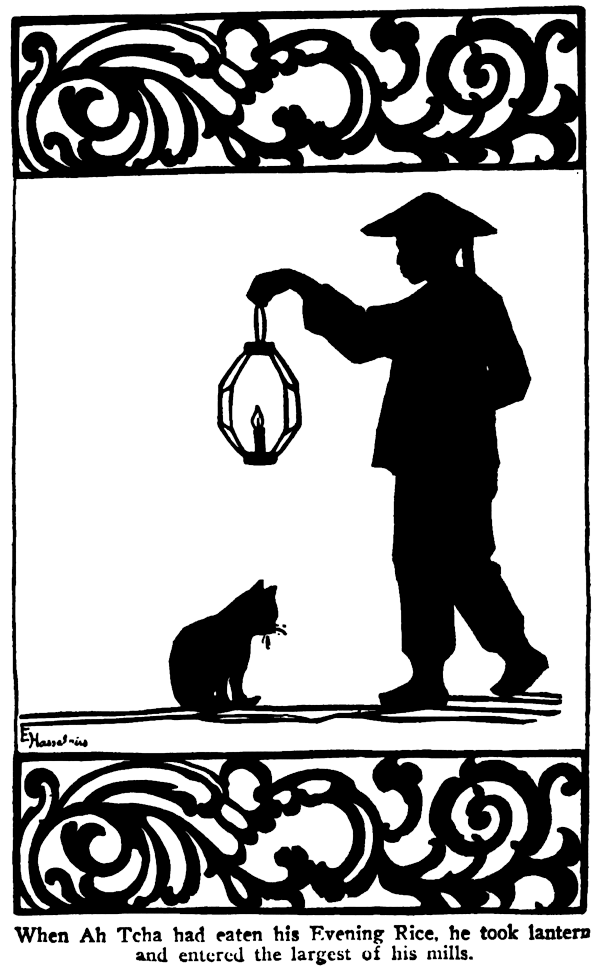
When Ah Tcha had eaten his Evening Rice, he took lantern and entered the largest of his mills. A scampering rat drew his attention to the floor. There he beheld no less than a score of rats, some gazing at him as if undecided whether to flee or continue the feast, others gnawing—and who are you, nibbling and caring not? And only a few short whisker-lengths away sat an enormous cat, sleeping the sleep of a mossy stone. The cat was black in color, black as a crow’s wing dipped in pitch, upon a night of inky darkness. That describes her coat. Her face was somewhat more black. Ah Tcha had never before seen her. She was not his cat. But his or not, he thought it a trifle unreasonable of her to sleep, while the rats held high carnival. The rats romped between her paws. Still she slept. It angered Ah Tcha. The lantern rays fell on her eyes. Still she slept. Ah Tcha grew more and more provoked. He decided then and there to teach the cat that his mill was no place for sleepy heads.

Accordingly, he seized an empty grain sack and hurled it with such exact aim that the cat was sent heels over head. “There, old Crouch-by-the-hole,” said Ah Tcha in a tone of wrath. “Remember your paining ear, and be more vigilant.” But the cat had no sooner regained her feet than she changed into . . . Nu Wu . . . changed into Nu Wu, the old woman who worked in the fields . . . a witch. What business she had in the mill is a puzzle. However, it is undoubtedly true that mills hold grain, and grain is worth money. And that may be an explanation. Her sleepiness is no puzzle at all. No wonder she was sleepy, after working so hard in the field, the day’s length through.

The anger of Nu Wu was fierce and instant. She wagged a crooked finger at Ah Tcha, screeching: “Oh, you cruel money-grubber. Because you fear the rats will eat a pennyworth of grain you must beat me with bludgeons. You make me work like a slave all day—and wish me to work all night. You beat me and disturb my slumber. Very well, since you will not let me sleep, I shall cause you to slumber eleven hours out of every dozen. . . . Close your eyes.” She swept her wrinkled hand across Ah Tcha’s face. Again taking the form of a cat, she bounded downstairs.

She had scarce reached the third step descending when Ah Tcha felt a compelling desire for sleep. It was as if he had taken gum of the white poppy flower, as if he had tasted honey of the gray moon blossom. Eyes half closed, he stumbled into a grain bin. His knees doubled beneath him. Down he went, curled like a dormouse. Like a dormouse he slumbered.

From that hour began a change in Ah Tcha’s fortune. The spell gripped him fast. Nine-tenths of his time was spent in sleep. Unable to watch over his laborers, they worked when they pleased, which was seldom. They idled when so inclined—and that was often, and long. Furthermore, they stole in a manner most shameful. Ah Tcha’s mills became empty of grain. His fields lost their fertility. His horses disappeared—strayed, so it was said. Worse yet, the unfortunate fellow was summoned to a magistrate’s yamen, there to defend himself in a lawsuit. A neighbor declared that Ah Tcha’s huge black cat had devoured many chickens. There were witnesses who swore to the deed. They were sure, one and all, that Ah Tcha’s black cat was the cat at fault. Ah Tcha was sleeping too soundly to deny that the cat was his. . . . So the magistrate could do nothing less than make the cat’s owner pay damages, with all costs of the lawsuit.

Thereafter, trials at court were a daily occurrence. A second neighbor said that Ah Tcha’s black cat had stolen a flock of sheep. Another complained that the cat had thieved from him a herd of fattened bullocks. Worse and worse grew the charges. And no matter how absurd, Ah Tcha, sleeping in the prisoner’s cage, always lost and had to pay damages. His money soon passed into other hands. His mills were taken from him. His farms went to pay for the lawsuits. Of all his wide lands, there remained only one little acre—and it was grown up in worthless bushes. Of all his goodly buildings, there was left one little hut, where the boy spent most of his time, in witch-imposed slumber.

Now, near by in the mountain of Huge Rocks Piled, lived a greatly ferocious loong, or, as foreigners would say, a dragon. This immense beast, from tip of forked tongue to the end of his shadow, was far longer than a barn. With the exception of length, he was much the same as any other loong. His head was shaped like that of a camel. His horns were deer horns. He had bulging rabbit eyes, a snake neck. Upon his many ponderous feet were tiger claws, and the feet were shaped very like sofa cushions. He had walrus whiskers, and a breath of red-and-blue flame. His voice was like the sound of a hundred brass kettles pounded. Black fish scales covered his body, black feathers grew upon his limbs. Because of his color he was sometimes called Oo Loong. From that it would seem that Oo means neither white nor pink.

The black loong was not regarded with any great esteem. His habit of eating a man—two men if they were little—every day made him rather unpopular. Fortunately, he prowled only at night. Those folk who went to bed decently at nine o’clock had nothing to fear. Those who rambled well along toward midnight, often disappeared with a sudden and complete thoroughness.

As every one knows, cats are much given to night skulking. The witch cat, Nu Wu, was no exception. Midnight often found her miles afield. On such a midnight, when she was roving in the form of a hag, what should approach but the black dragon. Instantly the loong scented prey, and instantly he made for the old witch.

There followed such a chase as never was before on land or sea. Up hill and down dale, by stream and wood and fallow, the cat woman flew and the dragon coursed after. The witch soon failed of breath. She panted. She wheezed. She stumbled on a bramble and a claw slashed through her garments. Too close for comfort. The harried witch changed shape to a cat, and bounded off afresh, half a li at every leap. The loong increased his pace and soon was close behind, gaining. For a most peculiar fact about the loong is that the more he runs the easier his breath comes, and the swifter grows his speed. Hence, it is not surprising that his fiery breath was presently singeing the witch cat’s back.

In a twinkling the cat altered form once more, and as an old hag scuttled across a turnip field. She was merely an ordinarily powerful witch. She possessed only the two forms—cat and hag. Nor did she have a gift of magic to baffle or cripple the hungry black loong. Nevertheless, the witch was not despairing. At the edge of the turnip field lay Ah Tcha’s miserable patch of thick bushes. So thick were the bushes as to be almost a wall against the hag’s passage. As a hag, she could have no hope of entering such a thicket. But as a cat, she could race through without hindrance. And the dragon would be sadly bothered in following. Scheming thus, the witch dashed under the bushes—a cat once more.

Ah Tcha was roused from slumber by the most outrageous noise that had ever assailed his ears. There was such a snapping of bushes, such an awful bellowed screeching that even the dead of a century must have heard. The usually sound-sleeping Ah Tcha was awakened at the outset. He soon realized how matters stood—or ran. Luckily, he had learned of the only reliable method for frightening off the dragon. He opened his door and hurled a red, a green, and a yellow firecracker in the monster’s path.

In through his barely opened door the witch cat dragged her exhausted self. “I don’t see why you couldn’t open the door sooner,” she scolded, changing into a hag. “I circled the hut three times before you had the gumption to let me in.”

“I am very sorry, good mother. I was asleep.” From Ah Tcha.

“Well, don’t be so sleepy again,” scowled the witch, “or I’ll make you suffer. Get me food and drink.”

“Again, honored lady, I am sorry. So poor am I that I have only water for drink. My food is the leaves and roots of bushes.”

“No matter. Get what you have—and quickly.”

Ah Tcha reached outside the door and stripped a handful of leaves from a bush. He plunged the leaves into a kettle of hot water and signified that the meal was prepared. Then he lay down to doze, for he had been awake fully half a dozen minutes and the desire to sleep was returning stronger every moment.

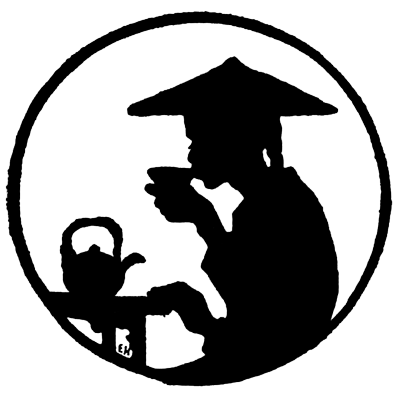
The witch soon supped and departed, without leaving so much as half a “Thank you.” When Ah Tcha awoke again, his visitor was gone. The poor boy flung another handful of leaves into his kettle and drank quickly. He had good reason for haste. Several times he had fallen asleep with the cup at his lips—a most unpleasant situation, and scalding. Having taken several sips, Ah Tcha stretched him out for a resumption of his slumber. Five minutes passed . . . ten minutes . . . fifteen. . . . Still his eyes failed to close. He took a few more sips from the cup and felt more awake than ever.

“I do believe,” said Ah Tcha, “that she has thanked me by bewitching my bushes. She has charmed the leaves to drive away my sleepiness.”

And so she had. Whenever Ah Tcha felt tired and sleepy—and at first that was often—he had only to drink of the bewitched leaves. At once his drowsiness departed. His neighbors soon learned of the bushes that banished sleep. They came to drink of the magic brew. There grew such a demand that Ah Tcha decided to set a price on the leaves. Still the demand continued. More bushes were planted. Money came.

Throughout the province people called for “the drink of Ah Tcha.” In time they shortened it by asking for “Ah Tcha’s drink,” then for “Tcha’s drink,” and finally for “Tcha.”

And that is its name at present, “Tcha,” or “Tay,” or “Tea,” as some call it. And one kind of Tea is still called “Oo Loong”—“Black Dragon.”

***********
I noticed Chrisman knew enough Chinese words to call a dragon a "Loong ."  I've also seen it as a "Lung", but that transliteration would have people thinking of the English word "lung."  He opened with the main character using an abacus and that Chinese coins had a hole in the center for stringing together.  I don't have an abacus to show, but do have some of those coins with a hole to illustrate his greedy start.  While the author's concerns may appear critical of the Chinese, surely greed and overbearing bosses are common everywhere and throughout the ages.

So why do I mention St. Louis?  

This past week, on June 10, I heard was "Iced Tea Day" and the story told by the radio announcer was it dates back to the 1904 St. Louis World's Fair.  Supposedly a hot day led to the invention of pouring it over ice.  It turns out this is one of many stories about as accurate as Chrisman.  Iced Tea is one of many St. Louis World's Fair food stories debunked on SeriousEats which says: 
If you believe the popular tales, more new American foods were invented at the 1904 World's Fair in St. Louis, Missouri, than during any other single event in history. The list includes the hamburger, the hot dog, peanut butter, iced tea, the club sandwich, cotton candy, and the ice cream cone, to name just a few. If all the pop histories and internet stories have it right, American foodways would be almost unrecognizable if the 1904 fair had not been held.


That picture from the Library of Congress collection shows it as the 1904 Louisiana Purchase Exposition, which is the official name.  The link takes you to a Wikipedia article with a wonderful section on the "Legacy" from the event.  Yes, it, too, talks about the food, but being born and growing up in St. Louis it was the buildings, originally expected to be temporary, that remain important to me.  I didn't realize the administration building for Washington University in St. Louis was a fair building.  Some of the fair's "legacy" went to other locations, but a separate article on Forest Park, where the fair was held, tells even more about that legacy.  Yes, I learned things in both articles as I grew up close enough to hear the Zoo's lions and tigers on an early morning before traffic drowned them out.  I remembered the aviary cage you could walk through dating back to the Exposition.  The park's buildings and other features include some I erroneously attributed to the fair, such as the Jewel Box and its Floral Clock (built in the 1930s and the clock is a memorial to Korean War military dead).  Some were correct, such as the waterfall known as The Cascades where I'm in a family picture dating back to my preschool years.  One of those correct, is the Art Museum.  I loved it so much I often saved lunch and bus money to buy art postcards there.  Instead I said goodbye to the statue out front of the Apotheosis of St. Louis before starting the long hike home.  I didn't know it was a bronze replica of a plaster statue at the fair -- nor the lawsuit by the original statue's sculptor (copyright issues even in 1906!).  It was indeed presented by the Exposition in remembrance of the fair.  I also didn't know things like the Exposition's "Bullfight Riot" and forgot the statue of King Louis IX, the namesake of the city, has had his sword stolen so often it's "considered a rite of passage for students in the engineering program at nearby Washington University."

It was for me a landmark deserving that "goodbye...before starting the long hike home."  Thank you for joining me on this trip back in time.

Charles Niehaus - http://en.wikipedia.org/wiki/Image:Apotheosis-of-saint-louis.jpg https://www.flickr.com/photos/cfaulkingham/19384712/
******************
This is part of a series of postings of stories under the category, "Keeping the Public in Public Domain."  The idea behind Public Domain was to preserve our cultural heritage after the authors and their immediate heirs were compensated.  I feel strongly current copyright law delays this intent on works of the 20th century.  My own library of folklore includes so many books within the Public Domain I decided to share stories from them.  I hope you enjoy discovering new stories.  


At the same time, my own involvement in storytelling regularly creates projects requiring research as part of my sharing stories with an audience.  Whenever that research needs to be shown here, the publishing of Public Domain stories will not occur that week.  This is a return to my regular posting of a research project here.  (Don't worry, this isn't dry research, my research is always geared towards future storytelling to an audience.)  Response has convinced me that "Keeping the Public in Public Domain" should continue along with my other postings as often as I can manage it.
Other Public Domain story resources I recommend-
  • There are many online resources for Public Domain stories, maybe none for folklore is as ambitious as fellow storyteller, Yoel Perez's database, Yashpeh, the International Folktales Collection.  I have long recommended it and continue to do so.  He has loaded Stith Thompson's Motif Index into his server as a database so you can search the whole 6 volumes for whatever word or expression you like by pressing one key. http://folkmasa.org/motiv/motif.htm
  • You may have noticed I'm no longer certain Dr. Perez has the largest database, although his offering the Motif Index certainly qualifies for those of us seeking specific types of stories.  There's another site, FairyTalez claiming to be the largest, with "over 2000 fairy tales, folktales, and fables" and they are "fully optimized for phones, tablets, and PCs", free and presented without ads.

    Between those two sites, there is much for story-lovers, but as they say in infomercials, "Wait, there's more!"
The email list for storytellers, Storytell, discussed Online Story Sources and came up with these additional suggestions:            
         - David K. Brown - http://people.ucalgary.ca/~dkbrown/stories.html
         - Richard Martin - http://www.tellatale.eu/tales_page.html
         - Spirit of Trees - http://spiritoftrees.org/featured-folktales
         - Story-Lovers - http://www.story-lovers.com/ is now only accessible through the Wayback Machine, described below, but the late Jackie Baldwin's wonderful site lives on there, fully searchable manually (the Google search doesn't work), at https://archive.org/ .  It's not easy, but go to Story-lovers.com snapshot for October 22 2016  and you can click on SOS: Searching Out Stories to scroll down through the many story topics and click on the story topic that interests you.
       - World of Tales - http://www.worldoftales.com/ 
           - Zalka Csenge Virag - http://multicoloreddiary.blogspot.com doesn't give the actual stories, but her recommendations, working her way through each country on a continent, give excellent ideas for finding new books and stories to love and tell.
     
You're going to find many of the links on these sites have gone down, BUT go to the Internet Archive Wayback Machine to find some of these old links.  Tim's site, for example, is so huge probably updating it would be a full-time job.  In the case of Story-Lovers, it's great that Jackie Baldwin set it up to stay online as long as it did after she could no longer maintain it.  Possibly searches maintained it.  Unfortunately Storytell list member, Papa Joe is on both Tim Sheppard's site and Story-Lovers, but he no longer maintains his old Papa Joe's Traveling Storytelling Show website and his Library (something you want to see!) is now only on the Wayback Machine.  It took some patience working back through claims of snapshots but finally in December of 2006 it appears!
    Somebody as of this writing whose stories can still be found by his website is the late Chuck Larkin - http://chucklarkin.com/stories.html.  I prefer to list these sites by their complete address so they can be found by the Wayback Machine, a.k.a. Archive.org, when that becomes the only way to find them.
You can see why I recommend these to you. Have fun discovering even more stories!


Saturday, February 29, 2020

Stead - The Feast of the Lanterns - Keeping the Public in Public Domain

 
Great lantern photos at Flickr with Creative Commons photos by Anyar Changtong.

I've heard January 29th called "The Impossible Day."  When I started thinking about it I remembered people born on it have birthdays that really only happen every four years, although I imagine they celebrate on either the day before or after on non-Leap Years.  While it might seem eventually wonderful to eliminate 3/4 of your years, it got me thinking about the many stories where someone unknowingly stays young while their family at home ages.  It's a common theme from Rip Van Winkle to the Irish tales of Tir Na Nog, or tales of going to kingdoms under the sea, and I think I've found the perfect one.

Today's story was in the 1909 Tales of Wonder Every Child Should Know edited by Nora A. Smith and Kate D. Wiggin, but it's only in the publishers' acknowledgements that we discover the story was found in the British book Books for the Bairns by W.T. Stead.  The Table of Contents identifies the story as being Chinese.  Not having the book available, I can't check to see how, if at all, they might have adapted it from Stead's story nor if any other attribution occurred in the British book.  I can only presume the story is derived from Chinese folklore.  Tales of Wonder Every Child Should Know is the fourth and last of Smith and Wiggin's excellent Fairy Series which each earlier had slightly different emphasis in The Fairy Ring, Magic Casements, and Tales of Laughter.

My own copy is a paperback reprint, so to save its binding I'm reprinting the Project Gutenberg.org copy of the story, reformatting it to match the original, but that link would let you enjoy the whole book.  All but Magic Casements can be found on Project Gutenberg.  I'm not sure how they missed it, but you still can read that book online, too, at the Internet Archive.  The sister team of Smith and Wiggin brought stories everyone, regardless of age, should know.

There are indeed Feasts of Lanterns, both in Asia and in the U.S.  I'll put a little bit about that after the story.

The Feast of the Lanterns

Wang Chih was only a poor man, but he had a wife and children to love, and they made him so happy that he would not have changed places with the Emperor himself.

He worked in the fields all day, and at night his wife always had a bowl of rice ready for his supper. And sometimes, for a treat, she made him some bean soup, or gave him a little dish of fried pork.

But they could not afford pork very often; he generally had to be content with rice.

One morning, as he was setting off to his work, his wife sent Han Chung, his son, running after him to ask him to bring home some firewood.

"I shall have to go up into the mountain for it at noon," he said. "Go and bring me my axe, Han Chung."

Han Chung ran for his father's axe, and Ho-Seen-Ko, his little sister, came out of the cottage with him.

"Remember it is the Feast of Lanterns to-night, father," she said. "Don't fall asleep up on the mountain; we want you to come back and light them for us."

She had a lantern in the shape of a fish, painted red and black and yellow, and Han Chung had got a big round one, all bright crimson, to carry in the procession; and, besides that, there were two large lanterns to be hung outside the cottage door as soon at it grew dark.

Wang Chih was not likely to forget the Feast of Lanterns, for the children had talked of nothing else for a month, and he promised to come home as early as he could.

At noontide, when his fellow-labourers gave up working, and sat down to rest and eat, Wang Chih took his axe and went up the mountain slope to find a small tree he might cut down for fuel.

He walked a long way, and at last saw one growing at the mouth of a cave.

"This will be just the thing," he said to himself. But, before striking the first blow, he peeped into the cave to see if it were empty.

To his surprise, two old men, with long, white beards, were sitting inside playing chess, as quietly as mice, with their eyes fixed on the chessboard.

Wang Chih knew something of chess, and he stepped in and watched them for a few minutes.

"As soon as they look up I can ask them if I may chop down a tree," he said to himself. But they did not look up, and by and by Wang Chih got so interested in the game that he put down his axe, and sat on the floor to watch it better.

The two old men sat cross-legged on the ground, and the chessboard rested on a slab, like a stone table, between them.

On one corner of the slab lay a heap of small, brown objects which Wang Chih took at first to be date stones; but after a time the chess-players ate one each, and put one in Wang Chih's mouth; and he found it was not a date stone at all.

It was a delicious kind of sweetmeat, the like of which he had never tasted before; and the strangest thing about it was that it took his hunger and thirst away.

He had been both hungry and thirsty when he came into the cave, as he had not waited to have his midday meal with the other field-workers; but now he felt quite comforted and refreshed.

He sat there some time longer, and noticed that as the old men frowned over the chessboard, their beards grew longer and longer, until they swept the floor of the cave, and even found their way out of the door.

"I hope my beard will never grow as quickly," said Wang Chih, as he rose and took up his axe again.

Then one of the old men spoke, for the first time. "Our beards have not grown quickly, young man. How long is it since you came here?"

"About half an hour, I dare say," replied Wang Chih. But as he spoke, the axe crumbled to dust beneath his fingers, and the second chess-player laughed, and pointed to the little brown sweetmeats on the table.

"Half an hour, or half a century—aye, half a thousand years, are all alike to him who tastes of these. Go down into your village and see what has happened since you left it."

So Wang Chih went down as quickly as he could from the mountain, and found the fields where he had worked covered with houses, and a busy town where his own little village had been. In vain he looked for his house, his wife, and his children.

There were strange faces everywhere; and although when evening came the Feast of Lanterns was being held once more, there was no Ho-Seen-Ko carrying her red and yellow fish, or Han Chung with his flaming red ball.

At last he found a woman, a very, very old woman, who told him that when she was a tiny girl she remembered her grandmother saying how, when she was a tiny girl, a poor young man had been spirited away by the Genii of the mountains, on the day of the Feast of Lanterns, leaving his wife and little children with only a few handfuls of rice in the house.

"Moreover, if you wait while the procession passes, you will see two children dressed to represent Han Chung and Ho-Seen-Ko, and their mother carrying the empty rice-bowl between them; for this is done every year to remind people to take care of the widow and fatherless," she said. So Wang Chih waited in the street; and in a little while the procession came to an end; and the last three figures in it were a boy and a girl, dressed like his own two children, walking on either side of a young woman carrying a rice-bowl. But she was not like his wife in anything but her dress, and the children were not at all like Han Chung and Ho-Seen-Ko; and poor Wang Chih's heart was very heavy as he walked away out of the town.

He slept out on the mountain, and early in the morning found his way back to the cave where the two old men were playing chess.

At first they said they could do nothing for him, and told him to go away and not disturb them; but Wang Chih would not go, and they soon found the only way to get rid of him was to give him some really good advice.

"You must go to the White Hare of the Moon, and ask him for a bottle of the elixir of life. If you drink that you will live forever," said one of them.

"But I don't want to live forever," objected Wang Chih. "I wish to go back and live in the days when my wife and children were here."

"Ah, well! For that you must mix the elixir of life with some water out of the sky-dragon's mouth."

"And where is the sky-dragon to be found?" inquired Wang Chih.

"In the sky, of course. You really ask very stupid questions. He lives in a cloud-cave. And when he comes out of it he breathes fire, and sometimes water. If he is breathing fire you will be burnt up, but if it is only water, you will easily be able to catch some in a little bottle. What else do you want?"

For Wang Chih still lingered at the mouth of the cave.

"I want a pair of wings to fly with, and a bottle to catch the water in," he replied boldly.

So they gave him a little bottle; and before he had time to say "Thank you!" a white crane came sailing past, and lighted on the ground close to the cave.

"The crane will take you wherever you like," said the old men. "Go now, and leave us in peace."

So Wang Chih sat on the white crane's back, and was taken up, and up, and up through the sky to the cloud-cave where the sky-dragon lived. And the dragon had the head of a camel, the horns of a deer, the eyes of a rabbit, the ears of a cow and the claws of a hawk.

Besides this, he had whiskers and a beard, and in his beard was a bright pearl.

All these things show that he was a real, genuine dragon, and if you ever meet a dragon who is not exactly like this, you will know he is only a make-believe one.

Wang Chih felt rather frightened when he perceived the cave in the distance, and if it had not been for the thought of seeing his wife again, and his little boy and girl, he would have been glad to turn back.

While he was far away the cloud-cave looked like a dark hole in the midst of a soft, white, woolly mass, such as one sees in the sky on an April day; but as he came nearer he found the cloud was as hard as a rock, and covered with a kind of dry, white grass.

When he got there, he sat down on a tuft of grass near the cave, and considered what he should do next.

The first thing was, of course, to bring the dragon out, and the next to make him breathe water instead of fire.

"I have it!" cried Wang Chih at last; and he nodded his head so many times that the white crane expected to see it fall off.

He struck a light, and set the grass on fire, and it was so dry that the flames spread all around the entrance to the cave, and made such a smoke and crackling that the sky-dragon put his head out to see what was the matter.

"Ho! ho!" cried the dragon, when he saw what Wang Chih had done, "I can soon put this to rights." And he breathed once, and the water came out his nose and mouth in three streams.

But this was not enough to put the fire out. Then he breathed twice, and the water came out in three mighty rivers, and Wang Chih, who had taken care to fill his bottle when the first stream began to flow, sailed away on the white crane's back as fast as he could, to escape being drowned.

The rivers poured over the cloud rock, until there was not a spark left alight, and rushed down through the sky into the sea below.

Fortunately, the sea lay right underneath the dragon's cave, or he would have done some nice mischief. As it was, the people on the coast looked out across the water toward Japan, and saw three inky-black clouds stretching from the sky into the sea.

"My word! There is a fine rain-storm out at sea!" they said to each other.

But, of course, it was nothing of the kind; it was only the sky-dragon putting out the fire Wang Chih had kindled.

Meanwhile, Wang Chih was on his way to the moon, and when he got there he went straight to the hut where the Hare of the Moon lived, and knocked at the door.

The Hare was busy pounding the drugs which make up the elixir of life; but he left his work, and opened the door, and invited Wang Chih to come in.

He was not ugly, like the dragon; his fur was quite white and soft and glossy, and he had lovely, gentle brown eyes.

The Hare of the Moon lives a thousand years, as you know, and when he is five hundred years old he changes his colour, from brown to white, and becomes, if possible, better tempered and nicer than he was before.

As soon as he heard what Wang Chih wanted, he opened two windows at the back of the hut, and told him to look through each of them in turn.

"Tell me what you see," said the Hare, going back to the table where he was pounding the drugs.

"I can see a great many houses and people," said Wang Chih, "and streets—why, this is the town I was in yesterday, the one which has taken the place of my old village."

Wang Chih stared, and grew more and more puzzled. Here he was up in the moon, and yet he could have thrown a stone into the busy street of the Chinese town below his window.

"How does it come here?" he stammered, at last.

"Oh, that is my secret," replied the wise old Hare. "I know how to do a great many things which would surprise you. But the question is, do you want to go back there?"

Wang Chih shook his head.

"Then close the window. It is the window of the Present. And look through the other, which is the window of the Past."

Wang Chih obeyed, and through this window he saw his own dear little village, and his wife, and Han Chung and Ho-Seen-Ko jumping about her as she hung up the coloured lanterns outside the door.

"Father won't be in time to light them for us, after all," Han Chung was saying.

Wang Chih turned, and looked eagerly at the White Hare.

"Let me go to them," he said. "I have got a bottle of water from the sky-dragon's mouth, and—"

"That's all right," said the White Hare. "Give it to me."

He opened the bottle, and mixed the contents carefully with a few drops of the elixir of life, which was clear as crystal, and of which each drop shone like a diamond as he poured it in.

"Now, drink this," he said to Wang Chih, "and it will give you the power of living once more in the past, as you desire."

Wang Chih held out his hand, and drank every drop.

The moment he had done so, the window grew larger, and he saw some steps leading from it down into the village street.

Thanking the Hare, he rushed through it, and ran toward his own house, arriving in time to take the taper from his wife's hand with which she was about to light the red and yellow lanterns which swung over the door.

"What has kept you so long, father? Where have you been?" asked Han Chung, while little Ho-Seen-Ko wondered why he kissed and embraced them all so eagerly.

But Wang Chih did not tell them his adventures just then; only when darkness fell, and the Feast of Lanterns began, he took his part in it with a merry heart.
Spades Park hosts the Feast of the Lanterns. Image: courtesy Jill Pierce
Anyone who has ever gone to places where they used to be, but have been away for a while, can certainly understand the disorientation and other feelings Wang Chih experienced when he returned to the formerly familiar place that had been his home. 

As for the Feast of the Lanterns, it still happens, even in the United States.  Each year in late summer in Indianapolis, Spades Park hosts the Feast of the Lanterns.  The event is hosted by the Near Eastside Community Organization.  Historic Indianapolis readers already know the history of this festival, which dates back to 1908.  Visitors are invited to listen to live music, enjoy delicious food, and soak up the last of the season’s halcyon days. 

Pacific Grove, CA has a site about their own Feast of lanterns that dates back to 2016 and is quite detailed.

While we've already spent a lot of time recently talking about Chinese New Year, also called the Lunar New Year, the website, Christmas traditions in China, goes beyond Christmas into the lunar New Year mentioning "The greatest spectacle takes place at the Feast of the Lanterns, when everyone lights at least one lantern for the occasion."  Right now the world wishes we could change much about this year's gathering and its role in the dispersal of Coronvirus, but at least this story lets us enjoy this long overlooked Tale of Wonder from the book, Tales of Wonder Every Child Should Know, that surely deserves to be better known and told.
******************
This is part of a series of postings of stories under the category, "Keeping the Public in Public Domain."  The idea behind Public Domain was to preserve our cultural heritage after the authors and their immediate heirs were compensated.  I feel strongly current copyright law delays this intent on works of the 20th century.  My own library of folklore includes so many books within the Public Domain I decided to share stories from them.  I hope you enjoy discovering new stories.  


At the same time, my own involvement in storytelling regularly creates projects requiring research as part of my sharing stories with an audience.  Whenever that research needs to be shown here, the publishing of Public Domain stories will not occur that week.  This is a return to my regular posting of a research project here.  (Don't worry, this isn't dry research, my research is always geared towards future storytelling to an audience.)  Response has convinced me that "Keeping the Public in Public Domain" should continue along with my other postings as often as I can manage it.
Other Public Domain story resources I recommend-
  • There are many online resources for Public Domain stories, maybe none for folklore is as ambitious as fellow storyteller, Yoel Perez's database, Yashpeh, the International Folktales Collection.  I have long recommended it and continue to do so.  He has loaded Stith Thompson's Motif Index into his server as a database so you can search the whole 6 volumes for whatever word or expression you like by pressing one key. http://folkmasa.org/motiv/motif.htm
  • You may have noticed I'm no longer certain Dr. Perez has the largest database, although his offering the Motif Index certainly qualifies for those of us seeking specific types of stories.  There's another site, FairyTalez claiming to be the largest, with "over 2000 fairy tales, folktales, and fables" and they are "fully optimized for phones, tablets, and PCs", free and presented without ads.

    Between those two sites, there is much for story-lovers, but as they say in infomercials, "Wait, there's more!"
The email list for storytellers, Storytell, discussed Online Story Sources and came up with these additional suggestions:            
         - David K. Brown - http://people.ucalgary.ca/~dkbrown/stories.html
         - Richard Martin - http://www.tellatale.eu/tales_page.html
         - Spirit of Trees - http://spiritoftrees.org/featured-folktales
         - Story-Lovers - http://www.story-lovers.com/ is now only accessible through the Wayback Machine, described below, but Jackie Baldwin's wonderful site lives on there, fully searchable manually (the Google search doesn't work), at https://archive.org/ .  It's not easy, but go to Story-lovers.com snapshot for October 22 2016  and you can click on SOS: Searching Out Stories to scroll down through the many story topics and click on the story topic that interests you.
       - World of Tales - http://www.worldoftales.com/ 
           - Zalka Csenge Virag - http://multicoloreddiary.blogspot.com doesn't give the actual stories, but her recommendations, working her way through each country on a continent, give excellent ideas for finding new books and stories to love and tell.
     
You're going to find many of the links on these sites have gone down, BUT go to the Internet Archive Wayback Machine to find some of these old links.  Tim's site, for example, is so huge probably updating it would be a full-time job.  In the case of Story-Lovers, it's great that Jackie Baldwin set it up to stay online as long as it did after she could no longer maintain it.  Possibly searches maintained it.  Unfortunately Storytell list member, Papa Joe is on both Tim Sheppard's site and Story-Lovers, but he no longer maintains his old Papa Joe's Traveling Storytelling Show website and his Library (something you want to see!) is now only on the Wayback Machine.  It took some patience working back through claims of snapshots but finally in December of 2006 it appears!
    Somebody as of this writing whose stories can still be found by his website is the late Chuck Larkin - http://chucklarkin.com/stories.html.  I prefer to list these sites by their complete address so they can be found by the Wayback Machine, a.k.a. Archive.org, when that becomes the only way to find them.
You can see why I recommend these to you. Have fun discovering even more stories!