Looking ahead to Father's Day, I think it should include a time to laugh at how awful fathers could be, but hopefully aren't. Andrew Lang in his Brown Fairy Book presented a French version that story aficionados will recognize as being in the tradition of the Norwegian story of "The Boy Who Went to the North Wind." In this case Father Grumbler deserves his less happy end.
FATHER GRUMBLER
Once upon a time there lived a man who had nearly as
many children as there were sparrows in the garden. He
had to work very hard all day to get them enough to eat,
and was often tired and cross, and abused everything and
everybody, so that people called him ‘Father Grumbler.’
By-and-by he grew weary of always working, and on
Sundays he lay a long while in bed, instead of going to
church. Then after a time he found it dull to sit so many
hours by himself, thinking of nothing but how to pay the
rent that was owing, and as the tavern across the road
looked bright and cheerful, he walked in one day and sat
down with his friends. ‘It was just to chase away Care,’
he said; but when he came out, hours and hours after,
Care came out with him.
Father Grumbler entered his house feeling more
dismal than when he left it, for he knew that he had
wasted both his time and money.
‘I will go and see the Holy Man in the cave near the
well,’ he said to himself, ‘and perhaps he can tell me
why all the luck is for other people, and only misfortunes
happen to me.’ And he set out at once for the cave.
It was a long way off, and the road led over mountains
and through valleys; but at last he reached the cave where
the Holy Man dwelt, and knocked at the door.
‘Who is there?’ asked a voice from within.
‘It is I, Holy Man, Father Grumbler, you know, who
has as many children as sparrows in the garden.’
‘Well, and what is it that you want?’
‘I want to know why other people have all the luck,
and only misfortunes happen to me!’
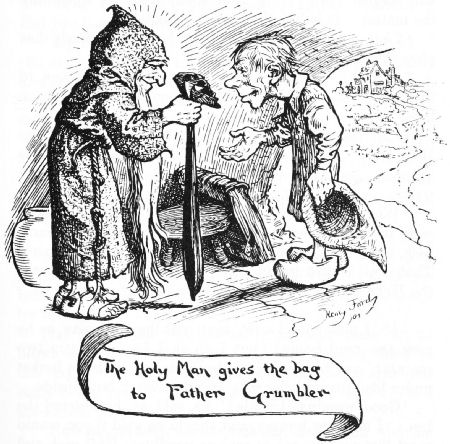
The Holy Man did not answer, but went into an inner
cave, from which he came out bearing something in his
hand. ‘Do you see this basket?’ said he. ‘It is a magical
basket, and if you are hungry you have only got to
say: “Little basket, little basket, do your duty,” and
you will eat the best dinner you ever had in your life.
But when you have had enough, be sure you don’t forget
to cry out: “That will do for to-day.” Oh!—and one
thing more—you need not show it to everybody and
declare that I have given it to you. Do you understand?’
Father Grumbler was always accustomed to think of
himself as so unlucky that he did not know whether the
Holy Man was not playing a trick upon him; but he took
the basket without being polite enough to say either
‘Thank you,’ or ‘Good-morning,’ and went away. However,
he only waited till he was out of sight of the cave
before he stooped down and whispered: ‘Little basket,
little basket, do your duty.’
Now the basket had a lid, so that he could not see
what was inside, but he heard quite clearly strange noises,
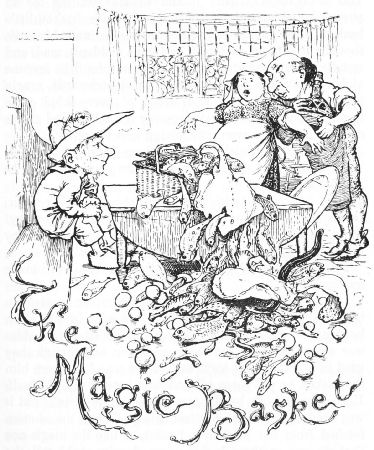
as if a sort of scuffling was going on. Then the lid burst
open, and a quantity of delicious little white rolls came
tumbling out one after the other, followed by a stream of
small fishes all ready cooked. What a quantity there
were to be sure! The whole road was covered with them,
and the banks on each side were beginning to disappear.
Father Grumbler felt quite frightened at the torrent, but
at last he remembered what the Holy Man had told him,
and cried at the top of his voice: ‘Enough! enough!
That will do for to-day!’ And the lid of the basket closed
with a snap.
Father Grumbler sighed with relief and happiness as
he looked around him, and sitting down on a heap of
stones, he ate till he could eat no more. Trout, salmon,
turbot, soles, and a hundred other fishes whose names he did not know, lay boiled, fried, and grilled within reach of
his hands. As the Holy Man had said, he had never
eaten such a dinner; still, when he had done, he shook his
head, and grumbled; ‘Yes, there is plenty to eat, of course,
but it only makes me thirsty, and there is not a drop to
drink anywhere.’
Yet, somehow, he could never tell why, he looked up
and saw the tavern in front of him, which he thought was
miles, and miles, and miles away.
‘Bring the best wine you have got, and two glasses,
good mother,’ he said as he entered, ‘and if you are fond
of fish there is enough here to feed the house. Only
there is no need to chatter about it all over the place.
You understand? Eh?’ And without waiting for an
answer he whispered to the basket: ‘Little basket, little
basket, do your duty.’ The innkeeper and his wife
thought that their customer had gone suddenly mad, and
watched him closely, ready to spring on him if he became
violent; but both instinctively jumped backwards, nearly
into the fire, as rolls and fishes of every kind came
tumbling out of the basket, covering the tables and chairs
and the floor, and even overflowing into the street.
‘Be quick, be quick, and pick them up,’ cried the man.
‘And if these are not enough, there are plenty more to be
had for the asking.’
The innkeeper and his wife did not need telling twice.
Down they went on their knees and gathered up everything
they could lay hands on. But busy though they
seemed, they found time to whisper to each other:
‘If we can only get hold of that basket it will make
our fortune!’
So they began by inviting Father Grumbler to sit down
to the table, and brought out the best wine in the cellar,
hoping it might loosen his tongue. But Father Grumbler
was wiser than they gave him credit for, and though they
tried in all manner of ways to find out who had given him
the basket, he put them off, and kept his secret to himself.
Unluckily, though he did not speak, he did drink, and it
was not long before he fell fast asleep. Then the woman
fetched from her kitchen a basket, so like the magic one
that no one, without looking very closely, could tell the
difference, and placed it in Father Grumbler’s hand,
while she hid the other carefully away.
It was dinner time when the man awoke, and, jumping
up hastily, he set out for home, where he found all the
children gathered round a basin of thin soup, and pushing their wooden bowls forward, hoping to have the first
spoonful. Their father burst into the midst of them,
bearing his basket, and crying:
‘Don’t spoil your appetites, children, with that stuff.
Do you see this basket? Well, I have only got to say,
“Little basket, little basket, do your duty,” and you will
see what will happen. Now you shall say it instead of
me, for a treat.’
The children, wondering and delighted, repeated the
words, but nothing happened. Again and again they
tried, but the basket was only a basket, with a few scales
of fish sticking to the bottom, for the innkeeper’s wife had
taken it to market the day before.
‘What is the matter with the thing?’ cried the father
at last, snatching the basket from them, and turning it
all over, grumbling and swearing while he did so, under
the eyes of his astonished wife and children, who did not
know whether to cry or to laugh.
‘It certainly smells of fish,’ he said, and then he
stopped, for a sudden thought had come to him.
‘Suppose it is not mine at all; supposing—— Ah,
the scoundrels!’
And without listening to his wife and children, who
were frightened at his strange conduct and begged him
to stay at home, he ran across to the tavern and burst
open the door.
‘Can I do anything for you, Father Grumbler?’ asked
the innkeeper’s wife in her softest voice.
‘I have taken the wrong basket—by mistake, of course,’
said he. ‘Here is yours, will you give me back my
own?’
‘Why, what are you talking about?’ answered she.
‘You can see for yourself that there is no basket here.’
And though Father Grumbler did look, it was quite
true that none was to be seen.
‘Come, take a glass to warm you this cold day,’ said
the woman, who was anxious to keep him in a good
temper, and as this was an invitation Father Grumbler
never refused, he tossed it off and left the house.
He took the road that led to the Holy Man’s cave,
and made such haste that it was not long before he
reached it.
‘Who is there?’ said a voice in answer to his knock.
‘It is me, it is me, Holy Man. You know quite well.
Father Grumbler, who has as many children as sparrows
in the garden.’
‘But, my good man, it was only yesterday that I gave
you a handsome present.’
‘Yes, Holy Man, and here it is. But something has
happened, I don’t know what, and it won’t work any
more.’
‘Well, put it down. I will go and see if I can find
anything for you.’
In a few minutes the Holy Man returned with a cock
under his arm.
‘Listen to me,’ he said, ‘whenever you want money,
you have only to say: “Show me what you can do,
cock,” and you will see some wonderful things. But,
remember, it is not necessary to let all the world into
the secret.’
‘Oh no, Holy Man, I am not so foolish as that.’
‘Nor to tell everybody that I gave it to you,’ went on
the Holy Man. ‘I have not got these treasures by the
dozen.’
And without waiting for an answer he shut the door.
As before, the distance seemed to have wonderfully
shortened, and in a moment the tavern rose up in front
of Father Grumbler. Without stopping to think, he went
straight in, and found the innkeeper’s wife in the kitchen
making a cake.
‘Where have you come from, with that fine red cock
in your basket,’ asked she, for the bird was so big that
the lid would not shut down properly.
‘Oh, I come from a place where they don’t keep these things by the dozen,’ he replied, sitting down in front of
the table.
The woman said no more, but set before him a bottle
of his favourite wine, and soon he began to wish to display
his prize.
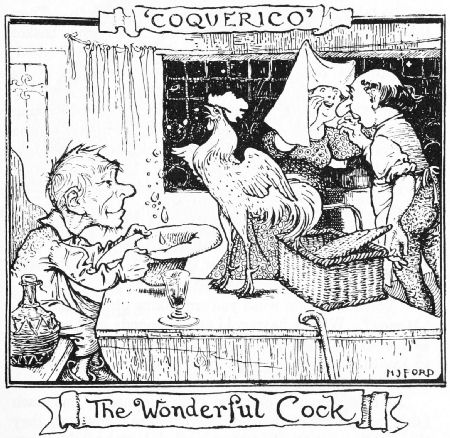
‘Show me what you can do, cock,’ cried he. And the
cock stood up and flapped his wings three times, crowing
‘coquerico’ with a voice like a trumpet, and at each crow
there fell from his beak golden drops, and diamonds as
large as peas.
This time Father Grumbler did not invite the innkeeper’s
wife to pick up his treasures, but put his own
hat under the cock’s beak, so as to catch everything he let fall; and he did not see the husband and wife exchanging
glances with each other which said, ‘That would be a
splendid cock to put with our basket.’
‘Have another glass of wine?’ suggested the innkeeper,
when they had finished admiring the beauty of
the cock, for they pretended not to have seen the gold
or the diamonds. And Father Grumbler, nothing loth,
drank one glass after another, till his head fell forward
on the table, and once more he was sound asleep. Then
the woman gently coaxed the cock from the basket
and carried it off to her own poultry yard, from which
she brought one exactly like it, and popped it in its
place.
Night was falling when the man awoke, and throwing
proudly some grains of gold on the table to pay for the
wine he had drunk, he tucked the cock comfortably into
his basket and set out for home.
His wife and all the children were waiting for him at
the door, and as soon as she caught sight of him she broke
out:
‘You are a nice man to go wasting your time and your
money drinking in that tavern, and leaving us to starve!
Aren’t you ashamed of yourself?’
‘You don’t know what you are talking of,’ he answered.
‘Money? Why, I have gold and diamonds now, as much
as I want. Do you see that cock? Well, you have only
to say to him, “Show what you can do, cock,” and something
splendid will happen.’
Neither wife nor children were inclined to put much
faith in him after their last experience; however, they
thought it was worth trying, and did as he told them.
The cock flew round the room like a mad thing, and
crowed till their heads nearly split with the noise; but no
gold or diamonds dropped on the brick floor—not the
tiniest grain of either.
Father Grumbler stared in silence for an instant, and
then he began to swear so loudly that even his family,
accustomed as they were to his language, wondered at
him.
At last he grew a little quieter, but remained as
puzzled as ever.
‘Can I have forgotten the words? But I know that
was what he said! And I saw the diamonds with my
own eyes!’ Then suddenly he seized the cock, shut it
into the basket, and rushed out of the house.
His heavy wooden shoes clattered as he ran along the
road, and he made such haste that the stars were only
just beginning to come out when he reached the cave of
the Holy Man.
‘Who is that knocking?’ asked a voice from within.
‘It is me! It is me! Holy Man! you know!
Father——’
‘But, my good fellow, you really should give some one
else a chance. This is the third time you have been—and
at such an hour, too!’
‘Oh, yes, Holy Man, I know it is very late, but you
will forgive me! It is your cock—there is something
the matter. It is like the basket. Look!’
‘That my cock? That my basket? Somebody has
played you a trick, my good man!’
‘A trick?’ repeated Father Grumbler, who began to
understand what had happened. ‘Then it must have been
those two——’
‘I warned you not to show them to anybody,’ said the
Holy Man. ‘You deserve——but I will give you one more
chance.’ And, turning, he unhooked something from the
wall.
‘When you wish to dust your own jacket or those of
your friends,’ he said, ‘you have only got to say, “Flack,
flick, switch, be quick,” and you will see what happens.
That is all I have to tell you.’ And, smiling to himself,
the Holy Man pushed Father Grumbler out of the cave.
‘Ah, I understand now,’ muttered the good man, as he
took the road home; ‘but I think I have got you two
rascals!’ and he hurried on to the tavern with his basket
under his arm, and the cock and the switch both inside.
‘Good evening, friends!’ he said, as he entered the
inn. ‘I am very hungry, and should be glad if you would
roast this cock for me as soon as possible. This cock and
no other—mind what I say,’ he went on. ‘Oh, and
another thing! You can light the fire with this basket.
When you have done that I will show you something I
have in my bag,’ and, as he spoke, he tried to imitate the
smile that the Holy Man had given him.
These directions made the innkeeper’s wife very
uneasy. However, she said nothing, and began to roast
the cock, while her husband did his best to make the man
sleepy with wine, but all in vain.
After dinner, which he did not eat without grumbling,
for the cock was very tough, the man struck his hand on
the table, and said: ‘Now listen to me. Go and fetch my
cock and my basket, at once. Do you hear?’
‘Your cock, and your basket, Father Grumbler?
But you have just——’
‘My cock and my basket!’ interrupted he. ‘And, if
you are too deaf and too stupid to understand what that
means, I have got something which may help to teach
you.’ And opening the bag, he cried: ‘Flack! flick!
switch, be quick.’
And flack! flick! like lightning a white switch sprang
out of the bag, and gave such hearty blows to the innkeeper
and his wife, and to Father Grumbler into the
bargain, that they all jumped as high as feathers when a
mattress is shaken.
‘Stop! stop! make it stop, and you shall have back
your cock and basket,’ cried the man and his wife. And
Father Grumbler, who had no wish to go on, called out
between his hops: ‘Stop then, can’t you? That is enough
for to-day!’
But the switch paid no attention, and dealt out its
blows as before, and might have been dealing them to
this day, if the Holy Man had not heard their cries and
come to the rescue. ‘Into the bag, quick!’ said he, and
the switch obeyed.
‘Now go and fetch me the cock and the basket,’ and the
woman went without a word, and placed them on the table.
‘You have all got what you deserved,’ continued the
Holy Man, ‘and I have no pity for any of you. I shall
take my treasures home, and perhaps some day I may find
a man who knows how to make the best of the chances
that are given him. But that will never be you,’ he
added, turning to Father Grumbler.
[From Contes Populaires.]
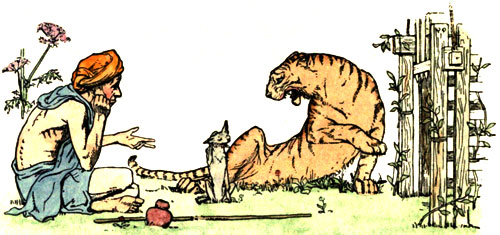
** "Father Grumbler" (originally known in French as Le Père Maréchal or similar regional variants) is a classic French conte populaire.This French version serves as a comedic moral fable about greed, foolishness, and poetic justice. It became widely known to English-speaking audiences after being collected and translated by Andrew Lang. Project Gutenberg offers two version of The Brown Fairy Book. One has no illustrations, but this used the "Numerous Illustrations by H. J. Ford." I think Ford's illustrations capture the fun lurking in this story.
**************
This is part of a
series of postings of stories under the category, “Keeping the
Public in Public Domain.” The idea behind Public Domain was to
preserve our cultural heritage after the authors and their immediate
heirs were compensated. I feel strongly current copyright law delays
this intent on works of the 20th century. My own library
of folklore includes so many books within the Public Domain I decided
to share stories from them. I hope you enjoy discovering them.
At
the same time, my own involvement in storytelling regularly creates
projects requiring research as part of my sharing stories with an
audience. Whenever that research needs to be shown here, the
publishing of Public Domain stories will not occur that week.
This is a return to my regular posting of a research project here.
(Don't worry, this isn't dry research, my research is always geared
towards future storytelling to an audience.) Response has
convinced me that "Keeping the Public in Public Domain"
should continue along with my other postings as often as I can manage
it.
See the sidebar for other Public
Domain story resources I recommend on the page “Public Domain Story Resources."




.jpg)


.jpg)