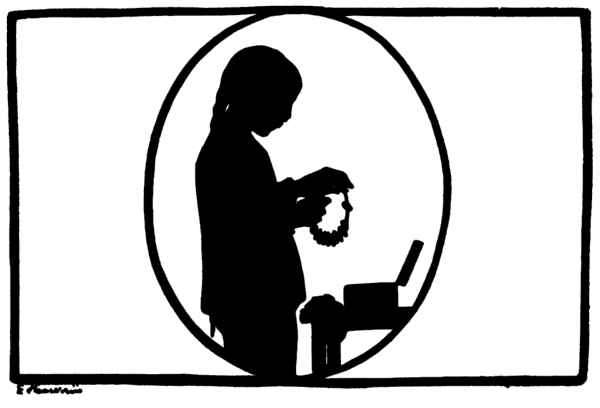
Arthur Bowie Chrisman won the Newbery medal with his book Shen of the Sea "for the most distinguished contribution to American Children's literature during the year 1925." Today's critical opinion, however, wouldn't agree. Modern opinion on Goodreads.com complains about the book's lack of Chinese authenticity and potential racism. One thing I want people to note is the publisher gave the book cover the subtitle of "Chinese Stories for Children" but the actual title page simply gives a subtitle of "A Book for Children" along with crediting Else Hasselriis for her many silhouettes illustrating the book. There's no claim anywhere that the author was presenting stories from Chinese folklore. The stories should stand on their own as the creative work of a man who never traveled to China, but was fascinated with it. Yes, as one reader, Miz Lizzie, who is a folklorist on Goodreads said, "It's about as authentic as 'The Mikado' (also regarded as 'authentic' at the time)." She and some other readers further point out the better route would have been to say it was inspired by China and also to be aware of the knowledge and time when it was written. Often it is suggested by the readers that the book's stories are best read aloud. Today's story I know was particularly popular on lists of stories recommended by librarian-storytellers in the early half of the 20th century. That along with a connection with St. Louis, Missouri and this past week lead me to present it. You decide if you would tell it as NOT authentic folklore, but created by a man who clearly loved a land he had never seen. (I'll say more about St. Louis & this past week afterwards.)
AH TCHA THE SLEEPER
Years ago, in southern China, lived a boy,
Ah Tcha by name. Ah Tcha was an orphan,
but not according to rule. A most peculiar
orphan was he. It is usual for orphans to
be very, very poor. That is the world-wide
custom. Ah Tcha, on the contrary, was quite
wealthy. He owned seven farms, with seven
times seven horses to draw the plow. He
owned seven mills, with plenty of breezes to
spin them. Furthermore, he owned seven
thousand pieces of gold, and a fine white cat.
The farms of Ah Tcha were fertile, were
wide. His horses were brisk in the furrow.
His mills never lacked for grain, nor wanted
for wind. And his gold was good sharp gold,
with not so much as a trace of copper. Surely,
few orphans have been better provided for
than the youth named Ah Tcha. And what
a busy person was this Ah Tcha. His bed
was always cold when the sun arose. Early
in the morning he went from field to field,
from mill to mill, urging on the people who
worked for him. The setting sun always
found him on his feet, hastening from here
to there, persuading his laborers to more gainful
efforts. And the moon of midnight often
discovered him pushing up and down the
little teak-wood balls of a counting board,
or else threading cash, placing coins upon a
string. Eight farms, nine farms he owned,
and more stout horses. Ten mills, eleven,
another white cat. It was Ah Tcha’s ambition
to become the richest person in the world.
They who worked for the wealthy orphan
were inclined now and then to grumble.
Their pay was not beggarly, but how they
did toil to earn that pay which was not beggarly.
It was go, and go, and go. Said the
ancient woman Nu Wu, who worked with
a rake in the field: “Our master drives us
as if he were a fox and we were hares in the
open. Round the field and round and round,
hurry, always hurry.” Said Hu Shu, her
husband, who bound the grain into sheaves:
“Not hares, but horses. We are driven like
the horses of Lung Kuan, who . . .” It’s a
long story.
But Ah Tcha, approaching the murmurers,
said, “Pray be so good as to hurry, most excellent
Nu Wu, for the clouds gather blackly,
with thunder.” And to the scowling husband
he said, “Speed your work, I beg you, honorable
Hu Shu, for the grain must be under
shelter before the smoke of Evening Rice
ascends.”
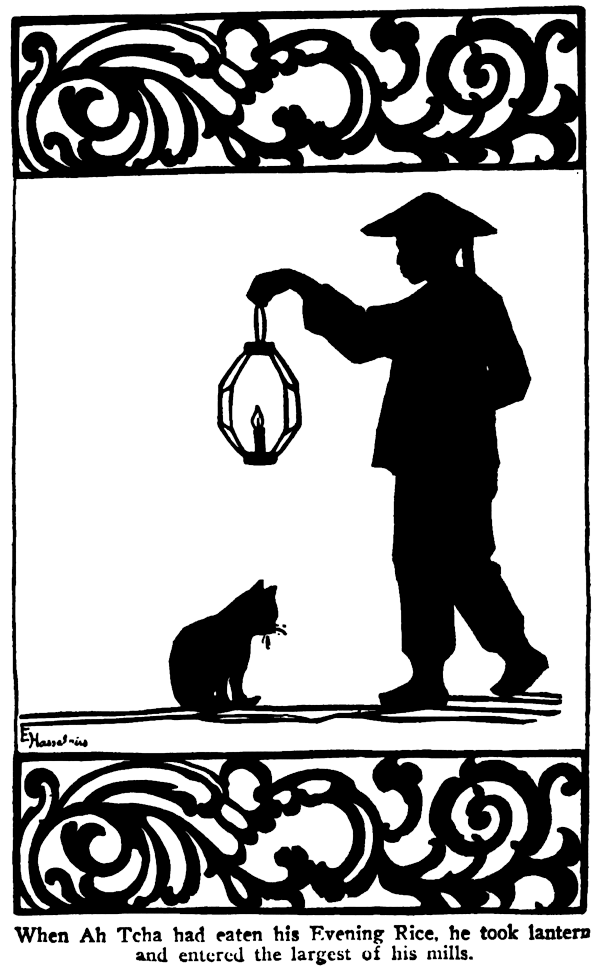
When Ah Tcha had eaten his Evening
Rice, he took lantern and entered the largest
of his mills. A scampering rat drew his attention
to the floor. There he beheld no less
than a score of rats, some gazing at him as
if undecided whether to flee or continue the
feast, others gnawing—and who are you, nibbling
and caring not? And only a few short
whisker-lengths away sat an enormous cat,
sleeping the sleep of a mossy stone. The cat
was black in color, black as a crow’s wing
dipped in pitch, upon a night of inky darkness.
That describes her coat. Her face was
somewhat more black. Ah Tcha had never
before seen her. She was not his cat. But
his or not, he thought it a trifle unreasonable
of her to sleep, while the rats held high carnival.
The rats romped between her paws.
Still she slept. It angered Ah Tcha. The
lantern rays fell on her eyes. Still she slept.
Ah Tcha grew more and more provoked. He
decided then and there to teach the cat that
his mill was no place for sleepy heads.
Accordingly, he seized an empty grain sack
and hurled it with such exact aim that the
cat was sent heels over head. “There, old
Crouch-by-the-hole,” said Ah Tcha in a tone
of wrath. “Remember your paining ear, and
be more vigilant.” But the cat had no sooner
regained her feet than she changed into . . .
Nu Wu . . . changed into Nu Wu, the old
woman who worked in the fields . . . a
witch. What business she had in the mill
is a puzzle. However, it is undoubtedly true
that mills hold grain, and grain is worth
money. And that may be an explanation.
Her sleepiness is no puzzle at all. No wonder
she was sleepy, after working so hard in the
field, the day’s length through.
The anger of Nu Wu was fierce and instant.
She wagged a crooked finger at Ah
Tcha, screeching: “Oh, you cruel money-grubber.
Because you fear the rats will eat
a pennyworth of grain you must beat me with
bludgeons. You make me work like a slave
all day—and wish me to work all night. You
beat me and disturb my slumber. Very well,
since you will not let me sleep, I shall cause
you to slumber eleven hours out of every
dozen. . . . Close your eyes.” She swept her
wrinkled hand across Ah Tcha’s face. Again
taking the form of a cat, she bounded downstairs.
She had scarce reached the third step
descending when Ah Tcha felt a compelling
desire for sleep. It was as if he had taken
gum of the white poppy flower, as if he had
tasted honey of the gray moon blossom. Eyes
half closed, he stumbled into a grain bin.
His knees doubled beneath him. Down he
went, curled like a dormouse. Like a dormouse
he slumbered.
From that hour began a change in Ah
Tcha’s fortune. The spell gripped him fast.
Nine-tenths of his time was spent in sleep.
Unable to watch over his laborers, they
worked when they pleased, which was seldom.
They idled when so inclined—and that was
often, and long. Furthermore, they stole in
a manner most shameful. Ah Tcha’s mills
became empty of grain. His fields lost their
fertility. His horses disappeared—strayed,
so it was said. Worse yet, the unfortunate
fellow was summoned to a magistrate’s
yamen, there to defend himself in a lawsuit.
A neighbor declared that Ah Tcha’s huge
black cat had devoured many chickens. There
were witnesses who swore to the deed. They
were sure, one and all, that Ah Tcha’s black
cat was the cat at fault. Ah Tcha was sleeping
too soundly to deny that the cat was his. . . . So
the magistrate could do nothing less
than make the cat’s owner pay damages, with
all costs of the lawsuit.
Thereafter, trials at court were a daily
occurrence. A second neighbor said that Ah
Tcha’s black cat had stolen a flock of sheep.
Another complained that the cat had thieved
from him a herd of fattened bullocks. Worse
and worse grew the charges. And no matter
how absurd, Ah Tcha, sleeping in the
prisoner’s cage, always lost and had to pay
damages. His money soon passed into other
hands. His mills were taken from him. His
farms went to pay for the lawsuits. Of all
his wide lands, there remained only one little
acre—and it was grown up in worthless
bushes. Of all his goodly buildings, there
was left one little hut, where the boy spent
most of his time, in witch-imposed slumber.
Now, near by in the mountain of Huge
Rocks Piled, lived a greatly ferocious loong,
or, as foreigners would say, a dragon. This
immense beast, from tip of forked tongue to
the end of his shadow, was far longer than a
barn. With the exception of length, he was
much the same as any other loong. His head
was shaped like that of a camel. His horns
were deer horns. He had bulging rabbit eyes,
a snake neck. Upon his many ponderous
feet were tiger claws, and the feet were
shaped very like sofa cushions. He had walrus
whiskers, and a breath of red-and-blue
flame. His voice was like the sound of a
hundred brass kettles pounded. Black fish
scales covered his body, black feathers grew
upon his limbs. Because of his color he was
sometimes called Oo Loong. From that it
would seem that Oo means neither white nor
pink.
The black loong was not regarded with any
great esteem. His habit of eating a man—two
men if they were little—every day made
him rather unpopular. Fortunately, he
prowled only at night. Those folk who went
to bed decently at nine o’clock had nothing
to fear. Those who rambled well along toward
midnight, often disappeared with a sudden
and complete thoroughness.
As every one knows, cats are much given
to night skulking. The witch cat, Nu Wu,
was no exception. Midnight often found her
miles afield. On such a midnight, when she
was roving in the form of a hag, what should
approach but the black dragon. Instantly
the loong scented prey, and instantly he made
for the old witch.
There followed such a chase as never was
before on land or sea. Up hill and down
dale, by stream and wood and fallow, the cat
woman flew and the dragon coursed after.
The witch soon failed of breath. She panted.
She wheezed. She stumbled on a bramble
and a claw slashed through her garments.
Too close for comfort. The harried witch
changed shape to a cat, and bounded off
afresh, half a li at every leap. The loong
increased his pace and soon was close behind,
gaining. For a most peculiar fact about the
loong is that the more he runs the easier his
breath comes, and the swifter grows his speed.
Hence, it is not surprising that his fiery breath
was presently singeing the witch cat’s back.
In a twinkling the cat altered form once
more, and as an old hag scuttled across a
turnip field. She was merely an ordinarily
powerful witch. She possessed only the two
forms—cat and hag. Nor did she have a
gift of magic to baffle or cripple the hungry
black loong. Nevertheless, the witch was not
despairing. At the edge of the turnip field
lay Ah Tcha’s miserable patch of thick bushes.
So thick were the bushes as to be almost a
wall against the hag’s passage. As a hag,
she could have no hope of entering such a
thicket. But as a cat, she could race through
without hindrance. And the dragon would
be sadly bothered in following. Scheming
thus, the witch dashed under the bushes—a
cat once more.
Ah Tcha was roused from slumber by the
most outrageous noise that had ever assailed
his ears. There was such a snapping of bushes,
such an awful bellowed screeching that even
the dead of a century must have heard. The
usually sound-sleeping Ah Tcha was awakened
at the outset. He soon realized how
matters stood—or ran. Luckily, he had
learned of the only reliable method for frightening
off the dragon. He opened his door
and hurled a red, a green, and a yellow firecracker
in the monster’s path.
In through his barely opened door the witch
cat dragged her exhausted self. “I don’t see
why you couldn’t open the door sooner,” she
scolded, changing into a hag. “I circled the
hut three times before you had the gumption
to let me in.”
“I am very sorry, good mother. I was
asleep.” From Ah Tcha.
“Well, don’t be so sleepy again,” scowled
the witch, “or I’ll make you suffer. Get me
food and drink.”
“Again, honored lady, I am sorry. So poor
am I that I have only water for drink. My
food is the leaves and roots of bushes.”
“No matter. Get what you have—and
quickly.”
Ah Tcha reached outside the door and
stripped a handful of leaves from a bush. He
plunged the leaves into a kettle of hot water
and signified that the meal was prepared.
Then he lay down to doze, for he had been
awake fully half a dozen minutes and the
desire to sleep was returning stronger every
moment.
The witch soon supped and departed, without
leaving so much as half a “Thank you.”
When Ah Tcha awoke again, his visitor was
gone. The poor boy flung another handful
of leaves into his kettle and drank quickly.
He had good reason for haste. Several times
he had fallen asleep with the cup at his lips—a
most unpleasant situation, and scalding.
Having taken several sips, Ah Tcha stretched
him out for a resumption of his slumber.
Five minutes passed . . . ten minutes . . .
fifteen. . . . Still his eyes failed to close. He
took a few more sips from the cup and felt
more awake than ever.
“I do believe,” said Ah Tcha, “that she has
thanked me by bewitching my bushes. She
has charmed the leaves to drive away my
sleepiness.”
And so she had. Whenever Ah Tcha felt
tired and sleepy—and at first that was often—he
had only to drink of the bewitched
leaves. At once his drowsiness departed.
His neighbors soon learned of the bushes that
banished sleep. They came to drink of the
magic brew. There grew such a demand that
Ah Tcha decided to set a price on the leaves.
Still the demand continued. More bushes
were planted. Money came.
Throughout the province people called for
“the drink of Ah Tcha.” In time they
shortened it by asking for “Ah Tcha’s drink,”
then for “Tcha’s drink,” and finally for
“Tcha.”
And that is its name at present, “Tcha,”
or “Tay,” or “Tea,” as some call it. And
one kind of Tea is still called “Oo Loong”—“Black
Dragon.”
***********
I noticed Chrisman knew enough Chinese words to call a dragon a "Loong ." I've also seen it as a "Lung", but that transliteration would have people thinking of the English word "lung." He opened with the main character using an abacus and that Chinese coins had a hole in the center for stringing together. I don't have an abacus to show, but do have some of those coins with a hole to illustrate his greedy start. While the author's concerns may appear critical of the Chinese, surely greed and overbearing bosses are common everywhere and throughout the ages.
So why do I mention St. Louis?
This past week, on June 10, I heard was "Iced Tea Day" and the story told by the radio announcer was it dates back to the 1904 St. Louis World's Fair. Supposedly a hot day led to the invention of pouring it over ice. It turns out this is one of many stories about as accurate as Chrisman. Iced Tea is one of many St. Louis World's Fair food stories debunked on
SeriousEats which says:
If you believe the popular tales, more new American foods were invented
at the 1904 World's Fair in St. Louis, Missouri, than during any other
single event in history. The list includes the hamburger, the hot dog,
peanut butter, iced tea, the club sandwich, cotton candy, and the ice
cream cone, to name just a few. If all the pop histories and internet
stories have it right, American foodways would be almost unrecognizable
if the 1904 fair had not been held.

That picture from the Library of Congress collection shows it as the 1904 Louisiana Purchase Exposition, which is the official name. The link takes you to a Wikipedia article with a wonderful section on the "Legacy" from the event. Yes, it, too, talks about the food, but being born and growing up in St. Louis it was the buildings, originally expected to be temporary, that remain important to me. I didn't realize the administration building for Washington University in St. Louis was a fair building. Some of the fair's "legacy" went to other locations, but a separate article on Forest Park, where the fair was held, tells even more about that legacy. Yes, I learned things in both articles as I grew up close enough to hear the Zoo's lions and tigers on an early morning before traffic drowned them out. I remembered the aviary cage you could walk through dating back to the Exposition. The park's buildings and other features include some I erroneously attributed to the fair, such as the Jewel Box and its Floral Clock (built in the 1930s and the clock is a memorial to Korean War military dead). Some were correct, such as the waterfall known as The Cascades where I'm in a family picture dating back to my preschool years. One of those correct, is the Art Museum. I loved it so much I often saved lunch and bus money to buy art postcards there. Instead I said goodbye to the statue out front of the Apotheosis of St. Louis before starting the long hike home. I didn't know it was a bronze replica of a plaster statue at the fair -- nor the lawsuit by the original statue's sculptor (copyright issues even in 1906!). It was indeed presented by the Exposition in remembrance of the fair. I also didn't know things like the Exposition's "Bullfight Riot" and forgot the statue of King Louis IX, the namesake of the city, has had his sword stolen so often it's "considered a rite of passage for students in the engineering program at nearby Washington University."
It was for me a landmark deserving that "goodbye...before starting the long hike home." Thank you for joining me on this trip back in time.
******************
This
is part of a series of postings of stories under the category,
"Keeping the Public in Public Domain." The idea
behind Public Domain was to preserve our cultural heritage after the
authors and their immediate heirs were compensated. I feel
strongly current copyright law delays this intent on works of the
20th century. My
own library of folklore includes so many books within the Public
Domain I decided to share stories from them. I hope you enjoy
discovering new stories.

At
the same time, my own involvement in storytelling regularly creates
projects requiring research as part of my sharing stories with an
audience. Whenever that research needs to be shown here, the publishing
of Public Domain stories will not occur that week. This is a return to
my regular posting of a research project here. (Don't worry, this
isn't dry research, my research is always geared towards future
storytelling to an audience.) Response has convinced me that "Keeping
the Public in Public Domain" should continue along with my other
postings as often as I can manage it.
Other
Public Domain story resources I recommend-
There
are many online resources for Public Domain stories, maybe none for
folklore is as ambitious as fellow storyteller, Yoel Perez's
database, Yashpeh,
the International Folktales Collection. I have long
recommended it and continue to do so. He has loaded
Stith Thompson's Motif Index into his server as a database so
you can search the whole 6 volumes for whatever word or expression
you like by pressing one key. http://folkmasa.org/motiv/motif.htm
- You may have noticed I'm no
longer certain Dr. Perez has the largest database, although his
offering the Motif Index certainly qualifies for those of us seeking
specific types of stories. There's another site, FairyTalez
claiming to be the largest, with "over 2000 fairy tales,
folktales, and fables" and they are "fully optimized for
phones, tablets, and PCs", free and presented without ads.
Between those two sites, there
is much for story-lovers, but as they say in infomercials, "Wait,
there's more!"
The
email list for storytellers, Storytell,
discussed Online Story Sources and came up with these additional
suggestions:
-
Story-Lovers - http://www.story-lovers.com/ is now only accessible
through the Wayback Machine, described below, but the late Jackie Baldwin's
wonderful site lives on there, fully searchable manually (the Google
search doesn't work), at https://archive.org/ . It's not easy, but go to Story-lovers.com snapshot for October 22 2016 and you can click on SOS: Searching Out Stories to scroll down through the many story topics and click on the story topic that interests you.
You're
going to find many of the links on these sites have gone down, BUT
go to the Internet Archive
Wayback Machine to find some of these old links. Tim's
site, for example, is so huge probably updating it would be a
full-time job. In the case of Story-Lovers, it's great that
Jackie Baldwin set it up to stay online as long as it did after she
could no longer maintain it. Possibly searches maintained it.
Unfortunately Storytell list member, Papa Joe is on both Tim
Sheppard's site and Story-Lovers, but he no longer maintains his old
Papa Joe's Traveling Storytelling Show website and his Library
(something you want to see!) is now only on the Wayback Machine. It
took some patience working back through claims of snapshots but finally
in December of 2006 it appears!
Somebody
as of this writing whose stories can still be found by his website
is the late Chuck Larkin - http://chucklarkin.com/stories.html.
I prefer to list these sites by their complete address so they can
be found by the Wayback Machine, a.k.a. Archive.org, when that
becomes the only way to find them.
You
can see why I recommend these to you. Have fun
discovering even more stories!