Tell me if you have a topic you'd like to see. (Contact: LoiS-sez@LoiS-sez.com .)
Please also let others know about this site.
Showing posts with label Japanese folklore. Show all posts

Friday, February 28, 2025

Lang - The Maiden with the Wooden Helmet - Keeping the Public in Public Domain

Illustration by Urokogataya

If you're looking for an unusual, but beautiful story for Women's History Month, there's a lovely tale from Japanese folklore. As might be expected when something is translated, it's sometimes called by various names. Wikipedia gives a reasonable summary of "Hachikazuki." The story dates back in print to the 14th to 16th century and is probably even older. In approximately 1735 to 1745 it was published as a children's booklet of mainly drawings by Urokogataya. 

The story is translated as "The Black Bowl" by Grace James in her Green willow and other Japanese fairy tales
and Lafcadio Hearn used her version in his anthology, Japanese fairy tales. 

Frankly that title never would have caught my attention. It was while prowling The Violet Fairy Book this title caught my eye. The Project Gutenberg eBook for some reason omits the illustration by Henry Justice Ford! Ford's illustrations were a vital part of the Langs' Fairy Book series. Ford's illustration, of any I found for the story, fit my vision of the Maiden's Helmet where others with a Bowl did not. 
Since this is the start of Women's History Month it's worth repeating this from the Wikipedia article on "The Langs' Fairy Books:
The authorship and translation of the Coloured Fairy Books is often and incorrectly attributed to Andrew Lang alone. Nora is not named on the front cover or spines of any of the Coloured Fairy Books, which all tout Andrew as their editor. However, as Andrew acknowledges in a preface to The Lilac Fairy Book (1910), "The fairy books have been almost wholly the work of Mrs. Lang, who has translated and adapted them from the French, German, Portuguese, Italian, Spanish, Catalan, and other languages." 

Every Women's History year has a theme and this year it is “Moving Forward Together,” which celebrates "Women Educating and Inspiring Generations." For centuries this story has educated young girls to be more than mere beauty, but be strong in carrying out their resolutions.

Here's Leonora Lang's translation from the German of "The Maiden with the Wooden Helmet."

by Henry Justice Ford for The Violet Fairy Book (1906)  

In a little village in the country of Japan there lived long, long ago a man and his wife. For many years they were happy and prosperous, but bad times came, and at last nothing was left them but their daughter, who was as beautiful as the morning. The neighbours were very kind, and would have done anything they could to help their poor friends, but the old couple felt that since everything had changed they would rather go elsewhere, so one day they set off to bury themselves in the country, taking their daughter with them.

Now the mother and daughter had plenty to do in keeping the house clean and looking after the garden, but the man would sit for hours together gazing straight in front of him, and thinking of the riches that once were his. Each day he grew more and more wretched, till at length he took to his bed and never got up again.

His wife and daughter wept bitterly for his loss, and it was many months before they could take pleasure in anything. Then one morning the mother suddenly looked at the girl, and found that she had grown still more lovely than before. Once her heart would have been glad at the sight, but now that they two were alone in the world she feared some harm might come of it. So, like a good mother, she tried to teach her daughter all she knew, and to bring her up to be always busy, so that she would never have time to think about herself. And the girl was a good girl, and listened to all her mother’s lessons, and so the years passed away.

At last one wet spring the mother caught cold, and though in the beginning she did not pay much attention to it, she gradually grew more and more ill, and knew that she had not long to live. Then she called her daughter and told her that very soon she would be alone in the world; that she must take care of herself, as there would be no one to take care of her. And because it was more difficult for beautiful women to pass unheeded than for others, she bade her fetch a wooden helmet out of the next room, and put it on her head, and pull it low down over her brows, so that nearly the whole of her face should lie in its shadow. The girl did as she was bid, and her beauty was so hidden beneath the wooden cap, which covered up all her hair, that she might have gone through any crowd, and no one would have looked twice at her. And when she saw this the heart of the mother was at rest, and she lay back in her bed and died.

The girl wept for many days, but by-and-by she felt that, being alone in the world, she must go and get work, for she had only herself to depend upon. There was none to be got by staying where she was, so she made her clothes into a bundle, and walked over the hills till she reached the house of the man who owned the fields in that part of the country. And she took service with him and laboured for him early and late, and every night when she went to bed she was at peace, for she had not forgotten one thing that she had promised her mother; and, however hot the sun might be, she always kept the wooden helmet on her head, and the people gave her the nickname of Hatschihime.

In spite, however, of all her care the fame of her beauty spread abroad: many of the impudent young men that are always to be found in the world stole softly up behind her while she was at work, and tried to lift off the wooden helmet. But the girl would have nothing to say to them, and only bade them be off; then they began to talk to her, but she never answered them, and went on with what she was doing, though her wages were low and food not very plentiful. Still she could manage to live, and that was enough.

One day her master happened to pass through the field where she was working, and was struck by her industry and stopped to watch her. After a while he put one or two questions to her, and then led her into his house, and told her that henceforward her only duty should be to tend his sick wife. From this time the girl felt as if all her troubles were ended, but the worst of them was yet to come.

Not very long after Hatschihime had become maid to the sick woman, the eldest son of the house returned home from Kioto, where he had been studying all sorts of things. He was tired of the splendours of the town and its pleasures, and was glad enough to be back in the green country, among the peach-blossoms and sweet flowers. Strolling about in the early morning, he caught sight of the girl with the odd wooden helmet on her head, and immediately he went to his mother to ask who she was, and where she came from, and why she wore that strange thing over her face.

His mother answered that it was a whim, and nobody could persuade her to lay it aside; whereat the young man laughed, but kept his thoughts to himself.

One hot day, however, he happened to be going towards home when he caught sight of his mother’s waiting maid kneeling by a little stream that flowed through the garden, splashing some water over her face. The helmet was pushed on one side, and as the youth stood watching from behind a tree he had a glimpse of the girl’s great beauty; and he determined that no one else should be his wife. But when he told his family of his resolve to marry her they were very angry, and made up all sorts of wicked stories about her. However, they might have spared themselves the trouble, as he knew it was only idle talk. ‘I have merely to remain firm,’ thought he, ‘and they will have to give in.’ It was such a good match for the girl that it never occurred to anyone that she would refuse the young man, but so it was. It would not be right, she felt, to make a quarrel in the house, and though in secret she wept bitterly, for a long while, nothing would make her change her mind. At length one night her mother appeared to her in a dream, and bade her marry the young man. So the next time he asked her—as he did nearly every day—to his surprise and joy she consented. The parents then saw they had better make the best of a bad business, and set about making the grand preparations suitable to the occasion. Of course the neighbours said a great many ill-natured things about the wooden helmet, but the bridegroom was too happy to care, and only laughed at them.

When everything was ready for the feast, and the bride was dressed in the most beautiful embroidered dress to be found in Japan, the maids took hold of the helmet to lift it off her head, so that they might do her hair in the latest fashion. But the helmet would not come, and the harder they pulled, the faster it seemed to be, till the poor girl yelled with pain. Hearing her cries the bridegroom ran in and soothed her, and declared that she should be married in the helmet, as she could not be married without. Then the ceremonies began, and the bridal pair sat together, and the cup of wine was brought them, out of which they had to drink. And when they had drunk it all, and the cup was empty, a wonderful thing happened. The helmet suddenly burst with a loud noise, and fell in pieces on the ground; and as they all turned to look they found the floor covered with precious stones which had fallen out of it. But the guests were less astonished at the brilliancy of the diamonds than at the beauty of the bride, which was beyond anything they had ever seen or heard of. The night was passed in singing and dancing, and then the bride and bridegroom went to their own house, where they lived till they died, and had many children, who were famous throughout Japan for their goodness and beauty.

(Japanische Marchen.)


*********

This is part of a series of postings of stories under the category, “Keeping the Public in Public Domain.” The idea behind Public Domain was to preserve our cultural heritage after the authors and their immediate heirs were compensated. I feel strongly current copyright law delays this intent on works of the 20th century. My own library of folklore includes so many books within the Public Domain I decided to share stories from them. I hope you enjoy discovering them.

At the same time, my own involvement in storytelling regularly creates projects requiring research as part of my sharing stories with an audience.  Whenever that research needs to be shown here, the publishing of Public Domain stories will not occur that week.  This is a return to my regular posting of a research project here.  (Don't worry, this isn't dry research, my research is always geared towards future storytelling to an audience.)  Response has convinced me that "Keeping the Public in Public Domain" should continue along with my other postings as often as I can manage it.

See the sidebar for other Public Domain story resources I recommend on the page “Public Domain Story Resources."

Friday, August 16, 2024

Lang - The Cat's Elopement - Keeping the Public in Public Domain

by Maja Lindberg
The illustration of the cat sleeping on a stack of books was something I saw and loved. It's by Swedish artist Maja Lindberg. I'm repeating the link to her site and would recommend prowling it. Let's applaud https://translate.google.com as my Swedish is nonexistent, but was able to ask permission to post it and it was generously given. That was last week and International Cat Day was Thursday, August 8. By that time I was knee deep in last week's story of "The Dancing Dog", but promised this Saturday would be CATURDAY as I was already looking forward to posting Lindberg's picture.

I love cats, but have learned I'm healthier no longer having a cat. Fortunately my allergies aren't severe enough to prevent me visiting homes with cats. 

Looking ahead I knew there are a great many stories about cats. Many are fables, but I wanted something else. I also found many stories showing the tricky nature of cats. My favorite was posted last year, the Grimm story of "Cat and Mouse in Partnership." This year I wanted to post something more for all who love cats. "The Cat's Elopement" fits that and opens Andrew Lang's The Pink Fairy Book.

There's a bit of a problem with retelling this story. I believe the names of the two cats would be distracting telling it. Lang offers a Japanese story found in a German book, so I'm hesitant to believe the cat names would be the correct names. Add to that when telling the story in English the male cat's name of Gon sounds like Gone, while the female cat's name of Koma sounds like Coma. If you search online for Japanese cat names there are many sites. Four hundred cat names and their meanings are alphabetically listed at Munchiecat.com. I found it interesting there was no Gom or Koma. Lost in translation? Personally I suggest enjoying the story and then choosing your own name for the two cats. 

The Cat’s Elopement

[From the Japanische Marchen und Sagen, von David Brauns (Leipzig: Wilhelm Friedrich).]

Once upon a time there lived a cat of marvellous beauty, with a skin as soft and shining as silk, and wise green eyes, that could see even in the dark. His name was Gon, and he belonged to a music teacher, who was so fond and proud of him that he would not have parted with him for anything in the world.

Now not far from the music master’s house there dwelt a lady who possessed a most lovely little pussy cat called Koma. She was such a little dear altogether, and blinked her eyes so daintily, and ate her supper so tidily, and when she had finished she licked her pink nose so delicately with her little tongue, that her mistress was never tired of saying, ‘Koma, Koma, what should I do without you?’

Well, it happened one day that these two, when out for an evening stroll, met under a cherry tree, and in one moment fell madly in love with each other. Gon had long felt that it was time for him to find a wife, for all the ladies in the neighbourhood paid him so much attention that it made him quite shy; but he was not easy to please, and did not care about any of them. Now, before he had time to think, Cupid had entangled him in his net, and he was filled with love towards Koma. She fully returned his passion, but, like a woman, she saw the difficulties in the way, and consulted sadly with Gon as to the means of overcoming them. Gon entreated his master to set matters right by buying Koma, but her mistress would not part from her. Then the music master was asked to sell Gon to the lady, but he declined to listen to any such suggestion, so everything remained as before.

At length the love of the couple grew to such a pitch that they determined to please themselves, and to seek their fortunes together. So one moonlight night they stole away, and ventured out into an unknown world. All day long they marched bravely on through the sunshine, till they had left their homes far behind them, and towards evening they found themselves in a large park. The wanderers by this time were very hot and tired, and the grass looked very soft and inviting, and the trees cast cool deep shadows, when suddenly an ogre appeared in this Paradise, in the shape of a big, big dog! He came springing towards them showing all his teeth, and Koma shrieked, and rushed up a cherry tree. Gon, however, stood his ground boldly, and prepared to give battle, for he felt that Koma’s eyes were upon him, and that he must not run away. But, alas! his courage would have availed him nothing had his enemy once touched him, for he was large and powerful, and very fierce. From her perch in the tree Koma saw it all, and screamed with all her might, hoping that some one would hear, and come to help. Luckily a servant of the princess to whom the park belonged was walking by, and he drove off the dog, and picking up the trembling Gon in his arms, carried him to his mistress.

So poor little Koma was left alone, while Gon was borne away full of trouble, not in the least knowing what to do. Even the attention paid him by the princess, who was delighted with his beauty and pretty ways, did not console him, but there was no use in fighting against fate, and he could only wait and see what would turn up.

The princess, Gon’s new mistress, was so good and kind that everybody loved her, and she would have led a happy life, had it not been for a serpent who had fallen in love with her, and was constantly annoying her by his presence. Her servants had orders to drive him away as often as he appeared; but as they were careless, and the serpent very sly, it sometimes happened that he was able to slip past them, and to frighten the princess by appearing before her. One day she was seated in her room, playing on her favourite musical instrument, when she felt something gliding up her sash, and saw her enemy making his way to kiss her cheek. She shrieked and threw herself backwards, and Gon, who had been curled up on a stool at her feet, understood her terror, and with one bound seized the snake by his neck. He gave him one bite and one shake, and flung him on the ground, where he lay, never to worry the princess any more. Then she took Gon in her arms, and praised and caressed him, and saw that he had the nicest bits to eat, and the softest mats to lie on; and he would have had nothing in the world to wish for if only he could have seen Koma again.

Time passed on, and one morning Gon lay before the house door, basking in the sun. He looked lazily at the world stretched out before him, and saw in the distance a big ruffian of a cat teasing and ill-treating quite a little one. He jumped up, full of rage, and chased away the big cat, and then he turned to comfort the little one, when his heart nearly burst with joy to find that it was Koma. At first Koma did not know him again, he had grown so large and stately; but when it dawned upon her who it was, her happiness knew no bounds. And they rubbed their heads and their noses again and again, while their purring might have been heard a mile off.

Paw in paw they appeared before the princess, and told her the story of their life and its sorrows. The princess wept for sympathy, and promised that they should never more be parted, but should live with her to the end of their days. By-and-bye the princess herself got married, and brought a prince to dwell in the palace in the park. And she told him all about her two cats, and how brave Gon had been, and how he had delivered her from her enemy the serpent.

And when the prince heard, he swore they should never leave them, but should go with the princess wherever she went. So it all fell out as the princess wished; and Gon and Koma had many children, and so had the princess, and they all played together, and were friends to the end of their lives.

***

For those able to live with cats, may you, too, play together and be friends to the end of your lives. I sometimes console myself and others who lose their pets with the thought that it lets us know and love so many. I've learned that people who have large birds have the opposite problem, needing to find another home for their birds when the shorter-lived human dies first.

 ***************************

This is part of a series of postings of stories under the category, "Keeping the Public in Public Domain."  The idea behind Public Domain was to preserve our cultural heritage after the authors and their immediate heirs were compensated.  I feel strongly current copyright law delays this intent on works of the 20th century.  My own library of folklore includes so many books within the Public Domain I decided to share stories from them.  I hope you enjoy discovering new stories.  


At the same time, my own involvement in storytelling regularly creates projects requiring research as part of my sharing stories with an audience.  Whenever that research needs to be shown here, the publishing of Public Domain stories will not occur that week.  This is a return to my regular posting of a research project here.  (Don't worry, this isn't dry research, my research is always geared towards future storytelling to an audience.)  Response has convinced me that "Keeping the Public in Public Domain" should continue along with my other postings as often as I can manage it.

Other Public Domain story resources I recommend-

  • There are many online resources for Public Domain stories, maybe none for folklore is as ambitious as fellow storyteller, Yoel Perez's database, Yashpeh, the International Folktales Collection.  I have long recommended it and continue to do so.  He has loaded Stith Thompson's Motif Index into his server as a database so you can search the whole 6 volumes for whatever word or expression you like by pressing one key. http://folkmasa.org/motiv/motif.htm

  • You may have noticed I'm no longer certain Dr. Perez has the largest database, although his offering the Motif Index certainly qualifies for those of us seeking specific types of stories.  There's another site, FairyTalez claiming to be the largest, with "over 2000 fairy tales, folktales, and fables" and they are "fully optimized for phones, tablets, and PCs", free and presented without ads.
    Between those two sites, there is much for story-lovers, but as they say in infomercials, "Wait, there's more!"

The email list for storytellers, Storytell, discussed Online Story Sources and came up with these additional suggestions:        

         - David K. Brown - http://people.ucalgary.ca/~dkbrown/stories.html

         - Richard Martin - http://www.tellatale.eu/tales_page.html

         - Spirit of Trees - http://spiritoftrees.org/featured-folktales

         - Story-Lovers - http://www.story-lovers.com/ is now only accessible through the Wayback Machine, described below, but the late Jackie Baldwin's wonderful site lives on there, fully searchable manually (the Google search doesn't work), at https://archive.org/ .  It's not easy, but go to Story-lovers.com snapshot for December 22 2016  and you can click on SOS: Searching Out Stories to scroll down through the many story topics and click on the story topic that interests you.

       - World of Tales - http://www.worldoftales.com/ 

 
           - Zalka Csenge Virag - http://multicoloreddiary.blogspot.com doesn't give the actual stories, but her recommendations, working her way through each country on a continent, give excellent ideas for finding new books and stories to love and tell.

     
You're going to find many of the links on these sites have gone down, BUT go to the Internet Archive Wayback Machine to find some of these old links.  Tim's site, for example, is so huge probably updating it would be a full-time job.  In the case of Story-Lovers, it's great that Jackie Baldwin set it up to stay online as long as it did after she could no longer maintain it.  Possibly searches maintained it.  Unfortunately Storytell list member, Papa Joe is on both Tim Sheppard's site and Story-Lovers, but he no longer maintains his old Papa Joe's Traveling Storytelling Show website and his Library (something you want to see!) is now only on the Wayback Machine.  It took some patience working back through claims of snapshots but finally in December of 2006 it appears!

    Somebody as of this writing whose stories can still be found by his website is the late Chuck Larkin - http://chucklarkin.com/stories.html.  I prefer to list these sites by their complete address so they can be found by the Wayback Machine, a.k.a. Archive.org, when that becomes the only way to find them.

You can see why I recommend these to you. 

Have fun discovering even more stories


Friday, August 2, 2024

Olcott - The Morning-Glory Fan - Keeping the Public in Public Domain

Sometimes when I find a story I wonder if it truly is well-known in the listed culture. I searched and found not only today's story, "The Morning-Glory Fan", but traditional morning-glory Japanese fans for sale.

Read more about the artist, Rieko Morita, at https://www.alexcious.com/products/detail638.html


unique traditional Japanese uchiwa fans

Flowers both wild and cultivated at this time of the year seem to be everywhere!  If you want to find stories about them, I strongly recommend The Wonder Garden by Frances Jenkins Olcott. She has deserved posting her stories here a dozen times. The subtitle shows it covers "nature myths and tales from all the world over for story-telling and reading aloud and for the children's own reading."


Enjoy those Morning-Glories as they only last a short time. May your memory of this lovely story last far longer.

**************************

This is part of a series of postings of stories under the category, "Keeping the Public in Public Domain."  The idea behind Public Domain was to preserve our cultural heritage after the authors and their immediate heirs were compensated.  I feel strongly current copyright law delays this intent on works of the 20th century.  My own library of folklore includes so many books within the Public Domain I decided to share stories from them.  I hope you enjoy discovering new stories.  


At the same time, my own involvement in storytelling regularly creates projects requiring research as part of my sharing stories with an audience.  Whenever that research needs to be shown here, the publishing of Public Domain stories will not occur that week.  This is a return to my regular posting of a research project here.  (Don't worry, this isn't dry research, my research is always geared towards future storytelling to an audience.)  Response has convinced me that "Keeping the Public in Public Domain" should continue along with my other postings as often as I can manage it.

Other Public Domain story resources I recommend-

  • There are many online resources for Public Domain stories, maybe none for folklore is as ambitious as fellow storyteller, Yoel Perez's database, Yashpeh, the International Folktales Collection.  I have long recommended it and continue to do so.  He has loaded Stith Thompson's Motif Index into his server as a database so you can search the whole 6 volumes for whatever word or expression you like by pressing one key. http://folkmasa.org/motiv/motif.htm

  • You may have noticed I'm no longer certain Dr. Perez has the largest database, although his offering the Motif Index certainly qualifies for those of us seeking specific types of stories.  There's another site, FairyTalez claiming to be the largest, with "over 2000 fairy tales, folktales, and fables" and they are "fully optimized for phones, tablets, and PCs", free and presented without ads.
    Between those two sites, there is much for story-lovers, but as they say in infomercials, "Wait, there's more!"

The email list for storytellers, Storytell, discussed Online Story Sources and came up with these additional suggestions:        

         - David K. Brown - http://people.ucalgary.ca/~dkbrown/stories.html

         - Richard Martin - http://www.tellatale.eu/tales_page.html

         - Spirit of Trees - http://spiritoftrees.org/featured-folktales

         - Story-Lovers - http://www.story-lovers.com/ is now only accessible through the Wayback Machine, described below, but the late Jackie Baldwin's wonderful site lives on there, fully searchable manually (the Google search doesn't work), at https://archive.org/ .  It's not easy, but go to Story-lovers.com snapshot for December 22 2016  and you can click on SOS: Searching Out Stories to scroll down through the many story topics and click on the story topic that interests you.

       - World of Tales - http://www.worldoftales.com/ 

 
           - Zalka Csenge Virag - http://multicoloreddiary.blogspot.com doesn't give the actual stories, but her recommendations, working her way through each country on a continent, give excellent ideas for finding new books and stories to love and tell.

     
You're going to find many of the links on these sites have gone down, BUT go to the Internet Archive Wayback Machine to find some of these old links.  Tim's site, for example, is so huge probably updating it would be a full-time job.  In the case of Story-Lovers, it's great that Jackie Baldwin set it up to stay online as long as it did after she could no longer maintain it.  Possibly searches maintained it.  Unfortunately Storytell list member, Papa Joe is on both Tim Sheppard's site and Story-Lovers, but he no longer maintains his old Papa Joe's Traveling Storytelling Show website and his Library (something you want to see!) is now only on the Wayback Machine.  It took some patience working back through claims of snapshots but finally in December of 2006 it appears!

    Somebody as of this writing whose stories can still be found by his website is the late Chuck Larkin - http://chucklarkin.com/stories.html.  I prefer to list these sites by their complete address so they can be found by the Wayback Machine, a.k.a. Archive.org, when that becomes the only way to find them.

You can see why I recommend these to you. 

Have fun discovering even more stories

Friday, June 30, 2023

Princess Fire-Fly - Frank Rinder - Keeping the Public in Public Domain

Firefly Catching, by Mizuno Toshikata, 1891

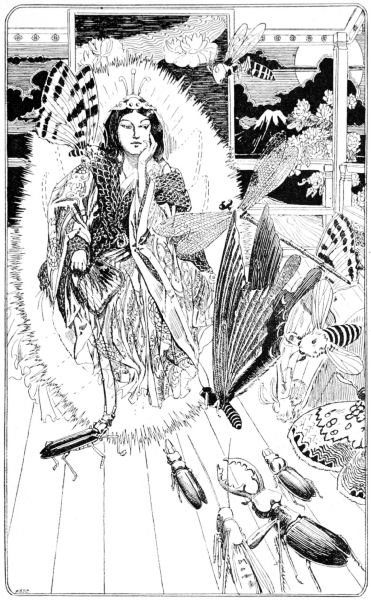
This weekend is the start of a prolonged Fourth of July celebration.  In some places fireworks are returning.   At the same time dry conditions and smoke from the widespread Canadian wildfires make fireworks unwise in many other locations.  Either way, nature is trying to bring us the unpredictable fireworks of the firefly.  Look outside when it's dark and enjoy the display of Lightning Bugs or Fireflies.  They are believed to be declining.  At one point their gathering for scientific study and also pesticide spraying made me believe it, too, but I live in a semi-rural area and now think they may be returning.  Over the centuries fireflies have fascinated people.  The Japanese legend has been translated many times.  I found four stories of the same legend in early Twentieth Century anthologies, but my favorite retelling was in The Turquoise Story Book, an anthology of summer stories by the Skinner sisters, Ada and Eleanor, which I've credited here before.  In their table of contents they credit the retelling to Frank Rinder.  A bit of further searching finds he was both an artist and a writer with his longer, but still poetic version of the story in his anthology, Old-World Japan; Legends of the Land of the Gods.  Surprisingly he chose artist T.H. Robinson to illustrate the book, but Rinder was also "art critic of the Glasgow Herald, and a writer on and collector of primarily early 20th Century prints", so that may explain his choice.  I think the story stands well enough on its own, but it does show the style of "Old-World Japan."

My only additional comment is I had to look up what a cockchafer is.  Wikipedia says it is "colloquially called the Maybug, Maybeetle, or doodlebug, is a species of scarab beetle."

Princess Fire-Fly


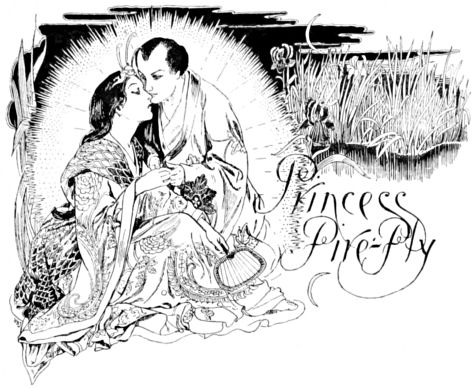
Decorative title - Princess Fire-Fly

DEEP in the pinky petals of a lotus bloom that grew in the castle moats of Fukui, in Echizen, lived Hi-O, the King of the Fire-Flies. In this beautiful flower his daughter, the Princess Hotaru, passed her childhood exploring every shady nook and fragrant corner of the bell-like palace, listening to the buzz of life around, and peeping over the edge of the petals at the wonderful world which lay mysteriously beyond. Hotaru-Himé had few youthful companions, but, as she daily bade her father farewell, she dreamed of the time when she, too, would fly abroad, and her brilliant light would attract universal admiration.

Gradually, a beautiful sheen o’erspread her body; night by night it became brighter, until at last her home, in the hours of darkness, was as a globe of coral wherein shone a lamp of gold. So glorious was her light that the stars paled before it, and the bright sickle moon withdrew behind a cloud from jealousy.

Himé was now allowed to fly from her home, to loiter among the pleasant rice fields, and to explore the indigo meadows which lay far off on the horizon. She had no lack of friends and would-be lovers; thousands of insects, attracted by her magic light, came and offered their homage, but Himé never forgot that she was of royal blood, and, while she haughtily thanked her many suitors, none found a way into her heart.

But the Princess whispered to herself, “Only he who loves me more than life shall call me bride.”

One evening the Princess, seated on a throne formed by the heart of the lotus, held her court. Soon the faint roseate petals of the flower were thronged with a host of ardent lovers. But the Princess whispered to herself, “Only he who loves me more than life shall call me bride.”

The golden beetle laid his fortunes at her feet, the cockchafer wooed her in passionate words, the dragon-fly proudly proffered his hand, and the hawk-moth humbly, yet persistently, addressed her. Countless other insects gained audience, but her answer was ever the same, “Go, and bring me fire, and I will be your bride.”

One by one they took wing, enraptured by the hope of success, and unconscious that they were all bent on the self-same errand. The hawk-moth entered the Buddhist Temple and circled round and round the tall wax lights, until, in an ecstasy of love, he flew into the flame, exclaiming, “Now to win the Princess or meet my death!” His poor singed body fell heavily to the ground. The beetle watched intently, for a moment or two,  the log fire crackling on the hearth, and then, regardless of his fate, boldly caught at a tongue of flame he hoped to carry to Himé—but his end was that of the hawk-moth. The dragon-fly, notwithstanding his sunlit splendours, could not fulfil the bidding of the Lady of the Lotus Bloom; he also fell a prey to her imperious command. Other lovers there were who tried to steal from the diamond his heart of fire, who winged their way to the summit of Fukui, or sped to the depths of the valleys in search of the talisman that was to make Himé their bride. The sun rose in morning splendour over untold numbers of dead bodies, which alone remained to tell of the great devotion that had inspired the lovers of Princess Hotaru.

Now tidings came to Hi-Maro, a Prince of the Fire-Flies living hard by, that the Princess Hotaru was exceedingly beautiful; whereupon he flew swiftly to her home among the lotus flowers. Even as, with a flood of golden light, he entered, the charms of Himé were not dimmed. One look passed between the youth and the maiden, and then each felt that a great love filled their hearts. Hi-Maro wooed and wed, and for many years lived happily with Hotaru-Himé in the castle moats of Fukui.

Centuries have passed since Hi-Maro won his bride, and still the dazzling fire-fly Princesses send their insect lovers in search of fire.

****

As other insects fly into your fires or lights and you see the fireflies winking on and off, I hope you will remember this legend...and also watch out for the demands of beautiful princesses.

**************************

This is part of a series of postings of stories under the category, "Keeping the Public in Public Domain."  The idea behind Public Domain was to preserve our cultural heritage after the authors and their immediate heirs were compensated.  I feel strongly current copyright law delays this intent on works of the 20th century.  My own library of folklore includes so many books within the Public Domain I decided to share stories from them.  I hope you enjoy discovering new stories.  


At the same time, my own involvement in storytelling regularly creates projects requiring research as part of my sharing stories with an audience.  Whenever that research needs to be shown here, the publishing of Public Domain stories will not occur that week.  This is a return to my regular posting of a research project here.  (Don't worry, this isn't dry research, my research is always geared towards future storytelling to an audience.)  Response has convinced me that "Keeping the Public in Public Domain" should continue along with my other postings as often as I can manage it.

Other Public Domain story resources I recommend-

  • There are many online resources for Public Domain stories, maybe none for folklore is as ambitious as fellow storyteller, Yoel Perez's database, Yashpeh, the International Folktales Collection.  I have long recommended it and continue to do so.  He has loaded Stith Thompson's Motif Index into his server as a database so you can search the whole 6 volumes for whatever word or expression you like by pressing one key. http://folkmasa.org/motiv/motif.htm

  • You may have noticed I'm no longer certain Dr. Perez has the largest database, although his offering the Motif Index certainly qualifies for those of us seeking specific types of stories.  There's another site, FairyTalez claiming to be the largest, with "over 2000 fairy tales, folktales, and fables" and they are "fully optimized for phones, tablets, and PCs", free and presented without ads.
    Between those two sites, there is much for story-lovers, but as they say in infomercials, "Wait, there's more!"

The email list for storytellers, Storytell, discussed Online Story Sources and came up with these additional suggestions:        

         - David K. Brown - http://people.ucalgary.ca/~dkbrown/stories.html

         - Richard Martin - http://www.tellatale.eu/tales_page.html

         - Spirit of Trees - http://spiritoftrees.org/featured-folktales

         - Story-Lovers - http://www.story-lovers.com/ is now only accessible through the Wayback Machine, described below, but the late Jackie Baldwin's wonderful site lives on there, fully searchable manually (the Google search doesn't work), at https://archive.org/ .  It's not easy, but go to Story-lovers.com snapshot for December 22 2016  and you can click on SOS: Searching Out Stories to scroll down through the many story topics and click on the story topic that interests you.

       - World of Tales - http://www.worldoftales.com/ 

 
           - Zalka Csenge Virag - http://multicoloreddiary.blogspot.com doesn't give the actual stories, but her recommendations, working her way through each country on a continent, give excellent ideas for finding new books and stories to love and tell.

     
You're going to find many of the links on these sites have gone down, BUT go to the Internet Archive Wayback Machine to find some of these old links.  Tim's site, for example, is so huge probably updating it would be a full-time job.  In the case of Story-Lovers, it's great that Jackie Baldwin set it up to stay online as long as it did after she could no longer maintain it.  Possibly searches maintained it.  Unfortunately Storytell list member, Papa Joe is on both Tim Sheppard's site and Story-Lovers, but he no longer maintains his old Papa Joe's Traveling Storytelling Show website and his Library (something you want to see!) is now only on the Wayback Machine.  It took some patience working back through claims of snapshots but finally in December of 2006 it appears!

    Somebody as of this writing whose stories can still be found by his website is the late Chuck Larkin - http://chucklarkin.com/stories.html.  I prefer to list these sites by their complete address so they can be found by the Wayback Machine, a.k.a. Archive.org, when that becomes the only way to find them.

You can see why I recommend these to you. 

Have fun discovering even more stories

Friday, August 19, 2022

Miller - The Boy and the Moonlight - Keeping the Public in Public Domain


 "ART FOR ALL!"  That's the rallying cry of Michigan Arts Access throughout last weekend's annual Teacher and Artist Retreat at Higgins Lake.  I was the only one officially bringing storytelling as a literary art, but often was teamed up in my original field of training, theatre.  Michigan Arts Access puts its mission up front and throughout its work:
 Michigan Arts Access is a non-profit organization promoting creativity, education and accessibility to the arts for people with disabilities by creating an inclusive society where they may participate in, learn through, excel in and enjoy the arts.

Or to put it more clearly - All means All!

Whether that means children in Special Education or adults living with disabilities it may seem to have been achieved, but Michigan has about 200,000 Special Education students, yet less than 10% have any access to the arts.  Without MIAA it would be closer to 1%.  For disabled adults, once they reach age 26, eligibility for public school programs end and almost no social, creative, or intellectual opportunities exist.  MIAA now offers Club Create in 7 areas for adults: Copper Country (Hancock), Genesee County (Flint), Ingham County (Lansing), Mid-Michigan (Mount Pleasant), North Oakland County (Lake Orion), Upper Peninsula (Marquette) and Wayne County (Detroit). 

I've had years of residency in Special Education classes in Genesse, Oakland, and Wayne Counties, but starting last autumn and this past year I've had the opportunity to bring storytelling and crafts to the adults in Club Create.  Challenges and delight in all these settings convince me of their value and the need for even more opportunities.

Storytelling, as I said, is a literary art.  Often I try to find a story that fits a theme or a curriculum need. I confess too rarely I think of poetry, especially the Japanese form of Haiku, yet today's story convinces me I'm missing something.  Olive Beaupre Miller is the editor of Little Pictures of Japan and says "Anyone may write verses in Japan, -- that is, anyone who listens with all his heart to the song of the nightingale among the flowers, to the voice of the frogs in a star-lit pool, and the music of the wind, singing in the trees."  She goes on to point out how it is practiced by all ages and written everywhere ..."embroidered screens, on cups and plates, on painted fans, on towels, on handkerchiefs, -- in fact, they write verses anywhere!"  I confess in the past I've skipped through three-fourths of the book as it's filled with those verses, skipping past the merry pages of haiku to the back where stories of the poets, mainly Basho, appear.  Maybe it was all the associating with the other arts, visual, music, dance, and, yes, theatre that led me to this story of the boyhood of the poet, Yone Noguchi, and what influenced him.


Miller has many poems about the moon, although I didn't find any by Noguchi.  This poem however seems to fit today's story.

Tree Shadows

All hushed the trees are waiting
On tiptoe for the sight
Of moonrise shedding splendor
Across the dusk of night.
Ah, now the moon is risen, 
And lo, without a sound
The trees all write their welcome
Far along the ground!

The rhyme in that poem makes me wonder about the accuracy of its translation, but it does seem to catch what the young poet, Yone Noguchi, might have felt.

While prowling through the book I found another that seems to match the way so much of this summer has been for so many.

A Hot Night

O summer moon, we pray,
Open the wind-bag of the gods,
And let the breezes play.
May the moon and arts brighten your life and the lives of all.
 
*********************

This is part of a series of postings of stories under the category, "Keeping the Public in Public Domain."  The idea behind Public Domain was to preserve our cultural heritage after the authors and their immediate heirs were compensated.  I feel strongly current copyright law delays this intent on works of the 20th century.  My own library of folklore includes so many books within the Public Domain I decided to share stories from them.  I hope you enjoy discovering new stories.  


At the same time, my own involvement in storytelling regularly creates projects requiring research as part of my sharing stories with an audience.  Whenever that research needs to be shown here, the publishing of Public Domain stories will not occur that week.  This is a return to my regular posting of a research project here.  (Don't worry, this isn't dry research, my research is always geared towards future storytelling to an audience.)  Response has convinced me that "Keeping the Public in Public Domain" should continue along with my other postings as often as I can manage it.

Other Public Domain story resources I recommend-

  • There are many online resources for Public Domain stories, maybe none for folklore is as ambitious as fellow storyteller, Yoel Perez's database, Yashpeh, the International Folktales Collection.  I have long recommended it and continue to do so.  He has loaded Stith Thompson's Motif Index into his server as a database so you can search the whole 6 volumes for whatever word or expression you like by pressing one key. http://folkmasa.org/motiv/motif.htm

  • You may have noticed I'm no longer certain Dr. Perez has the largest database, although his offering the Motif Index certainly qualifies for those of us seeking specific types of stories.  There's another site, FairyTalez claiming to be the largest, with "over 2000 fairy tales, folktales, and fables" and they are "fully optimized for phones, tablets, and PCs", free and presented without ads.
    Between those two sites, there is much for story-lovers, but as they say in infomercials, "Wait, there's more!"

The email list for storytellers, Storytell, discussed Online Story Sources and came up with these additional suggestions:        

         - David K. Brown - http://people.ucalgary.ca/~dkbrown/stories.html

         - Richard Martin - http://www.tellatale.eu/tales_page.html

         - Spirit of Trees - http://spiritoftrees.org/featured-folktales

         - Story-Lovers - http://www.story-lovers.com/ is now only accessible through the Wayback Machine, described below, but the late Jackie Baldwin's wonderful site lives on there, fully searchable manually (the Google search doesn't work), at https://archive.org/ .  It's not easy, but go to Story-lovers.com snapshot for October 22 2016  and you can click on SOS: Searching Out Stories to scroll down through the many story topics and click on the story topic that interests you.

       - World of Tales - http://www.worldoftales.com/ 

 
           - Zalka Csenge Virag - http://multicoloreddiary.blogspot.com doesn't give the actual stories, but her recommendations, working her way through each country on a continent, give excellent ideas for finding new books and stories to love and tell.

     
You're going to find many of the links on these sites have gone down, BUT go to the Internet Archive Wayback Machine to find some of these old links.  Tim's site, for example, is so huge probably updating it would be a full-time job.  In the case of Story-Lovers, it's great that Jackie Baldwin set it up to stay online as long as it did after she could no longer maintain it.  Possibly searches maintained it.  Unfortunately Storytell list member, Papa Joe is on both Tim Sheppard's site and Story-Lovers, but he no longer maintains his old Papa Joe's Traveling Storytelling Show website and his Library (something you want to see!) is now only on the Wayback Machine.  It took some patience working back through claims of snapshots but finally in December of 2006 it appears!

    Somebody as of this writing whose stories can still be found by his website is the late Chuck Larkin - http://chucklarkin.com/stories.html.  I prefer to list these sites by their complete address so they can be found by the Wayback Machine, a.k.a. Archive.org, when that becomes the only way to find them.

You can see why I recommend these to you. 

Have fun discovering even more stories