Tell me if you have a topic you'd like to see. (Contact: LoiS-sez@LoiS-sez.com .)
Please also let others know about this site.
Showing posts with label Birthdays. Show all posts

Friday, November 1, 2024

Alcott - Old Major - Keeping the Public in Public Domain

Today (November 2) is both my birthday and time to get ready for next week's Children's Book Week (November 4-10). I'm surprised to find I've never posted about Children's Book Week before. Here are a few facts about its own birth.

From the Bettmann Archive

The idea that children were banned from public libraries positively is astounding! Today's author, Louisa May Alcott, was a popular author long before Children's Book Week and children finally were allowed in libraries. She was both an activist for abolition, feminism, temperance, and women's suffrage, writing for both adults and children. It's strange today to learn according to that Wikipedia article:

Alcott had little interest in writing for children, but saw it as a good financial opportunity.[158] She felt that writing children's literature was tedious.[220] Alcott biographer Ruth K. MacDonald suggests that Alcott's hesitance to write children's novels may have arisen from the societal perception that writing for children was a means by which poor women made money.[220]

She's best known today for her three book series that began with Little Women, but she was very much an aunt to her niece, Lulu, producing Aunt Jo's Scrap-Bag (1872–1882). (66 short stories in six volumes)and later Lulu's Library (1886–1889). 

Today's story came from my search for stories about birthdays. This unusual birthday present is from volume 4, My Girls, in the Aunt Jo's Scrap-Bag series. While it shows yet another cause Alcott supported, humane treatment of animals, it is presented in a way children would view it.  

When storytelling a literary tale, unless it is extremely short, memorization is not recommended for most storytellers. Instead I would tell its source so that listeners may go back to it. In this story, I would write out the "eppytap" or "eppytarf", as the children in the story call it, and let the audience read it while I read it aloud. It provides an excellent end to the boy's birthday present.

OLD MAJOR.

"O, mamma, don't let them kill him! He isn't doing any harm, and he's old and weak, and hasn't any one to be good to him but Posy and me!" cried little Ned, bursting into his mother's room, red and breathless with anxiety and haste.

"Kill whom, dear? Sit down and tell me all about it."

"I can't sit down, and I must be quick, for they may do it while I'm gone. I left Posy to watch him, and she is going to scream with all her might the minute she sees them coming back!" cried Ned, hovering restlessly about the doorway, as if expecting the call that was to summon him to the rescue.

"Mercy on us! what is it, child?"

"A dear old horse, mamma, who has been hobbling round the road for a week. I've seen him driven away from all the neighbors, so Posy and I give him clover and pat him; and to-day we found him at our bars, looking over at us playing in the field. I wanted him to come in, but Mr. White came along and drove him off, and said he was to be killed because he had no master, and was a nuisance. Don't let him do it!"

"But, Neddy, I cannot take him in, as I did the lame chicken, and the cat without a tail. He is too big, and eats too much, and we have no barn. Mr. White can find his master, perhaps, or use him for light work."

Mamma got no further, for Ned said again,—

"No, he can't. He says the poor old thing is of no use but to boil up. And his master won't be found, because he has gone away, and left Major to take care of himself. Mr. White knew the man, and says he had Major more than eighteen years, and he was a good horse, and now he's left to die all alone. Wouldn't I like to pound that man?"

"It was cruel, Neddy, and we must see what we can do."

So mamma put down her work and followed her boy, who raced before her to tell Posy it would be "all right" now.

Mrs. West found her small daughter perched on a stone wall, patting the head of an old white horse, who looked more like a skeleton than a living animal. Ned gave a whoop as he came, and the poor beast hastily hobbled across the road, pressing himself into a nook full of blackberry vines and thorny barberry bushes, as if trying to get out of sight and escape tormentors.

"That's the way he does when any one comes, because the boys plague him, and people drive him about till he doesn't know what to do. Isn't it a pity to see him so, mamma?" said tender-hearted Ned, as he pulled a big handful of clover from his father's field close by.

Indeed, it was sad, for the poor thing had evidently been a fine horse once; one could see that by his intelligent eye, the way he pricked up his ears, and the sorrowful sort of dignity with which he looked about him, as if asking a little compassion in memory of his long faithfulness.

"See his poor legs all swelled up, and the bones in his back, and the burrs the bad boys put in his mane, and the dusty grass he has to eat. Look! he knows me, and isn't afraid, because I'm good to him," said Ned, patting old Major, who gratefully ate fresh clover from the friendly little hand.

"Yes, and he lets me stroke his nose, mamma. It's as soft as velvet, and his big eyes don't frighten me a bit, they are so gentle. Oh, if we could only put him in our field, and keep him till he dies, I should be so happy!" said Posy, with such a wheedlesome arm about mamma's neck, that it was very hard to deny her any thing.

"If you will let me have Major, I won't ask for any other birthday present," cried Ned, with a sudden burst of generosity, inspired, perhaps, by the confiding way in which the poor beast rubbed his gray head against the boy's shoulder.

"Why, Neddy, do you really mean that? I was going to give you something you want very much. Shall I take you at your word, and give you a worn-out old horse instead?" asked mamma, surprised, yet pleased at the offer.

Ned looked at her, then at old Major, and wavered; for he guessed that the other gift was the little wheelbarrow he had begged for so long,—the dear green one, with the delicious creak and rumble to it. He had seen it at the store, and tried it, and longed for it, and planned to trundle every thing in it, from Posy to a load of hay. Yes, it must be his, and Major must be left to his fate.

Just as he decided this, however, Posy gave a cry that told him Mr. White was coming. Major pressed further into the prickly hedge, with a patient sort of sigh, and a look that went to Ned's heart, for it seemed to say,—

"Good by, little friend. Don't give up any thing for me. I'm not worth it, for I can only love you in return."

Mr. White was very near, but Major was safe; for, with a sudden red in his freckled cheeks, Ned put his arm on the poor beast's drooping neck, and said, manfully,—

"I choose him, mamma; and now he's mine, I'd like to see anybody touch him!"

It was a pretty sight,—the generous little lad befriending the old horse, and loving him for pure pity's sake, in the sweet childish way we so soon forget.

Posy clapped her hands, mamma smiled, with a bright look at her boy, while Mr. White threw over his arm the halter, with which he was about to lead Major to his doom, and hastened to say,—

"I don't want to hurt the poor critter, ma'am, but he's no mortal use, and folks complain of his being in the way; so I thought the kindest thing was to put him out of his misery."

"Does he suffer, do you think? for if so, it would be no kindness to keep him alive," said mamma.

"Well, no, I don't suppose he suffers except for food and a little care; but if he can't have 'em, it will go hard with him," answered Mr. White, wondering if the old fellow had any work in him still.

"He never should have been left in this forlorn way. Those who had had his youth and strength should have cared for him in his age;" and Mrs. West looked indignant.

"So they should, ma'am; but Miller was a mean man, and when he moved, he just left the old horse to live or die, though he told me, himself, that Major had served him well, for nigh on to twenty years. What do you calculate to do about it, ma'am?" asked Mr. White, in a hurry to be off.

"I'll show you, sir. Ned, let down the bars, and lead old Major in. That shall be his home while he lives, for so faithful a servant has earned his rest, and he shall have it."

Something in the ring of mamma's voice and the gesture of her hand made Ned's eyes kindle, and Mr. White walk away, saying, affably,—

"All right, ma'am; I haven't a word to say against it."

But somehow Mr. White's big barn did not look as handsome to him as usual when he remembered that his neighbor, who had no barn at all, had taken in the friendless horse.

It was difficult to make Major enter the field; for he had been turned out of so many, driven away from so many lawns, and even begrudged the scanty pickings of the roadside, that he could not understand the invitation given him to enter and take possession of a great, green field, with apple trees for shade, and a brook babbling through the middle of it.

When at last he ventured over the bars, it was both sad and funny to see how hard he tried to enjoy himself and express his delight.

First, he sniffed the air, then he nibbled the sweet grass, took a long look about him, and astonished the children by lying down with a groan, and trying to roll. He could not do it, however, so lay still with his head stretched out, gently flapping his tail as if to say,—

"It's all right, my dears. I'm not very strong, and joy upsets me; but I'm quite comfortable, bless you!"

"Isn't it nice to see him, all safe and happy, mamma?" sighed Posy, folding her hands in childish satisfaction, while Ned sat down beside his horse, and began to take the burrs out of his mane.

"Very nice, only don't kill him with kindness, and be careful not to get hurt," answered mamma, as she went back to her work, feeling as if she had bought an elephant, and didn't know what to do with him.

Later in the day a sudden shower came up, and mamma looked about to be sure her little people were under cover, for they played out all day long, if possible. No chickens could the maternal hen find to gather under her wings, and so went clucking anxiously about till Sally, the cook, said, with a laugh,—

"Ned's down in the pastur', mum, holding an umberella over that old horse, and he's got a waterproof on him, too. Calvin see it, and 'most died a-laughing."

Mamma laughed too, but asked if Ned had on his rubber boots and coat.

"Yes, mum, I see him start all in his wet-weather rig, but I never mistrusted what the dear was up to till Calvin told me. Posy wanted to go, but I wouldn't let her, so she went to the upper window, where she can see the critter under his umberella."

Mamma went up to find her little girl surveying the droll prospect with solemn satisfaction; for there in the field, under the apple tree, stood Major, blanketed with the old waterproof, while his new master held an umbrella over his aged head with a patient devotion that would have endeared him to the heart of good Mr. Bergh.

Fortunately the shower was soon over, and Ned came in to dry himself, quite unconscious of any thing funny in his proceedings. Mamma kept perfectly sober while she proposed to build a rough shed for Major out of some boards on the place. Ned was full of interest at once; and with some help from Calvin, the corner under the apple tree was so sheltered that there would be no need of the umbrella hereafter.

So Major lived in clover, and was a happy horse; for Cockletop, the lame chicken, and Bobtail, the cat, welcomed him to their refuge, and soon became fast friends. Cockle chased grasshoppers or pecked about him with meditative clucks as he fed; while Bob rubbed against his legs, slept in his shed, and nibbled catnip socially as often as his constitution needed it.

But Major loved the children best, and they took good care of him, though some of their kind attentions might have proved fatal if the wise old beast had not been more prudent than they. It was pleasant to see him watch for them, with ears cocked at the first sound of the little voices, his dim eyes brightening at sight of the round faces peeping over the wall, and feeble limbs stirred into sudden activity by the beckoning of a childish hand.

The neighbors laughed at Ned, yet liked him all the better for the lesson in kindness he had taught them; and a time came when even Mr. White showed his respect for old Major.

All that summer Neddy's horse took his rest in the green meadow, but it was evident that he was failing fast, and that his "good time" came too late. Mamma prepared the children for the end as well as she could, and would have spared them the sorrow of parting by having Major killed quietly, if Ned had not begged so hard to let his horse die naturally; for age was the only disease, and Major seemed to suffer little pain, though he daily grew more weak, and lame, and blind.

One morning when the children went to carry him a soft, warm mash for breakfast, they found him dead; not in the shed, where they had left him warmly covered, but at the low place in the wall where they always got over to visit him.

There he lay, with head outstretched, as if his last desire had been to get as near them as possible, his last breath spent in thanking them. They liked to think that he crept there to say good by, and took great comfort in the memory of all they had done for him.

They cried over him tenderly, even while they agreed that it was better for him to die; and then they covered him with green boughs, after Ned had smoothed his coat for the last time, and Posy cut a lock from his mane to make mourning rings of.

Calvin said he would attend to the funeral, and went off to dig the grave in a lonely place behind the sand-bank. Ned declared that he could not have his horse dragged away and tumbled into a hole, but must see him buried in a proper manner; and mamma, with the utmost kindness, said she would provide all that was needed.

The hour was set at four in the afternoon, and the two little mourners, provided with large handkerchiefs, Ned, with a black bow on his arm, and Posy in a crape veil, went to drop a last tear over their departed friend.

At the appointed time Calvin appeared, followed by Mr. White, with a drag drawn by black Bill. This delicate attention touched Neddy; for it might have been bay Kitty, and that would have marred the solemnity of the scene.

As the funeral train passed the house on its way down the lane, mamma, with another crape veil on, came out and joined the procession, so full of sympathy that the children felt deeply grateful.

The October woods were gay with red and yellow leaves, that rustled softly as they went through the wood; and when they came to the grave, Ned thanked Calvin for choosing such a pretty place. A pine sighed overhead, late asters waved beside it, and poor Major's last bed was made soft with hemlock boughs.

When he was laid in it, mamma bade them leave the old waterproof that had served for a pall still about him, and then they showered in bright leaves till nothing was visible but a glimpse of the dear white tail.

The earth was thrown in, green sods heaped over it, and then the men departed, feeling that the mourners would like to linger a little while.

As he left, Mr. White said, with the same gravity which he had preserved all through the scene,—

"You are welcome to the use of the team and my time, ma'am. I don't wish any pay for 'em; in fact, I should feel more comfortable to do this job for old Major quite free and hearty."

Mamma thanked him, and when he was gone, Ned proposed that they should sing a hymn, and Posy added, "They always sing, 'Sister, thou art mild and lovely' at funerals, you know."

Mamma with difficulty kept sober at this idea but suggested the song about "Good old Charlie," as more appropriate. So it was sung with great feeling, and then Posy said, as she "wiped her weeping eyes,"—

"Now, Ned, show mamma our eppytap."

"She means eppytarf," explained Ned, with a superior air, as he produced a board, on which he had printed with India ink the following words,—


"Here lies dear old Major. He was a good horse when he was young. But people were not kind to him when he was old. We made him as happy as we could. He loved us, and we mourn for him. Amen."


Ned's knowledge of epitaphs was very slight, so he asked mamma if this one would do; and she answered warmly,—

"It is a very good one; for it has what many lack,—the merit of being true. Put it up, dear, and I'll make a wreath to hang on the gravestone."

Much gratified, Ned planted the board at the head of the grave, Posy gathered the brightest leaves, and mamma made a lovely garland in which to frame the "eppytap."

Then they left old Major to his rest, feeling sure that somewhere there must be a lower heaven for the souls of brave and faithful animals when their unrewarded work is done.

Many children went to see that lonely grave, but not one of them disturbed a leaf, or laughed at the little epitaph that preached them a sermon from the text,—

"Blessed are the merciful."


*****

Over the years I have adopted many animals, dogs, cats (now off limits due to allergies), goats, and chickens. I'm told C.S. Lewis said they must be waiting for us in heaven because without them heaven wouldn't be heavenly. I've not been able to find that quote and would appreciate it if anybody could help me find it. I certainly agree.

*********

This is part of a series of postings of stories under the category, “Keeping the Public in Public Domain.” The idea behind Public Domain was to preserve our cultural heritage after the authors and their immediate heirs were compensated. I feel strongly current copyright law delays this intent on works of the 20th century. My own library of folklore includes so many books within the Public Domain I decided to share stories from them. I hope you enjoy discovering them.

At the same time, my own involvement in storytelling regularly creates projects requiring research as part of my sharing stories with an audience.  Whenever that research needs to be shown here, the publishing of Public Domain stories will not occur that week.  This is a return to my regular posting of a research project here.  (Don't worry, this isn't dry research, my research is always geared towards future storytelling to an audience.)  Response has convinced me that "Keeping the Public in Public Domain" should continue along with my other postings as often as I can manage it.

See the sidebar for other Public Domain story resources I recommend on the page “PublicDomain Story Resources."

Friday, November 3, 2023

Sangster - A Birthday Party - Keeping the Public in Public Domain

It wasn't a surprise party, more like when we could get the three with birthdays that fell within a month together.  There was a gathering at a nearby Chinese buffet, so the three of us and other family members could have exactly what we wanted to eat.  The Birthday song wasn't sung, but a lot of conversation and the restaurant's festive lighting made it special.  (The lights were probably originally for a Christmas tree, constantly changing colors.)  

Over the centuries people have celebrated birthdays in far humbler ways.  I found a story dating back over a century ago.  The language at times is most charitably called "quaint."  To re-tell the story to today's audiences, I would certainly change some of it.  What I wouldn't change is the idea behind it.  Because the author, Margaret Elizabeth Sangster, was often involved with religious publications or volunteer work, it's not surprising that she weaves in a bit of Luke, chapter 14, that comes right before the parable about "The Great Banquet."  She also was a poet, so when a poem is inserted in the story, the storyteller could reach in a basket or purse to bring it out and read it.  (The poem's formatting didn't transfer well from the Gutenberg reprint, so I put it all in bold.)  Sangster's party is much more personal than the Biblical banquet, with a story of how family and friends manage to turn a birthday into a celebration even though very little money is available.  It's a perfect example of "It's the thought that counts."

Unnamed illustrator's frontispiece from Holiday Stories for Young People compiled & edited by M.E. Sangster

A Birthday Story.

BY MRS. M.E. SANGSTER.

Jack Hillyard turned over in his hand the few bits of silver which he had taken from his little tin savings-bank. There were not very many of them, a ten cent piece, a quarter, half a dollar and an old silver six-pence. And he had been saving them up a long, long time.

"Well," said Jack to himself, soberly, "there aren't enough to buy mother a silk dress, but I think I'll ask Cousin Susy, if she won't spend my money and get up a birthday party for the darling little mother. A birthday cake, with, let me see, thirty-six candles, that'll be a lot, three rows deep, and a big bunch of flowers, and a book. Mother's never had a birthday party that I remember. She's always been so awfully busy working hard for us, and so awfully tired when night came, but I mean her to have one now, or my name's not Jack."

Away went Jack to consult Cousin Susy.

He found her very much occupied with her dressmaking, for she made new gowns and capes for all the ladies in town, and she was finishing up Miss Kitty Hardy's wedding outfit. With her mouth full of pins, Cousin Susy could not talk, but her brown eyes beamed on Jack as she listened to his plan. At last she took all the pins out of her mouth, and said:

"Leave it all to me, Jack. We'll give her a surprise party; I'll see about everything, dear. Whom shall we ask?"

"When thou makest a dinner or a supper," said Jack, repeating his golden text of the last Sunday's lesson, "call not thy friends, nor thy kinsmen, nor thy rich neighbors, lest they also bid thee again and a recompense be made thee. But when thou makest a feast, call the poor, the maimed, the lame, the blind, and thou shalt be blessed, for they cannot recompense thee."

"Jack! Jack! Jack!" exclaimed Cousin Susy.

"I was only repeating my last golden text," answered Jack. "We don't often have to give a feast, and as it was so extraordinary," said Jack, saying the big word impressively, "I thought of my verse. I suppose we'd better ask the people mother likes, and they are the poor, the halt, the blind, and the deaf; for we haven't any rich neighbors, nor any kinsmen, except you, dear Cousin Susy."

"Well, I'm a kinswoman and a neighbor, dear, but I'm not rich. Now, let me see," said Miss Susy, smoothing out the shining white folds of Kitty Hardy's train. "We will send notes, and you must write them. There is old Ralph, the peddler, who is too deaf to hear if you shout at him ever and ever so much, but he'll enjoy seeing a good time; and we'll have Florrie Maynard, with her crutches and her banjo, and she'll have a happy time and sing for us; and Mrs. Maloney, the laundress, with her blind Patsy. I don't see Jackie, but you'll have a Scripture party after all. Run along and write your letters, and to-night we'll trot around and deliver them."

This was the letter Jack wrote:

"Dear Friend:—My mother's going to have a birthday next Saturday night, and she'll be thirty-six years old. That's pretty old. So I'm going to give her a surprise birthday party, and Cousin Susy's helping me with the surprise. Please come and help too, at eight o'clock sharp.

"Yours truly,

"Jack".

When this note was received everybody decided to go, and, which Jack did not expect, everybody decided to take a present along.

"You'll spend all my money, won't you?" said Jack.

"Certainly, my boy, I will, every penny. Except, perhaps, the old silver sixpence. Suppose we give that to the mother as a keepsake?"

"Very well, you know best. All I want is that she shall have a good time, a very good time. She's such a good mother."

"Jack," said Susy, "you make me think of some verses I saw in a book the other day. Let me read them to you." And Cousin Susy, who had a way of copying favorite poems and keeping them, fished out this one from her basket:

    LITTLE HANS.

    Little Hans was helping mother 


    Carry home the lady's basket;  


    Chubby hands of course were lifting  


    One great handle—can you ask it?  


    As he tugged away beside her,  


    Feeling oh! so brave and strong,  


    Little Hans was softly singing  


    To himself a little song:

    "Some time I'll be tall as father,  

    Though I think it's very funny,  

    And I'll work and build big houses,  

    And give mother all the money,  

    For," and little Hans stopped singing, 

    Feeling oh! so strong and grand, 

    "I have got the sweetest mother  

    You can find in all the land."

Now, some people couldn't do very much with the funds at Cousin Susy's disposal, but she could, and when Jack's money was spent for refreshments what do you think they had? Why, a great big pan of gingerbread, all marked out in squares with the knife, and raisins in it; and a round loaf of cup cake, frosted over with sugar, with thirty-six tiny tapers all ready to light, and a pitcher of lemonade, a plate of apples, and a big platter of popped corn.

Jack danced for joy, but softly, for mother had come home from her day's work and was tired, and the party was to be a surprise, and she was not to be allowed to step into the little square parlor.

That parlor was the pride of Jack and his mother. It had a bright rag carpet, a table with a marble top, six chairs, and a stool called an ottoman. On the wall between the windows hung a framed picture of Jack's dear father, who was in heaven, and over the mantelpiece there was a framed bouquet of flowers, embroidered by Jack's mother on white satin, when she had been a girl at school.

"Seems to me, Jack," said Mrs. Hillyard as she sat down in the kitchen to her cup of tea, "there is a smell of fresh gingerbread; I wonder who's having company."

Jack almost bit his tongue trying not to laugh.

"Oh!" said he grandly, "gingerbread isn't anything, mamma. When I'm a man you shall have pound-cake every day for breakfast."

By and by Mrs. Maloney and Patsy dropped in.

"I thought," said Mrs. Maloney, "it was kind o'lonesome-like at home, and I'd step in and see you and Jack to-night, ma'am."

"That was very kind," replied Mrs. Hillyard.

"Why, here comes Mr. Ralph," she added. "Well the more the merrier!"

Tap, tap, tap.

The neighbors kept coming, and coming, and Jack grew more and more excited, till at last when all were present, Cousin Susy, opening the parlor door, displayed the marble-top of the table covered with a white cloth, and there were the refreshments.

"A happy birthday, mother."

"Many returns."

"May you live a hundred years."

One and another had some kind word to say, and each gave a present, a card, or a flower, or a trifle of some sort, but with so much good will and love that Mrs. Hillyard's face beamed. All day she stood behind a counter in a great big shop, and worked hard for her bread and Jack's, but when evening came she was a queen at home with her boy and her friends to pay her honor.

"And were you surprised, and did you like the cake and the thirty-six candles, dearest, darling mamma?" said Jack, when everybody had gone home.

"Yes, my own manly little laddie, I liked everything, and I was never so surprised in my life." So the birthday party was a great success.


May you, too, enjoy many happy birthdays and other intimate celebrations.  Whether it happens in a restaurant or a private location, "It's the thought that counts."

*********

This is part of a series of postings of stories under the category, "Keeping the Public in Public Domain."  The idea behind Public Domain was to preserve our cultural heritage after the authors and their immediate heirs were compensated.  I feel strongly current copyright law delays this intent on works of the 20th century.  My own library of folklore includes so many books within the Public Domain I decided to share stories from them.  I hope you enjoy discovering new stories.  


At the same time, my own involvement in storytelling regularly creates projects requiring research as part of my sharing stories with an audience.  Whenever that research needs to be shown here, the publishing of Public Domain stories will not occur that week.  This is a return to my regular posting of a research project here.  (Don't worry, this isn't dry research, my research is always geared towards future storytelling to an audience.)  Response has convinced me that "Keeping the Public in Public Domain" should continue along with my other postings as often as I can manage it.

Other Public Domain story resources I recommend-

  • There are many online resources for Public Domain stories, maybe none for folklore is as ambitious as fellow storyteller, Yoel Perez's database, Yashpeh, the International Folktales Collection.  I have long recommended it and continue to do so.  He has loaded Stith Thompson's Motif Index into his server as a database so you can search the whole 6 volumes for whatever word or expression you like by pressing one key. http://folkmasa.org/motiv/motif.htm

  • You may have noticed I'm no longer certain Dr. Perez has the largest database, although his offering the Motif Index certainly qualifies for those of us seeking specific types of stories.  There's another site, FairyTalez claiming to be the largest, with "over 2000 fairy tales, folktales, and fables" and they are "fully optimized for phones, tablets, and PCs", free and presented without ads.
    Between those two sites, there is much for story-lovers, but as they say in infomercials, "Wait, there's more!"

The email list for storytellers, Storytell, discussed Online Story Sources and came up with these additional suggestions:        

         - David K. Brown - http://people.ucalgary.ca/~dkbrown/stories.html

         - Richard Martin - http://www.tellatale.eu/tales_page.html

         - Spirit of Trees - http://spiritoftrees.org/featured-folktales

         - Story-Lovers - http://www.story-lovers.com/ is now only accessible through the Wayback Machine, described below, but the late Jackie Baldwin's wonderful site lives on there, fully searchable manually (the Google search doesn't work), at https://archive.org/ .  It's not easy, but go to Story-lovers.com snapshot for December 22 2016  and you can click on SOS: Searching Out Stories to scroll down through the many story topics and click on the story topic that interests you.

       - World of Tales - http://www.worldoftales.com/ 

 
           - Zalka Csenge Virag - http://multicoloreddiary.blogspot.com doesn't give the actual stories, but her recommendations, working her way through each country on a continent, give excellent ideas for finding new books and stories to love and tell.

     
You're going to find many of the links on these sites have gone down, BUT go to the Internet Archive Wayback Machine to find some of these old links.  Tim's site, for example, is so huge probably updating it would be a full-time job.  In the case of Story-Lovers, it's great that Jackie Baldwin set it up to stay online as long as it did after she could no longer maintain it.  Possibly searches maintained it.  Unfortunately Storytell list member, Papa Joe is on both Tim Sheppard's site and Story-Lovers, but he no longer maintains his old Papa Joe's Traveling Storytelling Show website and his Library (something you want to see!) is now only on the Wayback Machine.  It took some patience working back through claims of snapshots but finally in December of 2006 it appears!

    Somebody as of this writing whose stories can still be found by his website is the late Chuck Larkin - http://chucklarkin.com/stories.html.  I prefer to list these sites by their complete address so they can be found by the Wayback Machine, a.k.a. Archive.org, when that becomes the only way to find them.

You can see why I recommend these to you. 

Have fun discovering even more stories


Saturday, November 5, 2016

The Birthday Dragon!

This past week has been one of those millstone, er milestone, birthdays.  What better way to celebrate than with a dragon?!  I love dragons and dragon stories, so I want to share both a bit of non-fattening dragon birthday cake
and a story about dragons and birthdays.  It comes in "bare bones" format to let you personalize it from a storytelling colleague active in the state of Georgia, Janice Butts.  Here's a photo of Janice in a beloved purple hat.  There's a story also about the photo.  When I contacted Janice for permission to use her telling of the story, she said:

I am sure it is dated now, but the hat was a gift from a friend to 'her favorite storyteller', so it makes me feel very professional.  I assume you can get it from my website. If not, we may have a problem, because I lost the hard drive recently with all those pictures.
 Again, enjoy the story.  I look forward to finding this on your blog.

Let's face it, we store all our memories these days on devices that can easily lose everything in a crash.  I'm going to give her photo here and, after the story, I'll give you a way to recover photos you may have sent out into the world online. 

Now let's gobble up the story as Janice shared it long ago.

The Birthday Dragon

(Janice opened with this disclaimer:
You are most welcome to use it in any way you see fit.  I got the idea from a children’s book.  I no longer remember the original or know where to find it.)


When telling this Janice personalizes it, using the name of the person celebrating their birthday for "child."

Child lives in poor village at the bottom of a mountain.  The whole community is poor because they don't have enough water to grow good crops.  When it is time for her birthday, child's mother says she can ask anyone she wants to her birthday party.  Child wants the dragon who lives at the top of mountain, as child has never met him, but heard lots of scary stories.

Mother refuses, but child decides to go find said dragon and invite him to party.  Child climbs the mountain 3 times, first 2 times dragon's fiery breath does not allow child to get near.  Third time, child manages to invite dragon to party.  He is touched and agrees, invites child to ride down the mountain on his back.  As they take off, his tail knocks away rocks that have been holding back a stream and brings water down with them.  Dragon is welcomed because of the water, and all live happily.  Each year since then the community has celebrated child's birthday because child brought water to them.

Janice closes with. . . what else? the song, Happy Birthday. 

LoiS here again.  Yes, you can sing that song without fear of royalty problems.  Back on October 2, 2015 I was able to report here the following wonderful news: I'll try to avoid my rant about copyright here -- the end of my Keeping the Public in Public Domain segments clearly shows my sentiments -- but I'm ecstatic about this long overdue ruling!  Warner/Chappell earned $2 million a year on a song dating back to their piano arrangement in 1935.  Most or all of that money will never be repaid.  Thank heavens the public kept the song alive.  Public Domain was intended to keep our cultural heritage alive, which Sonny Bono and his 1998 Copyright Term Extension Act, saving Micky Mouse from entering the Public Domain, has gone a long way away from that intent. 

I will add to that, the same corporate interests that went into the 1998 Copyright Term Extension Act want to see the Trans Pacific Partnership approved.  TPP is even worse because it will remove control of copyright from the control of the signing countries and make it no longer governed by the affected countries.  For World Read Aloud Day this year I explored the issue including also Intellectual Property and Digital Rights.  Take a look at the link to that article, because it will give you other resources to look into the issues which can affect us all.

Similarly the crash of a computer can be devastating, losing beloved photos.  I recommend regular back-ups.  Personally I use Carbonite because it covers so much inexpensively and without my needing to remember to do something.  Many of us have pictures on the internet, possibly Facebook or Google Plus or . . .   Performers put them on websites and are sometimes in articles.  (I HATE photos taken of me, but it's a necessity in my work.)  Here's an easy way to recover those online photos.  Search your name on Google.  In Janice's case, I added "storyteller" to avoid any others with her name.  I didn't trust my memory to find her website again and that was what I was seeking at first.  It didn't on the 1st page give me her site, BUT it included images!  When I went to her site, the purple hat pic she wanted me to use wasn't there BUT it was right there on the Google Images.  Clicked on the photo, then Save Image As, and it went to my Downloads.  An easy way for you to prowl the many images of yourself online and also save many of those photos you lost when your hard drive was lost!

I was happy to return the favor Janice did with today's story and guess there will always be a BUT or a Butt somewhere online.  For fun and even to buy her enjoyable CD, "Livin' Above Her Raisin'; Stories of the Blue Ridge Mountains", be sure to go to her site linked in my first paragraph above.

There's another local storyteller who also loves dragons I've mentioned here before, Loretta Vitek, has in her email signature the perfect things to end today's article. 
There is always a story, be a shame not to share it!
Do not meddle in the affairs of Dragons,
for thou would be crispy & good with sauce.
Arriverdella


Saturday, January 9, 2016

Bailey - The Birthday Stick - Keeping the Public in Public Domain

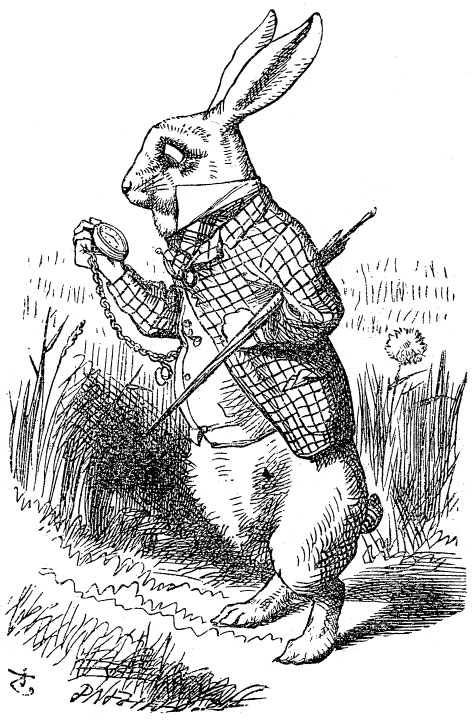
The White Rabbit by John Tenniel
Let's hear it for Un-Birthdays with today's story!  If it should actually be your birthday, here's a story about measuring up to be the best you can be...sounds like all those New Year's Resolutions. 

I want to say more after the story (which isn't from Alice in Wonderland) about a great Alice in Wonderland site, because the concept of Un-birthdays originated in Lewis Carroll's wonderful nonsense.  It might be called "illogic", but there's always a ring of truth in his work and shouldn't be dismissed as just for children. 

Before today's story, at the risk of saying this twice like the White Rabbit, "I'm late! I'm late", that's what made me look for a birthday story.  Too often I'm late getting out birthday wishes.  It's especially bad, not just for me, but for most people when it comes close to those with end of the year birthdays around the holidays.  I posted earlier this week on Facebook an apology to friends with birthdays recently.  It's no excuse, but I said: You are probably used to it, since the holidays get everybody's attention, but I've a few other things happening, too, so I feel like I've been worse than usual at wishing you had a great birthday. Happy Un-Birthday!"

I've often posted stories by Carolyn Sherwin Bailey as she not only published a great deal, but her writing is fairly close to being tellable without a lot of changes.  She knew how to reach an audience and wrote a lot on seasonal and special times of the year.  In fact earlier I gave a birthday story by her, "The Princess Who Saw Herself", about a tomboy of a princess I called "not your typical fairy tale princess, but more of a terror of a princess."  Here's a prince receiving a birthday present that, like the fairy godmother's gift in "Sleeping Beauty", is not what was expected.  Since New Year's and Birthdays are milestones, they're a perfect time to see if we are measuring up to all we might be.  That's the theme behind today's story from Bailey.  She calls it a folk tale but doesn't give the source.  Maybe it is, but it's also very much from the fortunate Miss Bailey.


Photograph of Lenny
Lenny de Rooy, creator of Alice-in-Wonderland.net
So if today should actually be your birthday, consider this your special present.  For the rest of us, let's enjoy our Un-birthday!  If you're at all interested in Alice in Wonderland, I recommend Alice-in-Wonderland.net/ where you can find so much for lovers of the original story and more.  That "more" includes not only Alice in Wonderland, and the sequel of Through the Looking Glass, complete with a lost chapter, and even the original manuscript which started it all, but also The Nursery ‘Alice’, Alice’s Adventures in Wonderland retold for children ‘from nought to five’, but as they say on t.v. "infomercials", That's Not All!  Disney's movie script and illustrations are given along with all the wonderful illustrations by John Tenniel, complete with information about him and also Alice Liddell, Carroll's inspiration for the stories.  There are other things like quotes, links, and trivia, enough to satisfy serious researchers, but also resources to throw your own Mad Tea Party, even ideas for an Alice inspired Christmas tree, playing cards, a store to purchase Alice items, a forum, and the blog by Lenny de Rooy, the site creator.  


“But I don’t want to go among mad people,” Alice remarked.
“Oh, you can’t help that,” said the Cat: “we’re all mad here. I’m mad. You’re mad.”
“How do you know I’m mad?” said Alice.
“You must be,” said the Cat, “or you wouldn’t have come here.”
 

******************
Don't go away mad.  Come back next week to see what's here.

This is part of a series of postings of stories under the category, "Keeping the Public in Public Domain."  The idea behind Public Domain was to preserve our cultural heritage after the authors and their immediate heirs were compensated.  I feel strongly current copyright law delays this intent on works of the 20th century.  My own library of folklore includes so many books within the Public Domain I decided to share stories from them.  I hope you enjoy discovering new stories.  


At the same time, my own involvement in storytelling regularly creates projects requiring research as part of my sharing stories with an audience.  Whenever that research needs to be shown here, the publishing of Public Domain stories will not occur that week.  This is a return to my regular posting of a research project here.  (Don't worry, this isn't dry research, my research is always geared towards future storytelling to an audience.)  Response has convinced me that "Keeping the Public in Public Domain" should continue along with my other postings as often as I can manage it.  


There are many online resources for Public Domain stories, none for folklore is as ambitious as fellow storyteller, Yoel Perez's database, Yashpeh, the International Folktales Collection.  I recommended it earlier and want to continue to do so.  He has just loaded Stith Thompson's Motif Index into his server as a database so one can search the whole 6 volumes for whatever word or expression he likes by pressing one key. http://folkmasa.org/motiv/motif.htm

He also loaded to his server the doctorate thesis of Prof. Dov Noy (Neunan) "Motif-index of Talmudic-Midrahic literature" Indiana University, 1954, as a PDF file.
in the hope that some of you would make use of it.

You can see why that is a site I recommend to you.

Have fun discovering even more stories!

Saturday, June 1, 2013

Bailey - The Princess Who Saw Herself - Keeping the Public in Public Domain

Carolyn Sherwin Bailey is both an award-winning author and a fine anthologist.  She won the Newbery Award for her children's novel, Miss Hickory and also is the author of the classic picture book, The Little Rabbit Who Wanted Red Wings.  I always know any anthology she put together will contain gems. Because she was also a teacher (also a principal and writer for both storytellers and educators), the stories tend to have a lesson included in the tale.

This is a story I discovered while seeking material for storytelling at a birthday party.  This eight year-old tomboy is not your typical fairy tale princess, but more of a terror of a princess. 


The fun is definitely in those early stages, but, when the princess realizes what it takes to be recognized as a princess, the reward comes swiftly.  After all, she may be a tomboy, but if she knows what it takes to win a prize she goes after it and wins it.

Both the  books I named at the beginning were written in the mid-1940s and are not yet in Public Domain, but ReadBookOnline.net lets you read many of her stories.  I noticed they included "Birthday of the Infanta", which is by Oscar Wilde.  The story actually is re-told by Ms. Bailey and her books always noted original authors, while making a story more easily tellable. 

I'm going to include a second and very unusual princess story by Ms. Bailey next time.  It's a glimpse of the variety found in her anthologies.
****
This is part of a series of bi-weekly posting of stories under the category, "Keeping the Public in Public Domain."  The idea behind Public Domain was to preserve our cultural heritage after the authors and their immediate heirs were compensated.  I feel strongly current copyright law delays this intent on works of the 20th century.  I hope you enjoy discovering new stories. 

Currently I'm involved in projects taking me out of my usual work of sharing stories with an audience.  My own library of folklore includes so many books within the Public Domain I decided to share stories from them.  This fall I expect to return to my normal monthly posting of a research project here.  Depending on response, I will decide at that time if "Keeping the Public in Public Domain" should continue along with my monthly postings.