Tell me if you have a topic you'd like to see. (Contact: LoiS-sez@LoiS-sez.com .)
Please also let others know about this site.
Showing posts with label Seneca folklore. Show all posts

Friday, January 27, 2023

The First Winter - Ada and Eleanor Skinner/ William Walker Canfield - Keeping the Public in Public Domain

Personal update upfront: Those experimental Covid pills worked!  I'm testing negative and will N95mask for 5 days just in case.  The "mild cold" disappeared with the pills although there's a trace of dizziness lurking in my inner ears.  

Here in metro Detroit we finally got our first real snowstorm and this Iroquois legend has much to teach us.  I went first to the wonderful seasonal books by the Skinner sisters, each labeled for a gem and they truly are gems!  Their story comes from The Pearl Story Book: Stories and Legends of Winter, Christmas & New Year's DayBut my search went further using their acknowledgements to find W.W. Canfield's The Legends of the Iroquois; Told by "The Cornplanter".  Because there are differences I'm giving both to show how the story changed.  I will start with the Skinner adapted version.  

THE FIRST WINTER

(Iroquois Legend)

There was a time when the days were always of the same length, and it was always summer. The red men lived continually in the smile of the Great Spirit and were happy. But there arose a chief who was so powerful that he at last declared himself mightier than the Great Spirit, and taught his brothers to go forth to the plain and mock him. They would call upon the Great Spirit to come and fight with them or would challenge him to take away the crop of growing corn or drive the game from the woods. They would say he was an unkind father to keep himself and their dead brothers in the Happy Hunting Grounds, where the red men could hunt forever without weariness.

They laughed at their old men who had feared for so many moons to reproach the Great Spirit for his unfair treatment of the Indians who were compelled to hunt and fish for game for their wives and children, while their own women had to plant the corn and harvest it.

“In the Happy Hunting Grounds,” they said, “the Great Spirit feeds our brothers and their wives and does not let any foes or dangers come upon them, but here he lets us go hungry many times. If he is as great as you have said, why does he not take care of his children here?”

Then the Great Spirit told them he would turn his smiling face away from them, so that they should have no more light and warmth and they must build fires in the forest if they would see.

But the red men laughed and taunted him, telling him that he had followed one trail so long that he could not get out of it, but would have to come every day and give them light and heat as usual. Then they would dance and make faces at him and taunt him with his helplessness.

In a few days the quick eyes of some of the red men saw in the morning the face of the Great Spirit appear where it was not wont to appear, but they were silent, fearing the jibes of their brothers. Finally, duller eyes noticed the change, and alarm and consternation spread among the people. Each day brought less and less of the Great Spirit’s smile and his countenance was often hidden by dark clouds, while terrible storms beat upon the frightened faces turned in appeal toward the heavens. The strong braves and warriors became as women; the old men covered their heads with skins and starved in the forests; while the women in their lodges crooned the low, mournful wail of the death song. Frosts and snows came upon an unsheltered and stricken race, and many of them perished.

Then the Great Spirit, who had almost removed his face from the sight of men, had pity and told them he would come back. Day after day the few that remained alive watched with joy the return of the sun. They sang in praise of the approaching summer and once more hailed with thankfulness the first blades of growing corn as it burst from the ground. The Great Spirit told his children that every year, as a punishment for the insults they had given their Father, they should feel for a season the might of the power they had mocked; and they murmured not, but bowed their heads in meekness.

***

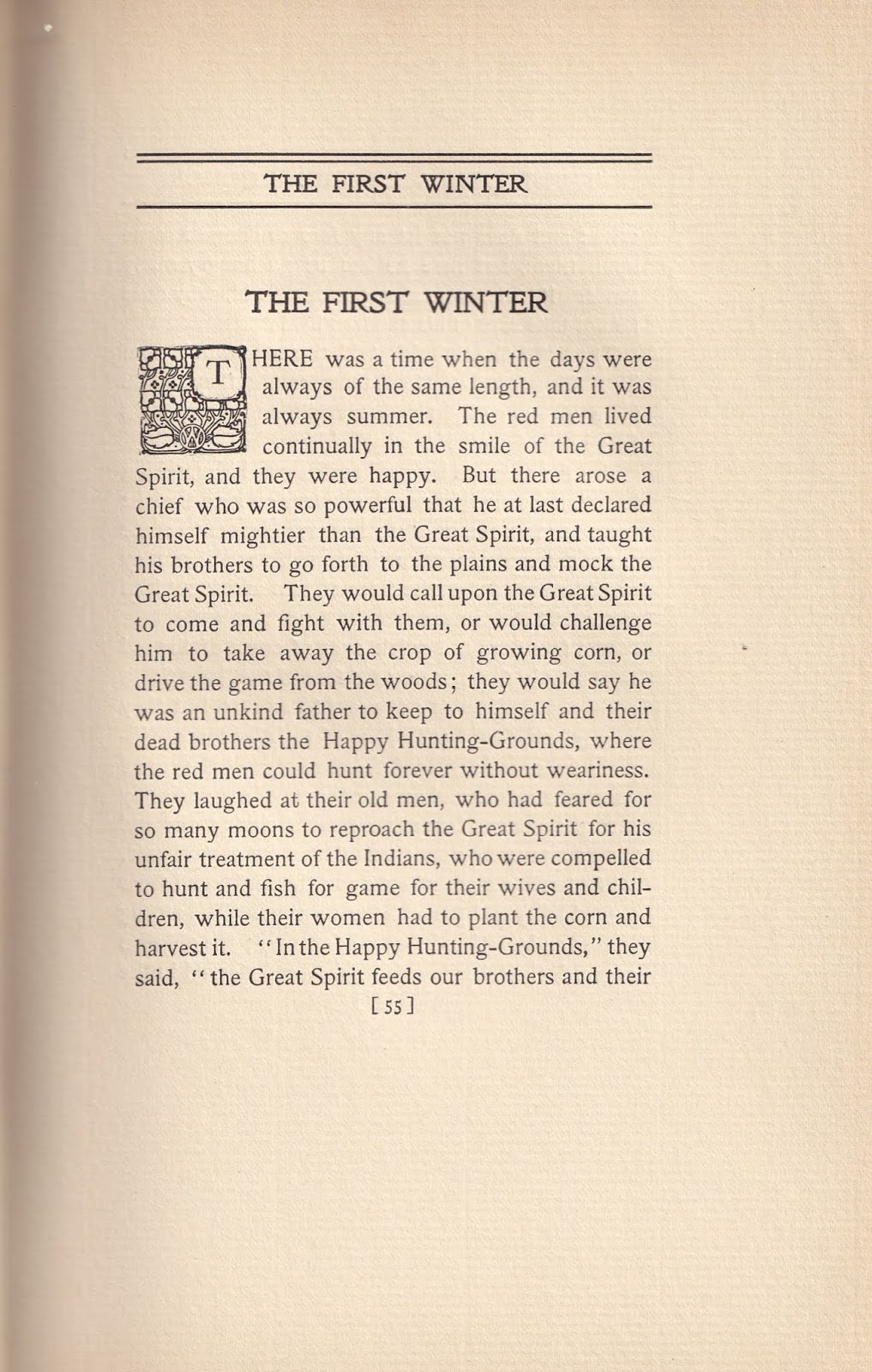
The Skinner sisters, Ada Maria and Eleanor Louise in their acknowledgements section of The Pearl Story Book: Stories & Legends of Winter, Christmas & New Year's Day credit W.W. Canfield and I was able to track down his The Legends of the Iroquois; Told by "The Cornplanter".  I want to show this version told by the Seneca chief known as The Cornplanter.  It is slightly different, but worth looking at the original traditional version.

THE FIRST WINTER

T

HERE was a time when the days were always of the same length, and it was always summer. The red men lived continually in the smile of the Great Spirit, and they were happy. But there arose a chief who was so powerful that he at last declared himself mightier than the Great Spirit, and taught his brothers to go forth to the plains and mock the Great Spirit. They would call upon the Great Spirit to come and fight with them, or would challenge him to take away the crop of growing corn, or drive the game from the woods; they would say he was an unkind father to keep to himself and their dead brothers the Happy Hunting-Grounds, where the red men could hunt forever without weariness. They laughed at their old men, who had feared for so many moons to reproach the Great Spirit for his unfair treatment of the Indians, who were compelled to hunt and fish for game for their wives and children, while their women had to plant the corn and harvest it. "In the Happy Hunting-Grounds," they said, "the Great Spirit feeds our brothers and their wives and does not let any foes or dangers come upon them, but here he lets us go hungry many times. If he is as great as you have said, why does he not take care of his children here?"

Then the Great Spirit told them he would turn his smiling face away from them, so that they should have no more light and warmth, and must build fires in the forests if they would see.

But the red men laughed and taunted him, telling him that he had followed one trail so long that he could not get out of it, but would have to come every day and give them light and heat. Then they would dance and make faces at him and taunt him with his helplessness.

In a few days the quick eyes of some of the red men saw in the morning the face of the Great Spirit appear where it was not wont to appear, but they were silent, fearing the jibes of their brothers. Finally duller eyes noticed the change, and alarm and consternation spread among the people. Each day brought less and less of the Great Spirit's smile and his countenance was often hidden by dark clouds, while terrible storms beat upon the frightened faces turned in appeal toward the heavens. The strong braves and warriors became as women; the old men covered their heads with skins and starved in the forests; while the women in their lodges crooned the low, mournful wail of the death-song, and the papooses crawled among the caves in the rocks and mountains and died unheeded. Frosts and snows came upon an unsheltered and stricken race, and many of them perished.

Then the Great Spirit, who had almost removed his face from the sight of the red men, had pity, and told them he would come back. Day after day the few that remained alive watched with joy the return of the sun. They sang in praise of the approaching summer, and once more hailed with thankfulness the first blades of growing corn as it burst from the ground. The Great Spirit told his children that every year, as a punishment for the insults they had given their Father, they should feel for a season the might of the power they had mocked; and they murmured not, but bowed their heads in meekness.

From the bodies of those who had perished of cold and hunger sprang all manner of poisonous plants, which spread themselves over the earth to vex and endanger the lives of the Indians of all generations; and in after years when any of the Indians from any reason "ate of the fatal root," it was said of them that they had "eaten of the bodies of their brothers who had defied the Great Spirit."

***

Be careful of how you interpret the weather.  If there's one thing it's guaranteed to do . . . it's change!  Until our days get much longer, let's remember this wisdom of when that respect was missing.

****************

This is part of a series of postings of stories under the category, "Keeping the Public in Public Domain."  The idea behind Public Domain was to preserve our cultural heritage after the authors and their immediate heirs were compensated.  I feel strongly current copyright law delays this intent on works of the 20th century.  My own library of folklore includes so many books within the Public Domain I decided to share stories from them.  I hope you enjoy discovering new stories.  


At the same time, my own involvement in storytelling regularly creates projects requiring research as part of my sharing stories with an audience.  Whenever that research needs to be shown here, the publishing of Public Domain stories will not occur that week.  This is a return to my regular posting of a research project here.  (Don't worry, this isn't dry research, my research is always geared towards future storytelling to an audience.)  Response has convinced me that "Keeping the Public in Public Domain" should continue along with my other postings as often as I can manage it.

Other Public Domain story resources I recommend-

  • There are many online resources for Public Domain stories, maybe none for folklore is as ambitious as fellow storyteller, Yoel Perez's database, Yashpeh, the International Folktales Collection.  I have long recommended it and continue to do so.  He has loaded Stith Thompson's Motif Index into his server as a database so you can search the whole 6 volumes for whatever word or expression you like by pressing one key. http://folkmasa.org/motiv/motif.htm

  • You may have noticed I'm no longer certain Dr. Perez has the largest database, although his offering the Motif Index certainly qualifies for those of us seeking specific types of stories.  There's another site, FairyTalez claiming to be the largest, with "over 2000 fairy tales, folktales, and fables" and they are "fully optimized for phones, tablets, and PCs", free and presented without ads.
    Between those two sites, there is much for story-lovers, but as they say in infomercials, "Wait, there's more!"

The email list for storytellers, Storytell, discussed Online Story Sources and came up with these additional suggestions:        

         - David K. Brown - http://people.ucalgary.ca/~dkbrown/stories.html

         - Richard Martin - http://www.tellatale.eu/tales_page.html

         - Spirit of Trees - http://spiritoftrees.org/featured-folktales

         - Story-Lovers - http://www.story-lovers.com/ is now only accessible through the Wayback Machine, described below, but the late Jackie Baldwin's wonderful site lives on there, fully searchable manually (the Google search doesn't work), at https://archive.org/ .  It's not easy, but go to Story-lovers.com snapshot for October 22 2016  and you can click on SOS: Searching Out Stories to scroll down through the many story topics and click on the story topic that interests you.

       - World of Tales - http://www.worldoftales.com/ 

 
           - Zalka Csenge Virag - http://multicoloreddiary.blogspot.com doesn't give the actual stories, but her recommendations, working her way through each country on a continent, give excellent ideas for finding new books and stories to love and tell.

     
You're going to find many of the links on these sites have gone down, BUT go to the Internet Archive Wayback Machine to find some of these old links.  Tim's site, for example, is so huge probably updating it would be a full-time job.  In the case of Story-Lovers, it's great that Jackie Baldwin set it up to stay online as long as it did after she could no longer maintain it.  Possibly searches maintained it.  Unfortunately Storytell list member, Papa Joe is on both Tim Sheppard's site and Story-Lovers, but he no longer maintains his old Papa Joe's Traveling Storytelling Show website and his Library (something you want to see!) is now only on the Wayback Machine.  It took some patience working back through claims of snapshots but finally in December of 2006 it appears!

    Somebody as of this writing whose stories can still be found by his website is the late Chuck Larkin - http://chucklarkin.com/stories.html.  I prefer to list these sites by their complete address so they can be found by the Wayback Machine, a.k.a. Archive.org, when that becomes the only way to find them.

You can see why I recommend these to you. 

Have fun discovering even more stories

Friday, April 8, 2022

Parker - How the Conifers Flaunt the Promise of Spring - Keeping the Public in Public Domain

Anthropologist and museum director, Arthur C. Parker, was from an important Seneca family on his father's side and wrote over the years about the Seneca along with the rest of the Iroquois Confederacy.  He was one of the founders of the Society of American Indians, the first national organization run by and for Native Americans and it also aimed to "educate the public about Native Americans."  I have long enjoyed three of his books, Seneca Myths & Folk Tales and Skunny Wundy; Seneca Indian Tales (both now in Public Domain); and Rumbling Wings and Other Indian Tales (which won't yet enter Public Domain for another two years).  As a children's librarian I first discovered him through his highly approachable Skunny Wundy, and think of it and today's story as I watch my oak trees begin to bud.  I also find it an interesting allegory of resistance to what seems like overwhelming attack.

Photo by Ira Huz on Unsplash

I confess it, I hate seeing the oak's brown leaves of winter, so while this gives the hope of spring, the story also explains their drab, stubborn leaves that cling through that long season.


I found myself wondering about the Tamarack.  There are various Michigan places named Tamarack, including the Tamarack District Library in Lakeview, Michigan, where I've presented two of my historical programs.  But I wasn't sure I knew what a Tamarack looked like.  It's always good research to start with the simple overview on Wikipedia.  There I learned it was also called a larch and the wood is so good for making snowshoes that "The word akemantak is an Algonquian name for the species and means 'wood used for snowshoes'."  Looking at the article's photos I still didn't know enough to identify it, although I began to realize it may be more often grown north of my metro Detroit location.  The Arborsmith LTD's tree of the month article was far more helpful, showing it in spring, telling of its color change in autumn, and a photo of it bare in winter in addition to explaining more about the tree.  

A further resource is "Get to Know Your Buds" from the Overton Park Conservancy.

Personally I'm delighted to see my oak trees budding and find the story of the two trees also a good allegory with the resilience of the Oak showing its determination to withstand attacks.

Overton Park photo of Red Oak buds
******************
This is part of a series of postings of stories under the category, "Keeping the Public in Public Domain."  The idea behind Public Domain was to preserve our cultural heritage after the authors and their immediate heirs were compensated.  I feel strongly current copyright law delays this intent on works of the 20th century.  My own library of folklore includes so many books within the Public Domain I decided to share stories from them.  I hope you enjoy discovering new stories.  


At the same time, my own involvement in storytelling regularly creates projects requiring research as part of my sharing stories with an audience.  Whenever that research needs to be shown here, the publishing of Public Domain stories will not occur that week.  This is a return to my regular posting of a research project here.  (Don't worry, this isn't dry research, my research is always geared towards future storytelling to an audience.)  Response has convinced me that "Keeping the Public in Public Domain" should continue along with my other postings as often as I can manage it.
Other Public Domain story resources I recommend-
  • There are many online resources for Public Domain stories, maybe none for folklore is as ambitious as fellow storyteller, Yoel Perez's database, Yashpeh, the International Folktales Collection.  I have long recommended it and continue to do so.  He has loaded Stith Thompson's Motif Index into his server as a database so you can search the whole 6 volumes for whatever word or expression you like by pressing one key. http://folkmasa.org/motiv/motif.htm
  • You may have noticed I'm no longer certain Dr. Perez has the largest database, although his offering the Motif Index certainly qualifies for those of us seeking specific types of stories.  There's another site, FairyTalez claiming to be the largest, with "over 2000 fairy tales, folktales, and fables" and they are "fully optimized for phones, tablets, and PCs", free and presented without ads.

    Between those two sites, there is much for story-lovers, but as they say in infomercials, "Wait, there's more!"
The email list for storytellers, Storytell, discussed Online Story Sources and came up with these additional suggestions:            
         - David K. Brown - http://people.ucalgary.ca/~dkbrown/stories.html
         - Richard Martin - http://www.tellatale.eu/tales_page.html
         - Spirit of Trees - http://spiritoftrees.org/featured-folktales
         - Story-Lovers - http://www.story-lovers.com/ is now only accessible through the Wayback Machine, described below, but the late Jackie Baldwin's wonderful site lives on there, fully searchable manually (the Google search doesn't work), at https://archive.org/ .  It's not easy, but go to Story-lovers.com snapshot for October 22 2016  and you can click on SOS: Searching Out Stories to scroll down through the many story topics and click on the story topic that interests you.
       - World of Tales - http://www.worldoftales.com/ 
           - Zalka Csenge Virag - http://multicoloreddiary.blogspot.com doesn't give the actual stories, but her recommendations, working her way through each country on a continent, give excellent ideas for finding new books and stories to love and tell.
     
You're going to find many of the links on these sites have gone down, BUT go to the Internet Archive Wayback Machine to find some of these old links.  Tim's site, for example, is so huge probably updating it would be a full-time job.  In the case of Story-Lovers, it's great that Jackie Baldwin set it up to stay online as long as it did after she could no longer maintain it.  Possibly searches maintained it.  Unfortunately Storytell list member, Papa Joe is on both Tim Sheppard's site and Story-Lovers, but he no longer maintains his old Papa Joe's Traveling Storytelling Show website and his Library (something you want to see!) is now only on the Wayback Machine.  It took some patience working back through claims of snapshots but finally in December of 2006 it appears!
    Somebody as of this writing whose stories can still be found by his website is the late Chuck Larkin - http://chucklarkin.com/stories.html.  I prefer to list these sites by their complete address so they can be found by the Wayback Machine, a.k.a. Archive.org, when that becomes the only way to find them.
You can see why I recommend these to you. Have fun discovering even more stories!

Friday, November 19, 2021

Parker - Corn Rains Into Empty Barrels - Keeping the Public in Public Domain

Choosing from the four corners of our nation four stories is bound to be entirely too small a glance at the richness of Native American folklore.  Even the wealth to be found in any one direction is like attempting to see one person from outer space.  The best I can do is choose a specific nation, in the same way Canada refers to their first confederations of people as the First Nations.  With Thanksgiving this weekend a few thoughts helped direct me to a story.  While I don't like calling it "Turkey Day", Thanksgiving certainly has a large focus on food.  

The holiday began in the East, so that felt like the appropriate direction for this week.  Taking a quick look at that Wikipedia link I find, of course, a religious group like the Pilgrims were frequent in giving thanks, but this particular celebration was after their first harvest in their new home and it lasted three days!  Not sure anybody other than grocery stores would be up to that nowadays.  There were 90 Wampanoag and 53 Pilgrims at that feast which certainly included corn.  

How much of that celebration do we really know correctly?  We've probably heard that Squanto taught the Pilgrims how to farm with the native corn crop, but have we heard his name was really Tisquantum?  Added to that I remember mentioning the idea of using aquarium water to fertilize while watering plants and that it was an idea dating back to that early corn crop.  The ladies I told this had never heard of it!  Nothing like a good fertilizing with fish poo!

How Well The Corn Prospered. Squanto or Tisquantum demonstrating corn he had fertilized by planting with fish.


When I tried to find any major collection of theWampanoag literature, I was puzzled to find only a few scattered tales.  Looking at the Wikipedia article and the condensed information on Warpaths2peacepipes.com it shows their near extermination in the years when Native American folklore was being collected.  Today they are gradually attempting to regain recognition, but a lack of cultural continuity, as opposed to assimilation, has slowed official federal and state recognition.  For the sake of letting the Wampanoag speak, I would like to feature something not among those few online scattered tales.  I haven't succeeded YET (maybe next year?)  I'll try to prowl my more general collections as time permits.

In the meantime the major eastern grouping of five, eventually six, nations is the Iroquois Confederacy or the Haudenosaunee.  There are many collections of their stories and some have been given here.  Of the entire Confederacy, the Seneca stories are my favorites.  You can attribute (or blame?) that on first meeting them in the children's anthology of Skunny Wundy: Seneca Indian Tales by Arthur C. Parker.  Parker was of both Seneca (including the Seneca chief, Ely) and Scottish-English descent with an outstanding career combining archaeology, museums (he was Director of Rochester Museum of Arts and Sciences) and folklore.  While Skunny Wundy is easily approached, I've chosen from his classic Seneca Myths & Folk Tales a story I think fits Thanksgiving and beyond.

CORN RAINS INTO EMPTY BARRELS.

At one time there was nothing to eat on all the earth. Nearly all the people had starved to death, and a few that remained gathered together on a high hill. They lived on boiled bark.

There was a certain young man who kept saying all the time, “It will be better after a while.” Nobody believed him because things were getting worse each day. His brother used to torture him with sharp stones and say harsh things to him. The young man, however, kept thinking that something would happen soon. After a while he heard footsteps, as if on a clean path. He listened for the span of a moon and then heard them running. He told the people but nobody believed him.

One morning while he sat in the doorway of his lodge with his head down on his knees, a young woman stood before him. He heard her breathe and looked up. She smiled and handed him a basket of bread. “My mother sent me to this lodge to find a young man,” she said. “My mother wants me to marry him.”

The people came out of the lodge and looked at the young woman and the young man’s mother asked from whence she had come. “I have come from the far south,” answered the girl. “There is plenty of food there.”

So the young man ate the bread and was married to the young woman from the south.

Then the young wife said, “My mother sent me to bring food to you. Let everybody take off the tops of their corn barrels and then enter the lodge and cover their faces.”

The sun had now come up and it was hot. The people did not like their faces covered, but soon they heard a sound like corn falling into their barrels. After a time the noise ceased and the young wife said, “It is finished now.”

Out into the shed went the people of the lodge and found the barrels full of shelled corn. Everybody ate and all were satisfied, except the younger brother, who threw his food into the fire and said he wanted game. Now the young wife had cooked the corn the young man threw away, and she was made sad by his action. So she said, “My husband, go to the river and get fish enough for the people.” But the younger brother said, “It is foolish to go to the river, for fish have deserted the river. There are none.” Nevertheless, the young husband went to the river and drew out enough fish for all the people. The younger brother was very angry.

The next day the husband went hunting and while he was absent the younger brother began to torment the young wife. “Your food is not good,” he said. “I cast your food away,” and again he threw food into the fire.

When the husband returned he found his wife crying and when he asked her what was troubling her she said, “Your younger brother has spoiled everything. He has rejected my food (speaking thereby the dissatisfaction of all the people). I shall now return to my home.”

The husband was very sad and begged her not to go, but his wife told him that her mother instructed her to return if she were abused. During the following night there was a sound of scraping in the corn barrels and in the morning when the women went for their corn it was all gone, and with it the bride had vanished.

After consultation the husband determined to search for his wife, and thus he set out on a long journey. At length he came to a region of great corn fields and after a while saw a high mound covered with corn plants. On this mound he found his wife and her mother. His wife showed him her body and it was burned and scarred. “This is what your brother did to me,” she said, “when he threw the corn into the fire. He would have killed me had I remained.”

After living in the south for several months the couple returned and found the people again starving. The young wife ordered them to open their corn barrels and hide their faces once again. They did so and shelled corn fell like rain into the barrels filling them to the top.

Then the young wife told the people that corn must never be wasted or thrown away for it is food and if destroyed will cause the crops to be poor and the corn to cease to yield.

*********

This story and the practical aspect of fertilizing corn with fish is only a small part of the important Native American relationship with corn.  Here among the Anishinaabeg I expected I had posted their story of how corn, or Mondaamin, came to become a major part of their diet.  It doesn't seem to be here.  Fortunately my live tellings in Jackson earlier this month did include it.  There's always another story to tell!

I guess that bottomless well of stories, coupled with the provision of food, is certainly a reason to be thankful.

******************

This is part of a series of postings of stories under the category, "Keeping the Public in Public Domain."  The idea behind Public Domain was to preserve our cultural heritage after the authors and their immediate heirs were compensated.  I feel strongly current copyright law delays this intent on works of the 20th century.  My own library of folklore includes so many books within the Public Domain I decided to share stories from them.  I hope you enjoy discovering new stories.  


At the same time, my own involvement in storytelling regularly creates projects requiring research as part of my sharing stories with an audience.  Whenever that research needs to be shown here, the publishing of Public Domain stories will not occur that week.  This is a return to my regular posting of a research project here.  (Don't worry, this isn't dry research, my research is always geared towards future storytelling to an audience.)  Response has convinced me that "Keeping the Public in Public Domain" should continue along with my other postings as often as I can manage it.
Other Public Domain story resources I recommend-
  • There are many online resources for Public Domain stories, maybe none for folklore is as ambitious as fellow storyteller, Yoel Perez's database, Yashpeh, the International Folktales Collection.  I have long recommended it and continue to do so.  He has loaded Stith Thompson's Motif Index into his server as a database so you can search the whole 6 volumes for whatever word or expression you like by pressing one key. http://folkmasa.org/motiv/motif.htm
  • You may have noticed I'm no longer certain Dr. Perez has the largest database, although his offering the Motif Index certainly qualifies for those of us seeking specific types of stories.  There's another site, FairyTalez claiming to be the largest, with "over 2000 fairy tales, folktales, and fables" and they are "fully optimized for phones, tablets, and PCs", free and presented without ads.

    Between those two sites, there is much for story-lovers, but as they say in infomercials, "Wait, there's more!"
The email list for storytellers, Storytell, discussed Online Story Sources and came up with these additional suggestions:            
         - David K. Brown - http://people.ucalgary.ca/~dkbrown/stories.html
         - Richard Martin - http://www.tellatale.eu/tales_page.html
         - Spirit of Trees - http://spiritoftrees.org/featured-folktales
         - Story-Lovers - http://www.story-lovers.com/ is now only accessible through the Wayback Machine, described below, but the late Jackie Baldwin's wonderful site lives on there, fully searchable manually (the Google search doesn't work), at https://archive.org/ .  It's not easy, but go to Story-lovers.com snapshot for October 22 2016  and you can click on SOS: Searching Out Stories to scroll down through the many story topics and click on the story topic that interests you.
       - World of Tales - http://www.worldoftales.com/ 
           - Zalka Csenge Virag - http://multicoloreddiary.blogspot.com doesn't give the actual stories, but her recommendations, working her way through each country on a continent, give excellent ideas for finding new books and stories to love and tell.
     
You're going to find many of the links on these sites have gone down, BUT go to the Internet Archive Wayback Machine to find some of these old links.  Tim's site, for example, is so huge probably updating it would be a full-time job.  In the case of Story-Lovers, it's great that Jackie Baldwin set it up to stay online as long as it did after she could no longer maintain it.  Possibly searches maintained it.  Unfortunately Storytell list member, Papa Joe is on both Tim Sheppard's site and Story-Lovers, but he no longer maintains his old Papa Joe's Traveling Storytelling Show website and his Library (something you want to see!) is now only on the Wayback Machine.  It took some patience working back through claims of snapshots but finally in December of 2006 it appears!
    Somebody as of this writing whose stories can still be found by his website is the late Chuck Larkin - http://chucklarkin.com/stories.html.  I prefer to list these sites by their complete address so they can be found by the Wayback Machine, a.k.a. Archive.org, when that becomes the only way to find them.
You can see why I recommend these to you. Have fun discovering even more stories!

Saturday, March 21, 2020

Parker - The Coming of Spring - Keeping the Public in Public Domain

The vernal equinox started in the U.S. Thursday, March 19 making it official, spring has arrived in the Northern Hemisphere with day and night roughly equal in length.  The Old Farmer's Almanac's website tells us the last time spring appeared this early was 1896, but don't get too excited, it's always either March 19, 20, or 21.  Three options, but it's also interesting that it won't happen again on March 21 until 2101.

Different people have different ways of feeling that spring has arrived in their area.

Alexas_Fotos / 21121 on Pixabay
This week I saw one in front of me.  I live near a golf course, but am not a golfer.  That course has been great for walking with my dog while winter closed it to golfers and days have been short.  Looks like I won't be able to walk it much longer as the lawns were looking green, flags were out at the holes, and the grounds crew had obviously been busy.  I guess you could switch the quote from The Field of Dreams to "If you groom it, they will come!"  Since a foursome is under the current suggested maximum of ten for social distancing, I suspect golf fanatics, known for even risking being struck by lightning, will take to the course.  Can't say for sure, but there's a snow and/or rainstorm working its way across the country.

Robins are often pointed to as a sign of spring.  Since they arrive even while snow still returns to Michigan, they're not a very reliable sign.  Michigan's first people, the Anishinaabe, also eagerly awaited spring's return to our mitten-shaped state.  Henry Rowe Schoolcraft  recorded some of those stories and the link to him here takes you to some, including one about our official state bird, the robin.

Stories travel.  The Anishinaabe tale of "Peboan and Seegwun" is such a favorite I've given it here twice!  Did our area's First People over on the western end of the Great Lakes influence the Seneca,  who were the farthest west of the eastern First People of the Iroquois Confederation.  The Seneca were located south of Lake Ontario, at the opposite, eastern end of the Great Lakes.  Did the Seneca influence our own "People of the Three Fires?"  I know the two nations weren't always friendly, but there's obvious similarity to our area's story in the tale recorded by Arthur C. Parker from Aurelia Miller one probably chilly January day in 1905 and published in his Seneca Myths & Folk Tales.  Whether you compare it to "Peboan and Seegwun" or not, I believe the imagery of the Seneca characters will stick with you because we all hope winter is ending and we are seeing "The Coming of Spring."

If you're looking for educational value, comparing the Seneca tale to "Peboan and Seegwun" is great for kids, but really that sounds like school.  Why spoil it?  Let's go back to that Old Farmer's Almanac article which asks "How Do YOU Celebrate the Vernal Equinox?" then answers it with Observe nature around you! and comes up with seven ideas to do it.

Their ideas aren't incompatible with "social distancing" and even work if you are in quarantine.  Then when spring showers (or late snows) start, come back inside and read as March is Reading Month!
******************
This is part of a series of postings of stories under the category, "Keeping the Public in Public Domain."  The idea behind Public Domain was to preserve our cultural heritage after the authors and their immediate heirs were compensated.  I feel strongly current copyright law delays this intent on works of the 20th century.  My own library of folklore includes so many books within the Public Domain I decided to share stories from them.  I hope you enjoy discovering new stories.  


At the same time, my own involvement in storytelling regularly creates projects requiring research as part of my sharing stories with an audience.  Whenever that research needs to be shown here, the publishing of Public Domain stories will not occur that week.  This is a return to my regular posting of a research project here.  (Don't worry, this isn't dry research, my research is always geared towards future storytelling to an audience.)  Response has convinced me that "Keeping the Public in Public Domain" should continue along with my other postings as often as I can manage it.
Other Public Domain story resources I recommend-
  • There are many online resources for Public Domain stories, maybe none for folklore is as ambitious as fellow storyteller, Yoel Perez's database, Yashpeh, the International Folktales Collection.  I have long recommended it and continue to do so.  He has loaded Stith Thompson's Motif Index into his server as a database so you can search the whole 6 volumes for whatever word or expression you like by pressing one key. http://folkmasa.org/motiv/motif.htm
  • You may have noticed I'm no longer certain Dr. Perez has the largest database, although his offering the Motif Index certainly qualifies for those of us seeking specific types of stories.  There's another site, FairyTalez claiming to be the largest, with "over 2000 fairy tales, folktales, and fables" and they are "fully optimized for phones, tablets, and PCs", free and presented without ads.

    Between those two sites, there is much for story-lovers, but as they say in infomercials, "Wait, there's more!"
The email list for storytellers, Storytell, discussed Online Story Sources and came up with these additional suggestions:            
         - David K. Brown - http://people.ucalgary.ca/~dkbrown/stories.html
         - Richard Martin - http://www.tellatale.eu/tales_page.html
         - Spirit of Trees - http://spiritoftrees.org/featured-folktales
         - Story-Lovers - http://www.story-lovers.com/ is now only accessible through the Wayback Machine, described below, but Jackie Baldwin's wonderful site lives on there, fully searchable manually (the Google search doesn't work), at https://archive.org/ .  It's not easy, but go to Story-lovers.com snapshot for October 22 2016  and you can click on SOS: Searching Out Stories to scroll down through the many story topics and click on the story topic that interests you.
       - World of Tales - http://www.worldoftales.com/ 
           - Zalka Csenge Virag - http://multicoloreddiary.blogspot.com doesn't give the actual stories, but her recommendations, working her way through each country on a continent, give excellent ideas for finding new books and stories to love and tell.
     
You're going to find many of the links on these sites have gone down, BUT go to the Internet Archive Wayback Machine to find some of these old links.  Tim's site, for example, is so huge probably updating it would be a full-time job.  In the case of Story-Lovers, it's great that Jackie Baldwin set it up to stay online as long as it did after she could no longer maintain it.  Possibly searches maintained it.  Unfortunately Storytell list member, Papa Joe is on both Tim Sheppard's site and Story-Lovers, but he no longer maintains his old Papa Joe's Traveling Storytelling Show website and his Library (something you want to see!) is now only on the Wayback Machine.  It took some patience working back through claims of snapshots but finally in December of 2006 it appears!
    Somebody as of this writing whose stories can still be found by his website is the late Chuck Larkin - http://chucklarkin.com/stories.html.  I prefer to list these sites by their complete address so they can be found by the Wayback Machine, a.k.a. Archive.org, when that becomes the only way to find them.
You can see why I recommend these to you. Have fun discovering even more stories!

Saturday, February 1, 2020

Cornplanter/Canfield - The First Winter - Keeping the Public in Public Domain

This is not the start of winter (thank heavens!), but we still have a lot of it left.  This past week I saw the first hopeful sign...the local parks have changed their sunset closing to half an hour later!  It means the days are finally a bit longer with more coming.  Winter is starting to leave -- HOORAY!  Okay, it's a long way until it's over, but it fits with today's story.


Recently I was able to purchase The Legends of the Iroquois which is officially listed as being written by William W. Canfield, but he attributes the source to "The Cornplanter", a Seneca who died in 1836 at the age of 104.  I have quite a few Iroquois books, including one by J.(Jesse)J. Cornplanter which is a reprint from Iroqrafts, so it is recognized as an important book to the Iroquois (originally published in 1938 and still under copyright because of renewal).  Jesse died in 1957 and was a descendant of the chief commonly called "The Cornplanter."  Jesse's father worked closely with the Seneca folklorist, Arthur C. Parker, whose books are starting to enter Public Domain.  The Seneca are among the five original (and still are) members of the Iroquois Confederation or League.  Their own name is the Haudenosaunee or "People of the Longhouse."  Living so long and training his son and Arthur Parker was not the extent of the Cornplanter's passing on of Iroquois folklore, so when I saw this book with its close reproduction of legends, I had to get it!

None of my half dozen other books include this story which matches my delight in the lengthening of daylight.  After the story I will include the notes accompanying the story, but first let it speak to us as we huddle in our "shorthouses."  (Yes, I made up that name, but the longhouses of the Haudenosaunee were perfect for this elder's passing along their traditions.)  Canfield explained it was during the last twenty years of his life the Cornplanter "recalled and told (the legends).  He did not speak of them generally, for he held them sacred, but reserved them for the ears of those in full sympathy with the people of which he was one of the last true representatives."  May you receive them with respect.
The notes show the work of William C. Canfield in interpreting and explaining the stories.  The type size in the Notes is truly the "fine print" so I will provide it here for your understanding and "full sympathy" with the Haudenosaunee values.
The Indians were taught never to speak ill of any of the celestial bodies or of the works of nature.  They must never complain of the glare and heat of the sun, lest they be stricken blind; nor must they complain of the clouds for fear that they might be shut up in caves in the mountains where no light could enter.  The moon must be treated with the same respect and consideration, for those who said aught against her were in imminent danger of death by a fall of rocks from the sky.  The most severe storms of wind, snow, frost or hail must be treated only with great respect.  Those who complained about them were by this act unarmed and could not resist their attacks and rigors.  In fact, they were taught to 'take the bitter with the sweet' without making wry faces.  This training through long generations rendered the race cold and stoical, apparently indifferent to suffering.  They probably suffered the same as others, but they bore it without a sign.  This legend was a very common one and was frequently told the young in order that the lesson might be deeply impressed upon them that they should never set themselves up in opposition to the Great Spirit or complain of the enforcement of his laws.
Canfield calls the legend "a very common one", but I find it interesting none of my other major Iroquois sources give it.  This is both a "pourquois" tale explaining how something came to be and a cautionary tale.  It does indeed offer lessons, but the trick is for the teller to avoid becoming "preachy", turning off the listeners.  The common saying about the weather is "everybody talks about it; no one does a thing about it."  This story shows an extreme our common grumbling, thank heaven!, doesn't create.  I plan to keep on grumbling, but am grateful something like this isn't caused by it.

Until next week "that's my story and I'm sticking to it!"
******************
This is part of a series of postings of stories under the category, "Keeping the Public in Public Domain."  The idea behind Public Domain was to preserve our cultural heritage after the authors and their immediate heirs were compensated.  I feel strongly current copyright law delays this intent on works of the 20th century.  My own library of folklore includes so many books within the Public Domain I decided to share stories from them.  I hope you enjoy discovering new stories.  


At the same time, my own involvement in storytelling regularly creates projects requiring research as part of my sharing stories with an audience.  Whenever that research needs to be shown here, the publishing of Public Domain stories will not occur that week.  This is a return to my regular posting of a research project here.  (Don't worry, this isn't dry research, my research is always geared towards future storytelling to an audience.)  Response has convinced me that "Keeping the Public in Public Domain" should continue along with my other postings as often as I can manage it.
Other Public Domain story resources I recommend-
  • There are many online resources for Public Domain stories, maybe none for folklore is as ambitious as fellow storyteller, Yoel Perez's database, Yashpeh, the International Folktales Collection.  I have long recommended it and continue to do so.  He has loaded Stith Thompson's Motif Index into his server as a database so you can search the whole 6 volumes for whatever word or expression you like by pressing one key. http://folkmasa.org/motiv/motif.htm
  • You may have noticed I'm no longer certain Dr. Perez has the largest database, although his offering the Motif Index certainly qualifies for those of us seeking specific types of stories.  There's another site, FairyTalez claiming to be the largest, with "over 2000 fairy tales, folktales, and fables" and they are "fully optimized for phones, tablets, and PCs", free and presented without ads.

    Between those two sites, there is much for story-lovers, but as they say in infomercials, "Wait, there's more!"
The email list for storytellers, Storytell, discussed Online Story Sources and came up with these additional suggestions:            
         - David K. Brown - http://people.ucalgary.ca/~dkbrown/stories.html
         - Richard Martin - http://www.tellatale.eu/tales_page.html
         - Spirit of Trees - http://spiritoftrees.org/featured-folktales
         - Story-Lovers - http://www.story-lovers.com/ is now only accessible through the Wayback Machine, described below, but Jackie Baldwin's wonderful site lives on there, fully searchable manually (the Google search doesn't work), at https://archive.org/ .  It's not easy, but go to Story-lovers.com snapshot for October 22 2016  and you can click on SOS: Searching Out Stories to scroll down through the many story topics and click on the story topic that interests you.
       - World of Tales - http://www.worldoftales.com/ 
           - Zalka Csenge Virag - http://multicoloreddiary.blogspot.com doesn't give the actual stories, but her recommendations, working her way through each country on a continent, give excellent ideas for finding new books and stories to love and tell.
     
You're going to find many of the links on these sites have gone down, BUT go to the Internet Archive Wayback Machine to find some of these old links.  Tim's site, for example, is so huge probably updating it would be a full-time job.  In the case of Story-Lovers, it's great that Jackie Baldwin set it up to stay online as long as it did after she could no longer maintain it.  Possibly searches maintained it.  Unfortunately Storytell list member, Papa Joe is on both Tim Sheppard's site and Story-Lovers, but he no longer maintains his old Papa Joe's Traveling Storytelling Show website and his Library (something you want to see!) is now only on the Wayback Machine.  It took some patience working back through claims of snapshots but finally in December of 2006 it appears!
    Somebody as of this writing whose stories can still be found by his website is the late Chuck Larkin - http://chucklarkin.com/stories.html.  I prefer to list these sites by their complete address so they can be found by the Wayback Machine, a.k.a. Archive.org, when that becomes the only way to find them.
You can see why I recommend these to you. Have fun discovering even more stories!