Tell me if you have a topic you'd like to see. (Contact: LoiS-sez@LoiS-sez.com .)
Please also let others know about this site.
Showing posts with label nursery rhymes. Show all posts

Friday, November 14, 2025

Historical Fragments - Mary Had a Little Lamb, the true story and a bit more


Mary Sawyer: 1806-1889 
I just found a resource on Facebook called Historical Fragments. My cousin and another friend were following and that's how I found it. There were three reviews there. Two were positive, but the third accused it of being AI generated. I don't know if that's true or not, but if it is, Hurrah for AI! 

Unfortunately the stories there tend to be posted without being broken up for paragraphs. (Possibly due to AI?) It makes it difficult to comfortably read the story. Because the nursery rhyme about "Mary Had a Little Lamb" is often used in storytelling I am going to give the Historical Fragments information BUT break it up into paragraphs for easier reading. At the end I have a bit of a satirical  Australian version  I confess also pops into my mind.

*** 

The nursery rhyme you sang as a child was based on a real 9-year-old girl who saved a dying lamb—and accidentally made history. "Mary had a little lamb, little lamb, little lamb..."You probably sang it in kindergarten. Maybe you sang it to your own children. But did you know Mary was real? And so was her lamb? 
 
This is the true story behind one of the most famous nursery rhymes in history. In March 1815, on a cold morning in Sterling, Massachusetts, nine-year-old Mary Sawyer was helping her father with chores in the barn. They discovered that one of their ewes had given birth to twin lambs overnight—but something was wrong. One lamb was healthy and nursing. The other had been rejected by its mother and was lying in the straw, barely breathing, too weak to even stand. Without its mother's care and milk, the tiny creature was dying of cold and hunger. 
 
Mary's heart broke at the sight. "Can I take it inside?" she begged her father. Her father shook his head. "No, Mary. It's almost dead anyway. Even if we try, it probably won't survive. "
 
But Mary couldn't bear to watch the lamb die. She pleaded with her father until he finally relented—though he made it clear he thought it was hopeless. When they returned to the house, Mary's mother agreed to let her try. Mary wrapped the freezing lamb in an old garment and held it close to the fireplace, cradling it in her arms through the long night. She didn't know if it would make it to morning. The lamb was so weak it couldn't even swallow at first. But Mary refused to give up. 
 
By morning, against all odds, the lamb was standing. Over the next few days, with Mary's constant care—feeding it milk, keeping it warm, nursing it back to strength—the little creature recovered completely. And then something magical happened. The lamb, whom Mary had saved from death, became utterly devoted to her. It recognized her voice. It came running when she called. And everywhere that Mary went, the lamb truly was "sure to go. "
 
One morning before school, Mary called out to her lamb as she was leaving. The lamb came trotting over immediately. Mary's mischievous older brother, Nat, grinned and said, "Let's take the lamb to school with us! "Mary hesitated—she knew it was against the rules—but the idea was too tempting. She agreed. 
 
She tried to smuggle the lamb into the one-room Redstone School by hiding it in a basket under her desk, hoping it would stay quiet. For a while, her plan worked. The lamb nestled silently beneath her seat as the lesson began. Then Mary was called to the front of the classroom to recite her lesson. As she stood and began to read aloud, the lamb suddenly bleated loudly and leaped out from under her desk, following Mary to the front of the room. 
 
The classroom erupted. The students burst into laughter at the sight of a fluffy white lamb wandering the aisles, bleating and looking for Mary. Even the teacher, Polly Kimball, "laughed outright"—though she gently told Mary that the lamb would have to go home. Mary, embarrassed but smiling, led her lamb outside to wait in a shed until school ended. She thought that would be the end of it—a funny story to tell at dinner. 
 
But someone else was watching. Among the visitors at the school that day was a young man named John Roulstone, a college-bound student staying with his uncle, the local minister. He was charmed by the sight of Mary's devoted lamb following her into school. 
 
The next day, John rode his horse across the fields to the little schoolhouse and handed Mary a slip of paper. On it, he'd written three simple stanzas:*"Mary had a little lamb,
Its fleece was white as snow,
And everywhere that Mary went,
The lamb was sure to go. It followed her to school one day,
That was against the rule.
It made the children laugh and play,
To see a lamb at school..."*Mary treasured that piece of paper. She kept it for years, along with the memory of the lamb she'd saved. 
 
The lamb lived to be four years old, bearing three lambs of her own before she was accidentally killed by a cow in the barn. Mary's mother saved some of the lamb's wool and knitted stockings for Mary, which she treasured for the rest of her life. But the story doesn't end there. 
 
In 1830, a well-known writer and editor named Sarah Josepha Hale published a collection called Poems for Our Children. Among them was a poem called "Mary's Lamb"—the same verses John Roulstone had written, plus three additional stanzas with a moral lesson about kindness to animals. The poem spread like wildfire. It was reprinted in schoolbooks across America. Children everywhere began singing it. By the 1850s, it was one of the most famous children's poems in the country. 
 
But here's where it gets even more remarkable: In 1877, nearly sixty years after Mary saved that lamb, inventor Thomas Edison was testing his brand-new phonograph—the first machine ever capable of recording and playing back sound. He needed something to recite to test if it worked. He chose "Mary Had a Little Lamb. "Edison's voice reciting those words became the first audio recording in human history. The poem that began with a nine-year-old girl's compassion became the first sound ever captured by technology. 
 
As for Mary herself, she lived a long, quiet life. She married, raised a family, and rarely talked about the famous poem until she was an elderly woman. In 1876, at age 70, Mary finally came forward to share her story publicly when she donated the stockings her mother had made from her lamb's wool to help raise money to save Boston's Old South Meeting House. She sold autographed cards tied with yarn from those stockings, telling the world: "I am the Mary. This is my lamb's wool. "People were astonished. The woman behind the nursery rhyme was real—and she was still alive. 
 
Mary Sawyer died in 1889 at age 83. Today, a statue of her little lamb stands in Sterling, Massachusetts, commemorating the day a nine-year-old girl's compassion for a dying animal created one of the most enduring stories in children's literature. 
 
The lesson of "Mary Had a Little Lamb" isn't just about a pet following its owner. It's about what happened before that—about a little girl who refused to let a helpless creature die, who fought for its life when everyone else had given up, who showed that kindness and determination can create miracles. Mary saved her lamb. And in return, that lamb gave her immortality. 
 
The next time you hear someone sing "Mary had a little lamb," remember: it wasn't just a nursery rhyme. It was a true story about a real girl who taught us that compassion matters, that small acts of kindness ripple through time, and that sometimes the gentlest hearts change the world. Mary Sawyer: 1806-1889
The girl who saved a lamb—and created a legend.

 *****

I went looking for a bit of satire I recalled learning from my Australian colleague and friend, Ellen F. Walker.  

Mary had a little lamb,
Her Father shot it dead.
Then it went to school with her,
Between two hunks of bread.

I'm fairly positive that's as much as she told me and said it was a common refrain in Australia. Because I wanted to be sure I had it correctly, I searched online and found https://www.poetrysoup.com/poem/the_rest_of_the_story-_mary_had_a_little_lamb_1624121 which claims copyright to the Australian poet who goes by the name of Speaks Volumes

Saturday, June 29, 2013

Bigham - Tommy Tinker's Charm String - Keeping the Public in Public Domain

In her preface to Stories of Mother Goose Village, Madge Bigham tells of first hearing nursery rhymes, then getting her own Mother Goose book, which led to her reading it until she almost wore it out, and then her desire for still more.  The very predictability of nursery rhymes is why they are an important step to beginning reading, but that imaginative nonsensical playfulness is what captures our attention.  Little Madge wanted still more, but was told "the dear old lady wrote only the one."  When that made young Madge sad, however, she was wisely told, "But never mind, when you grow into a great big girl, my dear, you may write another one and tell some more about Humpty Dumpty and Jack-be-Nimble and little Miss Muffet and all the rest."

What great advice!  Parents, teachers, storytellers, encourage your listeners to continue creating adventures for these beloved characters.  There's a Biblical tradition of creating stories beyond the sacred text.  Those stories are called Midrash.  Surely the literature of Mother Goose and other classics deserve similar encouragement.

Fortunately Ms. Bigham (and earlier I posted a similar story by Frank Baum) remembered that challenge.  It is still worth encouraging.  Stories of Mother Goose Village is filled with many of the favorite nursery rhyme characters, but there could always be more.  I also love how many stories are holiday tales, like the Old Woman Who Lived in the Shoe having both the tale of her Christmas tree and her New Year's basket.  There's Little Miss Muffet's Valentine and Mother Hubbard's Easter Lily, she also gives another valentine tale and even sneaks Cinderella in, saying "Cinderella did not live in Mother Goose Village, though she often went there."  Jack and Jill get a birthday story and other stories sometimes include parties and picnics.They also give a look at earlier customs and games.

The concept of a"charm string" may need its brief explanation, but surely everyone has felt the tug of "finders keepers."  The emphasis on the positive makes for a pleasant, low-key resolution.


The next story will be "something completely different" as it is a story from the Civil War.  With all the sesquicentennial interest, surely those stories, too, deserve to be kept in the Public Domain.
********************************************************************
This is part of a series of bi-weekly posting of stories under the category, "Keeping the Public in Public Domain."  The idea behind Public Domain was to preserve our cultural heritage after the authors and their immediate heirs were compensated.  I feel strongly current copyright law delays this intent on works of the 20th century.  I hope you enjoy discovering new stories. 

Currently I'm involved in projects taking me out of my usual work of sharing stories with an audience.  My own library of folklore includes so many books within the Public Domain I decided to share stories from them.  This fall I expect to return to my normal monthly posting of a research project here.  Depending on response, I will decide at that time if "Keeping the Public in Public Domain" should continue along with my monthly postings.


Thursday, May 24, 2012

15 Five Star Fairy Tale Activity Sources


At one time fairy tales were the deadest section in children's libraries, but I found activities in 15 sites and books proving it no longer needs to be true.
  • Storytelling friend, Mary Grace Ketner, of the Fairy Tale Lobby in "Are fairy tales still worth telling?" talked about the importance of fairy tales in her work with middle schoolers and beyond.  Recently she passed along a great idea for a fairy tale activity to the email list, Storytell.  It's sure to lobby young readers to try fairy tales.  She reported:
Some of y'all may have met my friend Sue Kuentz, a librarian who facilitates our local Texas Storytelling Youth Challenge.  In an email a day or two ago, she mentioned that her kids held a "Fairy Tale Bowl." What's that? I asked.  Her answer:
The Fairy Tale Bowl was brought into our district about 3 years ago. Our 2nd graders' TEKS involve fairy tales and folk tales, characters, setting, problem, solution, compare and contrast, and elements of these two genres.

So, as a celebration, the librarians put together this bowl in which the students are asked to read anywhere from 10 - 15 fairy tales/folk tales either in the class or at home (each school varies their titles). On a particular date, we hold the bowl in which all of 2nd grade dresses as a character in one of the tales. 4 representatives from each class participate in the bowl with our quizco buzzer system. There's 4 rounds of questions and 2 Lightning Rounds of questions. The winning team collects the most points and wins a class trophy, medals. All the kids who participated receive ribbons and certificates. Just a fun way to wind up the TEKS studied.  This was my first year to do it. Seemed too easy for the kids so I think I'll include some fractured tales next year.

This bowl is similar to our Battle of the Books for 3rd and 4th grade except we don't take points away for wrong answers in the Fairytale Bowl.

That's it in a nutshell.

Sue Kuentz, Librarian
Tuscany Heights Elementary  

Here are 14 other books and websites with great activities the Fairytale Bowl idea challenged me to find.
  • This is the first of Kathy Ross's excellent books.
  • Fairy Tale Land has activities for: Ugly Duckling; Little Red Riding Hood; Jack and the Bean Stalk; Gingerbread Man; Goldilock and the Three Bears; Cinderella; Sleeping Beauty.  Crossword puzzles must be done in Internet Explorer 5 or higher.  Some of this British site is clearly only for schools, but I especially liked the Fairytale Frames for use whether in a library, school, and beyond.  
 
  • by Avery Hart, Paul Mantell and Michael Kline

  • Fairy Ideas  This page has “Fairy Tale Head Bands” at its start, but it’s way more than that, including a large medieval section, dramatic play ideas, and ideas related to these tales: 3 Little Pigs; Cinderella; Peter Pan/Pirates; Alice in Wonderland; Little Red Riding Hood; Jack in the Beanstalk; Gingerbread Man/Boy.
  • by Kathy Ross

  • Changing Roles  Don’t let the lesson plan format stop you if you’re not a teacher as this works with a variety of ages, tales, and beyond the classroom.
  • Kathy Ross on fairies as opposed to specific tales
  • Fairy Tale Quiz  There are some real toughies in these 24 questions even for fairy tale fans, but you might know a few already...the rest should challenge you to dig up the answer.
  • Anna Llimos also created Medieval Castle Adventure Crafts
  •  Fairy Tales Theme  This says Preschool Activities and Crafts, but primary and elementary grades would be able to use many, too. Covers 17 Fairy Tales, Folk Tales, Tall Tales, and Legends, plus the site has other sections on the site about Fables,  Nursery Rhymes, and Legendary Animals.  This site has several alphabet lesson plans, crafts, and printable activities, including coloring sheets, so it’s a good place to check for handouts.  There even are a few science, social science, and safety ideas.
  •   ABC Teach - Fairy Tales Theme  ABC Teach offers a lot more to its paid members, but still there are available free items of slightly less than 1/3 of nearly 100 handouts and printables ranging from preschool through 8th grade as this site is aimed at teachers, parents, and homeschoolers.  

  • Not strictly fairy tales, but Kathy Ross's Crafts from Your Favorite Nursery Rhymes is planned for the preschool set and many activities also fit fairy tales for the youngest.
  • Perpetual Preschool Fairy Tales   If you work with young children and don’t yet have the entire Perpetual Preschool site bookmarked, why are you waiting?!?  Readers suggest Songs, Snacks, Art, Science, Games, and more.  It even gives the email address of the person suggesting so you may contact them for further information.  An outstanding resource for early childhood work/play!
King of the fractured tales at Scholastic's site
  • Scholastic's Myths, Folktales, and Fairy Tales  These are writing activities – noticing among other storytellers and authors the ever popular, John Sciezka, I admit to enjoying fractured folktales, but they always should only follow after the original is known.


While researching this I repeatedly found broken links on various sites.  Perhaps the education field is an area that changes frequently. If you discover any broken links, please let me know and I will update this article.  

LoiS(peaking of updating, fellow storytelling friend and blogger, Karen Chace, has been mentioned here before, but she just published some great Fairy Tale lesson plans at Catch the Story Bug! "Fun in the Classroom with Folktales & Fairytales" )


Friday, July 22, 2011

Oral Literacy Starts with Storytelling

This month's post started after I was contacted by a teacher in Egypt working with new mothers.  I've changed it a bit to fit (mainly) U.S. readers -- teachers, librarians, and parents -- interested in starting children on the road to oral literacy.

One of the best aids to literacy is the use of "nursery rhymes."  There are short simple rhymes meant for very young children in many languages.  I know such rhymes exist in Spanish and Chinese, but I've no idea if there's anything comparable in the children's literature of other cultures.  I expect there is as such verbal play is important for toddlers.  The benefit of such rhymes has less to do with story and more to do with predictability of the rhyme and the creative use of language.  
Dr. Betsy Diamant Cohen,  http://www.mgol.org/ , offers ideas on the many ways to use nursery rhymes.  She travels a good deal, but you can email her at info@mgol.org or call  443-928-3915.  She's a very creative educator used to working with parents and teachers of preschool children.  There are various resources on her website and she has an occasional e-newsletter.

After such rhymes, I like to make up stories telling more about what may have happened before, during, or after the rhyme.  A similar resource might be songs meant for young children.  As the children get a bit older, they can help make up such stories.  L. Frank Baum, the author of the Oz books, did a similar book, Mother Goose in Prose.  It's interesting to see another side of his creativity.

When teaching storytelling I find many beginners do well with these steps I learned years ago in Wordweaving training as a simple way to learn stories quickly and easily.  As a children's librarian I needed to learn new programs with several stories weekly.

1. Select a story you want to tell.
2. Learn the structure and block the story.
3. Visualize the settings and characters.
4. See the action as if you’re watching a silent movie.
5. Tell the story aloud, using your voice to project the images you visualized.
6. Learn the story by heart, not word for word.
7.  Practice telling the story until it comes naturally.
#2 mentions learning the structure of a story and "blocking" it.  You may think of this as "outlining" the minimum things that must happen.  Some people like to make a visual outline or "storyboard" by folding a paper in 1/2 lengthwise, then take the folded paper and fold it twice again so it has a total of 6 boxes.  (It forms 2 columns of 3 boxes each.)  Drawing stick figures of what happens in the 6 boxes gives a visual outline of the story which helps, too.

I found this idea from storyteller, Caren Niele, a bit ironic for a class in Egypt to use.  English speaking students love to use acronyms to help learn and remember concepts.  In the National Storytelling Network's small (80 pages) inexpensive ($5 US) book, A Beginner's Guide to Storytelling, in the segment called "Developing Your Story" she uses the acronym "CAMELS."  It stands for: Characters -- getting to understand the characters in a story and beyond the story; Audience -- tailoring your telling to your listeners; Message -- the purpose of the story; Energy -- matching it to your listeners; Language -- repetition, opening and closing of a story, and other important or unusual words; Setting. 
Some of her method was covered also in the Wordweaving steps, but they all combine to add a special flavor to a story.
Margaret Read MacDonald's book, The Parent's Guide to Storytelling; How to Make Up New Stories and Retell Old Favorites, would be useful for students as a textbook.  I also have heard good things about Sean Buvala's, Daddyteller, but haven't read it myself.  I know Sean and trust him.  He's passionate about getting fathers to feel at home with storytelling, but I expect much of what he says would also work for mothers.  There are other books for parents as their children get older, especially when they are school age, but those 2 would be a good starting point for telling to the youngest.
From http://jennybowker.blogspot.com/2007/10/goha-and-donkey-walk.html
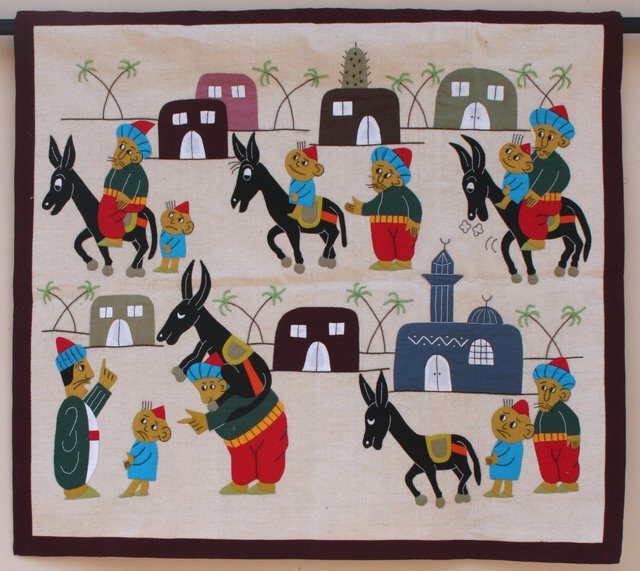
Students should think back to simple folktales recalled from childhood.  Those stories especially need to be passed along for cultural literacy.  In talking about Egypt, my personal favorites are stories about Goha in Egypt as well as those with his other names in other countries.  They teach while having humor.  On the internet many sites re-tell some of the simplest most basic tales from around the world.  Some have various versions differing from country to country, but keep their underlying plot and theme, changing only enough to fit the culture of their homelands.  The Egyptian Cinderella story of Rhodopis is a good example of this.  It also is fun to take a basic story and make it an Egyptian story where there wasn't one before.

Here's a page, Parent Connection (on The Story Connection), which explains both why parents should tell stories and gives a few tips for storytelling.  At the bottom of the page Dianne De Las Casas gives both websites and a bibliography.  Some of this is aimed at much older children, but your students will be able to grow in their storytelling with the other resources.

***
That's a lot to absorb, so I'll stop there.  Please stay in touch and let me know what you might like to discuss after this.