Tell me if you have a topic you'd like to see. (Contact: LoiS-sez@LoiS-sez.com .)
Please also let others know about this site.
Showing posts with label Sara Cone Bryant. Show all posts

Friday, July 24, 2026

Jacobs - The Tiger, The Brahmin and the Jackal - Keeping the Public in Public Domain

Next week on July 29 is World Tiger Day. This beautiful but dangerous creature has a long history with people. World Wildlife Fund has an interesting quiz worth taking to learn more about them. There also are many stories about them including today's tale said to have more than a hundred variants! If you start with what is probably the oldest, the Panchatantra, it would be about 28 or 29 THOUSAND! years old. 

Obviously it is a story worth telling. The question becomes where to start?

Joseph Jacobs is excellent at handling something with such a varied history. (He's the one noting more than a hundred variants when he discussed it in Europa's Fairy Book.) There's no room here to give a hundred versions for comparison, but I do want to mention Sara Cone Bryant's version in Stories to Tell Children because she can always be depended on to offer a tellable story. In it she explains, " Do you know what a Brahmin is? A Brahmin is a very good and gentle kind of man who lives in India, and who treats all the beasts as if they were his brothers. There is a great deal more to know about Brahmins, but that is enough for the story." Later in the story she uses the Banyan Tree for the tree in the story, saying "(A banyan tree is a kind of fruit tree.)" Jacobs uses a "pipal tree" which is probably more accurate given its religious importance to India, but in telling the story I find Bryant's use and explanation of the banyan tree easier to keep the flow of the story. Since the banyan is also considered a Hindu sacred plant, that is what I would use.

One further reason why I chose to post the Jacobs version is, once again in Indian Fairy Tales he has John D. Batten's illustrations. The two worked together on almost all of the Jacobs' folktale anthologies. Batten's work always adds to the enjoyment and understanding. Bryant lets stories stand on their own merits without illustrations. I do have one complaint with Batten's illustration, the jackal is not easy to picture. Neither Jacobs nor Bryant tell anything about jackals, keeping his words and actions the focus.
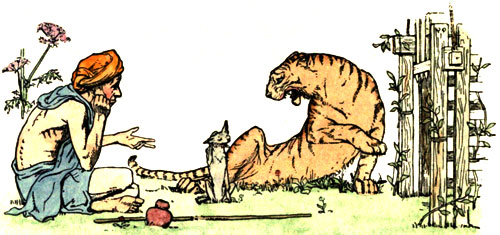
The Tiger, the Brahman, and the Jackal
O

nce upon a time, a tiger was caught in a trap. He tried in vain to get out through the bars, and rolled and bit with rage and grief when he failed.

By chance a poor Brahman came by. "Let me out of this cage, oh pious one!" cried the tiger.

"Nay, my friend," replied the Brahman mildly, "you would probably eat me if I did."

"Not at all!" swore the tiger with many oaths; "on the contrary, I should be for ever grateful, and serve you as a slave!"

Now when the tiger sobbed and sighed and wept and swore, the pious Brahman's heart softened, and at last he consented to open the door of the cage. Out popped the tiger, and, seizing the poor man, cried, "What a fool you[67] are! What is to prevent my eating you now, for after being cooped up so long I am just terribly hungry!"

In vain the Brahman pleaded for his life; the most he could gain was a promise to abide by the decision of the first three things he chose to question as to the justice of the tiger's action.

So the Brahman first asked a pipal tree what it thought of the matter, but the pipal tree replied coldly, "What have you to complain about? Don't I give shade and shelter to every one who passes by, and don't they in return tear down my branches to feed their cattle? Don't whimper—be a man!"

Then the Brahman, sad at heart, went further afield till he saw a buffalo turning a well-wheel; but he fared no better from it, for it answered, "You are a fool to expect gratitude! Look at me! Whilst I gave milk they fed me on cotton-seed and oil-cake, but now I am dry they yoke me here, and give me refuse as fodder!"

The Brahman, still more sad, asked the road to give him its opinion.

"My dear sir," said the road, "how foolish you are to expect anything else! Here am I, useful to everybody, yet all, rich and poor, great and small, trample on me as they go past, giving me nothing but the ashes of their pipes and the husks of their grain!"

On this the Brahman turned back sorrowfully, and on the way he met a jackal, who called out, "Why, what's the matter, Mr. Brahman? You look as miserable as a fish out of water!"

The Brahman told him all that had occurred. "How very confusing!" said the jackal, when the recital[68] was ended; "would you mind telling me over again, for everything has got so mixed up?"

The Brahman told it all over again, but the jackal shook his head in a distracted sort of way, and still could not understand.

"It's very odd," said he, sadly, "but it all seems to go in at one ear and out at the other! I will go to the place where it all happened, and then perhaps I shall be able to give a judgment."

So they returned to the cage, by which the tiger was waiting for the Brahman, and sharpening his teeth and claws.

"You've been away a long time!" growled the savage beast, "but now let us begin our dinner."

"Our dinner!" thought the wretched Brahman, as his knees knocked together with fright; "what a remarkably delicate way of putting it!"

"Give me five minutes, my lord!" he pleaded, "in order that I may explain matters to the jackal here, who is somewhat slow in his wits."

The tiger consented, and the Brahman began the whole story over again, not missing a single detail, and spinning as long a yarn as possible.

"Oh, my poor brain! oh, my poor brain!" cried the jackal, wringing its paws. "Let me see! how did it all begin? You were in the cage, and the tiger came walking by——"

"Pooh!" interrupted the tiger, "what a fool you are! I was in the cage."

"Of course!" cried the jackal, pretending to tremble with fright; "yes! I was in the cage—no I wasn't—dear![69] dear! where are my wits? Let me see—the tiger was in the Brahman, and the cage came walking by——no, that's not it, either! Well, don't mind me, but begin your dinner, for I shall never understand!"

"Yes, you shall!" returned the tiger, in a rage at the jackal's stupidity; "I'll make you understand! Look here—I am the tiger——"

"Yes, my lord!"

"And that is the Brahman——"

"Yes, my lord!"

"And that is the cage——"

"Yes, my lord!"

"And I was in the cage—do you understand?"

"Yes—no—— Please, my lord——"

"Well?" cried the tiger impatiently.

"Please, my lord!—how did you get in?"

"How!—why in the usual way, of course!"

"Oh, dear me!—my head is beginning to whirl again! Please don't be angry, my lord, but what is the usual way?"

At this the tiger lost patience, and, jumping into the cage, cried, "This way! Now do you understand how it was?"

"Perfectly!" grinned the jackal, as he dexterously shut the door, "and if you will permit me to say so, I think matters will remain as they were!"

***

The endangered status of Tigers is part of the quiz mentioned at the start. Here are several World Wildlife Fund articles about them. I particularly want to recommend their Teaching Tools About Wildlife and Forests.

**********************************

This is part of a series of postings of stories under the category, “Keeping the Public in Public Domain.” The idea behind Public Domain was to preserve our cultural heritage after the authors and their immediate heirs were compensated. I feel strongly current copyright law delays this intent on works of the 20th century. My own library of folklore includes so many books within the Public Domain I decided to share stories from them. I hope you enjoy discovering them.

At the same time, my own involvement in storytelling regularly creates projects requiring research as part of my sharing stories with an audience.  Whenever that research needs to be shown here, the publishing of Public Domain stories will not occur that week.  This is a return to my regular posting of a research project here.  (Don't worry, this isn't dry research, my research is always geared towards future storytelling to an audience.)  Response has convinced me that "Keeping the Public in Public Domain" should continue along with my other postings as often as I can manage it.

See the sidebar for other Public Domain story resources I recommend on the page “Public Domain Story Resources."

Friday, March 6, 2026

MacManus (Klingensmith adaptation) - Billy Beg and His Bull - Keeping the Public in Public Domain

https://blogger.googleusercontent.com/img/b/R29vZ2xl/AVvXsEjj4ElJVDHFwI9NShfJ9UF60-KzGlcdTkZpDoMsUsCEo171PESSSTZt0OG-8oa7pvIfwumxNvk6p5_LMHMJokKId8zEqrtX_fF9A85C1BCbF63858w1W8utuxMOihH7w-uKyQqF5pUsv-F25X0Bu5Vomk-Xh8S4_sK8yAakYVdf34RZz-Q/s1600/kelly-sikkema-4_cK-T0_TD4-unsplash.jpg
Photo by Kelly Sikkema on Unsplash

As March begins I'm already seeing decorations and people wearing green clothes, all are obviously celebrating Saint Patrick's Day on March 17.  I have a program coming up of Irish stories and went looking to see what I should tell. Of course I'm going to tell Olcott's "2 short stories about St. Patrick Driving Snakes Out of Ireland."  They are a lot of fun. I have a short tale of a leprechaun and his pot of gold. I also have an Irish tale of a piper and a mermaid I've told for a great many years. Putting them all together it still seemed short so I went to the Virginia Hamilton series that all begin "Favorite Fairy Tales Told in . . . " There on the cover was today's tale of "Billy Beg and His Bull." 

Something crazy is happening with Blogger's handling of images. At first I thought the problem was that the cover of the Haviland book is under copyright. It did the same with my attempt to show the cover of a picture book version, by Ellin Greene. There was an illustration in the Public Domain version of the tale by Sara Cone Bryant that was also rejected. However it also rejected a photo from Unsplash that was clearly available (although I would give credit to the photographer). Just as I was about to give up, I found a way to handle the Unsplash image.

The same happened with the story, but Archive.org let me highlight the text and copy it so that it is here below. 


It's a fairly long story and, while I had seen Ellin Greene's picture book of it ages ago, I had never read it. Maybe I hadn't, but people like Sara Cone Bryant and the sister team of Kate Douglas Wiggin and Nora Archibald Smith all told versions of the story originally found in the Irish anthology, In Chimney Corners, by Seumas MacManus

I looked at all their versions after learning the story from Haviland. There was always credit going back to MacManus. Seeing a little known book titled Just Stories by Annie Klingensmith had the story and called it's version of the story "Adapted", I looked at it, too. The adaptation is minor, but I liked it the best of all four of the versions. (It even called the queen's confederate a "witch" instead of a "hen wife" which doesn't work half as well for American listeners.) The repetition, which is so much a part of this story is still there, but somehow it feels a bit more manageable. Hamilton's copyrighted version takes out even a bit more repetition while still keeping some to maintain the Irish feeling.
 
Because the story is so long, I'm going to stop it at about the halfway point with the rest of the story continued next week. If you want to see the rest of the story online right now, the link to Just Stories has it all.

*** 

Billy Beg and His Bull

ONCE upon a time there were a king and queen who had one son called Billy Beg. The queen gave Billy a bull. Billy was very fond of the bull and the bull was very fond of Billy.

When Billy was grown to be a young man the queen died. With her last breath, she asked the king not to part Billy and his bull. The king promised, come what might, come what may, he never would.

After some time the king married again. The new queen did not like Billy and she liked his bull still less. She tried to get the king to kill the bull, but the king would not break his promise. So the queen went to a witch to ask what to do.

The witch said, "What will you give me to rid you of the bull?’

"Anything you ask,’’ said the queen. 

"Very well, then,” said the witch, "you take to your bed very ill, and call me for your nurse.”

So the queen took to her bed very ill, and the witch was called. When the king came in to see how the queen was, the witch said, There is only one thing that will save her life?” 

"What is that?” said the king. 

"Three mouthfuls of the blood of Billy Beg's bull" said the witch.

But the king would not hear of breaking his promise to Billy’s mother.

The queen grew worse and worse for three days, and then the king gave up and said the bull should be killed.

When Billy heard that his bull was to be killed he became very down-hearted, and went about looking very sad. The bull saw him and asked what was wrong. Billy told the bull what was wrong, and the bull said, "Cheer up. Do as I tell you, and the queen will never get any of my blood.”

The next day the bull was led up to be killed and Billy came and stood near him. "Jump on my back, Billy,” said the bull, and up Billy jumped.

With that the bull leaped nine miles high, nine miles deep, and nine miles broad, and came down with Billy sticking between his horns. Then away he rushed over the top of the queen and away he ran where you wouldn’t know night from day nor day from night, over high hills and low hills, sheep walks and bullock traces, the Cove of Cork, and old Tom Fox with his bugle horn.

At last they stopped. "Now Billy,” said the bull, ''put your hand into my left ear and take out a napkin you will find there. When you spread the napkin out. it will be covered with eating and drinking fit for a king."

Billy did as he was told. Sure enough, when he spread the napkin out, it was covered with eating and drinking fit for a king. Billy ate and drank and put the napkin back where he got it.

Then says the bull, "Put your hand into my right ear and you will find a stick. Wave the stick three times and it will be turned into a sword and give you the strength of a thousand men. When you have no need of a sword it will turn back into a stick again.”

Billy did as he was told. Then said the bull, "At twelve o’clock to-morrow, I shall have to meet and fight a great bull. So get on my back and let us be off.”

So Billy jumped on the bull’s back, and away went the bull, where you wouldn’t know night from day nor day from night, over high hills and low hills, sheep walks and bullock traces, the Cove of Cork, and old Tom Fox and his bugle horn. There he met the other bull and they fought, and such a fight was never seen before nor since. They knocked the soft ground into hard, and the hard into soft, the soft into spring wells, the spring wells into rocks, and the rocks into high hills.

They fought till Billy Beg’s bull killed the other. Then Billy took out the napkin and had a good dinner. After dinner the bull said to Billy, ‘‘Tomorrow at twelve o’clock, I have to meet the brother of the bull I have just killed. He is bigger than the other bull and I shall have a hard fight.”

So Billy got on the bull’s back again and the bull started off and away again where you wouldn’t know night from day nor day from night, over high hills and low hills, sheep walks and bullock traces, the Cove of Cork, and old Tom Fox with his bugle horn. There they met the brother of the bull that Billy’s bull had killed and they at it and fought.

The like of the fight was never seen before or since. They knocked the soft ground into hard and the hard into soft, the soft into spring wells, and the spring wells into rocks, and the rocks into high hills.

They fought long and hard and at last Billy’s bull killed the other bull. Then Billy ate and drank as before and the bull said, "Tomorrow I must meet and fight the brother of the two bulls I killed. He is stronger than the others and will kill me. When I am dead take the napkin and the stick with you. Then you will never be hungry, and with the stick you can overcome any thing you fight with. Cut a strip of my hide for a belt. As long as you wear the belt nothing can kill you.”

Billy was very sorry to hear that the bull would be killed but he got on his back and they started off and away where you wouldn’t know night from day nor day from night, over high hills and low hills, sheep walks and bullock traces, the Cove of Cork, and old Tom Fox with his bugle horn.

Sure enough, the next day at twelve, they met the great bull, and the two bulls at it and fought.

Such a fight was never seen before or since. They knocked the soft ground into hard, and the hard into soft, the soft into spring wells, the spring wells into rocks, and the rocks into high hills. They fought long, but at last the other bull killed Billy’s.

Billy was so sorry that he sat beside his bull two days without eating and cried all the time. Then he cut himself a belt of the bull’s hide and set off with the napkin and the stick to seek his fortune. After three days he came to a farm that belonged to an old gentleman.

***

The story now takes a major turn away from the bull, but using all the bull gave to Billy. 

To use a bit of Irish dialect: Sure and 'tis a fine story worth hearing it all. I had problems with the Blogger graphics. At first it seemed it might mean future posts are text only. If that happens it's still a story worth waiting to hear. It also might remove the illustrations in other stories, but storytelling is all about seeing the stories in your mind, so I hope this doesn't stop you finding stories worth telling.

*********** 

Saturday, January 18, 2020

Chinese New Year of the Rat and "The Rat Princess" - Keeping the Public in Public Domain

HD Wallpapers at http://wallpapers9.org/chinese-new-year-pictures/
Did you know our Solar or Gregorian date of January 17 is the start of what is called the Little Year?  It's mainly a time to prepare for the start of the Chinese New Year.  Many countries besides China and the Chinese people celebrate this time of the Lunar New Year, although the Wikipedia article also points to several Asian Lunar New Year dates due to all the many ways calendars were figured out.  Still those other dates are dwarfed by China's large population and many of Chinese ancestry around the world and it "has strongly influenced lunar new year celebrations of China's neighbouring cultures, including the Korean New Year (seol), the Tết of Vietnam, and the Losar of Tibet.[3] It is also celebrated worldwide in regions and countries with significant Overseas Chinese populations, including Singapore,[4] Indonesia, Malaysia, Myanmar,[5] Thailand, Cambodia, the Philippines,[6] and Mauritius,[7] as well as many in North America and Europe."  (Those footnotes are in the Wikipedia article.) Vietnam and Korea share similar Confucian culture, so they celebrate the Lunar New Year.  Japan once celebrated it.

Back to the current time of the "Little Year", it's not only preparation for the coming celebration, but its main activities are house cleaning to sweep away bad luck and prayers to the stove god.  Considering how it's winter in the northern hemisphere and definitely here in the mitten-shaped state of Michigan, I may not consider my stove, furnace, or fireplace a god, but certainly want to keep them all working!  As for bad luck, I'll gladly pick up a broom and sweep especially around the dirt left by my old computer tower and hope my new "All in One" lasts a long time.  I first learned of the "Little Year" at this site, ChineseNewYear.net

The whole combination of three festivals (Little Year, Spring Festival -- which we think of as Chinese New Year, and the Lantern Festival which runs from February 5th to 8th) is there, along with a large section about food, decoration, myths about Chinese New Year, historical and modern clothing, taboos, and, of course, more.  That last one, taboos, caught my eye.  I'm not superstitious, but my recent computer woes had me check what to avoid to guarantee good luck, since that's the big wish in New Year's festivities, lunar or solar.

Taboos:
Photo by Annie Spratt on Unsplash
  1. Do not say negative words (this includes death, sick, empty, pain, ghost, poor, break, kill!)
  2. Do not break ceramics or glass
  3. Do not clean or sweep (you did that during Little Year, now you don't want to throw out the garbage or sweep away your good luck)
  4. Do not use scissors, knives or other sharp objects (originally this was to give women a break, but nowadays 99% of hair salons close until lunar February 2, when festivities end)
  5. Do not visit the wife's family (it implies marriage problems, but on lunar February 2 they should visit the wife's family along with their children and bring a modest gift -- To my own daughters, hint, hint!)
  6. Do not demand debt repayment, but also don't borrow money lest you need to borrow all year
  7. Avoid fighting and crying to ensure a smooth year
  8. To avoid being sick all year you shouldn't take medicine, visit the doctor, have or do surgery, or get shots, although if you're chronically ill or suddenly ill you should do what is needed
  9. Do not give New Year blessings to someone still in bed (lest they be bed-ridden all year), but also don't tell them to wake up or you'll be bossed around all year
  10. Gift-giving taboos rule out clocks, apples, and splitting pears.  Those all involve similarity to Chinese pronunciation, which reminds me the site's listing of Chinese New Year Greetings don't include pronunciation, but I was always told tone in Chinese could make such a difference that if you said something incorrectly you might be talking about your mother-in-law (#5?) instead of your horse and vice-versa.
It's fun to look at such traditions and doubt much is really believed, although lovers of the television show Fresh Off the Boat or various Asian books and films can just hear the mother saying "It's for your own good!"

Freestocks.org at Unsplash.com
I imagine you have heard about the 12 Chinese zodiac animals and how the coming year is the Year of the Rat.  That doesn't  sound like a good year to most of us, but "In Chinese culture, rats were seen as a sign of wealth and surplus. Because of their reproduction rate, married couples also prayed to them for children."  The good attributes of a Rat person is they're "clever, quick thinkers, but content with living a quiet and peaceful life."


Today I can celebrate by once again bringing a Public  Domain story . . . HURRAY!  It's from Sara Cone Bryant whose work has appeared here 3 times before.  It can be found with other stories and storytelling tips in her classic How to Tell Stories to Children and Some Stories to Tell and the story opens with a hint on telling it.  The story lets us go back to the days when Japan celebrated the Lunar New Year with this tale that might remind you of yet another Japanese tale, but I'll talk about that after the story.

Some readers may be familiar not only with the style of this story and how one thing leads to another before coming back to the beginning, but it especially reminds me of yet another Japanese tale so well illustrated by the award-winning Gerald McDermott in The Stonecutter.

If you go to https://www.youtube.com/watch?v=vbHiI8Qo8rs you can have the rare opportunity to watch his first commercial film at the age of 19, an extremely complex animation short featuring approximately 2000 animation cels presented in six minutes.  He only made five films and all are under 12 minutes.  After retiring from film animation at the age of 32, McDermott began producing animated children’s books, eventually becoming one of the world’s best-known authors of books for young readers, winning numerous awards in the process. More about McDermott at http://www.afana.org/mcdermott.htm" from http://archive.org/

Maybe he started the Lunar New Year at age 32 making a book and we are all the richer for it!
*****************
This is part of a series of postings of stories under the category, "Keeping the Public in Public Domain."  The idea behind Public Domain was to preserve our cultural heritage after the authors and their immediate heirs were compensated.  I feel strongly current copyright law delays this intent on works of the 20th century.  My own library of folklore includes so many books within the Public Domain I decided to share stories from them.  I hope you enjoy discovering new stories.  


At the same time, my own involvement in storytelling regularly creates projects requiring research as part of my sharing stories with an audience.  Whenever that research needs to be shown here, the publishing of Public Domain stories will not occur that week.  This is a return to my regular posting of a research project here.  (Don't worry, this isn't dry research, my research is always geared towards future storytelling to an audience.)  Response has convinced me that "Keeping the Public in Public Domain" should continue along with my other postings as often as I can manage it.
Other Public Domain story resources I recommend-
  • There are many online resources for Public Domain stories, maybe none for folklore is as ambitious as fellow storyteller, Yoel Perez's database, Yashpeh, the International Folktales Collection.  I have long recommended it and continue to do so.  He has loaded Stith Thompson's Motif Index into his server as a database so you can search the whole 6 volumes for whatever word or expression you like by pressing one key. http://folkmasa.org/motiv/motif.htm
  • You may have noticed I'm no longer certain Dr. Perez has the largest database, although his offering the Motif Index certainly qualifies for those of us seeking specific types of stories.  There's another site, FairyTalez claiming to be the largest, with "over 2000 fairy tales, folktales, and fables" and they are "fully optimized for phones, tablets, and PCs", free and presented without ads.

    Between those two sites, there is much for story-lovers, but as they say in infomercials, "Wait, there's more!"
The email list for storytellers, Storytell, discussed Online Story Sources and came up with these additional suggestions:            
         - David K. Brown - http://people.ucalgary.ca/~dkbrown/stories.html
         - Richard Martin - http://www.tellatale.eu/tales_page.html
         - Spirit of Trees - http://spiritoftrees.org/featured-folktales
         - Story-Lovers - http://www.story-lovers.com/ is now only accessible through the Wayback Machine, described below, but Jackie Baldwin's wonderful site lives on there, fully searchable manually (the Google search doesn't work), at https://archive.org/ .  It's not easy, but go to Story-lovers.com snapshot for October 22 2016  and you can click on SOS: Searching Out Stories to scroll down through the many story topics and click on the story topic that interests you.
       - World of Tales - http://www.worldoftales.com/ 
           - Zalka Csenge Virag - http://multicoloreddiary.blogspot.com doesn't give the actual stories, but her recommendations, working her way through each country on a continent, give excellent ideas for finding new books and stories to love and tell.
     
You're going to find many of the links on these sites have gone down, BUT go to the Internet Archive Wayback Machine to find some of these old links.  Tim's site, for example, is so huge probably updating it would be a full-time job.  In the case of Story-Lovers, it's great that Jackie Baldwin set it up to stay online as long as it did after she could no longer maintain it.  Possibly searches maintained it.  Unfortunately Storytell list member, Papa Joe is on both Tim Sheppard's site and Story-Lovers, but he no longer maintains his old Papa Joe's Traveling Storytelling Show website and his Library (something you want to see!) is now only on the Wayback Machine.  It took some patience working back through claims of snapshots but finally in December of 2006 it appears!
    Somebody as of this writing whose stories can still be found by his website is the late Chuck Larkin - http://chucklarkin.com/stories.html.  I prefer to list these sites by their complete address so they can be found by the Wayback Machine, a.k.a. Archive.org, when that becomes the only way to find them.
You can see why I recommend these to you. Have fun discovering even more stories!

Thursday, February 20, 2014

Tell a Fairy Tale Day is February 26th!

The annual "Tell a Fairy Tale Day" is fast approaching.  Of course today's post includes a story to tell. Sara Cone Bryant has had two earlier posts in the Keeping the Public in Public Domain stories.  She was such an important part of the storytelling movement in the early 20th century that she deserves attention on a day dedicated to storytelling.

There's a listing about her on the Online Books Page listing her works available online, including a very cursory Wikipedia article, but neither show her and maybe there's a reason for that. 

She looks like somebody we might rule out as too old-fashioned to be relevant.  

Don't be fooled.  

I'm going to give a story that meets a difficult topic sometimes wanted by teachers and parents: cleanliness, neatness, or tidiness -- call it what you will, it's a subject needed for preschool and primary grades.  Bryant had a timeless understanding of what my Australian storytelling friends so aptly call "The Littlies."  In How to Tell Stories to Children and Some Stories to Tell she has three age groups of "Stories Selected and Adapted for Telling."  This is in the Kindergarten and Grade 1 section, but most preschool classes could handle it, too.  

(Looking at later in life, just the other day at rehearsal, cast members were comparing notes on "personal hygiene" and mentioned a talented actor or two who could have used this story, a shower, and some deodorant.  We might have wished this story had been one of those stories told back when those fellows were "Littlies" in case it made a difference!  Stories do have a way of staying in our minds and that is why they can be a gentle but powerful way to teach.)

Because Bryant is quick to point out that stories need adaptation, don't feel a change or two is out of line.  Boys no longer wear pinafores, so just change it to clothes.  If you want this to be a fairy tale, there's no problem with the boy meeting a "Tidy Angel", but it could just as easily be the "Tidy Fairy" or . . .  By all means, however, keep this light.  

Yet another personal side note here, I remember being shocked to hear my mother reading Cat in the Hat to my two daughters like it was a Greek Tragedy!  Not only that, she wasn't fooling when she saw the mess Thing 1 and Thing 2 made!  This story from Laura E. Richards' classic 1903 book, The Golden Windows, should be done with a sense of fun and even sly cheek-in-your-tongue.

 
 I hope you let the parting grumble by the pig be at least somewhat exaggerated.

Having talked so much about Sara Cone Bryant and the book where she explains storytelling, here's a bonus, her Table of Contents to show you why you might want to download your own copy.  If you look on the list of stories at Grades 2 and 3 you will see "The Burning of the Rice Fields."  The 2004 Indian Ocean tsunami shows that not all stories are fairy tales and they do indeed have a value 100 years later.
******************
This is part of a series of postings of stories under the category, "Keeping the Public in Public Domain."  The idea behind Public Domain was to preserve our cultural heritage after the authors and their immediate heirs were compensated.  I feel strongly current copyright law delays this intent on works of the 20th century.  My own library of folklore includes so many books within the Public Domain I decided to share stories from them.  I hope you enjoy discovering new stories. 

At the same time, my own involvement in storytelling regularly creates projects requiring research as part of my sharing stories with an audience.  Whenever that research needs to be shown here, the publishing of Public Domain stories will not occur that week.  This is a return to my normal monthly posting of a research project here.  Response has convinced me that "Keeping the Public in Public Domain" should continue along with my monthly postings as often as I can manage it.   


Saturday, July 27, 2013

Bryant - Why the Sea Is Salt - Keeping the Public in Public Domain

It's beach time, let's learn "Why the Sea Is Salt" from Sara Cone Bryant in her book, How to Tell Stories to Children and Some Stories to Tell.  The book is geared toward teaching storytelling and Bryant notes:
This book came out initially in 1918, so it's also worth considering if it is still relevant to teaching storytelling.  Bryant makes a point of explaining the difference between telling a story and reading it aloud and why it is more effective.  Whether she told to children or to college women unable to read German literature in the original language, both preferred a re-telling to a reading or even a "recitation."  The storytelling is freer and has a more direct connection between teller and audience, aided also by the teller's enjoyment of the tale. She also points out the value of storytelling beyond reading for the teacher.  The book was written specifically for the teachers who "have not a knack for storytelling, who feel as shy as their youngest scholar at the thought of it, who do not know where the good stories are, or which ones are easy to tell."

On "The Purpose of Storytelling" she points out how it establishes a quick confidential relationship and also provides "the gradual development of concentration and interested attention in (the listeners)" -- those are still goals for language arts.   Before giving her selections, she discusses how to select stories that will be liked and why; how to adapt a story (including making a long story short or filling out a short story -- some stories posted here need such adaptation, but public domain requires the original text); how to tell the story; and specific schoolroom uses.  I challenge you to read the book and find any of her ideas about storytelling that were true in 1918 are untrue 100 years later.

And now her version of


****************************************************** 
This is part of a series of bi-weekly posting of stories under the category, "Keeping the Public in Public Domain."  The idea behind Public Domain was to preserve our cultural heritage after the authors and their immediate heirs were compensated.  I feel strongly current copyright law delays this intent on works of the 20th century.  I hope you enjoy discovering new stories. 

Currently I'm involved in projects taking me out of my usual work of sharing stories with an audience.  My own library of folklore includes so many books within the Public Domain I decided to share stories from them.  This fall I expect to return to my normal monthly posting of a research project here.  Depending on response, I will decide at that time if "Keeping the Public in Public Domain" should continue along with my monthly postings.


Wednesday, July 24, 2013

Bryant - The Dagda's Harp - Keeping the Public in Public Domain

Today's story is of ancient Irish legend and music, but it comes from a book with a title that may turn off some  readers.

Titling a book, Best Stories to Tell to Children is certainly presumptuous, but Sara Cone Bryant was a major leader in the early 20th century encouraging and teaching storytelling.  These are  the Best Stories or what she calls "a handful of the very dearest" stories from her very popular earlier books, How to Tell Stories for Children and Stories to Tell Children, both of which, like Best Stories, are online in more than one location.   In the Introduction to How to Tell we discover some of her suggested stories, like today's post, have fascinated listeners in college.  (How to Tell also shows children are anything but an easy audience.)

Little is known about Bryant personally, but her work, both in teaching storytelling and the stories she suggested, continue to be found all over the internet and reprinted.  Online teachers curriculum continues to point to their educational value.  Bryant, reveals her married name on the title page of Best Stories as Mrs. Theodore F. Borst.  Reading the Introduction to How to Tell is where I discovered she gave English lectures on German literature and found storytelling helped college students unable to read the original.  In contrast, she tells of her difficulty gaining the attention of 60 rambunctious children at a settlement house.  Storytelling gradually won them over, but the scene could certainly match many a gathering today of youth unaware of the fun and power of stories.

I'll list the tales in Best Stories after today's selection.  In both How to Tell and Stories to Tell Bryant suggests appropriate grade levels.  (I think today's children might not be quite as advanced for some of the stories.)  "How" goes to fifth grade and "Stories" gives today's tale, but the grade listing, which goes to fourth grade, omits it.  It's definitely a more mature legend.


Storytelling friends with Michigan ties, Yvonne Healy and Richard Marsh, come to mind with this tale.  Yvonne came from Ireland as a girl and recently took her very teenage, very Michigan daughters back for a tour with Richard.  Richard relocated from Michigan to Ireland, giving "Legendary Tours" among other ways of storytelling.  He swears he can't tell without his hands in bus driver position.  Not true, but his tours + tales won over what could have been a difficult teenage audience.  Yvonne has a Bibliography for Irish Stories and Irish Storytelling on her site and Richard's site definitely includes Irish material, but also Spanish, Basque, and more.  (There's an interesting tie to Ireland in Basque history.)

Now for the list of Best Stories according to Bryant.  They seem to be arranged in order of difficulty, starting with nursery tales for the youngest and "The Dagda's Harp" second from the end.  Remember all of these stories can be found online.


Next will be a story and a look at Bryant's How to Tell Stories to Children.
********************************************************
This is part of a series of bi-weekly posting of stories under the category, "Keeping the Public in Public Domain."  The idea behind Public Domain was to preserve our cultural heritage after the authors and their immediate heirs were compensated.  I feel strongly current copyright law delays this intent on works of the 20th century.  I hope you enjoy discovering new stories. 

Currently I'm involved in projects taking me out of my usual work of sharing stories with an audience.  My own library of folklore includes so many books within the Public Domain I decided to share stories from them.  This fall I expect to return to my normal monthly posting of a research project here.  Depending on response, I will decide at that time if "Keeping the Public in Public Domain" should continue along with my monthly postings.