Tell me if you have a topic you'd like to see. (Contact: LoiS-sez@LoiS-sez.com .)
Please also let others know about this site.

Friday, January 30, 2026

Hawthorne - The Snow Image - Keeping the Public in Public Domain

Snow has been keeping us and a large portion of the United States busy shoveling and plowing. This is my attitude about it: Bah Humbug!

At the same time I know that "Snow Days" as well as concern for bitter wind chills have made many children happy even if their time out doors has required bundling up and being careful not to get frostbitten.

As a result I just had to find an appropriate story. Nathaniel Hawthorne wrote the perfect one about how adults just don't see things from the same way.

Literary tales can be hard to tell, but the Skinner sisters, Ada and Eleanor, in their winter anthology, The Pearl Story Book, did a good start with their abridgement of the story. At the same time Project Gutenberg has a well-illustrated version of it in The Snow Image: A Childish Miracle. I'm going to insert the illustrations by Marcus Waterman in their appropriate places in the Skinner version of the story.

I leave it up to you as to how you might further adapt the story while keeping the "childish miracle" of the story alive.  

THE SNOW-IMAGE

Nathaniel Hawthorne


One afternoon of a cold winter’s day, when the sun shone forth with chilly brightness, after a long storm, two children asked leave of their mother to run out and play in the new-fallen snow.

The elder child was a little girl, whom, because she was of a tender and modest disposition, and was thought to be very beautiful, her parents, and other people who were familiar with her, used to call Violet.

But her brother was known by the title of Peony, on account of the ruddiness of his broad and round little phiz, which made everybody think of sunshine and great scarlet flowers.

“Yes, Violet—yes, my little Peony,” said their kind mother; “you may go out and play in the new snow.”

Forth sallied the two children, with a hop-skip-and-jump, that carried them at once into the very heart of a huge snow-drift, whence Violet emerged like a snow bunting, while little Peony floundered out with his round face in full bloom.

Then what a merry time they had! To look at them, frolicking in the wintry garden, you would have thought that the dark and pitiless storm had been sent for no other purpose but to provide a new plaything for Violet and Peony; and that they themselves had been created, as the snowbirds were, to take delight only in the tempest and in the white mantle which it spread over the earth.

At last, when they had frosted one another all over with handfuls of snow, Violet, after laughing heartily at little Peony’s figure, was struck with a new idea.

“You look exactly like a snow-image, Peony,” said she, “if your cheeks were not so red. And that puts me in mind! Let us make an image out of snow—an image of a little girl—and it shall be our sister, and shall run about and play with us all winter long. Won’t it be nice?”

“Oh, yes!” cried Peony, as plainly as he could speak, for he was but a little boy. “That will be nice! And mamma shall see it.”

“Yes,” answered Violet; “mamma shall see the new little girl. But she must not make her come into the warm parlour, for, you know, our little snow-sister will not love the warmth.”

And forthwith the children began this great business of making a snow-image that should run about; while their mother, who was knitting at the window and overheard some of their talk, could not help smiling at the gravity with which they set about it. They really seemed to imagine that there would be no difficulty whatever in creating a live little girl out of the snow.

Indeed, it was an exceedingly pleasant sight—those bright little souls at their task! Moreover, it was really wonderful to observe how knowingly and skillfully they managed the matter. Violet assumed the chief direction, and told Peony what to do, while, with her own delicate fingers, she shaped out all the nicer parts of the snow-figure.

It seemed, in fact, not so much to be made by the children, as to grow up under their hands, while they were playing and prattling about it. Their mother was quite surprised at this, and the longer she looked, the more and more surprised she grew.

Now, for a few moments, there was a busy and earnest but indistinct hum of the two children’s voices, as Violet and Peony wrought together with one happy consent. Violet still seemed to be the guiding spirit, while Peony acted rather as a labourer and brought her the snow from far and near. And yet the little urchin evidently had a proper understanding of the matter, too.

“Peony, Peony!” cried Violet; for her brother was at the other side of the garden. “Bring me those light wreaths of snow that have rested on the lower branches of the pear-tree. You can clamber on the snow-drift, Peony, and reach them easily. I must have them to make some ringlets for our snow-sister’s head!”

“Here they are, Violet!” answered the little boy. “Take care you do not break them. Well done! Well done! How pretty!”

“Does she not look sweet?” said Violet, with a very satisfied tone; “and now we must have some little shining bits of ice to make the brightness of her eyes. She is not finished yet. Mamma will see how very beautiful she is; but papa will say, ‘Tush! nonsense! come in out of the cold!’”

“Let us call mamma to look out,” said Peony; and then he shouted, “Mamma! mamma!! mamma!!! Look out and see what a nice ’ittle girl we are making!”

“What a nice playmate she will be for us all winter long!” said Violet. “I hope papa will not be afraid of her giving us a cold! Sha’n’t you love her dearly, Peony?”

“Oh, yes!” cried Peony. “And I will hug her and she shall sit down close by me and drink some of my warm milk.”

“Oh, no, Peony!” answered Violet, with grave wisdom. “That will not do at all. Warm milk will not be wholesome for our little snow-sister. Little snow-people like her eat nothing but icicles. No, no, Peony; we must not give her anything warm to drink!”

There was a minute or two of silence; for Peony, whose short legs were never weary, had gone again to the other side of the garden. All of a sudden, Violet cried out, loudly and joyfully, “Look here, Peony! Come quickly! A light has been shining on her cheek out of that rose-coloured cloud! And the colour does not go away! Is not that beautiful?”

“Yes, it is beau-ti-ful,” answered Peony, pronouncing the three syllables with deliberate accuracy. “O Violet, only look at her hair! It is all like gold!”

“Oh, certainly,” said Violet, as if it were very much a matter of course. “That colour, you know, comes from the golden clouds that we see up there in the sky. She is almost finished now. But her lips must be made very red, redder than her cheeks. Perhaps, Peony, it will make them red if we both kiss them!”

Accordingly, the mother heard two smart little smacks, as if both her children were kissing the snow-image on its frozen mouth. But, as this did not seem to make the lips quite red enough, Violet next proposed that the snow-child should be invited to kiss Peony’s scarlet cheek. “Come, ’ittle snow-sister, kiss me!” cried Peony.

“There! she has kissed you,” added Violet, “and now her lips are very red. And she blushed a little, too!”

“Oh, what a cold kiss!” cried Peony.

Just then, there came a breeze of the pure west wind sweeping through the garden and rattling the parlour-windows. It sounded so wintry cold, that the mother was about to tap on the window-pane with her thimbled finger, to summon the two children in, when they both cried out to her with one voice:

“Mamma! mamma! We have finished our little snow-sister, and she is running about the garden with us!”

“What imaginative little beings my children are!” thought the mother, putting the last few stitches into Peony’s frock. “And it is strange, too, that they make me almost as much a child as they themselves are! I can hardly help believing now that the snow-image has really come to life!”

“Dear mamma!” cried Violet, “pray look out and see what a sweet playmate we have!”

The mother, being thus entreated, could no longer delay to look forth from the window. The sun was now gone out of the sky, leaving, however, a rich inheritance of his brightness among those purple and golden clouds which make the sunsets of winter so magnificent.

But there was not the slightest gleam or dazzle, either on the window or on the snow; so that the good lady could look all over the garden, and see everything and everybody in it. And what do you think she saw there? Violet and Peony, of course, her own two darling children.

Ah, but whom or what did she see besides? Why, if you will believe me, there was a small figure of a girl, dressed all in white, with rose-tinged cheeks and ringlets of golden hue, playing about the garden with the two children!

A stranger though she was, the child seemed to be on as familiar terms with Violet and Peony, and they with her, as if all the three had been playmates during the whole of their little lives. The mother thought to herself that it must certainly be the daughter of one of the neighbours, and that, seeing Violet and Peony in the garden, the child had run across the street to play with them.

So this kind lady went to the door, intending to invite the little runaway into her comfortable parlour; for, now that the sunshine was withdrawn, the atmosphere out of doors was already growing very cold.


But, after opening the house-door, she stood an instant on the threshold, hesitating whether she ought to ask the child to come in, or whether she should even speak to her. Indeed, she almost doubted whether it were a real child, after all, or only a light wreath of the new-fallen snow, blown hither and thither about the garden by the intensely cold west wind.

There was certainly something very singular in the aspect of the little stranger. Among all the children of the neighbourhood the lady could remember no such face, with its pure white and delicate rose-colour, and the golden ringlets tossing about the forehead and cheeks.

And as for her dress, which was entirely of white, and fluttering in the breeze, it was such as no reasonable woman would put upon a little girl when sending her out to play in the depth of winter. It made this kind and careful mother shiver only to look at those small feet, with nothing in the world on them except a very thin pair of white slippers.

Nevertheless, airily as she was clad, the child seemed to feel not the slightest inconvenience from the cold, but danced so lightly over the snow that the tips of her toes left hardly a print in its surface; while Violet could but just keep pace with her, and Peony’s short legs compelled him to lag behind.

All this while, the mother stood on the threshold, wondering how a little girl could look so much like a flying snow-drift, or how a snow-drift could look so very like a little girl.

She called Violet and whispered to her.

“Violet, my darling, what is this child’s name?” asked she. “Does she live near us?”

“Why, dearest mamma,” answered Violet, laughing to think that her mother did not comprehend so very plain an affair, “this is our little snow-sister whom we have just been making!”

“Yes, dear mamma,” cried Peony, running to his mother, and looking up simply into her face. “This is our snow-image! Is it not a nice ’ittle child?”

“Violet,” said her mother, greatly perplexed, “tell me the truth, without any jest. Who is this little girl?”

“My darling mamma,” answered Violet, looking seriously into her mother’s face, surprised that she should need any further explanation, “I have told you truly who she is. It is our little snow-image which Peony and I have been making. Peony will tell you so, as well as I.”

“Yes, mamma,” declared Peony, with much gravity in his crimson little phiz, “this is ’ittle snow-child. Is not she a nice one? But, mamma, her hand is, oh, so very cold!”

While mamma still hesitated what to think and what to do, the street-gate was thrown open, and the father of Violet and Peony appeared, wrapped in a pilot-cloth sack, with a fur cap drawn down over his ears, and the thickest of gloves upon his hands.

Mr. Lindsey was a middle-aged man, with a weary and yet a happy look in his wind-flushed and frost-pinched face, as if he had been busy all day long, and was glad to get back to his quiet home. His eyes brightened at the sight of his wife and children, although he could not help uttering a word or two of surprise at finding the whole family in the open air, on so bleak a day, and after sunset, too.

He soon perceived the little white stranger, sporting to and fro in the garden, like a dancing snow-wreath and the flock of snowbirds fluttering about her head.

“Pray, what little girl may this be?” inquired this very sensible man. “Surely her mother must be crazy, to let her go out in such bitter weather as it has been today, with only that flimsy white gown and those thin slippers!”

“My dear husband,” said his wife, “I know no more about the little thing than you do. Some neighbour’s child, I suppose. Our Violet and Peony,” she added, laughing at herself for repeating so absurd a story, “insist that she is nothing but a snow-image which they have been busy about in the garden, almost all the afternoon.”

As she said this, the mother glanced her eyes toward the spot where the children’s snow-image had been made. What was her surprise on perceiving that there was not the slightest trace of so much labour!—no image at all!—no piled-up heap of snow!—nothing whatever, save the prints of little footsteps around a vacant space!

“This is very strange!” said she.

“What is strange, dear mother?” asked Violet. “Dear father, do not you see how it is? This is our snow-image, which Peony and I have made, because we wanted another playmate. Did not we, Peony?”

“Yes, papa,” said crimson Peony. “This is our ’ittle snow-sister. Is she not beau-ti-ful? But she gave me such a cold kiss!”

“Pooh, nonsense, children!” cried their good honest father, who had a plain, sensible way of looking at matters. “Do not tell me of  making live figures out of snow. Come, wife; this little stranger must not stay out in the bleak air a moment longer. We will bring her into the parlour; and you shall give her a supper of warm bread and milk, and make her as comfortable as you can.”

So saying, this honest and very kind-hearted man was going toward the little damsel, with the best intentions in the world. But Violet and Peony, each seizing their father by the hand, earnestly besought him not to make her come in.

“Nonsense, children, nonsense, nonsense!” cried the father, half-vexed, half-laughing. “Run into the house, this moment! It is too late to play any longer now. I must take care of this little girl immediately, or she will catch her death of cold.”

And so, with a most benevolent smile, this very well-meaning gentleman took the snow-child by the hand and led her toward the house.

She followed him, droopingly and reluctant, for all the glow and sparkle were gone out of her figure; and, whereas just before she had resembled a bright, frosty, star-gemmed evening, with a crimson gleam on the cold horizon, she now looked as dull and languid as a thaw.

As kind Mr. Lindsey led her up the steps of the door, Violet and Peony looked into his face, their eyes full of tears which froze before they could run down their cheeks, and again entreated him not to bring their snow-image into the house.

“Not bring her in!” exclaimed the kind-hearted man. “Why, you are crazy, my little Violet!—quite crazy, my small Peony! She is so cold already that her hand has almost frozen mine, in spite of my thick gloves. Would you have her freeze to death?”

His wife, as he came up the steps, had been taking another long, earnest gaze at the little white stranger. She hardly knew whether it was a dream or no; but she could not help fancying that she saw the delicate print of Violet’s fingers on the child’s neck. It looked just as if, while Violet was shaping out the image, she had given it a gentle pat with her hand, and had neglected to smooth the impression quite away.

“After all, husband,” said the mother, “after all, she does look strangely like a snow-image! I do believe she is made of snow!”

A puff of the west wind blew against the snow-child, and again she sparkled like a star.

“Snow!” repeated good Mr. Lindsey, drawing the reluctant guest over his hospitable threshold. “No wonder she looks like snow. She is half frozen, poor little thing! But a good fire will put everything to rights.”

This common-sensible man placed the snow-child on the hearth-rug, right in front of the hissing and fuming stove.

“Now she will be comfortable!” cried Mr. Lindsey, rubbing his hands and looking about him, with the pleasantest smile you ever saw. “Make yourself at home, my child.”

Sad, sad and drooping, looked the little white maiden as she stood on the hearth-rug, with the hot blast of the stove striking through her like a pestilence. Once she threw a glance toward the window, and caught a glimpse, through its red curtains, of the snow-covered roofs and the stars glimmering frostily, and all the delicious intensity of the cold night. The bleak wind rattled the window-panes as if it were summoning her to come forth. But there stood the snow-child, drooping, before the hot stove!

But the common-sensible man saw nothing amiss.

“Come, wife,” said he, “let her have a pair of thick stockings and a woolen shawl or blanket directly; and tell Dora to give her some warm supper as soon as the milk boils. You, Violet and Peony, amuse your little friend. She is out of spirits, you see, at finding herself in a strange place. For my part, I will go around among the neighbours and find out where she belongs.”

The mother, meanwhile, had gone in search of the shawl and stockings. Without heeding the remonstrance of his two children, who still kept murmuring that their little snow-sister did not love the warmth, good Mr. Lindsey took his departure, shutting the parlour door carefully behind him.

Turning up the collar of his sack over his ears, he emerged from the house, and had barely reached the street-gate, when he was recalled by the screams of Violet and Peony and the rapping of a thimbled finger against the parlour window.

“Husband! husband!” cried his wife, showing her horror-stricken face through the window panes. “There is no need of going for the child’s parents!”

“We told you so, father!” screamed Violet and Peony, as he re-entered the parlour. “You would bring her in; and now our poor—dear—beau-ti-ful little snow-sister is thawed!”

And their own sweet little faces were already dissolved in tears; so that their father, seeing what strange things occasionally happen in this every-day world, felt not a little anxious lest his children might be going to thaw too. In the utmost perplexity, he demanded an explanation of his wife. She could only reply that, being summoned to the parlour by cries of Violet and Peony, she found no trace of the little white maiden, unless it were the remains of a heap of snow, which, while she was gazing at it, melted quite away upon the hearth-rug.

“And there you see all that is left of it!” added she, pointing to a pool of water, in front of the stove.

“Yes, father,” said Violet, looking reproachfully at him through her tears, “there is all that is left of our dear little snow-sister!”

“Naughty father!” cried Peony, stamping his foot, and—I shudder to say—shaking his little fist at the common-sensible man. “We told you how it would be! What for did you bring her in?”

And the stove, through the isinglass of its door, seemed to glare at good Mr. Lindsey, like a red-eyed demon, triumphing in the mischief which it had done! (Abridged.)

******

May both children and adults survive this snowy, cold time and eventually see spring. 


****************

This is part of a series of postings of stories under the category, “Keeping the Public in Public Domain.” The idea behind Public Domain was to preserve our cultural heritage after the authors and their immediate heirs were compensated. I feel strongly current copyright law delays this intent on works of the 20th century. My own library of folklore includes so many books within the Public Domain I decided to share stories from them. I hope you enjoy discovering them.

At the same time, my own involvement in storytelling regularly creates projects requiring research as part of my sharing stories with an audience.  Whenever that research needs to be shown here, the publishing of Public Domain stories will not occur that week.  This is a return to my regular posting of a research project here.  (Don't worry, this isn't dry research, my research is always geared towards future storytelling to an audience.)  Response has convinced me that "Keeping the Public in Public Domain" should continue along with my other postings as often as I can manage it.

See the sidebar for other Public Domain story resources I recommend on the page “Public Domain Story Resources."


Friday, January 23, 2026

Grimm - The Three Languages - Keeping the Public in Public Domain

An email newsletter from The Epoch Times in discussing literature stated:

 In their fairy tale “The Three Languages,” the Brothers Grimm demonstrate how to handle one’s individual, special gifts. It’s the story of a count’s son whose father thinks his son’s gifts are useless. The son must learn that his gifts are unique and that they will play a special role in determining his destiny.

I'm not sure that was the message I got from the story. We've discussed here the idea of not stating a moral or message, instead letting audiences draw their own conclusions. 

Whatever message you might receive from the story, it is certainly an interesting tale. I went hunting Public Domain versions at Project Gutenberg and found the translations didn't differ much in volumes including this little known tale. Snowdrop and Other Tales by Arthur Rackham had the benefit of his illustrations. While the book included both color and black and white illustrations, "The Three Languages" only has one in black and white. The better to create images in your own mind, I guess. 

At any rate, with or without a stated moral or colored illustrations, I found the story intriguing. 

The Three Languages

THERE once lived in Switzerland an old Count, who had an only son; but he was very stupid, and could learn nothing. So his father said to him: ‘Listen to me, my son. I can get nothing into your head, try as hard as I may. You must go away from here, and I will hand you over to a renowned Professor for a whole year.’ At the end of the year he came home again, and his father asked: ‘Now, my son, what have you learnt?’

‘Father, I have learnt the language of dogs.’

‘Mercy on us!’ cried his father, ‘is that all you have learnt? I will send you away again to another Professor in a different town.’ The youth was taken there, and remained with this Professor also for another year. When he came back his father asked him again: ‘My son, what have you learnt?’

He answered: ‘I have learnt bird language.’

Then the father flew into a rage, and said: ‘Oh, you hopeless creature, have you been spending all this precious time and learnt nothing? Aren’t you ashamed to come into my presence? I will send you to a third Professor, but if you learn nothing this time, I won’t be your father any longer.’

The son stopped with the third Professor in the same way for a whole year, and when he came home again and his father asked, ‘My son, what have you learnt?’ he answered—

‘My dear father, this year I have learnt frog language.’

Thereupon his father flew into a fearful passion, and said: ‘This creature is my son no longer. I turn him out of the house and command you to lead him into the forest and take his life.’

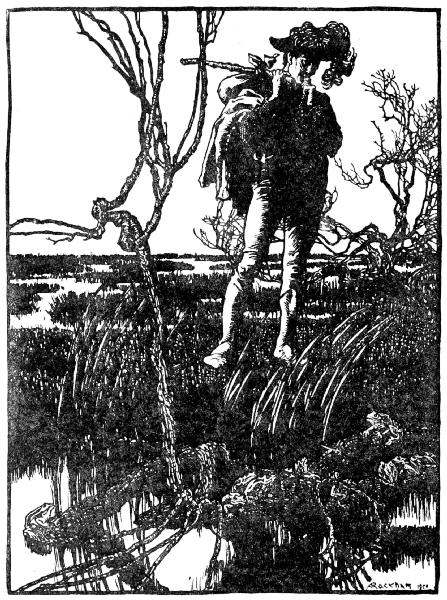
The youth listens to the Frogs

On the way he passed a swamp, in which a number of Frogs were croaking.

They led him forth, but when they were about to kill him, for pity’s sake they could not do it, and let him go. Then they cut out the eyes and tongue of a Fawn, in order that they might take back proofs to the old Count.

The youth wandered about, and at length came to a castle, where he begged a night’s lodging.

‘Very well,’ said the Lord of the castle. ‘If you like to pass the night down there in the old tower, you may; but I warn you that it will be at the risk of your life, for it is full of savage dogs. They bark and howl without ceasing, and at certain hours they must have a man thrown to them, and they devour him at once.’

The whole neighbourhood was distressed by the scourge, but no one could do anything to remedy it. But the youth was not a bit afraid, and said: ‘Just let me go down to these barking dogs, and give me something that I can throw to them; they won’t do me any harm.’

As he would not have anything else, they gave him some food for the savage dogs, and took him down to the tower.

The dogs did not bark at him when he entered, but ran round him wagging their tails in a most friendly manner, ate the food he gave them, and did not so much as touch a hair of his head.

The next morning, to the surprise of every one, he made his appearance again, and said to the Lord of the castle, ‘The Dogs have revealed to me in their own language why they live there and bring mischief to the country. They are enchanted, and obliged to guard a great treasure which is hidden under the tower, and will get no rest till it has been dug up; and how that has to be done I have also learnt from them.’

Every one who heard this was delighted, and the Lord of the castle said he would adopt him as a son if he accomplished the task successfully. He went down to the tower again, and as he knew how to set to work he accomplished his task, and brought out a chest full of gold. The howling of the savage Dogs was from that time forward heard no more. They entirely disappeared, and the country was delivered from the scourge.

After a time, he took it into his head to go to Rome. On the way he passed a swamp, in which a number of Frogs were croaking. He listened, and when he heard what they were saying he became quite pensive and sad.

At last he reached Rome, at a moment when the Pope had just died, and there was great doubt among the Cardinals whom they ought to name as his successor. They agreed at last that the man to whom some divine miracle should be manifested ought to be chosen as Pope. Just as they had come to this decision, the young Count entered the church, and suddenly two snow-white doves flew down and alighted on his shoulders.

The clergy recognised in this the sign from Heaven, and asked him on the spot whether he would be Pope.

He was undecided, and knew not whether he was worthy of the post; but the Doves told him that he might accept, and at last he said ‘Yes.’

Thereupon he was anointed and consecrated, and so was fulfilled what he had heard from the Frogs on the way, which had disturbed him so much—namely, that he should become Pope.

Then he had to chant mass, and did not know one word of it. But the two Doves sat upon his shoulders and whispered it to him.

****

Aside from finding it interesting how the two Counts decided whether or not to accept the young man as a son, I wonder if any of us would want to know one of these animal languages. Personally it would be so much simpler if my dog and I could understand each other. <SIGH!>

***********************  

This is part of a series of postings of stories under the category, “Keeping the Public in Public Domain.” The idea behind Public Domain was to preserve our cultural heritage after the authors and their immediate heirs were compensated. I feel strongly current copyright law delays this intent on works of the 20th century. My own library of folklore includes so many books within the Public Domain I decided to share stories from them. I hope you enjoy discovering them.

At the same time, my own involvement in storytelling regularly creates projects requiring research as part of my sharing stories with an audience.  Whenever that research needs to be shown here, the publishing of Public Domain stories will not occur that week.  This is a return to my regular posting of a research project here.  (Don't worry, this isn't dry research, my research is always geared towards future storytelling to an audience.)  Response has convinced me that "Keeping the Public in Public Domain" should continue along with my other postings as often as I can manage it.
See the sidebar for other Public Domain story resources I recommend on the page “Public Domain Story Resources."

Friday, January 16, 2026

Asbjornsen and Moe - The Giant Who Had No Heart in His Body -- Keeping the Public in Public Domain

I've been prowling the many Norwegian Folktales of  Peter Christen Asbjørnsen and Jørgen Moe, commonly just called Asbjørnsen and Moe. They set out to follow the example of the Grimm Brothers. There are many versions of their work, with Project Gutenberg giving six in English. The story of "The Giant Who Had No Heart in His Body" has some variations in the telling if you go through the six Project Gutenberg translations or in other books. While those variations might not have pleased Asbjørnsen and Moe, it does let the storyteller match it to an audience and their own personal taste. 

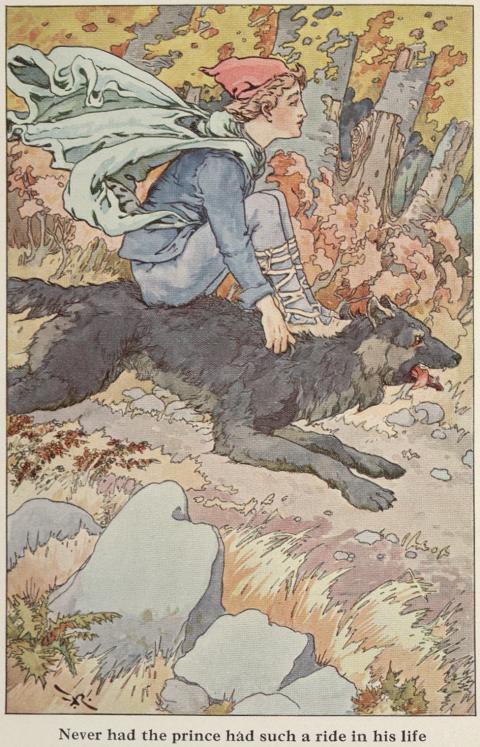
I found my own choice is the retelling by Gudrun Thorne-Thomsen in her anthology of East o' the Sun and West o' the Moon. It makes our hero a bit of a Cinderella  type, but I prefer its ending. I also enjoy the illustration by Frederick Richardson of the young prince riding a wolf. 

The Giant Who Had No Heart in His Body

Once on a time there was a King who had seven sons. Six of them were stout, brave lads, but the youngest was the cinderlad, you must know; and he went about by himself neither saying nor doing much. Best of all he liked to sit by the hearth and watch the glowing cinders, so they called him Boots, and thought little of him.

Now, when the Princes were grown up, the six were to set off to fetch brides for themselves. As for Boots, they would not be seen with him, so he was to stay at home; but the others were to bring back a bride for him, if any could be found willing to marry such a one. The King gave the six the finest clothes you ever set eyes upon, so fine that the light gleamed from them a long way off; and each had his horse, which cost many, many hundred dollars, and so they set off. Now, when they had been to many palaces, and seen many princesses, they came to a king who had six daughters. Such lovely king's daughters they had never seen, and so they asked them to be their brides, and when they had got them, they set off home again. But they quite forgot that they were to bring back a bride for Boots, their brother, who was staying at home.

When they had gone a good bit on their way, they passed close by a steep hillside, like a wall, where was a giant's house. Out came the giant and set his eyes upon them, and turned them all into stone, princes, princesses and all. Now, the king waited and waited for his six sons, but so long as he waited so long they stayed away; so he fell into great grief, and said he would never know what it was to be happy again.

One day Boots said to the King,—

"I've been thinking to ask your leave to set out and find my brothers."

"Nay, nay!" said his father, "that would be of no use, for you are not clever enough. Better stay and dig in the ashes all your life."

But Boots had set his heart upon it. Go he would; and he begged and pleaded so long that the King was forced to let him go. He gave Boots an old broken-down nag; but Boots did not care a pin for that, he sprang up on his sorry old steed.

"Farewell, Father," he said, "I'll come back, never fear, and likely enough I shall bring my six brothers back with me," and with that he rode off.

When he had ridden a while he came to a raven, which lay in the road and flapped its wings, and was not able to get out of the way, it was so starved.

"Oh, dear friend," said the raven, "give me a little food, and I'll help you again at your utmost need."

"I haven't much food," said the Prince, "and I don't see how you'll ever be able to help me; but still I can spare you a little. I see you need it."

So he gave the raven some of the food he had brought with him.

Now, when he had gone a little farther, he came to a brook, and in the brook lay a great salmon which had got upon a dry place and dashed itself about, and could not get into the water again.

"Oh, dear friend," said the salmon to the Prince; "help me out into the water again, and I'll help you at your utmost need."

"Well!" said the Prince, "the help you'll give me will not be great, I daresay, but it's a pity you should be there and choke;" and with that he shot the fish out into the stream again.

After that he went on a long, long way, and there met him a wolf, which was so famished that it lay and crawled along the road.

"Dear friend, do let me have some food," said the wolf, "I'm so hungry that the wind whistles through my ribs. I've had nothing to eat these two years. When I have eaten, you can ride upon my back, and I'll help you again in your utmost need."

"Well, the help I shall get from you will not be great, I'll be bound," said the Prince; "but you may take all I have, since you are in such great need."

Never had the prince had such a ride in his life

So when the wolf had eaten the food. Boots took the bit and put it between the wolf's jaws, and laid the saddle on his back; and away they went like the wind. Never had the Prince had such a ride before.

"When we have gone still farther," said Graylegs, "I'll show you the Giant's house."

And after a while they came to it.

"See, here is the Giant's house," said the Wolf; "and see, here are your six brothers whom the Giant has turned to stone; and see, here are their six brides. Yonder is the door, and in at that door you must go. When you get in you'll find a princess, and she'll tell you what to do to make an end of the Giant. Only mind you do as she bids you."

Well! Boots went in, but, truth to say, he was very much afraid. The Giant was away, but in one of the rooms sat the Princess, just as the wolf had said, and so lovely a princess Boots had never set eyes upon.

"Oh, heaven help you! whence have you come?" said the Princess, as she saw him; "it will surely be your death. No one can make an end of the Giant who lives here. He is a most cruel monster, and he has no heart in his body."

"Well! well!" said Boots; "but now that I am here, I may as well try what I can do with him, and I will see if I can't free my brothers, who have been turned to stone; and you, too, I will try to save, that I will."

"Well, if you must, you must," said the Princess; "so let us see if we can't hit upon a plan. Just creep under the bed yonder, and mind you listen to what he and I talk about. But, pray, do lie as still as a mouse."

So he crept under the bed, and he had scarce got well underneath, before the Giant came.

"Ha!" roared the Giant, "what a smell of Christian blood there is in the house."

"Yes, I know there is," said the Princess, "for there came a crow flying with a man's bone, and let it fall down the chimney. I made all the haste I could to get it out, but all one can do the smell doesn't go so soon."

So the Giant said no more about it, and when night came they went to bed. After they had lain a while the Princess said, "There is one thing I'd be glad to ask you about, if I only dared."

"What thing is that?" asked the Giant.

"Only this, where do you keep your heart, since you don't carry it about you," said the Princess.

"Ah! that's a thing you've no business to ask about: but if you must know, it lies under the door sill." said the Giant.

"Ho, ho!" said Boots to himself under the bed. "Then we'll soon see if we can't find it."

Next morning the Giant got up very early, and strode off to the wood; but he was hardly out of the house before Boots and the Princess set to work to look under the door sill for this heart; but the more they dug and the more they hunted the more they couldn't find it.

"He has balked us this time," said the Princess, "but we'll try him once more."

So she picked all the prettiest flowers she could find, and strewed them over the door sill, which they had laid in its right place again; and when the time came for the Giant to come home, Boots crept under the bed. Just as he was well under back came the Giant.

Snuff-snuff went the Giant's nose. "My eyes and limbs, what a smell of Christian blood there is in here," said he.

"I know there is," said the Princess, "for there came a crow flying with a man's bone in his bill, and let it fall down the chimney. I made as much haste as I could to get it out, but I dare say it's that you smell."

So the Giant held his peace and said no more about it. A little while after, he asked who it was that had strewed flowers about the door sill.

"Oh, I, of course," said the Princess.

"And, pray, what is the meaning of all this? said the Giant.

"Ah!" said the Princess, "I strewed them there when I knew your heart lay under there."

"You don't say so," said the Giant; "but after all it doesn't lie there at all."

So when they went to bed in the evening, the Princess asked the Giant again where his heart was, for she said she would so much like to know.

"Well," said the Giant, "if you must know, it lies away yonder in the cupboard against the wall."

"So, so!" thought Boots and the Princess; "then we will soon find it."

Next morning the Giant was away early, and strode off to the wood. As soon as he was gone, Boots and the Princess were in the cupboard hunting for the heart, but the more they looked for it the less they found it.

"Well," said the Princess, "we'll just try him once more."

So she decked the cupboard with flowers and garlands, and when the time came for the Giant to come home, Boots crept under the bed again.

Then back came the Giant.

Snuff-snuff! "My eyes and limbs, what a smell of Christian blood there is in here!"

"I know there is," said the Princess, "for a little while since there came a crow flying with a man's bone in his bill, and let it fall down the chimney. I made all the haste I could to get it out of the house; but after all my pains I dare say it's that you smell."

When the Giant heard that he said no more about it, but after a while he saw how the cupboard was all decked about with flowers and garlands; and he asked who it was that had done that. Who could it be but the Princess?

"And, pray what's the meaning of all this foolishness?" asked the Giant.

"Oh, I couldn't help doing it when I knew your heart lay there," said the Princess.

"How can you be so silly as to believe any such thing?" said the Giant.

"How can I help believing it, when you say it?" said the Princess.

"You're a goose," said the Giant; "where my heart is, you will never come."

"Yet for all that," said the Princess, "it would be such a pleasure to know where it really lies."

Then the poor Giant could hold out no longer, but said,—

"Far, far away in a lake lies an island; on that island stands a church; in that church is a well; in that well swims a duck; in that duck there is an egg, and in that egg there lies my heart."

In the morning early, while it was still gray dawn, the Giant strode off to the wood.

"Now I must set off too," said Boots; "if I only knew how to find the way." He took a long farewell of the Princess, and when he slipped out of the Giant's door, there stood the Wolf waiting for him. Boots told him all that had happened, and said now he wished to ride to the well inside the church, if only he knew the way. The Wolf bade him jump on his back, and away they went, over hill and dale, over hedge and field, till the wind whistled after them. After they had travelled many, many days, they came at last to the lake. Then the Prince did not know how to get across, but the Wolf bade him not to be afraid, but to hold fast. So he jumped into the lake with the Prince on his back, and swam over to the island. When they came to the church, the church keys hung high, high up on the top of the tower, and the Prince knew not how to get them down.

"Call upon the raven," said the Wolf.

So the Prince called upon the raven, and immediately the raven came, and flew up and fetched the keys, and so the Prince got into the church. When he came to the well, there was the duck, which swam about forward and backward, just as the Giant had said. So the Prince stood and coaxed it and coaxed it, till finally it came to him, and he grasped it in his hand; but just as he lifted it up from the water the duck dropped the egg in the well, and then Boots was beside himself to know how to get it out again.

"Now call upon the salmon," said the Wolf, and Boots called upon the salmon, and the salmon came and fetched up the egg from the bottom of the well.

Then the Wolf told him to squeeze the egg, and as soon as he squeezed the egg, the Giant screamed and begged and prayed to be spared, saying he would do all that the Prince wished if he would only not squeeze his heart in two.

"Tell him to restore to life again your six brothers and their brides, whom he has turned to stone," said the Wolf. Yes, the Giant was ready to do that, and he turned the six brothers into king's sons again, and their brides into king's daughters.

Then Boots left the Giant's heart on the altar of the church. That took all the evil power from the cruel Giant, and I have never heard of him since.

And now, Boots rode back again on the Wolf to the Giant's house, and there stood all his six brothers alive and merry with their brides. Then Boots went into the hillside after his bride, and they all set off home again to their father's house. And you may fancy how glad the old King was when he saw his seven sons come back, each with his bride;—"But the loveliest bride is the bride of Boots, after all," said the King, "and he shall sit highest at the table, with her by his side."

So they had a great wedding feast, and the mirth was both loud and long, and if they have not done feasting, why they are at it still. 

************ 

This is part of a series of postings of stories under the category, “Keeping the Public in Public Domain.” The idea behind Public Domain was to preserve our cultural heritage after the authors and their immediate heirs were compensated. I feel strongly current copyright law delays this intent on works of the 20th century. My own library of folklore includes so many books within the Public Domain I decided to share stories from them. I hope you enjoy discovering them.

At the same time, my own involvement in storytelling regularly creates projects requiring research as part of my sharing stories with an audience.  Whenever that research needs to be shown here, the publishing of Public Domain stories will not occur that week.  This is a return to my regular posting of a research project here.  (Don't worry, this isn't dry research, my research is always geared towards future storytelling to an audience.)  Response has convinced me that "Keeping the Public in Public Domain" should continue along with my other postings as often as I can manage it.

See the sidebar for other Public Domain story resources I recommend on the page “Public Domain Story Resources."


Friday, January 9, 2026

National Appreciate a Dragon Day (Mackenzie - Story of Wu and the Thunder Dragon - Keeping the Public in Public Domain)

January the 16th is National Appreciate a Dragon Day. I always appreciate dragons, so the day is one I love to promote. While the European version of the dragon tends to stress its power as malevolent, I prefer the Asian view of it being powerful, but in ways that can be benevolent. I went prowling for Asian dragon stories in the Public Domain for today.
   
This is me on a slide on Baldwin Road in Auburn Hills, Michigan just north of I-75
 

Myths of China and Japan by Donald A. Mackenzie tends to get a bit dry and academic, but Chapter 7, "Dragon Folk Stories" gives a few Chinese tales with a hint of why the dragon is respected. There's also more later in the book, including Japanese dragons.

"Story of Wu and the Thunder Dragon" 

To those who win their favour, the dragons are preservers even when they come forth as destroyers. The story is told of how Wu, the son of a farmer named Yin, won the favour of a dragon and rose to be a great man in China. When he was a boy of thirteen, he was sitting one day at the garden gate, looking across the plain which is watered by a winding river that flows from the mountains. He was a silent, dreamy boy, who had been brought up by his grandmother, his mother having died when he was very young, and it was his habit thus to sit in silence, thinking and observing things. Along the highway came a handsome youth riding a white horse. He was clad in yellow garments and seemed to be of high birth. Four man-servants accompanied him, and one held an umbrella to shield him from the sun’s bright [89]rays. The youth drew up his horse at the gate and, addressing Wu, said: “Son of Yin, I am weary. May I enter your father’s house and rest a little time?”

The boy bowed and said: “Enter.”

Yin then came forward and opened the gate. The noble youth dismounted and sat on a seat in the court, while his servants tethered the horse. The farmer chatted with his visitor, and Wu gazed at them in silence. Food was brought, and when the meal was finished, the youth thanked him for his hospitality and walked across the courtyard. Wu noticed that before one of the servants passed through the gate, he turned the umbrella upside down. When the youth had mounted his horse, he turned to the silent, observant boy and said: “I shall come again to-morrow.”

Wu bowed and answered: “Come!”

The strangers rode away, and Wu sat watching them until they had vanished from sight.

When evening came on, the farmer spoke to his son regarding the visitors, and said: “The noble youth knew my name and yet I have never set eyes on him before.”

Wu was silent for a time. Then he said: “I cannot say who the youth is or who his attendants are.”

“You watched them very closely, my son. Did you note anything peculiar about them?”

Said Wu: “There were no seams in their clothing; the white horse had spots of five colours and scaly armour instead of hair. The hoofs of the horse and the feet of the strangers did not touch the ground.”19

Yin rose up with agitation and exclaimed: “Then they are not human beings, but spirits.” [90]

Said Wu: “I watched them as they went westward. Rain-clouds were gathering on the horizon, and when they were a great distance off they all rose in the air and vanished in the clouds.”20

Yin was greatly alarmed to hear this, and said: “I must ask your grandmother what she thinks of this strange happening.”

The old woman was fast asleep, and as she had grown very deaf it was difficult to awaken her. When at length she was thoroughly roused, and sat up with head and hands trembling with palsy,21 Yin repeated to her in a loud voice all that Wu had told him.

Said the woman: “The horse, spotted with five colours, and with scaly armour instead of hair, is a dragon-horse. When spirits appear before human beings they wear magic garments. That is why the clothing of your visitors had no seams. Spirits tread on air. As these spirits went westward, they rose higher and higher in the air, going towards the rain-clouds. The youth was the Yellow Dragon. He is to raise a storm, and as he had four followers, the storm will be a great one. May no evil befall us.”

Then Yin told the old woman that one of the strangers had turned the umbrella upside down before passing through the garden gate. “That is a good omen,” she said. Then she lay down and closed her eyes. “I have need of sleep,” she murmured; “I am very old.”22 [91]

Heavy masses of clouds were by this time gathering in the sky, and Yin decided to sit up all night. Wu asked to be permitted to do the same, and his father consented. Then the boy lit a yellow lantern, put on a yellow robe that his grandmother had made for him, burned incense, and sat down reading charms from an old yellow book.23

The storm burst forth in fury just when dawn was breaking dimly. Wu then closed his yellow book and went to a window. The thunder bellowed, the lightning flamed, and the rain fell in torrents, and swollen streams poured down from the mountains. Soon the river rose in flood and swept across the fields. Cattle gathered in groups on shrinking mounds that had become islands surrounded by raging water.

Yin feared greatly that the house would be swept away, and wished he had fled to the mountains.

At night the cottage was entirely surrounded by the flood. Trees were cast down and swept away. “We cannot escape now,” groaned Yin.

Wu sat in silence, displaying no signs of emotion. “What do you think of it all?” his father asked.

Wu reminded him that one of the strangers had turned the umbrella upside down, and added: “Before the dragon youth went away he spoke and said: ‘I shall come again to-morrow’.”

“He has come indeed,” Yin groaned, and covered his face with his hands.

Said Wu: “I have just seen the dragon. As I looked towards the sky he spread out his great hood above our home. He is protecting us now.”

“Alas! my son, you are dreaming.” [92]

“Listen, father, no rain falls on the roof.”

Yin listened intently. Then he said: “You speak truly, my son. This is indeed a great marvel.”

“It was well,” said Wu, “that you welcomed the dragon yesterday.”

“He spoke to you first, my son; and you answered, ‘Enter’. Ah, you have much wisdom. You will become a great man.”

The storm began to subside, and Wu prevailed upon his father to lie down and sleep.24

Much damage had been done by storm and flood, and large numbers of human beings and domesticated animals had perished. In the village, which was situated at the mouth of the valley, only a few houses were left standing.

The rain ceased to fall at midday. Then the sun came out and shone brightly, while the waters began to retreat.

Wu went outside and sat at the garden gate, as was his custom. In time he saw the yellow youth returning from the west, accompanied by his four attendants. When he came nigh, Wu bowed and the youth drew up his horse and spoke, saying: “I said I should return to-day.”

Wu bowed.

“But this time I shall not enter the courtyard,” the youth added.

“As you will,” Wu said reverently.

The dragon youth then handed the boy a single scale which he had taken from the horse’s neck, and said: “Keep this and I shall remember you.”

Then he rode away and vanished from sight.

The boy re-entered the house. He awoke his father [93]and said: “The storm is over and the dragon has returned to his pool.”25

Yin embraced his son, and together they went to inform the old woman. She awoke, sat up, and listened to all that was said to her. When she learned that the dragon youth had again appeared and had spoken to Wu, she asked: “Did he give you ought before he departed?”

Wu opened a small wooden box and showed her the scale that had been taken from the neck of the dragon horse.

The woman was well pleased, and said: “When the Emperor sends for you, all will be well.”

Yin was astonished to hear these words, and exclaimed: “Why should the Emperor send for my boy?”

“You shall see,” the old woman made answer as she lay down again.

Before long the Emperor heard of the great marvel that had been worked in the flooded valley. Men who had taken refuge on the mountains had observed that no rain fell on Yin’s house during the storm. So His Majesty sent couriers to the valley, and these bade Yin to accompany them to the palace, taking Wu with him.

On being brought before the Emperor, Yin related everything that had taken place. Then His Majesty asked to see the scale of the dragon horse.

It was growing dusk when Wu opened the box, and the scale shone so brightly that it illumined the throne-room so that it became as bright as at high noon.

Said the Emperor: “Wu shall remain here and become one of my magicians. The yellow dragon has imparted to him much power and wisdom.”

Thus it came about that Wu attained high rank in [94]the kingdom. He found that great miracles could be worked with the scale of the dragon horse. It cured disease, and it caused the Emperor’s army to win victories. Withal, Wu was able to foretell events, and he became a renowned prophet and magician.

The farmer’s son grew to be very rich and powerful. A great house was erected for him close to the royal palace, and he took his grandmother and father to it, and there they lived happily until the end of their days.

Thus did Wu, son of Yin, become a great man, because of the favour shown to him by the thunder-dragon, who had wrought great destruction in the river valley and taken toll of many lives.

It will be gathered from this story that the Chinese dragon is not always a “beneficent deity”, as some writers put it. Like certain other gods, he is a destroyer and preserver in one. 

The appearance of four servants (the gods of the four quarters) with the dragon-god, indicates that the coming storm is to be one of exceptional violence. 

21 The deep slumberer in a folk-tale is usually engaged “working a spell”. As will be gathered from the story, the boy received his knowledge and power from his grandmother. She resembles the Norse Vala and the Witch of Endor. 

22 The Norse Vala makes similar complaint when awakened by Odin. It looks as if this Chinese story is based on one about consulting a spirit of a “wise woman” who sleeps in her tomb. 

23 An interesting glimpse of the connection between colour symbolism and magic. Everything is yellow because a yellow dragon is being invoked. 

24 This sleep appears to be as necessary as that of the grandmother. 

25 The latest spell had been worked, and it was not necessary that the father should sleep any longer. 

***

I hope you'll return to the Appreciate a dragon day page for more information on these wonderful creatures. . . and tell about them, too!

**************


This is part of a series of postings of stories under the category, “Keeping the Public in Public Domain.” The idea behind Public Domain was to preserve our cultural heritage after the authors and their immediate heirs were compensated. I feel strongly current copyright law delays this intent on works of the 20th century. My own library of folklore includes so many books within the Public Domain I decided to share stories from them. I hope you enjoy discovering them.

At the same time, my own involvement in storytelling regularly creates projects requiring research as part of my sharing stories with an audience.  Whenever that research needs to be shown here, the publishing of Public Domain stories will not occur that week.  This is a return to my regular posting of a research project here.  (Don't worry, this isn't dry research, my research is always geared towards future storytelling to an audience.)  Response has convinced me that "Keeping the Public in Public Domain" should continue along with my other postings as often as I can manage it.
See the sidebar for other Public Domain story resources I recommend on the page “Public Domain Story Resources."


Friday, January 2, 2026

Freeman - The Blue Robin - Keeping the Public in Public Domain

As we enter 2026 things look as divided as ever! I found an interesting fairy tale, by Mary Wilkins Freeman that fits my wish for the New Year. Take a look at that link for Freeman. Her marriage was less than delightful and upon her husband's death "he left the majority of his wealth to his chauffeur and only  one dollar to his former wife.[5]"  Fortunately for us she was recognized for her writing and it supported her. 

I found today's story in Carolyn Sherwin Bailey's For the Storyteller; Storytelling and Stories to TellThe section on "Imagination and the Fairy Tale" would be a post unto itself, but here are some points it makes related to Freeman's story.

A good fairy story is the best stimulus to child imagination.

Not any fairy story, selected with slight discrimination and told to a child just because it is a story of fancy, however. “Blue Beard,” “Ali Baba,” “The Cruel Stepmother” do little but cause child nightmares and give children ideas of cruelty, vengeance and crime. These concepts will present themselves to the child soon enough in the daily newspapers.[215] Let us shut them out of the story hour. In selecting a fairy story to tell to children, we will first analyze it with exceeding care, asking ourselves these questions in regard to it:

What constitutes the imaginative element of this story?

Is its point of unreality an idea which we want to give permanence in the child’s mind?

Is the story told in a series of such familiar, known images that there is material in it for stimulating the child’s constructive imagination?

If a fanciful story survives these three tests, we may be sure that it is perfect.

          . . .

One of the most beautiful of all fairy stories, Mary Wilkins Freeman wrote. “The Blue Robin” is perfect in treatment and theme. 

Not too surprisingly I can't find a picture of a Blue Robin (nor is drawing my art). For some crazy reason Blogger isn't accepting ANY kind of a picture, but then that exercise of the imagination, too, is part of storytelling.

        The Blue Robin 

The country over which King Chrysanthemum reigned was very far inland, so there was very little talk about the sea-serpent, but everybody was agitated over the question whether there was, or was not, a Blue Robin.

The whole kingdom was divided about it. The members of parliament were “F. B. R.,” for Blue Robin or “A. B. R.,” against Blue Robin. The ladies formed clubs to discuss the question, and sometimes talked whole afternoons about it, and the children even laid down their dolls, and their tops to search for the Blue Robin. Indeed, many children had to be kept tied to their mother’s apron-strings all the time to prevent them from running away to a Blue Robin hunt. It was a very common thing to see ladies going to a Blue Robin club, with a child at each apron-string, pulling back and crying, “I want to go hunting the Blue Robin! I want to go hunting the Blue Robin!”

The country was agitated over this question for many years, then finally there were riots about it.

People had to lock themselves in their houses, and when the Blue Robin party was uppermost, paint blue robins on their front doors, and when it was not, wash them off. After the riots commenced, it was really almost all that people could do to paint blue robins on and wash them off, their front doors.

At last King Chrysanthemum had to take extreme measures. He decided to consult the Wise Man. A committee was chosen of eight F. B. R.’s, and eight A. B. R.’s, and a chairman, and they set out at once, marching four abreast, the chairman with his chair leading the way, to consult the Wise Man. He had to be found before he could be consulted, however, and that was a very difficult matter. The Wise Man considered it the height of folly to live like other people in a house immovably fixed upon one spot of ground, and therefore he always carried his house about with him, as a turtle carries his shell.

He had fashioned a little dwelling of cloth and steel ribs, something like an umbrella, which he strapped to himself, and lived in, traveling all over the country in pursuit of wisdom.

The committee marched a whole week, before they came upon the Wise Man one afternoon in a pasture where huckleberries grew. He was standing quite still when they approached and made their obeisances. The Chairman of the committee placed his chair, a rocking-chair with a red plush cushion, before the Wise Man, seated himself, and spoke. “All Hail, Wise Man!” said he in a loud voice.

The Wise Man’s house had a little door in front like a coach door, and two tiny windows. One of the windows had the curtains drawn, but out of the other looked the Wise Man’s calm blue right eye. There was so much wisdom in his two eyes that he knew people could not comprehend it, so he always curtained one window. The house was about one foot higher than his head, and reached to his ankles. They could see his feet in their leather sandals below it.

The Wise Man said not one word in response to the Chairman’s salutation, only looked at him with his blue right eye. Then the Chairman laid the matter before the Wise Man and besought his aid in the terrible situation of the country. After the Chairman had ceased speaking there was a silence for half an hour. Not a sound was to be heard except the creaking of the Chairman’s rocking-chair. Then the Wise Man cleared his throat. The committee leaned forward expectantly, but they had to wait another half hour before he spoke, and then it was not very satisfactory. “Ideas are not as thick as huckleberries in this pasture,” was all he said.

The committee looked at one another, and nodded ruefully. It was quite true, but it did not help them in their dilemma. They waited another half hour; then the Wise Man began moving off across the pasture in his house.

“Oh, stop, stop!” cried the Chairman. “Stop, stop!” cried the committee. They all ran after him, and begged him not to go away until he had given them some useful advice.

“Offer a reward!” called out the Wise Man, as he scudded away.

“For what, for what!” cried the committee.

“For finding the Blue Robin,” called out the Wise Man, and then a puff of wind caught his umbrella-like house, and he was lifted quite off his feet, and bobbed away out of sight over the huckleberry-bushes.

The committee hastened back to the city, and reported. Another special parliament was called, and the reward for finding the Blue Robin was offered. That was really a difficult matter, because the Princess Honey was only five years old, and the customary reward—her hand in marriage—could hardly be offered. However, it was stated that if the finder of the Blue Robin was of suitable age when the Princess was grown, she should be his bride; and furthermore that he and all his relatives should be pensioned for life and that he should be appointed Poet Laureate, and given a regiment, a steam yacht, a special train, and a pound of candy every day from the national candy mills. The offer was painted in blue letters on yellow paper, and pasted up all over the country, and then the search began in good earnest. Business all over the kingdom was at a standstill. Nobody did anything but hunt the Blue Robin.

People ate nothing in those days but cornmeal pudding, hastily mixed and boiled. There was no bread baked, because all the bakers and all the housewives were out hunting the Blue Robin. The mothers untied the children from their apron-strings, and the schools were all closed, because it was agreed that finding the Blue Robin and establishing peace in the kingdom, was of more importance than books, and all the children who were old enough were out hunting—that is, all the children except Poppy.

It should be stated here that everybody in this country, with the exception of the Princess, had a flower-name. The Princess was so much sweeter, that only the inmost sweetness of all flowers was good enough for her name, and she was called Honey.

Poppy was about ten years old, and his father was an editor of a newspaper, and very poor. He could scarcely support his five children. His wife had died the year before, and he could not afford to hire a housekeeper.

So Poppy had to stay at home, and keep the house, and take care of his four young brothers and sisters, while his father was away editing, and he could not hunt the Blue Robin. It was a great cross to him, but he loved his little brothers and sisters, and he made the best of it.

After the search for the Blue Robin began, his father was much busier, and had often to be away all night, so Poppy had to rock and trot the twin babies, Pink and Phlox, and go without sleep, after working hard cooking and washing dishes and sewing all day. Poppy had to mend the children’s clothes, and he was even trying to make some little frocks for Petunia and Portulacca. They were twins also, five years old.

As Poppy sat in the window and sewed, with his right foot rocking Pink’s cradle, and his left foot rocking Phlox’s, with Petunia and Portulacca sitting beside him on their little stools, he told them all he had ever heard about the wonderful Blue Robin.

“Nobody is even quite certain he has seen it, himself,” said Poppy, “but he knows somebody else, who knows somebody else, who has; and if you ever could find the first somebody, why he could tell where the Blue Robin was.”

“Can’t they find the first somebody?” asked Portulacca.

“I guess he died before people were born,” said Poppy. Then he went on and told Petunia and Portulacca how there was a wonderful blue stone in the King’s crown, which was unlike all other precious stones, and said to be the Blue Robin’s egg; and how there was a little Blue Book in the King’s library which had a strange verse in it about the Blue Robin.

Then Poppy repeated the verse. He had learned it at school. It ran in this way:

“He who loveth me alone,
Can tell me not from stick or stone;
He who loveth more than me,
Shall me in fullest glory see.”

“What does that mean?” asked Petunia and Portulacca.

“I don’t know,” replied Poppy. Then he mended faster than ever. Many children ran past the window, hunting the Blue Robin, but he did not complain, even to himself.

That night his father did not come home, and Pink and Phlox cried as usual, and he had to rock them, and trot them. About midnight, however, they both fell asleep in their cradles, and Poppy began to think he might get a little rest himself. He could scarcely keep his eyes open. Petunia and Portulacca had been sound asleep in their cribs ever since seven o’clock.

Everything was very still, and he was just dozing, when he heard a sound which made him start up wide awake at once, although the children never stirred. He heard a single sweet bird-pipe, sweeter than anything he had ever heard in his life, and it seemed to be right in the room at his elbow. When the babies fell asleep Poppy had blown out the candle, the hearth-fire had gone out, and the room had been very dark, but now something was shining on the table like a lamp, which gave out a wonderful blue light. The sweet pipe came again. Poppy stared at the blue light on the table, which grew brighter and brighter, until he saw what it was. The Blue Robin shone on his table like a living sapphire, its blue wings seeming to fan the blue light into flames, its blue breast brighter than anything he had ever seen.

While all the world was out searching for the Blue Robin, it had come of its own accord to the poor little faithful boy in his poor little home.

The children all slept soundly, and did not stir. Poppy stood up trembling, and went over to the table, and immediately the Blue Robin flew to his hand, and clung there.

Then Poppy went out of the house, and down the road to the King’s palace with the Blue Robin on his hand. Although it was so late, scarcely anybody had gone to bed. They were all out with lanterns, hunting for the Blue Robin.

When Poppy with the Blue Robin on his hand came in sight, all the lanterns went out.

“What is that?” the people cried, “what is that wonderful blue light?”

They crowded around Poppy.

Then all of a sudden they shouted, “Poppy has found the Blue Robin! Poppy has found the Blue Robin!” and followed him to the King’s Palace.

The shouts were heard in the newspaper office where Poppy’s father was hard at work, and he ran to the window. When he saw his son with the Blue Robin, he was overwhelmed with joy. He stuck his pen behind his ear and came down on the fire-escape, and also went to the palace. The King had not gone to bed, though it was so late, neither had the Queen. They were talking about the Blue Robin and the perilous state of the country with the Prime Minister, on the front door-step.

When they saw Poppy and the Blue Robin, and all the people, and heard the shouts of joy, the King tossed his crown in the air, the Prime Minister swung his hat, and the Queen ran in and wrapped up the Princess Honey in a little yellow silk gown, and brought her to see the wonderful sight.

It was wonderful—the Blue Robin on Poppy’s hand seemed to light the whole city. Poppy, by the King’s order, stood on the top door-step, and everybody could see the bird on his hand. Then the Blue Robin began to sing, and sang an hour without ceasing, so loud that everybody could hear.

When the bird stopped singing, the King advanced. “You shall now receive your reward,” he said to Poppy, “and I will take the Blue Robin, and put him in a golden cage, and have him guarded by a regiment of picked soldiers.”

The King extended his hand and Poppy his, but just as the King touched the Blue Robin, he disappeared. There came a faint song from far above the city roofs, and people tipped back their heads, and strained their eyes, but they could not see the Blue Robin; they never saw him again, as long as they lived.

However, he had been seen by many witnesses, and the object of the search was attained. There were no longer two parties in parliament, and the country was in a state of perfect peace. Indeed, parliament only met afterward to agree, and eat cake and ice cream, and shake hands.

Poppy had his reward at once—that is, everything but the hand of the Princess Honey—and he and his father and his little brothers and sisters, were very rich and happy, until he grew to be a man. Then the Princess Honey had grown to be a beautiful maiden, and he married her with great pomp, and the King gave them the Blue Robin’s egg for a wedding-present.

***************************** 

This is part of a series of postings of stories under the category, “Keeping the Public in Public Domain.” The idea behind Public Domain was to preserve our cultural heritage after the authors and their immediate heirs were compensated. I feel strongly current copyright law delays this intent on works of the 20th century. My own library of folklore includes so many books within the Public Domain I decided to share stories from them. I hope you enjoy discovering them.

At the same time, my own involvement in storytelling regularly creates projects requiring research as part of my sharing stories with an audience.  Whenever that research needs to be shown here, the publishing of Public Domain stories will not occur that week.  This is a return to my regular posting of a research project here.  (Don't worry, this isn't dry research, my research is always geared towards future storytelling to an audience.)  Response has convinced me that "Keeping the Public in Public Domain" should continue along with my other postings as often as I can manage it.

See the sidebar for other Public Domain story resources I recommend on the page “Public Domain Story Resources."


Friday, December 26, 2025

Gerald or Professor Whiskers

I don't know why, but this current holiday season has left me feeling like I'm walking in high heels with one heel broken off! Even a group I was truly looking forward to doing a Christmas program was cancelled for bad weather. I was glad I didn't have to try and reach them on a day that would have been truly awful for driving, but hearing my next program there would be winter instead left me thinking of the many stories that only can be told at Christmas. One of them, Helen Hunt Jackson's tale from her childhood,  "A Christmas Tree for Cats", comes from my love of cats that nowadays no longer permits my living with a cat. My allergies improved immensely when I accepted this. Fortunately I am able to visit homes with cats. 

On Facebook a friend highlighted a story worth following that tale by Jackson. Jibor Camavin told this tale of his cat, Gerald, or as Jibor says his grandkids call him, "Professor Whiskers."


They told me at the shelter he was twelve years old and "not very adoptable." His face is lopsided, one ear flops weird, and he's missing half his teeth so his tongue kind of hangs out permanently. The volunteer said he'd been returned twice already because people thought he looked "off" and I stood there looking at this beat up tuxedo cat thinking about how I've felt pretty unadoptable myself since my divorce.
I'm 52 and I went in looking for a kitten, something cute and normal that my grandkids could play with when they visit, but this guy was sitting in the back corner wearing a little bow tie someone had put on him and I just couldn't leave him there. His name was Gerald. They said he'd probably only have a year or two left and he'd need special food and monthly vet checkups. I took him home that afternoon and my sister said "you adopted the Walmart clearance version of a cat" which honestly made me love him more.
Gerald has one speed and it's judgmental. He sits on the cat tree by the window and stares at me like I'm failing an exam only he knows about. When I'm on the couch he jumps up and positions himself so he's looking directly into my soul with those huge uneven eyes. My neighbor came over for coffee last week and actually got uncomfortable, she said "why is he looking at me like that, does he know something I don't?" I told her Gerald judges everyone equally, it's his gift.
I started making him different bow ties because the shelter one was getting ratty and I found this amazing seller on Tedooo app who does custom pet accessories. I sent her Gerald's measurements and now he's got seven different ties, one for each day of the week. She told me she'd never made anything for a cat described as "permanently disappointed looking" before. People on my street have started asking about them when I post pictures and I ended up opening my own little shop on Tedooo app selling pet bow ties and bandanas because apparently there's a whole market for judgmental animal fashion.
My daughter says Gerald looks like he's perpetually asking to speak to the manager and she's not wrong. But here's the thing, he sleeps on my chest every single night and purrs so loud it sounds like a motorcycle. When I had that terrible week last month where I couldn't stop crying about everything, he didn't leave my side. Just sat there staring at me with that crooked face like "yeah, life's hard, get it together."
I've had him for eight months now and the vet says he's actually healthier than they expected. My grandkids named him Professor Whiskers because they think he looks wise. He's become the neighborhood celebrity, people stop me on walks asking about "that cat with the face." Gerald doesn't care what anyone thinks. He just exists exactly as he is, taking up space, demanding respect. I'm trying to learn that from him.
 
* * * 
I haven't been able to "Message" Jibor, but I'd love to tell him we had a cat live to be 24! May this cat live a long, long time. Pets truly are family. (Fortunately I can have a dog in our family.) It is said that Christmas pets often don't work out well, but maybe those adopted after Christmas are a better match. So many pets are waiting for adoption. Here in my area I especially support K9Stray Rescue, but rescue groups are everywhere as the need for "furever" homes is great. If there is room in your heart for a new family member, please check your local shelter.