Tell me if you have a topic you'd like to see. (Contact: LoiS-sez@LoiS-sez.com .)
Please also let others know about this site.

Friday, June 27, 2025

Aesop - The Man and the Satyr - Keeping the Public in Public Domain

As the 4th of July fast approaches most of the country is sweating its way through an early summer heat wave. It's understandably a common conversation topic. Aesop put in fable form something I recently talked about from a scientific point of view without knowing it.

Searching Aesop in Project Gutenberg produces 39 volumes. I wanted something with an illustration for the story and chose Aesop's Fables: A New Revised Version From Original Sources with Upwards of 200 Illustrations by Harrison Weir, John Tenniel, Ernest Griset and Others.

Like most Aesop fables, how you tell the story is always open to the storyteller. Modern storytelling omits the moral, expecting the listener to form their own conclusion. That's not usually the case with the older versions available in Public Domain. If you want a one sentence moral, this is a fairly basic telling of both the fable and the moral. While the moral has nothing to do with the heat we're experiencing, it is interesting that our breath not only carries heat and cold, but stories, too!

The Man and the Satyr.
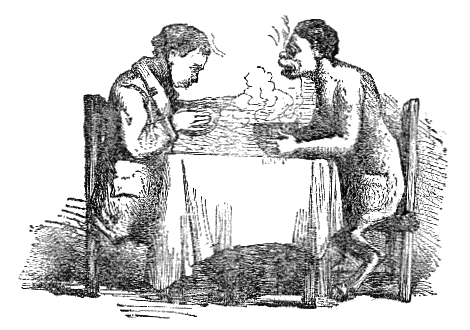
A Man and a Satyr once formed a bond of alliance. One very cold wintry day, as they talked together, the Man put his fingers to his mouth and blew on them. On the Satyr inquiring the reason, he told him that he did it to warm his hands. Later on in the day they sat down to eat, the food prepared being quite scalding. The Man raised one of his dishes towards his mouth and blew in it. On the Satyr again inquiring the reason, he said that he did it to cool the meat. "I can no longer consider you as a friend," said the Satyr; "a fellow who with the same breath blows hot and cold I could never trust."

A man who talks for both sides is not to be trusted by either.

**********

This is part of a series of postings of stories under the category, “Keeping the Public in Public Domain.” The idea behind Public Domain was to preserve our cultural heritage after the authors and their immediate heirs were compensated. I feel strongly current copyright law delays this intent on works of the 20th century. My own library of folklore includes so many books within the Public Domain I decided to share stories from them. I hope you enjoy discovering them.

At the same time, my own involvement in storytelling regularly creates projects requiring research as part of my sharing stories with an audience.  Whenever that research needs to be shown here, the publishing of Public Domain stories will not occur that week.  This is a return to my regular posting of a research project here.  (Don't worry, this isn't dry research, my research is always geared towards future storytelling to an audience.)  Response has convinced me that "Keeping the Public in Public Domain" should continue along with my other postings as often as I can manage it.

See the sidebar for other Public Domain story resources I recommend on the page “Public Domain Story Resources."


Friday, June 20, 2025

Chandler - Why the Sun Travels Regularly - Keeping the Public in Public Domain

It's offiffiffica'ly SUMMER! While weather with the current nation's heat wave and things like Memorial Day or the end of school may seem to have already brought Summer, the summer solstice in 2025 occurred on June 20 at 10:42 p.m. ET, marking the longest day of the year in the Northern Hemisphere and the official start of summer. It has been great to see the days become longer, but surely few in a northern part of the United States mind trading the days getting shorter while we leave winter's cold behind. 

I went looking for a story about this change and found one in Katherine Chandler's In the Reign of Coyote. Chandler tells us she found it in The Pacific Northwest Oregon and Washington, 2 vols., compiled and published by the Northwest Pacific History Company, Portland, Oregon, 1889, II. Aside from the frame characters used to present the stories, I strongly suspect she is correct when she says "While the essentials of the stories have been retained, the narratives have been elaborated and modified." We are not told by Chandler which of the Native Americans started this tale and there are many in the Pacific Northwest. The drawings for each story by J.W. Ferguson Kennedy add to that elaboration. If looking just for that story, it's at https://archive.org/details/inreignofcoyote0000kath/page/104/mode/2up


We're looking at an extra hot start to the days of summer, but even at that it's not enough to scorch a rabbit to pieces! At least the regularity of the length of those days can be counted on to happen.

*************** 

This is part of a series of postings of stories under the category, “Keeping the Public in Public Domain.” The idea behind Public Domain was to preserve our cultural heritage after the authors and their immediate heirs were compensated. I feel strongly current copyright law delays this intent on works of the 20th century. My own library of folklore includes so many books within the Public Domain I decided to share stories from them. I hope you enjoy discovering them.

At the same time, my own involvement in storytelling regularly creates projects requiring research as part of my sharing stories with an audience.  Whenever that research needs to be shown here, the publishing of Public Domain stories will not occur that week.  This is a return to my regular posting of a research project here.  (Don't worry, this isn't dry research, my research is always geared towards future storytelling to an audience.)  Response has convinced me that "Keeping the Public in Public Domain" should continue along with my other postings as often as I can manage it.

See the sidebar for other Public Domain story resources I recommend on the page “Public Domain Story Resources."


Friday, June 13, 2025

Olcott - Why Wild Roses Have Thorns - Keeping the Public in Public Domain

With summer days being enveloped in clouds from the Canadian wildfires, it may be tempting to stay indoors. The very area where these fire originate has a story about a wildflower that sometimes catches us -- quite literally -- and how it came to have thorns.

Today's story is from the Saulteaux, also Anishinaabe, who spread out from here in the Great Lakes to western Canada. The tale itself is found in Frances Jenkins Olcott's The Red Indian Fairy Book. While the book title might seem disrespectful in today's terminology, her retelling fits perfectly with the way I've heard elders tell Anishinaabe tales. 


May the firefighters win their battle so we may safely enjoy the beauties of nature. As my friend, the elder Simon Otto, who has gone on the Long Walk, would say "May you Walk in Peace."
 
********************** 

This is part of a series of postings of stories under the category, “Keeping the Public in Public Domain.” The idea behind Public Domain was to preserve our cultural heritage after the authors and their immediate heirs were compensated. I feel strongly current copyright law delays this intent on works of the 20th century. My own library of folklore includes so many books within the Public Domain I decided to share stories from them. I hope you enjoy discovering them.

At the same time, my own involvement in storytelling regularly creates projects requiring research as part of my sharing stories with an audience.  Whenever that research needs to be shown here, the publishing of Public Domain stories will not occur that week.  This is a return to my regular posting of a research project here.  (Don't worry, this isn't dry research, my research is always geared towards future storytelling to an audience.)  Response has convinced me that "Keeping the Public in Public Domain" should continue along with my other postings as often as I can manage it.

See the sidebar for other Public Domain story resources I recommend on the page “Public Domain Story Resources."

Friday, June 6, 2025

Aesop - Father and Sons - Keeping the Public in Public Domain

A search of Project Gutenberg for Aesop produces 38 books. How to tell Aesop, with or without the moral is sometimes debated, but the fables are always easily retold -- or 38 volumes (and many more!) wouldn't exist. Father's Day calls for a bit of paternal wisdom and today's story is a brief and easy way to do so.

While it comes from V.S. Vernon Jones with illustrations by Arthur Rackham, Rackham didn't illustrate this story. After it another book with illustrations by the author, Thomas Bewick, does match the story.


FATHER AND SONS

A certain man had several Sons who were always quarrelling with one another, and, try as he might, he could not get them to live together in harmony. So he determined to convince them of their folly by the following means. Bidding them fetch a bundle of sticks, he invited each in turn to break it across his knee. All tried and all failed: and then he undid the bundle, and handed them the sticks one by one, when they had no difficulty at all in breaking them. "There, my boys," said he, "united you will be more than a match for your enemies: but if you quarrel and separate, your weakness will put you at the mercy of those who attack you."

Union is strength. 

Illustration by Thomas Bewick for his "The Old Man and His Sons" in The Fables of Aesop and Others

May families have reason to celebrate Father's Day with this little story or the other two longer classic tales of Fathers here given by Andersen and Asbjornsen. Hmmmmm both Danish, but Aesop shows Fathers have long desrved recognition.

*****************************************

This is part of a series of postings of stories under the category, “Keeping the Public in Public Domain.” The idea behind Public Domain was to preserve our cultural heritage after the authors and their immediate heirs were compensated. I feel strongly current copyright law delays this intent on works of the 20th century. My own library of folklore includes so many books within the Public Domain I decided to share stories from them. I hope you enjoy discovering them.

At the same time, my own involvement in storytelling regularly creates projects requiring research as part of my sharing stories with an audience.  Whenever that research needs to be shown here, the publishing of Public Domain stories will not occur that week.  This is a return to my regular posting of a research project here.  (Don't worry, this isn't dry research, my research is always geared towards future storytelling to an audience.)  Response has convinced me that "Keeping the Public in Public Domain" should continue along with my other postings as often as I can manage it.

See the sidebar for other Public Domain story resources I recommend on the page “Public Domain Story Resources."