Tell me if you have a topic you'd like to see. (Contact: LoiS-sez@LoiS-sez.com .)
Please also let others know about this site.

Friday, November 28, 2025

Seton - The Snowstorm - Keeping the Public in Public Domain

As I write this the first real taste of winter's snow seems to be approaching. (It's timing during Thanksgiving travels is especially drawing the attention of meteorologists.) The founder of the Boy Scouts, Ernest Thompson Seton, in his book, Woodland Tales, offers stories and activities throughout the seasons. Yes, winter and snow get its share of attention. The book is almost over when he tells this tale of how a snowstorm is viewed by different cultures. 

In retelling this story I would substitute a few things to make them tell a bit more. I would say an Inuit from Alaska for "Eskimo" and would add "the Inuit word 'Siqniq' for him."  As for "an Indian", the talk of "Nana-bo-jou" shows it is a child who is an Anishinaabe.

 Photo by ak-girl on Freeimages.com

TALE 100
The Snowstorm

It was at the great winter Carnival of Montreal not long ago. Looking out of a window on a stormy day were five children of different races: an Eskimo, a Dane, a Russian, an Indian, and a Yankee. The managers of the Carnival had brought the first four with their parents; but the Yankee was the son of a rich visitor.

"Look," cried the little Eskimo from Alaska, as he pointed to the driving snow. "Look at the ivory chips falling! El Sol is surely carving a big Walrus tusk into a fine dagger for himself. See how he whittles, and sends the white dust flying."

Of course he didn't say "El Sol," but used the Eskimo name for him.

Then the Dane said: "No, that isn't what makes it. That is Mother Earth getting ready for sleep. Those are the goose feathers of her feather bed, shaken up by her servants before she lies down and is covered with her white mantle."

The little Indian, with his eyes fixed on the storm, shook his head gravely and said: "My father taught me that these are the ashes from Nana-bo-jou's pipe; he has finished his smoke and is wrapping his blanket about him to rest. And my father always spake true."

"Nay, you are all wrong," said the little Russian. "My grandmother told me that it is Mother Carey. She is out riding in her strongest, freshest steed, the White Wind. He has not been out all summer; he is full of strength and fury; he spumes and rages. The air is filled with the foam from his bridle, and froth from his shoulders, as she rides him, and spurs him, and rides him. I love to see it, and know that she is filling the air with strength and with messages. They carry me back to my own dear homeland. It thrills me with joy to see the whiteness."

But the Yankee boy said: "Why, it's just snowing."

*********

The story tends to end abruptly and should sit there, letting the many wonderful views contrast with the rich Yankee boy's view of  "it's just snowing." 

May your own views of the season include stories!

********************** 

This is part of a series of postings of stories under the category, “Keeping the Public in Public Domain.” The idea behind Public Domain was to preserve our cultural heritage after the authors and their immediate heirs were compensated. I feel strongly current copyright law delays this intent on works of the 20th century. My own library of folklore includes so many books within the Public Domain I decided to share stories from them. I hope you enjoy discovering them.

At the same time, my own involvement in storytelling regularly creates projects requiring research as part of my sharing stories with an audience.  Whenever that research needs to be shown here, the publishing of Public Domain stories will not occur that week.  This is a return to my regular posting of a research project here.  (Don't worry, this isn't dry research, my research is always geared towards future storytelling to an audience.)  Response has convinced me that "Keeping the Public in Public Domain" should continue along with my other postings as often as I can manage it.

See the sidebar for other Public Domain story resources I recommend on the page “Public Domain Story Resources."


Friday, November 21, 2025

Powers - Corn Plume and Bean Maiden - Keeping the Public in Public Domain

As we fill our tables to celebrate Thanksgiving it is appropriate to look back to the cultural roots of what is there. History.com has an interesting article, "What Are the 'Three Sisters' of Native American Agriculture?" It shows that companion planting "reflects Indigenous agricultural knowledge and teachings about cooperation and balance."

That story of the Three Sisters and the Sky Woman should have been easy to find. 

It wasn't. 

First of all I checked about  the Haudenosaunee, better known as the Iroquois Confederation.I even went to Wikipedia's article on the Three Sisters, but was unable to find a Public Domain source. I checked Arthur C. Parker, who was a Seneca and recorded many of their stories, but apparently not this one. There also is an Iroquois reprint named  Legends of the Longhouse by J.J. Cornplanter (that is a popular Iroquois last name) it opens with the Sky Woman story of the Three Sisters, but it was first published in 1938, so unfortunately we must wait another nine (9!) years for it to to become Public Domain.

Then I went to another source, Mabel Powers, who has several books telling stories from the Haudenosaunee.. While not Native American herself, she became named Yeh Sen Noh Wehs or Daughter of the Senecas for her work saving and republishing their large body of stories. Today's story is from her Stories the Iroquois Tell Their Children. Her several books unfortunately do not include the Three Sisters, but she does have today's different story, which involves all three -- Corn, Bean, and Squash. It seems to continue after the "three sustainers" were first created in that origin story. It certainly continues the idea of companion planting.

CORN PLUME AND BEAN MAIDEN

The Great Spirit had smiled upon his Red Children. The land was filled with plenty, for the Great Spirit had given to them the three sustainers of life, the corn, the bean, and the squash. Flowers bloomed, birds sang, and all the earth was glad with the Red Children, for the gifts of the Great Spirit.

On one side of a hill grew the tall, waving corn, with its silk tassels and plumes. On another side, beans, with their velvety pods, climbed toward the sky. Some distance down a third slope, beautiful yellow squashes turned their faces to the sun.

One day, the Spirit of the corn grew restless. There came a rustling through the waving leaves, and a great sigh burst from the heart of the tall stalks. The Spirit of the corn was lonely.

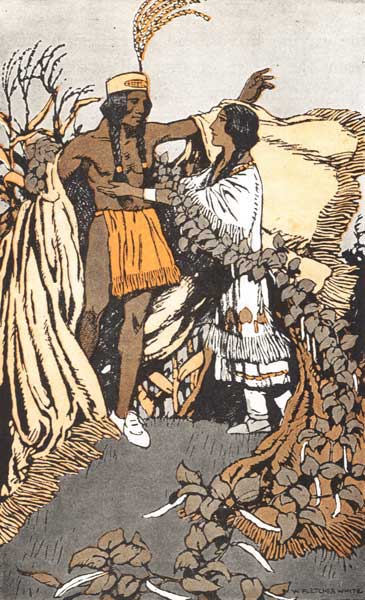
After that, every morning at sunrise, a handsome young chief was seen to come and stand on the brow of the hill. On his head were shining red plumes. Tall, and strong, and splendid he stood, wrapped in the folds of his waving blanket, whose fringed tassels danced to the summer breeze.

"Che che hen! Che che hen! Some one I would marry! Some one I would marry!" the young chieftain would sing, many, many times.

One day, his voice reached the Squash Maiden, on the other side of the hill. The Squash Maiden drew about her a rich green blanket, into which she had woven many flaunting gold trumpet-shaped flowers. Then she ran swiftly to the young chieftain.

Marry me! Marry me

"Marry me! Marry me!" said the Squash Maiden, as she spread her beautiful gold and green blanket at his feet.

Corn Plume looked down at the Squash Maiden sitting on her blanket at his feet. She was good to look upon, and yet Corn Plume was not content. He wanted a maiden who would stand by his side, not always sit at his feet.

Then Corn Plume spoke thus to the Squash Maiden.

"Corn Plume cannot marry Squash Maiden. She is very beautiful, but she will not make song in Corn Plume's heart. Squash Maiden will grow tired of his lodge. She will not stay in his wigwam. She likes to go a long trail, and wander far from the lodge.

"Corn Plume cannot make Squash Maiden his wife, for he is not content with her. But she shall be Corn Plume's sister, and sit in his lodge whenever she will. The maiden Corn Plume weds must be ever at his side. She must go where he goes, stay where he stays."

Next morning at sunrise, the voice of Corn Plume was again heard, singing from the hilltop, "Che che hen! Che che hen! Some one I would marry! Some one I would marry! Che che hen! Che che hen!"

This time his song reached the ears of the Bean Maiden. Her heart sang, when she heard the voice of Corn Plume, for she knew that he was calling her. So light of heart was Bean Maiden, that she ran like a deer up the hillside. On and on, up and over the brow of the hill she climbed, till she reached the young chieftain's side.

Then Corn Plume turned and beheld the most beautiful maiden he had ever seen. Her eyes were deep and dark, like mountain pools. Her breath was sweet as the waters of the maple. She threw off her blanket of green, and purple, and white, and stretched her twining arms to him.

Corn Plume desired to keep Bean Maiden forever close to him. He bent his tall plumed head to her. Her arms wound round and round the young chieftain, and Corn Plume was content.

So closely were the arms of Corn Plume and the Bean Maiden entwined, so truly were they wed, that the Indians never attempted to separate them. Ever after, corn and beans were planted in the same hill, and often a squash seed was added.

Since the Great Spirit had placed the corn, the bean, and the squash together on a hill, the Indian said they should continue to live and grow and occupy a hill together.

The door of Corn Plume's lodge was ever open to the Squash Maiden, if she chose to enter. But seldom did she stay in his wigwam. More often, she was found running off on a long trail.

But Bean Maiden remained true to Corn Plume. Always she was found by his side. Never did she leave the lodge unless he went with her. Corn Plume's lodge was her lodge, and her trail was his trail.

And because the Spirits of the corn and the bean are as one, the Indians not only plant and grow them together, but cook and eat them together. "In life, they were one," they say, "We will not separate them in death."

And now, when a great rustling and sighing of the corn is heard in the White man's land, the Indians often say, "'Tis the Spirit of Corn Plume, crying for his lost Bean Maiden!"

corn ear

 **********

There is another book by Mabel Powers, Around an Iroquois Story Fire which also has a very similar story, "How Corn and Beans Came to Be", complete with a Bean Song, but Squash is not in it and, because it was copyrighted in 1950, it certainly is not Public Domain. She lived a long life, 1872-1966, and was an "Advocate for Native Americans, Women and Peace", especially in the Chautauqua area. Her own legacy deserves to remembered.

As we close today's story I want to conclude with a link to the 1933 Haudenosaunee Thanksgiving Address, which is also called "Greetings to the Natural World." Each segment ends with "Now our minds are one." Certainly in our divided world that is something worth wishing. I especially like

The Creator
Now we turn our thoughts to the Creator, or Great Spirit, and send greetings and thanks for all
the gifts of Creation. Everything we need to live a good life is here on this Mother Earth. For all the love that is still around us, we gather our minds together as one and send our choicest
words of greetings and thanks to the Creator.
Now our minds are one. 

***************************** 

This is part of a series of postings of stories under the category, “Keeping the Public in Public Domain.” The idea behind Public Domain was to preserve our cultural heritage after the authors and their immediate heirs were compensated. I feel strongly current copyright law delays this intent on works of the 20th century. My own library of folklore includes so many books within the Public Domain I decided to share stories from them. I hope you enjoy discovering them.

At the same time, my own involvement in storytelling regularly creates projects requiring research as part of my sharing stories with an audience.  Whenever that research needs to be shown here, the publishing of Public Domain stories will not occur that week.  This is a return to my regular posting of a research project here.  (Don't worry, this isn't dry research, my research is always geared towards future storytelling to an audience.)  Response has convinced me that "Keeping the Public in Public Domain" should continue along with my other postings as often as I can manage it.

See the sidebar for other Public Domain story resources I recommend on the page “Public Domain Story Resources."


Friday, November 14, 2025

Historical Fragments - Mary Had a Little Lamb, the true story and a bit more


Mary Sawyer: 1806-1889 
I just found a resource on Facebook called Historical Fragments. My cousin and another friend were following and that's how I found it. There were three reviews there. Two were positive, but the third accused it of being AI generated. I don't know if that's true or not, but if it is, Hurrah for AI! 

Unfortunately the stories there tend to be posted without being broken up for paragraphs. (Possibly due to AI?) It makes it difficult to comfortably read the story. Because the nursery rhyme about "Mary Had a Little Lamb" is often used in storytelling I am going to give the Historical Fragments information BUT break it up into paragraphs for easier reading. At the end I have a bit of a satirical  Australian version  I confess also pops into my mind.

*** 

The nursery rhyme you sang as a child was based on a real 9-year-old girl who saved a dying lamb—and accidentally made history. "Mary had a little lamb, little lamb, little lamb..."You probably sang it in kindergarten. Maybe you sang it to your own children. But did you know Mary was real? And so was her lamb? 
 
This is the true story behind one of the most famous nursery rhymes in history. In March 1815, on a cold morning in Sterling, Massachusetts, nine-year-old Mary Sawyer was helping her father with chores in the barn. They discovered that one of their ewes had given birth to twin lambs overnight—but something was wrong. One lamb was healthy and nursing. The other had been rejected by its mother and was lying in the straw, barely breathing, too weak to even stand. Without its mother's care and milk, the tiny creature was dying of cold and hunger. 
 
Mary's heart broke at the sight. "Can I take it inside?" she begged her father. Her father shook his head. "No, Mary. It's almost dead anyway. Even if we try, it probably won't survive. "
 
But Mary couldn't bear to watch the lamb die. She pleaded with her father until he finally relented—though he made it clear he thought it was hopeless. When they returned to the house, Mary's mother agreed to let her try. Mary wrapped the freezing lamb in an old garment and held it close to the fireplace, cradling it in her arms through the long night. She didn't know if it would make it to morning. The lamb was so weak it couldn't even swallow at first. But Mary refused to give up. 
 
By morning, against all odds, the lamb was standing. Over the next few days, with Mary's constant care—feeding it milk, keeping it warm, nursing it back to strength—the little creature recovered completely. And then something magical happened. The lamb, whom Mary had saved from death, became utterly devoted to her. It recognized her voice. It came running when she called. And everywhere that Mary went, the lamb truly was "sure to go. "
 
One morning before school, Mary called out to her lamb as she was leaving. The lamb came trotting over immediately. Mary's mischievous older brother, Nat, grinned and said, "Let's take the lamb to school with us! "Mary hesitated—she knew it was against the rules—but the idea was too tempting. She agreed. 
 
She tried to smuggle the lamb into the one-room Redstone School by hiding it in a basket under her desk, hoping it would stay quiet. For a while, her plan worked. The lamb nestled silently beneath her seat as the lesson began. Then Mary was called to the front of the classroom to recite her lesson. As she stood and began to read aloud, the lamb suddenly bleated loudly and leaped out from under her desk, following Mary to the front of the room. 
 
The classroom erupted. The students burst into laughter at the sight of a fluffy white lamb wandering the aisles, bleating and looking for Mary. Even the teacher, Polly Kimball, "laughed outright"—though she gently told Mary that the lamb would have to go home. Mary, embarrassed but smiling, led her lamb outside to wait in a shed until school ended. She thought that would be the end of it—a funny story to tell at dinner. 
 
But someone else was watching. Among the visitors at the school that day was a young man named John Roulstone, a college-bound student staying with his uncle, the local minister. He was charmed by the sight of Mary's devoted lamb following her into school. 
 
The next day, John rode his horse across the fields to the little schoolhouse and handed Mary a slip of paper. On it, he'd written three simple stanzas:*"Mary had a little lamb,
Its fleece was white as snow,
And everywhere that Mary went,
The lamb was sure to go. It followed her to school one day,
That was against the rule.
It made the children laugh and play,
To see a lamb at school..."*Mary treasured that piece of paper. She kept it for years, along with the memory of the lamb she'd saved. 
 
The lamb lived to be four years old, bearing three lambs of her own before she was accidentally killed by a cow in the barn. Mary's mother saved some of the lamb's wool and knitted stockings for Mary, which she treasured for the rest of her life. But the story doesn't end there. 
 
In 1830, a well-known writer and editor named Sarah Josepha Hale published a collection called Poems for Our Children. Among them was a poem called "Mary's Lamb"—the same verses John Roulstone had written, plus three additional stanzas with a moral lesson about kindness to animals. The poem spread like wildfire. It was reprinted in schoolbooks across America. Children everywhere began singing it. By the 1850s, it was one of the most famous children's poems in the country. 
 
But here's where it gets even more remarkable: In 1877, nearly sixty years after Mary saved that lamb, inventor Thomas Edison was testing his brand-new phonograph—the first machine ever capable of recording and playing back sound. He needed something to recite to test if it worked. He chose "Mary Had a Little Lamb. "Edison's voice reciting those words became the first audio recording in human history. The poem that began with a nine-year-old girl's compassion became the first sound ever captured by technology. 
 
As for Mary herself, she lived a long, quiet life. She married, raised a family, and rarely talked about the famous poem until she was an elderly woman. In 1876, at age 70, Mary finally came forward to share her story publicly when she donated the stockings her mother had made from her lamb's wool to help raise money to save Boston's Old South Meeting House. She sold autographed cards tied with yarn from those stockings, telling the world: "I am the Mary. This is my lamb's wool. "People were astonished. The woman behind the nursery rhyme was real—and she was still alive. 
 
Mary Sawyer died in 1889 at age 83. Today, a statue of her little lamb stands in Sterling, Massachusetts, commemorating the day a nine-year-old girl's compassion for a dying animal created one of the most enduring stories in children's literature. 
 
The lesson of "Mary Had a Little Lamb" isn't just about a pet following its owner. It's about what happened before that—about a little girl who refused to let a helpless creature die, who fought for its life when everyone else had given up, who showed that kindness and determination can create miracles. Mary saved her lamb. And in return, that lamb gave her immortality. 
 
The next time you hear someone sing "Mary had a little lamb," remember: it wasn't just a nursery rhyme. It was a true story about a real girl who taught us that compassion matters, that small acts of kindness ripple through time, and that sometimes the gentlest hearts change the world. Mary Sawyer: 1806-1889
The girl who saved a lamb—and created a legend.

 *****

I went looking for a bit of satire I recalled learning from my Australian colleague and friend, Ellen F. Walker.  

Mary had a little lamb,
Her Father shot it dead.
Then it went to school with her,
Between two hunks of bread.

I'm fairly positive that's as much as she told me and said it was a common refrain in Australia. Because I wanted to be sure I had it correctly, I searched online and found https://www.poetrysoup.com/poem/the_rest_of_the_story-_mary_had_a_little_lamb_1624121 which claims copyright to the Australian poet who goes by the name of Speaks Volumes

Friday, November 7, 2025

Grimm - The Seven Ravens - Keeping the Public in Public Domain

I was challenged by "The Epoch Times", <news@mail2.theepochtimes.com> section on literature saying: 

 The Brothers Grimm’s fairy tale "The Seven Ravens”: The Brothers Grimm show how children should be taught to be careful about what they say, for they'll never know how their words might affect those around them. This fairy tale follows a family and the hardships they endure because of the father’s careless words said in anger.

Of course I had heard about "The Seven Ravens", but decided I didn't truly know it well enough to re-tell it. I'm glad I looked further and want to share it here. It's an unusual tale of a family.

This translation and artwork is from Grimm's Fairy Tales edited by Frances Jenkins Olcott (I have often appreciated her work) with illustrations by RieCramer.

THE SEVEN RAVENS

There was once a man who had seven sons, but never a daughter no matter how much he wished for one.

At length, his wife had a child, and it was a daughter. The joy was great. But the child was sickly and small, and so weak that it had to be baptized at once.

The father sent one of the boys in a hurry to the spring, to fetch water for the baptism. The other six boys ran along with him. And as each strove to be the first to fill the jug, it fell into the spring. There they stood, and did not know what to do. None of them dared to go home.

When they did not come back, the father grew impatient, and said, “They have forgotten all about it in a game of play, the wicked boys!”

Soon he grew afraid lest the child should die without being baptized, and he cried out in anger, “I wish the boys were all turned into Ravens!”

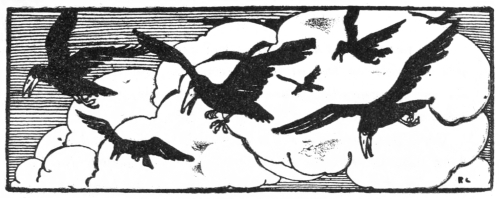
Hardly was the word spoken, before he heard a whirring of wings in the air above his head. He looked up, and saw seven coal-black Ravens flying high and away.

The parents could not recall the curse. And though they grieved over the loss of their seven sons, yet they comforted themselves somewhat with their dear little daughter, who soon grew strong and every day more beautiful.

For a long time, she did not know that she had had brothers. Her parents were careful not to mention them before her. But one day, she chanced to overhear some people talking about her, and saying, “that the maiden is certainly beautiful, but really to blame for the misfortune of her seven brothers.”

Then she was much troubled, and went to her father and mother, and asked if it was true that she had had brothers, and what was become of them.

The parents did not dare to keep the secret longer, and said that her birth was only the innocent cause of what had happened to her brothers. But the maiden laid it daily to heart, and thought that she must deliver her brothers.

She had no peace and rest until she set out secretly, and went forth into the wide world to seek them out, and set them free, let it cost what it might. She took nothing with her but a little ring belonging to her parents as a keepsake, a loaf of bread against hunger, a little pitcher of water against thirst, and a little chair as a provision against weariness.

And now, she went continually onward, far, far, to the very end of the world. Then she came to the Sun, but it was too hot and terrible, and devoured little children. Hastily she ran away, and ran to the Moon, but it was far too cold, and also awful and malicious. And when it saw the child, it said:

I smell, I smell The flesh of men!
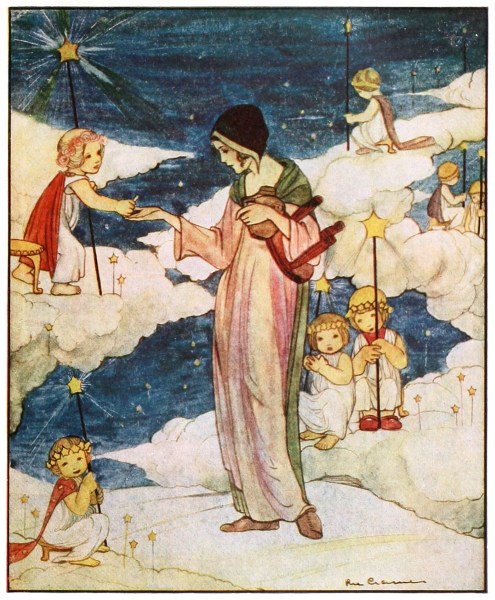
EACH STAR SAT ON ITS OWN LITTLE CHAIR

On this she ran swiftly away, and came to the Stars, which were kind and good to her, and each of them sat on its own little chair. But the Morning Star arose, and gave her the drumstick of a chicken, and said, “If you have not that drumstick you cannot open the Glass Mountain, and in the Glass Mountain are your brothers.”

The maiden took the drumstick, wrapped it carefully in a cloth, and went onward again until she came to the Glass Mountain. The door was shut, and she thought she would take out the drumstick. But when she undid the cloth, it was empty, and she had lost the good Star’s present. What was she now to do? She wished to rescue her brothers, and had no key to the Glass Mountain. The good little sister took a knife, cut off one of her little fingers, put it in the door, and succeeded in opening it.

When she had got inside, a little Dwarf came to meet her, who said, “My Child, what are you looking for?”

“I am looking for my brothers, the Seven Ravens,” she replied.

The Dwarf said, “The Lord Ravens are not at home, but if you wish to wait here until they come, step in.”

Thereupon the little Dwarf carried the Ravens’ dinner in, on seven little plates, and in seven little glasses. The little sister ate a morsel from each plate, and from each little glass she took a sip. But in the last little glass she dropped the ring which she had brought away with her.

Suddenly, she heard a whirring of wings and a rushing through the air, and then the little Dwarf said, “Now the Lord Ravens are flying home.”

Then they came, and wanted to eat and drink, and looked for their little plates and glasses. Then said one after the other, “Who has eaten something from my plate? Who has drunk out of my little glass? It was a human mouth.”

And when the seventh came to the bottom of the glass, the ring rolled against his mouth. Then he looked at it, and saw that it was a ring belonging to his father and mother, and said, “God grant that our little sister may be here, and then we shall be free.”

When the maiden, who was standing behind the door watching, heard that wish, she came forth, and on this all the Ravens were restored to their human form again. And they embraced and kissed each other, and went joyfully home.


This is part of a series of postings of stories under the category, “Keeping the Public in Public Domain.” The idea behind Public Domain was to preserve our cultural heritage after the authors and their immediate heirs were compensated. I feel strongly current copyright law delays this intent on works of the 20th century. My own library of folklore includes so many books within the Public Domain I decided to share stories from them. I hope you enjoy discovering them.

At the same time, my own involvement in storytelling regularly creates projects requiring research as part of my sharing stories with an audience.  Whenever that research needs to be shown here, the publishing of Public Domain stories will not occur that week.  This is a return to my regular posting of a research project here.  (Don't worry, this isn't dry research, my research is always geared towards future storytelling to an audience.)  Response has convinced me that "Keeping the Public in Public Domain" should continue along with my other postings as often as I can manage it.

See the sidebar for other Public Domain story resources I recommend on the page “Public Domain Story Resources."