Tell me if you have a topic you'd like to see. (Contact: LoiS-sez@LoiS-sez.com .)
Please also let others know about this site.

Friday, November 28, 2025

Seton - The Snowstorm - Keeping the Public in Public Domain

As I write this the first real taste of winter's snow seems to be approaching. (It's timing during Thanksgiving travels is especially drawing the attention of meteorologists.) The founder of the Boy Scouts, Ernest Thompson Seton, in his book, Woodland Tales, offers stories and activities throughout the seasons. Yes, winter and snow get its share of attention. The book is almost over when he tells this tale of how a snowstorm is viewed by different cultures. 

In retelling this story I would substitute a few things to make them tell a bit more. I would say an Inuit from Alaska for "Eskimo" and would add "the Inuit word 'Siqniq' for him."  As for "an Indian", the talk of "Nana-bo-jou" shows it is a child who is an Anishinaabe.

 Photo by ak-girl on Freeimages.com

TALE 100
The Snowstorm

It was at the great winter Carnival of Montreal not long ago. Looking out of a window on a stormy day were five children of different races: an Eskimo, a Dane, a Russian, an Indian, and a Yankee. The managers of the Carnival had brought the first four with their parents; but the Yankee was the son of a rich visitor.

"Look," cried the little Eskimo from Alaska, as he pointed to the driving snow. "Look at the ivory chips falling! El Sol is surely carving a big Walrus tusk into a fine dagger for himself. See how he whittles, and sends the white dust flying."

Of course he didn't say "El Sol," but used the Eskimo name for him.

Then the Dane said: "No, that isn't what makes it. That is Mother Earth getting ready for sleep. Those are the goose feathers of her feather bed, shaken up by her servants before she lies down and is covered with her white mantle."

The little Indian, with his eyes fixed on the storm, shook his head gravely and said: "My father taught me that these are the ashes from Nana-bo-jou's pipe; he has finished his smoke and is wrapping his blanket about him to rest. And my father always spake true."

"Nay, you are all wrong," said the little Russian. "My grandmother told me that it is Mother Carey. She is out riding in her strongest, freshest steed, the White Wind. He has not been out all summer; he is full of strength and fury; he spumes and rages. The air is filled with the foam from his bridle, and froth from his shoulders, as she rides him, and spurs him, and rides him. I love to see it, and know that she is filling the air with strength and with messages. They carry me back to my own dear homeland. It thrills me with joy to see the whiteness."

But the Yankee boy said: "Why, it's just snowing."

*********

The story tends to end abruptly and should sit there, letting the many wonderful views contrast with the rich Yankee boy's view of  "it's just snowing." 

May your own views of the season include stories!

********************** 

This is part of a series of postings of stories under the category, “Keeping the Public in Public Domain.” The idea behind Public Domain was to preserve our cultural heritage after the authors and their immediate heirs were compensated. I feel strongly current copyright law delays this intent on works of the 20th century. My own library of folklore includes so many books within the Public Domain I decided to share stories from them. I hope you enjoy discovering them.

At the same time, my own involvement in storytelling regularly creates projects requiring research as part of my sharing stories with an audience.  Whenever that research needs to be shown here, the publishing of Public Domain stories will not occur that week.  This is a return to my regular posting of a research project here.  (Don't worry, this isn't dry research, my research is always geared towards future storytelling to an audience.)  Response has convinced me that "Keeping the Public in Public Domain" should continue along with my other postings as often as I can manage it.

See the sidebar for other Public Domain story resources I recommend on the page “Public Domain Story Resources."


Friday, November 21, 2025

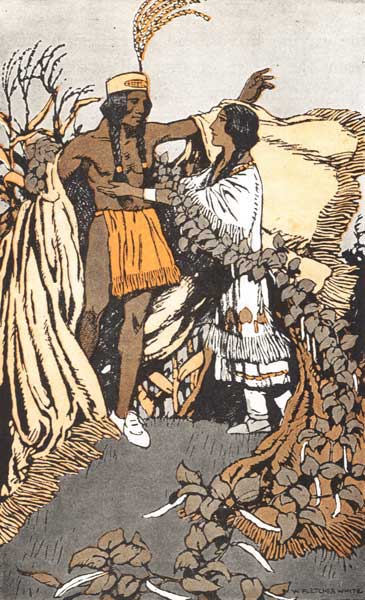
Powers - Corn Plume and Bean Maiden - Keeping the Public in Public Domain

As we fill our tables to celebrate Thanksgiving it is appropriate to look back to the cultural roots of what is there. History.com has an interesting article, "What Are the 'Three Sisters' of Native American Agriculture?" It shows that companion planting "reflects Indigenous agricultural knowledge and teachings about cooperation and balance."

That story of the Three Sisters and the Sky Woman should have been easy to find. 

It wasn't. 

First of all I checked about  the Haudenosaunee, better known as the Iroquois Confederation.I even went to Wikipedia's article on the Three Sisters, but was unable to find a Public Domain source. I checked Arthur C. Parker, who was a Seneca and recorded many of their stories, but apparently not this one. There also is an Iroquois reprint named  Legends of the Longhouse by J.J. Cornplanter (that is a popular Iroquois last name) it opens with the Sky Woman story of the Three Sisters, but it was first published in 1938, so unfortunately we must wait another nine (9!) years for it to to become Public Domain.

Then I went to another source, Mabel Powers, who has several books telling stories from the Haudenosaunee.. While not Native American herself, she became named Yeh Sen Noh Wehs or Daughter of the Senecas for her work saving and republishing their large body of stories. Today's story is from her Stories the Iroquois Tell Their Children. Her several books unfortunately do not include the Three Sisters, but she does have today's different story, which involves all three -- Corn, Bean, and Squash. It seems to continue after the "three sustainers" were first created in that origin story. It certainly continues the idea of companion planting.

CORN PLUME AND BEAN MAIDEN

The Great Spirit had smiled upon his Red Children. The land was filled with plenty, for the Great Spirit had given to them the three sustainers of life, the corn, the bean, and the squash. Flowers bloomed, birds sang, and all the earth was glad with the Red Children, for the gifts of the Great Spirit.

On one side of a hill grew the tall, waving corn, with its silk tassels and plumes. On another side, beans, with their velvety pods, climbed toward the sky. Some distance down a third slope, beautiful yellow squashes turned their faces to the sun.

One day, the Spirit of the corn grew restless. There came a rustling through the waving leaves, and a great sigh burst from the heart of the tall stalks. The Spirit of the corn was lonely.

After that, every morning at sunrise, a handsome young chief was seen to come and stand on the brow of the hill. On his head were shining red plumes. Tall, and strong, and splendid he stood, wrapped in the folds of his waving blanket, whose fringed tassels danced to the summer breeze.

"Che che hen! Che che hen! Some one I would marry! Some one I would marry!" the young chieftain would sing, many, many times.

One day, his voice reached the Squash Maiden, on the other side of the hill. The Squash Maiden drew about her a rich green blanket, into which she had woven many flaunting gold trumpet-shaped flowers. Then she ran swiftly to the young chieftain.

Marry me! Marry me

"Marry me! Marry me!" said the Squash Maiden, as she spread her beautiful gold and green blanket at his feet.

Corn Plume looked down at the Squash Maiden sitting on her blanket at his feet. She was good to look upon, and yet Corn Plume was not content. He wanted a maiden who would stand by his side, not always sit at his feet.

Then Corn Plume spoke thus to the Squash Maiden.

"Corn Plume cannot marry Squash Maiden. She is very beautiful, but she will not make song in Corn Plume's heart. Squash Maiden will grow tired of his lodge. She will not stay in his wigwam. She likes to go a long trail, and wander far from the lodge.

"Corn Plume cannot make Squash Maiden his wife, for he is not content with her. But she shall be Corn Plume's sister, and sit in his lodge whenever she will. The maiden Corn Plume weds must be ever at his side. She must go where he goes, stay where he stays."

Next morning at sunrise, the voice of Corn Plume was again heard, singing from the hilltop, "Che che hen! Che che hen! Some one I would marry! Some one I would marry! Che che hen! Che che hen!"

This time his song reached the ears of the Bean Maiden. Her heart sang, when she heard the voice of Corn Plume, for she knew that he was calling her. So light of heart was Bean Maiden, that she ran like a deer up the hillside. On and on, up and over the brow of the hill she climbed, till she reached the young chieftain's side.

Then Corn Plume turned and beheld the most beautiful maiden he had ever seen. Her eyes were deep and dark, like mountain pools. Her breath was sweet as the waters of the maple. She threw off her blanket of green, and purple, and white, and stretched her twining arms to him.

Corn Plume desired to keep Bean Maiden forever close to him. He bent his tall plumed head to her. Her arms wound round and round the young chieftain, and Corn Plume was content.

So closely were the arms of Corn Plume and the Bean Maiden entwined, so truly were they wed, that the Indians never attempted to separate them. Ever after, corn and beans were planted in the same hill, and often a squash seed was added.

Since the Great Spirit had placed the corn, the bean, and the squash together on a hill, the Indian said they should continue to live and grow and occupy a hill together.

The door of Corn Plume's lodge was ever open to the Squash Maiden, if she chose to enter. But seldom did she stay in his wigwam. More often, she was found running off on a long trail.

But Bean Maiden remained true to Corn Plume. Always she was found by his side. Never did she leave the lodge unless he went with her. Corn Plume's lodge was her lodge, and her trail was his trail.

And because the Spirits of the corn and the bean are as one, the Indians not only plant and grow them together, but cook and eat them together. "In life, they were one," they say, "We will not separate them in death."

And now, when a great rustling and sighing of the corn is heard in the White man's land, the Indians often say, "'Tis the Spirit of Corn Plume, crying for his lost Bean Maiden!"

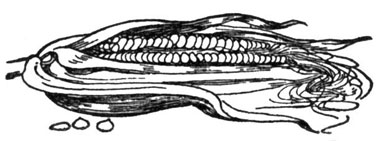
corn ear

 **********

There is another book by Mabel Powers, Around an Iroquois Story Fire which also has a very similar story, "How Corn and Beans Came to Be", complete with a Bean Song, but Squash is not in it and, because it was copyrighted in 1950, it certainly is not Public Domain. She lived a long life, 1872-1966, and was an "Advocate for Native Americans, Women and Peace", especially in the Chautauqua area. Her own legacy deserves to remembered.

As we close today's story I want to conclude with a link to the 1933 Haudenosaunee Thanksgiving Address, which is also called "Greetings to the Natural World." Each segment ends with "Now our minds are one." Certainly in our divided world that is something worth wishing. I especially like

The Creator
Now we turn our thoughts to the Creator, or Great Spirit, and send greetings and thanks for all
the gifts of Creation. Everything we need to live a good life is here on this Mother Earth. For all the love that is still around us, we gather our minds together as one and send our choicest
words of greetings and thanks to the Creator.
Now our minds are one. 

***************************** 

This is part of a series of postings of stories under the category, “Keeping the Public in Public Domain.” The idea behind Public Domain was to preserve our cultural heritage after the authors and their immediate heirs were compensated. I feel strongly current copyright law delays this intent on works of the 20th century. My own library of folklore includes so many books within the Public Domain I decided to share stories from them. I hope you enjoy discovering them.

At the same time, my own involvement in storytelling regularly creates projects requiring research as part of my sharing stories with an audience.  Whenever that research needs to be shown here, the publishing of Public Domain stories will not occur that week.  This is a return to my regular posting of a research project here.  (Don't worry, this isn't dry research, my research is always geared towards future storytelling to an audience.)  Response has convinced me that "Keeping the Public in Public Domain" should continue along with my other postings as often as I can manage it.

See the sidebar for other Public Domain story resources I recommend on the page “Public Domain Story Resources."


Friday, November 14, 2025

Historical Fragments - Mary Had a Little Lamb, the true story and a bit more


Mary Sawyer: 1806-1889 
I just found a resource on Facebook called Historical Fragments. My cousin and another friend were following and that's how I found it. There were three reviews there. Two were positive, but the third accused it of being AI generated. I don't know if that's true or not, but if it is, Hurrah for AI! 

Unfortunately the stories there tend to be posted without being broken up for paragraphs. (Possibly due to AI?) It makes it difficult to comfortably read the story. Because the nursery rhyme about "Mary Had a Little Lamb" is often used in storytelling I am going to give the Historical Fragments information BUT break it up into paragraphs for easier reading. At the end I have a bit of a satirical  Australian version  I confess also pops into my mind.

*** 

The nursery rhyme you sang as a child was based on a real 9-year-old girl who saved a dying lamb—and accidentally made history. "Mary had a little lamb, little lamb, little lamb..."You probably sang it in kindergarten. Maybe you sang it to your own children. But did you know Mary was real? And so was her lamb? 
 
This is the true story behind one of the most famous nursery rhymes in history. In March 1815, on a cold morning in Sterling, Massachusetts, nine-year-old Mary Sawyer was helping her father with chores in the barn. They discovered that one of their ewes had given birth to twin lambs overnight—but something was wrong. One lamb was healthy and nursing. The other had been rejected by its mother and was lying in the straw, barely breathing, too weak to even stand. Without its mother's care and milk, the tiny creature was dying of cold and hunger. 
 
Mary's heart broke at the sight. "Can I take it inside?" she begged her father. Her father shook his head. "No, Mary. It's almost dead anyway. Even if we try, it probably won't survive. "
 
But Mary couldn't bear to watch the lamb die. She pleaded with her father until he finally relented—though he made it clear he thought it was hopeless. When they returned to the house, Mary's mother agreed to let her try. Mary wrapped the freezing lamb in an old garment and held it close to the fireplace, cradling it in her arms through the long night. She didn't know if it would make it to morning. The lamb was so weak it couldn't even swallow at first. But Mary refused to give up. 
 
By morning, against all odds, the lamb was standing. Over the next few days, with Mary's constant care—feeding it milk, keeping it warm, nursing it back to strength—the little creature recovered completely. And then something magical happened. The lamb, whom Mary had saved from death, became utterly devoted to her. It recognized her voice. It came running when she called. And everywhere that Mary went, the lamb truly was "sure to go. "
 
One morning before school, Mary called out to her lamb as she was leaving. The lamb came trotting over immediately. Mary's mischievous older brother, Nat, grinned and said, "Let's take the lamb to school with us! "Mary hesitated—she knew it was against the rules—but the idea was too tempting. She agreed. 
 
She tried to smuggle the lamb into the one-room Redstone School by hiding it in a basket under her desk, hoping it would stay quiet. For a while, her plan worked. The lamb nestled silently beneath her seat as the lesson began. Then Mary was called to the front of the classroom to recite her lesson. As she stood and began to read aloud, the lamb suddenly bleated loudly and leaped out from under her desk, following Mary to the front of the room. 
 
The classroom erupted. The students burst into laughter at the sight of a fluffy white lamb wandering the aisles, bleating and looking for Mary. Even the teacher, Polly Kimball, "laughed outright"—though she gently told Mary that the lamb would have to go home. Mary, embarrassed but smiling, led her lamb outside to wait in a shed until school ended. She thought that would be the end of it—a funny story to tell at dinner. 
 
But someone else was watching. Among the visitors at the school that day was a young man named John Roulstone, a college-bound student staying with his uncle, the local minister. He was charmed by the sight of Mary's devoted lamb following her into school. 
 
The next day, John rode his horse across the fields to the little schoolhouse and handed Mary a slip of paper. On it, he'd written three simple stanzas:*"Mary had a little lamb,
Its fleece was white as snow,
And everywhere that Mary went,
The lamb was sure to go. It followed her to school one day,
That was against the rule.
It made the children laugh and play,
To see a lamb at school..."*Mary treasured that piece of paper. She kept it for years, along with the memory of the lamb she'd saved. 
 
The lamb lived to be four years old, bearing three lambs of her own before she was accidentally killed by a cow in the barn. Mary's mother saved some of the lamb's wool and knitted stockings for Mary, which she treasured for the rest of her life. But the story doesn't end there. 
 
In 1830, a well-known writer and editor named Sarah Josepha Hale published a collection called Poems for Our Children. Among them was a poem called "Mary's Lamb"—the same verses John Roulstone had written, plus three additional stanzas with a moral lesson about kindness to animals. The poem spread like wildfire. It was reprinted in schoolbooks across America. Children everywhere began singing it. By the 1850s, it was one of the most famous children's poems in the country. 
 
But here's where it gets even more remarkable: In 1877, nearly sixty years after Mary saved that lamb, inventor Thomas Edison was testing his brand-new phonograph—the first machine ever capable of recording and playing back sound. He needed something to recite to test if it worked. He chose "Mary Had a Little Lamb. "Edison's voice reciting those words became the first audio recording in human history. The poem that began with a nine-year-old girl's compassion became the first sound ever captured by technology. 
 
As for Mary herself, she lived a long, quiet life. She married, raised a family, and rarely talked about the famous poem until she was an elderly woman. In 1876, at age 70, Mary finally came forward to share her story publicly when she donated the stockings her mother had made from her lamb's wool to help raise money to save Boston's Old South Meeting House. She sold autographed cards tied with yarn from those stockings, telling the world: "I am the Mary. This is my lamb's wool. "People were astonished. The woman behind the nursery rhyme was real—and she was still alive. 
 
Mary Sawyer died in 1889 at age 83. Today, a statue of her little lamb stands in Sterling, Massachusetts, commemorating the day a nine-year-old girl's compassion for a dying animal created one of the most enduring stories in children's literature. 
 
The lesson of "Mary Had a Little Lamb" isn't just about a pet following its owner. It's about what happened before that—about a little girl who refused to let a helpless creature die, who fought for its life when everyone else had given up, who showed that kindness and determination can create miracles. Mary saved her lamb. And in return, that lamb gave her immortality. 
 
The next time you hear someone sing "Mary had a little lamb," remember: it wasn't just a nursery rhyme. It was a true story about a real girl who taught us that compassion matters, that small acts of kindness ripple through time, and that sometimes the gentlest hearts change the world. Mary Sawyer: 1806-1889
The girl who saved a lamb—and created a legend.

 *****

I went looking for a bit of satire I recalled learning from my Australian colleague and friend, Ellen F. Walker.  

Mary had a little lamb,
Her Father shot it dead.
Then it went to school with her,
Between two hunks of bread.

I'm fairly positive that's as much as she told me and said it was a common refrain in Australia. Because I wanted to be sure I had it correctly, I searched online and found https://www.poetrysoup.com/poem/the_rest_of_the_story-_mary_had_a_little_lamb_1624121 which claims copyright to the Australian poet who goes by the name of Speaks Volumes

Friday, November 7, 2025

Grimm - The Seven Ravens - Keeping the Public in Public Domain

I was challenged by "The Epoch Times", <news@mail2.theepochtimes.com> section on literature saying: 

 The Brothers Grimm’s fairy tale "The Seven Ravens”: The Brothers Grimm show how children should be taught to be careful about what they say, for they'll never know how their words might affect those around them. This fairy tale follows a family and the hardships they endure because of the father’s careless words said in anger.

Of course I had heard about "The Seven Ravens", but decided I didn't truly know it well enough to re-tell it. I'm glad I looked further and want to share it here. It's an unusual tale of a family.

This translation and artwork is from Grimm's Fairy Tales edited by Frances Jenkins Olcott (I have often appreciated her work) with illustrations by RieCramer.

THE SEVEN RAVENS

There was once a man who had seven sons, but never a daughter no matter how much he wished for one.

At length, his wife had a child, and it was a daughter. The joy was great. But the child was sickly and small, and so weak that it had to be baptized at once.

The father sent one of the boys in a hurry to the spring, to fetch water for the baptism. The other six boys ran along with him. And as each strove to be the first to fill the jug, it fell into the spring. There they stood, and did not know what to do. None of them dared to go home.

When they did not come back, the father grew impatient, and said, “They have forgotten all about it in a game of play, the wicked boys!”

Soon he grew afraid lest the child should die without being baptized, and he cried out in anger, “I wish the boys were all turned into Ravens!”

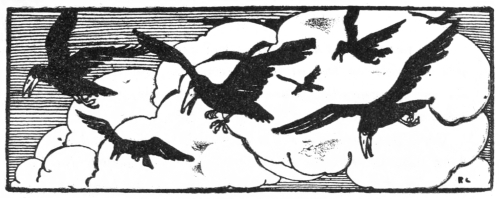
Hardly was the word spoken, before he heard a whirring of wings in the air above his head. He looked up, and saw seven coal-black Ravens flying high and away.

The parents could not recall the curse. And though they grieved over the loss of their seven sons, yet they comforted themselves somewhat with their dear little daughter, who soon grew strong and every day more beautiful.

For a long time, she did not know that she had had brothers. Her parents were careful not to mention them before her. But one day, she chanced to overhear some people talking about her, and saying, “that the maiden is certainly beautiful, but really to blame for the misfortune of her seven brothers.”

Then she was much troubled, and went to her father and mother, and asked if it was true that she had had brothers, and what was become of them.

The parents did not dare to keep the secret longer, and said that her birth was only the innocent cause of what had happened to her brothers. But the maiden laid it daily to heart, and thought that she must deliver her brothers.

She had no peace and rest until she set out secretly, and went forth into the wide world to seek them out, and set them free, let it cost what it might. She took nothing with her but a little ring belonging to her parents as a keepsake, a loaf of bread against hunger, a little pitcher of water against thirst, and a little chair as a provision against weariness.

And now, she went continually onward, far, far, to the very end of the world. Then she came to the Sun, but it was too hot and terrible, and devoured little children. Hastily she ran away, and ran to the Moon, but it was far too cold, and also awful and malicious. And when it saw the child, it said:

I smell, I smell The flesh of men!
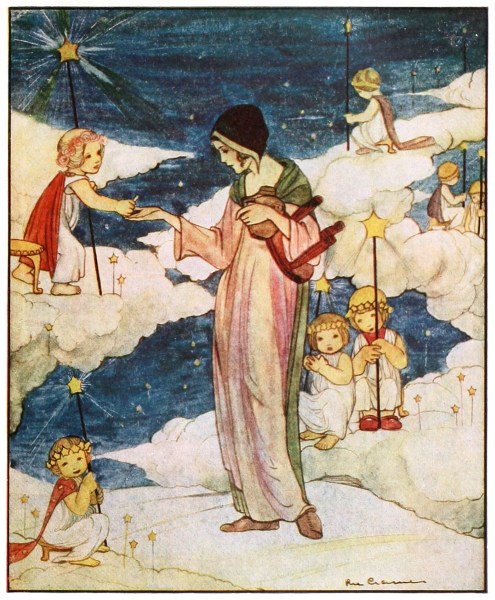
EACH STAR SAT ON ITS OWN LITTLE CHAIR

On this she ran swiftly away, and came to the Stars, which were kind and good to her, and each of them sat on its own little chair. But the Morning Star arose, and gave her the drumstick of a chicken, and said, “If you have not that drumstick you cannot open the Glass Mountain, and in the Glass Mountain are your brothers.”

The maiden took the drumstick, wrapped it carefully in a cloth, and went onward again until she came to the Glass Mountain. The door was shut, and she thought she would take out the drumstick. But when she undid the cloth, it was empty, and she had lost the good Star’s present. What was she now to do? She wished to rescue her brothers, and had no key to the Glass Mountain. The good little sister took a knife, cut off one of her little fingers, put it in the door, and succeeded in opening it.

When she had got inside, a little Dwarf came to meet her, who said, “My Child, what are you looking for?”

“I am looking for my brothers, the Seven Ravens,” she replied.

The Dwarf said, “The Lord Ravens are not at home, but if you wish to wait here until they come, step in.”

Thereupon the little Dwarf carried the Ravens’ dinner in, on seven little plates, and in seven little glasses. The little sister ate a morsel from each plate, and from each little glass she took a sip. But in the last little glass she dropped the ring which she had brought away with her.

Suddenly, she heard a whirring of wings and a rushing through the air, and then the little Dwarf said, “Now the Lord Ravens are flying home.”

Then they came, and wanted to eat and drink, and looked for their little plates and glasses. Then said one after the other, “Who has eaten something from my plate? Who has drunk out of my little glass? It was a human mouth.”

And when the seventh came to the bottom of the glass, the ring rolled against his mouth. Then he looked at it, and saw that it was a ring belonging to his father and mother, and said, “God grant that our little sister may be here, and then we shall be free.”

When the maiden, who was standing behind the door watching, heard that wish, she came forth, and on this all the Ravens were restored to their human form again. And they embraced and kissed each other, and went joyfully home.


This is part of a series of postings of stories under the category, “Keeping the Public in Public Domain.” The idea behind Public Domain was to preserve our cultural heritage after the authors and their immediate heirs were compensated. I feel strongly current copyright law delays this intent on works of the 20th century. My own library of folklore includes so many books within the Public Domain I decided to share stories from them. I hope you enjoy discovering them.

At the same time, my own involvement in storytelling regularly creates projects requiring research as part of my sharing stories with an audience.  Whenever that research needs to be shown here, the publishing of Public Domain stories will not occur that week.  This is a return to my regular posting of a research project here.  (Don't worry, this isn't dry research, my research is always geared towards future storytelling to an audience.)  Response has convinced me that "Keeping the Public in Public Domain" should continue along with my other postings as often as I can manage it.

See the sidebar for other Public Domain story resources I recommend on the page “Public Domain Story Resources."

Thursday, October 30, 2025

O'Donnell - How the Ghost of a Dog Saved Life - Keeping the Public in Public Domain

With Halloween this year being on a Friday, it seems everybody is extending Halloween through the weekend. I wasn't about to do that until the title of a book began to haunt me. Clearly I needed to take a look at Elliott O'Donnell's Animal Ghosts or Animal Hauntings and the Hereafter , a title I found while searching at Project Gutenberg

O'Donnell, Wikipedia tells us was "known primarily for his books about ghosts." He started by writing a psychic thriller in his spare time, "but specialised in what were claimed as true stories of ghosts and hauntings. These were immensely popular, but his flamboyant style and amazing stories suggest that he combined fact with fiction." In Animal Ghosts he certainly spent a lot of time citing sources telling of spectral animals. I prowled the Cat section first and felt much of the stories spent too much time setting up background on his tellers to make the actual story tellable. Then I went to the Dogs. (Okay, that sounds like the truth about this "source.") The story I felt needed telling is about a Newfoundland.  

I've had Huskies and Malamutes all my adult life, but then there was Fred, a Newfoundland/Chow mix. We were going to just foster him, but he stayed. I confess the Newfoundland in him was a sweet, appealing "Drool Monster." Unfortunately there was also the Chow which made him smaller than a true Newfoundland. (Think about the size of a Saint Bernard if you've never met a Newf.) I'm sure somebody thought the mix would be more manageable. Trust me, the personality of a Chow may appeal to some, but it can't be because they are "manageable" -- they are excitable and in charge. Looking back at Fred, I can see the Newf in him fitting this story.

How the Ghost of a Dog saved Life

When I was a boy, an elderly friend of mine, Miss Lefanu, narrated to me an anecdote which impressed me much. It was to this effect.

Miss Lefanu was walking one day along a very lonely country lane, when she suddenly observed an enormous Newfoundland dog following in her wake a few yards behind. Being very fond of dogs, she called out to it in a caressing voice and endeavoured to stroke it. To her disappointment, however, it dodged aside, and repeated the manoeuvre every time she tried to touch it. At length, losing patience, she desisted, and resumed her walk, the dog still following her. In this fashion they went on, until they came to a particularly dark part of the road, where the branches of the trees almost met overhead, and there was a pool of stagnant, slimy water, suggestive of great depth. On the one side the hedge was high, but on the other there was a slight gap leading into a thick spinney. Miss Lefanu never visited the spot alone after dusk, and had been warned against it even in the daytime. As she drew near to it, everything that she had ever heard about it flashed across her mind, and she was more than once on the verge of turning back, when the sight of the big, friendly-looking dog plodding behind, reassuring her, she pressed on. Just as she came to the gap, there was a loud snapping of twigs, and, to her horror, two tramps, with singularly sinister faces, sprang out, and were about to strike her with their bludgeons, when the dog, uttering a low, ominous growl, dashed at them. In an instant the expression of murderous joy in their eyes died out, one of abject terror took its place, and, dropping their weapons, they fled, as if the very salvation of their souls depended on it. As may be imagined, Miss Lefanu lost no time in getting home, and the first thing she did on arriving there was to go into the kitchen and order the cook to prepare, at once, a thoroughly good meal for her gallant rescuer—the Newfoundland dog, which she had shut up securely in the back yard, with the laughing remark, "There—you can't escape me now." Judge of her astonishment, however, when, on her return, the dog had gone. As the walls of the back yard were twelve feet high, and the doors had been shut all the while—no one having passed through them—it was impossible for the animal to have escaped, and the only interpretation that could possibly be put on the matter was that the dog was superphysical—a conclusion that was subsequently confirmed by the experiences of various other people. As the result of exhaustive enquiries Miss Lefanu eventually learned that many years before, on the very spot where the tramps had leaped out on her, a pedlar and his Newfoundland dog had been discovered murdered.

This story being true, then, there is one more link in the chain of evidence to show that dogs, as well as men, have spirits, and spirits that can, on occasion, at least, perform deeds of practical service.

***

Other animals in Animal Ghosts are horses, bulls, cows, pigs, sheep, wild animals, inhabitants of the jungle, and birds. Ghosts a plenty!

O'Donnell in his Preface says: If human beings, with all their vices, have a future life, assuredly animals, who in character so often equal, nay, excel human beings, have a future life also. 

I definitely agree. Without them heaven wouldn't be heavenly. 

******************************* 

This is part of a series of postings of stories under the category, “Keeping the Public in Public Domain.” The idea behind Public Domain was to preserve our cultural heritage after the authors and their immediate heirs were compensated. I feel strongly current copyright law delays this intent on works of the 20th century. My own library of folklore includes so many books within the Public Domain I decided to share stories from them. I hope you enjoy discovering them.

At the same time, my own involvement in storytelling regularly creates projects requiring research as part of my sharing stories with an audience.  Whenever that research needs to be shown here, the publishing of Public Domain stories will not occur that week.  This is a return to my regular posting of a research project here.  (Don't worry, this isn't dry research, my research is always geared towards future storytelling to an audience.)  Response has convinced me that "Keeping the Public in Public Domain" should continue along with my other postings as often as I can manage it.

See the sidebar for other Public Domain story resources I recommend on the page “Public Domain Story Resources."


Friday, October 24, 2025

Asbjörnsen - Friends in Life and Death - Keeping the Public in Public Domain

T'is time to think spooky stories! 

The longer you live, the more friends you outlive. This is a strange story I want to add to my collection of spooky stories. I like to have a plastic cauldron with stories on strips to let the audience pull out the next tale. Of course if I know a particular story is inappropriate for that group, I remove it beforehand.


This story is unusual for a tale by the Norwegian storyteller, Peter Christian Asbjörnsen. It's from the translation by G.W. Dasent called  Tales from the Fjeld: A Second Series of Popular Tales. I recommend the earlier volume, Popular Tales from the Norse which Dasent also translated. It has many familiar Scandinavian stories. That volume was also compiled by Jørgen Engebretsen Moe, so I was surprised to see he wasn't involved in Tales from the Fjeld. Moe was a bishop, so he may have been too busy for a second collection. These tales are not well known, unlike the first book.

You may notice the quotation marks at the start of each paragraph. The book opens with:"We were up on the Fjeld, Edward and I and Anders our guide, in quest of reindeer." From there the stories come from Anders. For a book with the story in a story frame it isn't as intrusive as many using a story frame. 

This is a story about friends who were not too busy for each other.  

FRIENDS IN LIFE AND DEATH.

"Once on a time there were two young men who were such great friends that they swore to one another they would never part, either in life or death. One of them died before he was at all old, and a little while after the other wooed a farmer's daughter, and was to be married to her. So when they were bidding guests to the wedding the bridegroom went himself to the churchyard where his friend lay, and knocked at his grave, and called him by name. No! he neither answered nor came. He knocked again, and he called again, but no one came. A third time he knocked louder and called louder to him, to come that he might talk to him. So, after a long, long time, he heard a rustling, and at last the dead man came up out of the grave.

"'It was well you came at last,' said the bridegroom, 'for I have been standing here ever so long, knocking and calling for you.'

"'I was a long way off,' said the dead man, 'so that I did not quite hear you till the last time you called.'

"'All right,' said the bridegroom; 'but I am going to stand bridegroom to-day, and you mind well, I dare say, what we used to talk about, and how we were to stand by each other at our weddings as best man.'

"'I mind it well,' said the dead man, 'but you must wait a bit till I have made myself a little smart; and, after all, no one can say I have on a wedding garment.'

"The lad was hard put to it for time, for he was overdue at home to meet the guests, and it was all but time to go to church; but still he had to wait awhile and let the dead man go into a room by himself, as he begged, so that he might brush himself up a bit, and come smart to church like the rest, for, of course, he was to go with the bridal train to church.

"Yes! the dead man went with him both to church and from church, but when they had got so far on with the wedding that they had taken off the bride's crown, he said he must go. So, for old friendship's sake, the bridegroom said he would go with him to the grave again. And as they walked to the churchyard the bridegroom asked his friend if he had seen much that was wonderful, or heard anything that was pleasant to know.

"'Yes! that I have,' said the dead man. 'I have seen much, and heard many strange things.'

"'That must be fine to see,' said the bridegroom. 'Do you know I have a mind to go along with you, and see all that with my own eyes.'

"'You are quite welcome,' said the dead man; 'but it may chance that you may be away some time.'

"'So it might,' said the bridegroom; but for all that he would go down into the grave.

"But before they went down the dead man took and cut up a turf out of the graveyard and put it on the young man's head. Down and down they went, far and far away, through dark, silent wastes, across wood, and moor, and bog, till they came to a great, heavy gate, which opened to them as soon as the dead man touched it. Inside it began to grow lighter, first as though it were moonshine, and the further they went the lighter it got. At last they got to a spot where there were such green hills, knee-deep in grass, and on them fed a large herd of kine, who grazed as they went; but for all they ate those kine looked poor, and thin, and wretched.

"'What's all this?' said the lad who had been bridegroom; 'why are they so thin, and in such bad case, though they eat, every one of them, as though they were well paid to eat?'

"'This is a likeness of those who never can have enough, though they rake and scrape it together ever so much,' said the dead man.

"So they journeyed on far and farther than far, till they came to some hill pastures, where there was naught but bare rocks and stones, with here and there a blade of grass. Here was grazing another herd of kine, which were so sleek, and fat, and smooth that their coats shone again.

"'What are these,' asked the bridegroom, 'who have so little to live on, and yet are in such good plight? I wonder what they can be.'

"'This,' said the dead man, 'is a likeness of those who are content with the little they have, however poor it be.'

"So they went farther and farther on till they came to a great lake, and it and all about it was so bright and shining that the bridegroom could scarce bear to look at it—it was so dazzling.

"'Now, you must sit down here,' said the dead man, 'till I come back. I shall be away a little while.'

"With that he set off, and the bridegroom sat down, and as he sat sleep fell on him, and he forgot everything in sweet deep slumber. After a while the dead man came back.

"'It was good of you to sit still here, so that I could find you again.'

"But when the bridegroom tried to get up he was all overgrown with moss and bushes, so that he found himself sitting in a thicket of thorns and brambles.

"So when he had made his way out of it they journeyed back again, and the dead man led him by the same way to the brink of the grave. There they parted and said farewell, and as soon as the bridegroom got out of the grave he went straight home to the house where the wedding was.

"But when he got where he thought the house stood, he could not find his way. Then he looked about on all sides, and asked every one he met, but he could neither hear nor learn anything of the bride, or the wedding, or his kindred, or his father and mother; nay, he could not so much as find any one whom he knew. And all he met wondered at the strange shape, who went about and looked for all the world like a scarecrow.

"Well! as he could find no one he knew, he made his way to the priest, and told him of his kinsmen and all that had happened up to the time he stood bridegroom, and how he had gone away in the midst of his wedding. But the priest knew nothing at all about it at first; but when he had hunted in his old registers he found out that the marriage he spoke of had happened a long, long time ago, and that all the folk he talked of had lived four hundred years before.

"In that time there had grown up a great stout oak in the priest's yard, and when he saw it he clambered up into it, that he might look about him. But the grey-beard who had sat in Heaven and slumbered for four hundred years, and had now at last come back, did not come down from the oak as well as he went up. He was stiff and gouty, as was likely enough; and so when he was coming down he made a false step, fell down, broke his neck, and that was the end of him."


 This is part of a series of postings of stories under the category, “Keeping the Public in Public Domain.” The idea behind Public Domain was to preserve our cultural heritage after the authors and their immediate heirs were compensated. I feel strongly current copyright law delays this intent on works of the 20th century. My own library of folklore includes so many books within the Public Domain I decided to share stories from them. I hope you enjoy discovering them.

At the same time, my own involvement in storytelling regularly creates projects requiring research as part of my sharing stories with an audience.  Whenever that research needs to be shown here, the publishing of Public Domain stories will not occur that week.  This is a return to my regular posting of a research project here.  (Don't worry, this isn't dry research, my research is always geared towards future storytelling to an audience.)  Response has convinced me that "Keeping the Public in Public Domain" should continue along with my other postings as often as I can manage it.

See the sidebar for other Public Domain story resources I recommend on the page “Public Domain Story Resources."

Friday, October 17, 2025

Cowles - The Beginning of Birds - Keeping the Public in Public Domain

Sometimes serendipity brings what you need while looking for something else! I was looking to see if a story existed that might be a dimly seen tale of how flying creatures like pterodactyls evolved into birds. My search took me to early Twentieth Century storyteller and folklorist, Julia Darrow Cowles, It's been a long time (2013) since I posted something by her and there's still little more known about her except for online copies of her seventeen books. Once again I find her Indian Nature Myths is calling to me.  

Photo by Man from Forest on Unsplash 

It didn't give the prehistoric story I hoped to find, BUT I've also been eager to find a story about leaves changing colors -- this does it beautifully! Every year I'm always flabbergasted to think those gorgeous colors lurk all season long under the chlorophyll keeping them green until now! ! ! Yes, it's great to have green trees, but oh how incredible it is that such reds, oranges, and even yellow were there all along. 

Yes, it's sad when those leaves come down. I call it God's Confetti. I confess here in Michigan we have what I consider too long a time when all those bare branches show us the true shape of a tree. What few birds remain until spring do indeed tend to be the color of any oak leaves clinging to the trees. . . except for the cardinal which I dearly love and they don't seem to fit this story. Still that's no reason to skip a good story. Maybe in Montana and other areas where the Blackfeet Nation live there are no cardinals. If so, may all the other birds hurry back.

THE BEGINNING OF BIRDS

(Blackfeet)

IN very early times, the Red Children believe, there were no birds. And this is the way they account for their beginning:

All summer the trees had been full of leaves, shaking, whispering, dancing, as the winds blew upon them. “I wish I might fly,” said one little leaf. “I would go sailing straight up into the heavens. But the tree holds me tightly; I cannot get away.”

“If the tree should let you go, you would only fall to the ground and die,” said a bigger leaf. “It is better to be content as you are.”

So the leaves fluttered and danced and whispered one to another, day after day.

One morning the wind was cold, and the leaves had to dance fast to keep warm. Then the old tree said, “It is the breath of Po-poon-o-ki. He lives in the ice lodge of the far North. He will soon visit us, with his war paints. I must hold you tightly, little leaves, as long as I can.” But the little leaves did not understand what the tree meant.

Then, one still night, Po-poon-o-ki came. He went from tree to tree, and over each one he splashed his war paints, till the leaves were no longer green, but dashed with red, and brown, and yellow, and crimson.

“How beautiful the trees are!” cried the Indian children the next morning. “See their bright colors.”

For a few days the leaves danced and whispered, laughing over their beautiful hues. Then Po-poon-o-ki came back, and with his swift, cold breath, he blew against the trees, and the little leaves were tossed and torn from the friendly branches. They did not fly up into the heavens, but frightened and sobbing they dropped to the earth.

“We shall die!” they cried. “We shall die!”

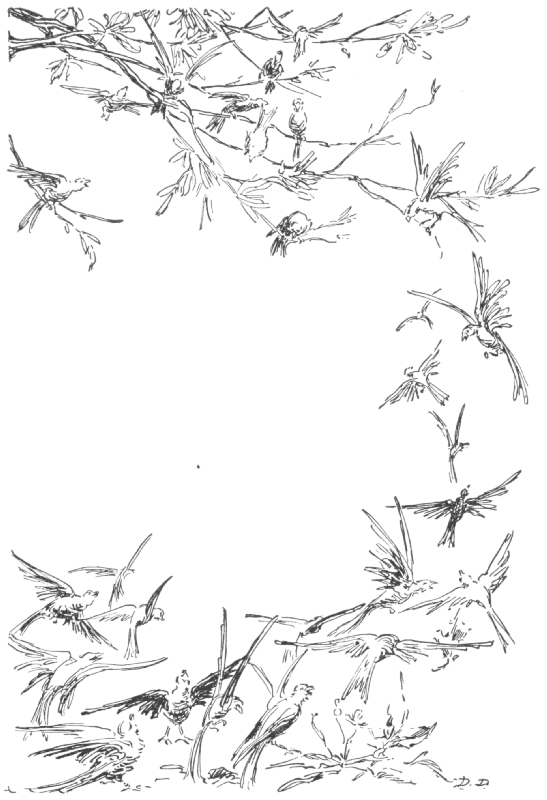
Then a strange thing happened. The guardian spirit of the tree whispered, “No, little leaves, you shall not die. You shall be changed into living forms. I will give you breath and life.” And instantly there arose from the earth where the leaves had dropped, a great flock of winged birds, red, and brown, and yellow, and crimson,  all the beautiful colors that Po-poon-o-ki had given the leaves. Then they flew away to the South Land, where winter’s breath could not reach them.


“THERE AROSE A GREAT FLOCK OF WINGED BIRDS”

But in the spring, when Ni-poon-o-ki, the spirit of summer, came stealing up from the South, and Po-poon-o-ki went back to his ice lodge in the far North, then the birds came back, too. There were new leaves on the trees, but the birds flew straight to the branches which had been their home, and there, safely sheltered by the new leaves, they built their nests.

And after awhile, when there were eggs in all the home nests, the hearts of the birds became so full of joy that they could no longer be silent. Their throats swelled, and opening wide their little mouths, they filled all the air with bursts of happy song.

************** 

This is part of a series of postings of stories under the category, “Keeping the Public in Public Domain.” The idea behind Public Domain was to preserve our cultural heritage after the authors and their immediate heirs were compensated. I feel strongly current copyright law delays this intent on works of the 20th century. My own library of folklore includes so many books within the Public Domain I decided to share stories from them. I hope you enjoy discovering them.

At the same time, my own involvement in storytelling regularly creates projects requiring research as part of my sharing stories with an audience.  Whenever that research needs to be shown here, the publishing of Public Domain stories will not occur that week.  This is a return to my regular posting of a research project here.  (Don't worry, this isn't dry research, my research is always geared towards future storytelling to an audience.)  Response has convinced me that "Keeping the Public in Public Domain" should continue along with my other postings as often as I can manage it.

See the sidebar for other Public Domain story resources I recommend on the page “Public Domain Story Resources."

Friday, October 10, 2025

Indigenous Peoples' Day or Columbus Day?


boroughofwenonah.com

The second Monday in October is a Federal Holiday in the United States. The question of what it should be called, however, is a question that, for now, will be unsettled. Historyoftheholiday.com does an excellent job of discussing how the 20th century holiday, Columbus Day, has begun to transition to Indigenous Peoples' Day. 

I couldn't have said it better than that site explains it! 

Another well-written look specifically at Indigenous Peoples' Day is this is from the October Michigan D.A.R. newsletter:

Indigenous Peoples’ Day is October 13, 2025. It’s a great time to immerse yourself in the history and culture of Michigan’s 12 federally recognized tribes and 4 state recognized tribes. 

Visit a museum! These are just a few of Michigan’s museums offering excellent information on the rich histories and cultures of American Indians in our state; Ziibiwing Center in Mt. Pleasant, Besser Museum in Alpena, Andrew J. Blackbird Museum in Harbor Springs, Potawatomi Heritage Center in Wilson, Museum of Ojibwa Culture in St. Ignace. 

Attend a powwow! On October 13, 2025 go the Indigenous Peoples’ Day Powwow at Hart Plaza in Downtown Detroit – the first powwow hosted in 30 years! The powwow is open to the public and there will be dancing, singing, and plenty of delicious food. 

National American Indian Heritage Month starts on November 1st. It is a month-long celebration and a time for education and awareness of the many contributions of American Indians in our country. The 2025 BIA theme for the month is “Weaving together our past, present and future”. ***

The month was formally designated inespecially 1990 by President George H. W. Bush, who proclaimed November as National American Indian Heritage Month. Legislation was signed in 2009 by President Barack Obama to permanently designate the Friday after Thanksgiving as Native American Heritage Day. 

This is a time to honor the diverse cultures, histories, and importance of American Indian communities, to educate the public about the challenges Indigenous people have encountered, and to acknowledge and support the many tribes in our country. 

*** Actually that was chosen for 2024. The Bureau of Indian Affairs has not chosen a theme for 2025 and the current government shutdown has https://www.bia.gov not being updated.

If you wonder which of the two is celebrated "offiffiffic'ally" where you are, the Pew Research Center has the answers including "Depending on where in the United States you live and for whom you work, Columbus Day may be a paid day off, an unpaid commemorative day, another holiday entirely or a regular Monday."

Looking at yet another site, academickids.com so well says: 

 While the two holidays have different focuses, they share a date and often spark discussions about history, exploration, and the importance of understanding multiple perspectives.

Of course I want to share the stories of our Michigan (and beyond into the Great Lakes Region, including up into Canada) People of the Three Fires (the Anishinaabe), the Ojibwe, Odawa, and Potawatomi. For now I will let the dust settle on this and wait until November.

Friday, October 3, 2025

Davis & Chow-Leung - How the Moon Became Beautiful - Keeping the Public in Public Domain

It's bigger! It's brighter! It's culturally significant! The Super Harvest Moon this year occurs on October 6. To learn more about it go to https://astrophotons.com/super-harvest-moon to understand why it's so rare.  

" On average, you'll see 3-4 supermoons a year. But a Super Harvest Moon (when the supermoon aligns with the harvest timing) happens less often - sometimes only once a decade."

That page also gives facts, history, its cultural significance and even how to photograph it. 

The moon will always fascinate us, so a good story about it is worth knowing, ready to tell. All around the world there are many stories about seeing people in the moon. I think the most beautiful and worth telling is this Chinese story. Mary Hayes and Reverend Chow-Leung in 1908 published Chinese Tables and Folk Stories, opening with today's tale. No credit is given for the illustrations.

HOW THE MOON BECAME BEAUTIFUL

月何以美

The Moon is very beautiful with his round, bright face which shines with soft and gentle light on all the world of man. But once there was a time when he was not so beautiful as he is now. Six thousand years ago the face of the Moon became changed in a single night. Before that time his face had been so dark and gloomy that no one liked to look at him, and for this reason he was always very sad.

One day he complained to the flowers and to the stars—for they were the only things that would ever look in his face.

He said, “I do not like to be the Moon. I wish I were a star or a flower. If I were a star, even the smallest one, some great general would care for me; but alas! I am only the Moon and no one likes me. If I could only be a flower and grow in a garden where the beautiful earth women come, they would place me in their hair and praise my fragrance and beauty. Or, if I could even grow in the wilderness where no one could see, the birds would surely come and sing sweet songs for me. But I am only the Moon and no one honors me.”

The stars answered and said, “We can not help you. We were born here and we can not leave our places. We never had any one to help us. We do our duty, we work all the day and twinkle in the dark night to make the skies more beautiful.—But that is all we can do,” they added, as they smiled coldly at the sorrowful Moon.

Then the flowers smiled sweetly and said, “We do not know how we can help you. We live always in one place—in a garden near the most beautiful maiden in all the world. As she is kind to every one in trouble we will tell her about you. We love her very much and she loves us. Her name is Tseh-N’io.”

Still the Moon was sad. So one evening he went to see the beautiful maiden Tseh-N’io. And when he saw her he loved her at once. He said, “Your face is very beautiful. I wish that you would come to me, and that my face would be as your face. Your motions are gentle and full of grace. Come with me and we will be as one—and perfect. I know that even the worst people in all the world would have only to look at you and they would love you. Tell me, how did you come to be so beautiful?”

“I have always lived with those who were gentle and happy, and I believe that is the cause of beauty and goodness,” answered Tseh-N’io.

And so the Moon went every night to see the maiden. He knocked on her window, and she came. And when he saw how gentle and beautiful she was, his love grew stronger, and he wished more and more to be with her always.

One day Tseh-N’io said to her mother, “I should like to go to the Moon and live always with him. Will you allow me to go?”

Her mother thought so little of the question that she made no reply, and Tseh-N’io told her friends that she was going to be the Moon’s bride.

In a few days she was gone. Her mother searched everywhere but could not find her. And one of Tseh-N’io’s friends said,—“She has gone with the Moon, for he asked her many times.”

A year and a year passed by and Tseh-N’io, the gentle and beautiful earth maiden, did not return. Then the people said, “She has gone forever. She is with the Moon.”


The face of the Moon is very beautiful now. It is happy and bright and gives a soft, gentle light to all the world. And there are those who say that the Moon is now like Tseh-N’io, who was once the most beautiful of all earth maidens.

 ***

Shine on, shine on Harvest Moon, and happy storytelling about how it came to be so beautiful. 

Friday, September 26, 2025

Skinner - The Devil in Prison - Keeping the Public in Public Domain

It's Hispanic Heritage Month, a time apt to catch us off guard as it starts on September 15 rather than the first. 

by Enrique R 
Charles M. Skinner is one of the few anthologists of Hispanic Heritage in Public Domain. (Next year that number will increase to give even more stories.) Looking at his Myths & Legends Beyond Our Borders there are several stories worth noting. This tale comes from the Mexican border town, Ojinaga, so close to the United States yet remote because of Pegüis Canyon, where today's story occurs. While Ojinaga is directly opposite Presidio, Texas, the ten miles of steep limestone cliffs and its Conchos River make it seem a world apart. The town's rural nature remains even as Wikipedia sadly states "Because of its location on the Río Grande border between Chihuahua and the U.S. state of Texas, Ojinaga is often a station for narcotic smuggling and illegal immigration."

Today's story steps back into "some forgotten year in the eighteenth century." 


The little church at the top of the canyon no longer seems to exist. Tourist information only mentions "In addition, the canyon also cave paintings with that date back of thousands years." Sadly the Devil is no longer "in Prison."
 
freepik.com

 **********************

This is part of a series of postings of stories under the category, “Keeping the Public in Public Domain.” The idea behind Public Domain was to preserve our cultural heritage after the authors and their immediate heirs were compensated. I feel strongly current copyright law delays this intent on works of the 20th century. My own library of folklore includes so many books within the Public Domain I decided to share stories from them. I hope you enjoy discovering them.

At the same time, my own involvement in storytelling regularly creates projects requiring research as part of my sharing stories with an audience.  Whenever that research needs to be shown here, the publishing of Public Domain stories will not occur that week.  This is a return to my regular posting of a research project here.  (Don't worry, this isn't dry research, my research is always geared towards future storytelling to an audience.)  Response has convinced me that "Keeping the Public in Public Domain" should continue along with my other postings as often as I can manage it.

See the sidebar for other Public Domain story resources I recommend on the page “Public Domain Story Resources."


Friday, September 19, 2025

Vernon Jones/Aesop - The Bat and the Weasels - Keeping the Public in Public Domain

Another bit  of popular culture invades the calendar as DC Comics has declared September 20 Batman Day. https://comicbookclublive.com/2025/09/16/dc-comics-announces-batman-day-2025-festivities/ can fill you in on what that involves if it interests you. It made me look at real bats and what stories might go with them.

Bats bring many benefits, even though people misunderstand them. "What will understanding bat social behavior and reproductive strategies do to protect bat populations?" is the latest of many articles giving their value. My neighbors had to have bats removed from inside the siding of their old farmhouse. At the same time our neighborhood has bat houses and I hope those bats catch many insects. 

Aesop fables offer two batty stories, "The Bat, Birds and Beasts" and today's story of "The Bat and the Weasels." Essentially they are the same tale with the dual nature of the bat being the point of the story. A few week's ago I used the Vernon Jones version of  an Aesop tale and found I liked his version of "The Bat and the Weasels." That includes his interpretation of the story's moral. 

Nowadays most storytellers don't include telling their opinion of the moral, letting the audience form their own. In prowling for the right bat story from the many versions of Aesop, I found I wanted to include the moral he gives. I suggest telling the story without the moral, then possibly, after allowing a bit of time for the audience to form their own moral, give his. It seems particularly appropriate both in today's divided political climate and in the discussion of whether a moral should be stated or not.

THE BAT AND THE WEASELS

A Bat fell to the ground and was caught by a Weasel, and was just going to be killed and eaten when it begged to be let go. The Weasel said he couldn't do that because he was an enemy of all birds on principle. "Oh, but," said the Bat, "I'm not a bird at all: I'm a mouse." "So you are," said the Weasel, "now I come to look at you"; and he let it go. Some time after this the Bat was caught in just the same way by another Weasel, and, as before, begged for its life. "No," said the Weasel, "I never let a mouse go by any chance." "But I'm not a mouse," said the Bat; "I'm a bird." "Why, so you are," said the Weasel; and he too let the Bat go.

*** 

Look and see which way the wind blows before you commit yourself.

********

May the wind always blow the wisdom found in ancient fables your way. May you also not have any "bats in your belfry", just stories. At the same time may bats continue doing what they do best for the environment!

********************************** 

This is part of a series of postings of stories under the category, “Keeping the Public in Public Domain.” The idea behind Public Domain was to preserve our cultural heritage after the authors and their immediate heirs were compensated. I feel strongly current copyright law delays this intent on works of the 20th century. My own library of folklore includes so many books within the Public Domain I decided to share stories from them. I hope you enjoy discovering them.

At the same time, my own involvement in storytelling regularly creates projects requiring research as part of my sharing stories with an audience.  Whenever that research needs to be shown here, the publishing of Public Domain stories will not occur that week.  This is a return to my regular posting of a research project here.  (Don't worry, this isn't dry research, my research is always geared towards future storytelling to an audience.)  Response has convinced me that "Keeping the Public in Public Domain" should continue along with my other postings as often as I can manage it.

See the sidebar for other Public Domain story resources I recommend on the page “Public Domain Story Resources."
 

Friday, September 12, 2025

Brayman - Adventure with Pirates - Keeping the Public in Public Domain

AARGH! It's time for this year's story for the International Talk Like A Pirate Day. 

You can sing along with co-creators Baur and Summers and syndicated humor columnist Dave Barry (whose promotion really publicized Talk Like a Pirate Day) on their "Drunken Sailor" Sing Along A-Go-Go video.[6] Beyond that, Michigan filk musician Tom Smith wrote the original "Talk Like a Pirate Day" song in 2003.

Of course the holiday demands finding a pirate story and that can be a bit like "walking the plank."

James O. Brayman calls himself the editor  of Thrilling Adventures by Land and Sea which he goes on to add "BEING REMARKABLE HISTORICAL FACTS, GATHERED FROM AUTHENTIC SOURCES." What those sources might be is never given, but his Preface gives a clue to what interested him and, he trusted, his readers:  

There is in the adventures of the daring and heroic, something that interests all. There is a charm about them which, while it partakes of the nature of Romance, does not exercise the same influence upon the mind or heart. When there are noble purposes and noble ends connected with them, they excite in the mind of the reader, noble impulses.

There are many stories in the book, but, of course, "Adventure with Pirates" caught my eye. Its tale of resourcefulness in danger is enjoyable. The most difficult thing about it is the need for a bit of explanation of nautical terms to landlubbers. "Grapling" is a grappling iron, "a hooked iron used for grappling and holding fast a vessel or other object" and it's fastened to a rope connecting two ships or a ship and an object. A Spar is any pole used to support sails (mast, boom, gaff). A Gaff is the angled spar that forms the top edge (head) of a gaff sail. The Halyard is the rope (line) that hoists a sail or a spar. 

This AI illustration of a sail might help. 

Now to hear the tale of an old Maine fisherman and his four sons forced to outwit a pirate.

ADVENTURE WITH PIRATES.

There lived, not many years ago, on the eastern shore of Mt. Desert--a large island off the coast of Maine--an old fisherman, by the name of Jedediah Spinnet, who owned a schooner of some hundred tons burden, in which he, together with some four stout sons, was wont to go, about once a year, to the Grand Banks, for the purpose of catching codfish. The old man had five things, upon the peculiar merits of which he loved to boast--his schooner, "Betsy Jenkins," and his four sons. The four sons were all their father represented them to be, and no one ever doubted his word, when he said that their like was not to be found for fifty miles around. The oldest was thirty-two, while the youngest had just completed his twenty-sixth year, and they answered to the names of Seth, Andrew, John, and Samuel.

One morning a stranger called upon Jedediah to engage him to take to Havana some iron machinery belonging to steam engines for sugar plantations. The terms were soon agreed upon, and the old man and his sons immediately set about putting the machinery on board; that accomplished, they set sail for Havana, with a fair wind, and for several days proceeded on their course without any adventure of any kind. One morning, however, a vessel was descried off their starboard quarter, which, after some hesitation, the old man pronounced a pirate. There was not much time allowed them for doubting, for the vessel soon saluted them with a very agreeable whizzing of an eighteen pound shot under the stern.

"That means for us to heave to," remarked the old man.

"Then I guess we'd better do it hadn't we?" said Seth.

"Of course."

Accordingly, the Betsy Jenkins was brought up into the wind, and her main-boom hauled over to windward.

"Now boys," said the old man, as soon as the schooner came to a stand, "all we can do is to be as cool as possible, and to trust to fortune. There is no way to escape that I can see now; but, perhaps, if we are civil, they will take such stuff as they want, then let us go. At any rate there is no use crying about it, for it can't be helped. Now get your pistols, and see that they are surely loaded, and have your knives ready, but be sure and hide them, so that the pirates shall see no show of resistance. In a few moments all the arms which the schooner afforded, with the exception of one or two old muskets, were secured about the persons of our Down Easters, and they quietly awaited the coming of the schooner.

"One word more, boys," said the old man, just as the pirate came round under the stern.

"Now watch every movement I make, and be ready to jump the moment I speak."

As Captain Spinnet ceased speaking, the pirate luffed under the fisherman's lee-quarter, and, in a moment more, the latter's deck was graced with the presence of a dozen as savage-looking mortals as eyes ever rested upon.

"Are you the captain of this vessel," demanded the leader of the boarders, as he approached the old man.

"Yes sir."

"What is your cargo?"

"Machinery for ingines."

"Nothing else?" asked the pirate with a searching look.

At this moment, Captain Spinnet's eye caught what looked like a sail off to the southward and eastward, but no sign betrayed the discovery, and, while a brilliant idea shot through his mind, he hesitatingly replied:

"Well, there is a leetle something else."

"Ha! and what is it?"

"Why, sir, perhaps I hadn't ought to tell," said Captain Spinnet, counterfeiting the most extreme perturbation. "You see, 'twas given to me as a sort of trust, an' 't wouldn't be right for me to give up. You can take any thing else you please, for I s'pose I can't help myself."

"You are an honest codger, at any rate," said the pirate; "but, if you would live ten minutes longer, just tell me what you've got on board, and exactly where it lays."

The sight of the cocked pistol brought the old man to his senses, and, in a deprecating tone, he muttered:

"Don't kill me, sir, don't, I'll tell you all. We have got forty thousand silver dollars nailed up in boxes and stowed away under some of the boxes just forward of the cabin bulkhead, but Mr. Defoe didn't suspect that any body would have thought of looking for it there."

"Perhaps so," chuckled the pirate, while his eyes sparkled with delight. And then, turning to his own vessel, he ordered all but three of his men to jump on board the Yankee.

In a few moments the pirates had taken off the hatches, and, in their haste to get at the "silver dollars," they forgot all else; but not so with Spinnet; he had his wits at work, and no sooner had the last of the villains disappeared below the hatchway, than he turned to his boys.

"Now, boys, for our lives. Seth, you clap your knife across the fore throat and peak halyards; and you, John, cut the main. Be quick now, an' the moment you've done it, jump aboard the pirate. Andrew and Sam, you cast off the pirate's graplings; an' then you jump--then we'll walk into them three chaps aboard the clipper. Now for it."

No sooner were the last words out of the old man's mouth, than his sons did exactly as they had been directed. The fore and main halyards were cut, and the two graplings cast off at the same instant, and, as the heavy gaffs came rattling down, our five heroes leaped on board the pirate. The moment the clipper felt at liberty, her head swung off, and, before the astonished buccaneers could gain the decks of the fisherman, their own vessel was a cable's length to leeward, sweeping gracefully away before the wind, while the three men left in charge were easily secured.

"Halloa, there!" shouted Captain Spinnet, as the luckless pirates crowded around the lee gangway of their prize, "when you find them silver dollars, just let us know, will you?"

Half a dozen pistol shots was all the answer the old man got, but they did him no harm; and, crowding up all sail, he made for the vessel he had discovered, which lay dead to leeward of him, and which he made out to be a large ship. The clipper cut through the water like a dolphin, and, in a remarkably short space of time, Spinnet luffed up under the ship's stern, and explained all that had happened. The ship proved to be an East Indiaman, bound for Charleston, having, all told, thirty men on board, twenty of whom at once jumped into the clipper and offered their services in helping to take the pirate.

Before dark, Captain Spinnet was once more within hailing distance of his own vessel, and raising a trumpet to his mouth, he shouted:

"Schooner ahoy! Will you quietly surrender yourselves prisoners, if we come on board!"

"Come and try it!" returned the pirate captain, as he brandished his cutlass above his head in a threatening manner, which seemed to indicate that he would fight to the last.

But that was his last moment, for Seth was crouched below the bulwarks, taking deliberate aim along the barrel of a heavy rifle, and, as the bloody villain was in the act of turning to his men, the sharp crack of Seth Spinnet's weapon rang its fatal death-peal, and the next moment the captain fell back into the arms of his men, with a brace of bullets in his heart.

"Now," shouted the old man, as he leveled the long pivot gun, and seized a lighted match, "I'll give you just five minutes to make your minds up in, and, if you don't surrender, I'll blow every one of you into the other world."

The death of their captain, and, withal the sight of the pivot gun--its peculiar properties they knew full well--brought the pirates to their senses, and they threw down their weapons, and agreed to give themselves up.

In two days from that time, Captain Spinnet delivered his cargo safely in Havana, gave the pirates into the hands of the civil authorities, and delivered the clipper up to the government, in return for which, he received a sum of money sufficient for an independence during the remainder of his life, as well as a very handsome medal from the government.

****

While Brayman doesn't bother to give his sources, I like that he says they are "REMARKABLE HISTORICAL FACTS, GATHERED FROM AUTHENTIC SOURCES." Of course those sources are all long gone, so if it's a "fish tale" there's no one around now to deny it.  It might even be possible that up around Mt. Desert--a large island off the coast of Maine -- folks still talk about an old fisherman by the name of Jedediah Spinnet, I think he deserves to be remembered.

****************************

This is part of a series of postings of stories under the category, “Keeping the Public in Public Domain.” The idea behind Public Domain was to preserve our cultural heritage after the authors and their immediate heirs were compensated. I feel strongly current copyright law delays this intent on works of the 20th century. My own library of folklore includes so many books within the Public Domain I decided to share stories from them. I hope you enjoy discovering them.

At the same time, my own involvement in storytelling regularly creates projects requiring research as part of my sharing stories with an audience.  Whenever that research needs to be shown here, the publishing of Public Domain stories will not occur that week.  This is a return to my regular posting of a research project here.  (Don't worry, this isn't dry research, my research is always geared towards future storytelling to an audience.)  Response has convinced me that "Keeping the Public in Public Domain" should continue along with my other postings as often as I can manage it.

See the sidebar for other Public Domain story resources I recommend on the page “Public Domain Story Resources."