Tell me if you have a topic you'd like to see. (Contact: LoiS-sez@LoiS-sez.com .)
Please also let others know about this site.

Thursday, October 30, 2025

O'Donnell - How the Ghost of a Dog Saved Life - Keeping the Public in Public Domain

With Halloween this year being on a Friday, it seems everybody is extending Halloween through the weekend. I wasn't about to do that until the title of a book began to haunt me. Clearly I needed to take a look at Elliott O'Donnell's Animal Ghosts or Animal Hauntings and the Hereafter , a title I found while searching at Project Gutenberg

O'Donnell, Wikipedia tells us was "known primarily for his books about ghosts." He started by writing a psychic thriller in his spare time, "but specialised in what were claimed as true stories of ghosts and hauntings. These were immensely popular, but his flamboyant style and amazing stories suggest that he combined fact with fiction." In Animal Ghosts he certainly spent a lot of time citing sources telling of spectral animals. I prowled the Cat section first and felt much of the stories spent too much time setting up background on his tellers to make the actual story tellable. Then I went to the Dogs. (Okay, that sounds like the truth about this "source.") The story I felt needed telling is about a Newfoundland.  

I've had Huskies and Malamutes all my adult life, but then there was Fred, a Newfoundland/Chow mix. We were going to just foster him, but he stayed. I confess the Newfoundland in him was a sweet, appealing "Drool Monster." Unfortunately there was also the Chow which made him smaller than a true Newfoundland. (Think about the size of a Saint Bernard if you've never met a Newf.) I'm sure somebody thought the mix would be more manageable. Trust me, the personality of a Chow may appeal to some, but it can't be because they are "manageable" -- they are excitable and in charge. Looking back at Fred, I can see the Newf in him fitting this story.

How the Ghost of a Dog saved Life

When I was a boy, an elderly friend of mine, Miss Lefanu, narrated to me an anecdote which impressed me much. It was to this effect.

Miss Lefanu was walking one day along a very lonely country lane, when she suddenly observed an enormous Newfoundland dog following in her wake a few yards behind. Being very fond of dogs, she called out to it in a caressing voice and endeavoured to stroke it. To her disappointment, however, it dodged aside, and repeated the manoeuvre every time she tried to touch it. At length, losing patience, she desisted, and resumed her walk, the dog still following her. In this fashion they went on, until they came to a particularly dark part of the road, where the branches of the trees almost met overhead, and there was a pool of stagnant, slimy water, suggestive of great depth. On the one side the hedge was high, but on the other there was a slight gap leading into a thick spinney. Miss Lefanu never visited the spot alone after dusk, and had been warned against it even in the daytime. As she drew near to it, everything that she had ever heard about it flashed across her mind, and she was more than once on the verge of turning back, when the sight of the big, friendly-looking dog plodding behind, reassuring her, she pressed on. Just as she came to the gap, there was a loud snapping of twigs, and, to her horror, two tramps, with singularly sinister faces, sprang out, and were about to strike her with their bludgeons, when the dog, uttering a low, ominous growl, dashed at them. In an instant the expression of murderous joy in their eyes died out, one of abject terror took its place, and, dropping their weapons, they fled, as if the very salvation of their souls depended on it. As may be imagined, Miss Lefanu lost no time in getting home, and the first thing she did on arriving there was to go into the kitchen and order the cook to prepare, at once, a thoroughly good meal for her gallant rescuer—the Newfoundland dog, which she had shut up securely in the back yard, with the laughing remark, "There—you can't escape me now." Judge of her astonishment, however, when, on her return, the dog had gone. As the walls of the back yard were twelve feet high, and the doors had been shut all the while—no one having passed through them—it was impossible for the animal to have escaped, and the only interpretation that could possibly be put on the matter was that the dog was superphysical—a conclusion that was subsequently confirmed by the experiences of various other people. As the result of exhaustive enquiries Miss Lefanu eventually learned that many years before, on the very spot where the tramps had leaped out on her, a pedlar and his Newfoundland dog had been discovered murdered.

This story being true, then, there is one more link in the chain of evidence to show that dogs, as well as men, have spirits, and spirits that can, on occasion, at least, perform deeds of practical service.

***

Other animals in Animal Ghosts are horses, bulls, cows, pigs, sheep, wild animals, inhabitants of the jungle, and birds. Ghosts a plenty!

O'Donnell in his Preface says: If human beings, with all their vices, have a future life, assuredly animals, who in character so often equal, nay, excel human beings, have a future life also. 

I definitely agree. Without them heaven wouldn't be heavenly. 

******************************* 

This is part of a series of postings of stories under the category, “Keeping the Public in Public Domain.” The idea behind Public Domain was to preserve our cultural heritage after the authors and their immediate heirs were compensated. I feel strongly current copyright law delays this intent on works of the 20th century. My own library of folklore includes so many books within the Public Domain I decided to share stories from them. I hope you enjoy discovering them.

At the same time, my own involvement in storytelling regularly creates projects requiring research as part of my sharing stories with an audience.  Whenever that research needs to be shown here, the publishing of Public Domain stories will not occur that week.  This is a return to my regular posting of a research project here.  (Don't worry, this isn't dry research, my research is always geared towards future storytelling to an audience.)  Response has convinced me that "Keeping the Public in Public Domain" should continue along with my other postings as often as I can manage it.

See the sidebar for other Public Domain story resources I recommend on the page “Public Domain Story Resources."


Friday, October 24, 2025

Asbjörnsen - Friends in Life and Death - Keeping the Public in Public Domain

T'is time to think spooky stories! 

The longer you live, the more friends you outlive. This is a strange story I want to add to my collection of spooky stories. I like to have a plastic cauldron with stories on strips to let the audience pull out the next tale. Of course if I know a particular story is inappropriate for that group, I remove it beforehand.


This story is unusual for a tale by the Norwegian storyteller, Peter Christian Asbjörnsen. It's from the translation by G.W. Dasent called  Tales from the Fjeld: A Second Series of Popular Tales. I recommend the earlier volume, Popular Tales from the Norse which Dasent also translated. It has many familiar Scandinavian stories. That volume was also compiled by Jørgen Engebretsen Moe, so I was surprised to see he wasn't involved in Tales from the Fjeld. Moe was a bishop, so he may have been too busy for a second collection. These tales are not well known, unlike the first book.

You may notice the quotation marks at the start of each paragraph. The book opens with:"We were up on the Fjeld, Edward and I and Anders our guide, in quest of reindeer." From there the stories come from Anders. For a book with the story in a story frame it isn't as intrusive as many using a story frame. 

This is a story about friends who were not too busy for each other.  

FRIENDS IN LIFE AND DEATH.

"Once on a time there were two young men who were such great friends that they swore to one another they would never part, either in life or death. One of them died before he was at all old, and a little while after the other wooed a farmer's daughter, and was to be married to her. So when they were bidding guests to the wedding the bridegroom went himself to the churchyard where his friend lay, and knocked at his grave, and called him by name. No! he neither answered nor came. He knocked again, and he called again, but no one came. A third time he knocked louder and called louder to him, to come that he might talk to him. So, after a long, long time, he heard a rustling, and at last the dead man came up out of the grave.

"'It was well you came at last,' said the bridegroom, 'for I have been standing here ever so long, knocking and calling for you.'

"'I was a long way off,' said the dead man, 'so that I did not quite hear you till the last time you called.'

"'All right,' said the bridegroom; 'but I am going to stand bridegroom to-day, and you mind well, I dare say, what we used to talk about, and how we were to stand by each other at our weddings as best man.'

"'I mind it well,' said the dead man, 'but you must wait a bit till I have made myself a little smart; and, after all, no one can say I have on a wedding garment.'

"The lad was hard put to it for time, for he was overdue at home to meet the guests, and it was all but time to go to church; but still he had to wait awhile and let the dead man go into a room by himself, as he begged, so that he might brush himself up a bit, and come smart to church like the rest, for, of course, he was to go with the bridal train to church.

"Yes! the dead man went with him both to church and from church, but when they had got so far on with the wedding that they had taken off the bride's crown, he said he must go. So, for old friendship's sake, the bridegroom said he would go with him to the grave again. And as they walked to the churchyard the bridegroom asked his friend if he had seen much that was wonderful, or heard anything that was pleasant to know.

"'Yes! that I have,' said the dead man. 'I have seen much, and heard many strange things.'

"'That must be fine to see,' said the bridegroom. 'Do you know I have a mind to go along with you, and see all that with my own eyes.'

"'You are quite welcome,' said the dead man; 'but it may chance that you may be away some time.'

"'So it might,' said the bridegroom; but for all that he would go down into the grave.

"But before they went down the dead man took and cut up a turf out of the graveyard and put it on the young man's head. Down and down they went, far and far away, through dark, silent wastes, across wood, and moor, and bog, till they came to a great, heavy gate, which opened to them as soon as the dead man touched it. Inside it began to grow lighter, first as though it were moonshine, and the further they went the lighter it got. At last they got to a spot where there were such green hills, knee-deep in grass, and on them fed a large herd of kine, who grazed as they went; but for all they ate those kine looked poor, and thin, and wretched.

"'What's all this?' said the lad who had been bridegroom; 'why are they so thin, and in such bad case, though they eat, every one of them, as though they were well paid to eat?'

"'This is a likeness of those who never can have enough, though they rake and scrape it together ever so much,' said the dead man.

"So they journeyed on far and farther than far, till they came to some hill pastures, where there was naught but bare rocks and stones, with here and there a blade of grass. Here was grazing another herd of kine, which were so sleek, and fat, and smooth that their coats shone again.

"'What are these,' asked the bridegroom, 'who have so little to live on, and yet are in such good plight? I wonder what they can be.'

"'This,' said the dead man, 'is a likeness of those who are content with the little they have, however poor it be.'

"So they went farther and farther on till they came to a great lake, and it and all about it was so bright and shining that the bridegroom could scarce bear to look at it—it was so dazzling.

"'Now, you must sit down here,' said the dead man, 'till I come back. I shall be away a little while.'

"With that he set off, and the bridegroom sat down, and as he sat sleep fell on him, and he forgot everything in sweet deep slumber. After a while the dead man came back.

"'It was good of you to sit still here, so that I could find you again.'

"But when the bridegroom tried to get up he was all overgrown with moss and bushes, so that he found himself sitting in a thicket of thorns and brambles.

"So when he had made his way out of it they journeyed back again, and the dead man led him by the same way to the brink of the grave. There they parted and said farewell, and as soon as the bridegroom got out of the grave he went straight home to the house where the wedding was.

"But when he got where he thought the house stood, he could not find his way. Then he looked about on all sides, and asked every one he met, but he could neither hear nor learn anything of the bride, or the wedding, or his kindred, or his father and mother; nay, he could not so much as find any one whom he knew. And all he met wondered at the strange shape, who went about and looked for all the world like a scarecrow.

"Well! as he could find no one he knew, he made his way to the priest, and told him of his kinsmen and all that had happened up to the time he stood bridegroom, and how he had gone away in the midst of his wedding. But the priest knew nothing at all about it at first; but when he had hunted in his old registers he found out that the marriage he spoke of had happened a long, long time ago, and that all the folk he talked of had lived four hundred years before.

"In that time there had grown up a great stout oak in the priest's yard, and when he saw it he clambered up into it, that he might look about him. But the grey-beard who had sat in Heaven and slumbered for four hundred years, and had now at last come back, did not come down from the oak as well as he went up. He was stiff and gouty, as was likely enough; and so when he was coming down he made a false step, fell down, broke his neck, and that was the end of him."


 This is part of a series of postings of stories under the category, “Keeping the Public in Public Domain.” The idea behind Public Domain was to preserve our cultural heritage after the authors and their immediate heirs were compensated. I feel strongly current copyright law delays this intent on works of the 20th century. My own library of folklore includes so many books within the Public Domain I decided to share stories from them. I hope you enjoy discovering them.

At the same time, my own involvement in storytelling regularly creates projects requiring research as part of my sharing stories with an audience.  Whenever that research needs to be shown here, the publishing of Public Domain stories will not occur that week.  This is a return to my regular posting of a research project here.  (Don't worry, this isn't dry research, my research is always geared towards future storytelling to an audience.)  Response has convinced me that "Keeping the Public in Public Domain" should continue along with my other postings as often as I can manage it.

See the sidebar for other Public Domain story resources I recommend on the page “Public Domain Story Resources."

Friday, October 17, 2025

Cowles - The Beginning of Birds - Keeping the Public in Public Domain

Sometimes serendipity brings what you need while looking for something else! I was looking to see if a story existed that might be a dimly seen tale of how flying creatures like pterodactyls evolved into birds. My search took me to early Twentieth Century storyteller and folklorist, Julia Darrow Cowles, It's been a long time (2013) since I posted something by her and there's still little more known about her except for online copies of her seventeen books. Once again I find her Indian Nature Myths is calling to me.  

Photo by Man from Forest on Unsplash 

It didn't give the prehistoric story I hoped to find, BUT I've also been eager to find a story about leaves changing colors -- this does it beautifully! Every year I'm always flabbergasted to think those gorgeous colors lurk all season long under the chlorophyll keeping them green until now! ! ! Yes, it's great to have green trees, but oh how incredible it is that such reds, oranges, and even yellow were there all along. 

Yes, it's sad when those leaves come down. I call it God's Confetti. I confess here in Michigan we have what I consider too long a time when all those bare branches show us the true shape of a tree. What few birds remain until spring do indeed tend to be the color of any oak leaves clinging to the trees. . . except for the cardinal which I dearly love and they don't seem to fit this story. Still that's no reason to skip a good story. Maybe in Montana and other areas where the Blackfeet Nation live there are no cardinals. If so, may all the other birds hurry back.

THE BEGINNING OF BIRDS

(Blackfeet)

IN very early times, the Red Children believe, there were no birds. And this is the way they account for their beginning:

All summer the trees had been full of leaves, shaking, whispering, dancing, as the winds blew upon them. “I wish I might fly,” said one little leaf. “I would go sailing straight up into the heavens. But the tree holds me tightly; I cannot get away.”

“If the tree should let you go, you would only fall to the ground and die,” said a bigger leaf. “It is better to be content as you are.”

So the leaves fluttered and danced and whispered one to another, day after day.

One morning the wind was cold, and the leaves had to dance fast to keep warm. Then the old tree said, “It is the breath of Po-poon-o-ki. He lives in the ice lodge of the far North. He will soon visit us, with his war paints. I must hold you tightly, little leaves, as long as I can.” But the little leaves did not understand what the tree meant.

Then, one still night, Po-poon-o-ki came. He went from tree to tree, and over each one he splashed his war paints, till the leaves were no longer green, but dashed with red, and brown, and yellow, and crimson.

“How beautiful the trees are!” cried the Indian children the next morning. “See their bright colors.”

For a few days the leaves danced and whispered, laughing over their beautiful hues. Then Po-poon-o-ki came back, and with his swift, cold breath, he blew against the trees, and the little leaves were tossed and torn from the friendly branches. They did not fly up into the heavens, but frightened and sobbing they dropped to the earth.

“We shall die!” they cried. “We shall die!”

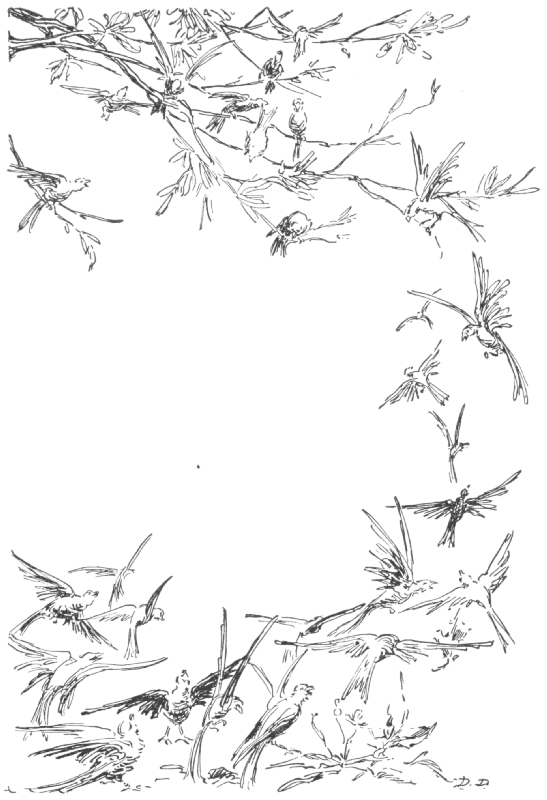
Then a strange thing happened. The guardian spirit of the tree whispered, “No, little leaves, you shall not die. You shall be changed into living forms. I will give you breath and life.” And instantly there arose from the earth where the leaves had dropped, a great flock of winged birds, red, and brown, and yellow, and crimson,  all the beautiful colors that Po-poon-o-ki had given the leaves. Then they flew away to the South Land, where winter’s breath could not reach them.


“THERE AROSE A GREAT FLOCK OF WINGED BIRDS”

But in the spring, when Ni-poon-o-ki, the spirit of summer, came stealing up from the South, and Po-poon-o-ki went back to his ice lodge in the far North, then the birds came back, too. There were new leaves on the trees, but the birds flew straight to the branches which had been their home, and there, safely sheltered by the new leaves, they built their nests.

And after awhile, when there were eggs in all the home nests, the hearts of the birds became so full of joy that they could no longer be silent. Their throats swelled, and opening wide their little mouths, they filled all the air with bursts of happy song.

************** 

This is part of a series of postings of stories under the category, “Keeping the Public in Public Domain.” The idea behind Public Domain was to preserve our cultural heritage after the authors and their immediate heirs were compensated. I feel strongly current copyright law delays this intent on works of the 20th century. My own library of folklore includes so many books within the Public Domain I decided to share stories from them. I hope you enjoy discovering them.

At the same time, my own involvement in storytelling regularly creates projects requiring research as part of my sharing stories with an audience.  Whenever that research needs to be shown here, the publishing of Public Domain stories will not occur that week.  This is a return to my regular posting of a research project here.  (Don't worry, this isn't dry research, my research is always geared towards future storytelling to an audience.)  Response has convinced me that "Keeping the Public in Public Domain" should continue along with my other postings as often as I can manage it.

See the sidebar for other Public Domain story resources I recommend on the page “Public Domain Story Resources."

Friday, October 10, 2025

Indigenous Peoples' Day or Columbus Day?


boroughofwenonah.com

The second Monday in October is a Federal Holiday in the United States. The question of what it should be called, however, is a question that, for now, will be unsettled. Historyoftheholiday.com does an excellent job of discussing how the 20th century holiday, Columbus Day, has begun to transition to Indigenous Peoples' Day. 

I couldn't have said it better than that site explains it! 

Another well-written look specifically at Indigenous Peoples' Day is this is from the October Michigan D.A.R. newsletter:

Indigenous Peoples’ Day is October 13, 2025. It’s a great time to immerse yourself in the history and culture of Michigan’s 12 federally recognized tribes and 4 state recognized tribes. 

Visit a museum! These are just a few of Michigan’s museums offering excellent information on the rich histories and cultures of American Indians in our state; Ziibiwing Center in Mt. Pleasant, Besser Museum in Alpena, Andrew J. Blackbird Museum in Harbor Springs, Potawatomi Heritage Center in Wilson, Museum of Ojibwa Culture in St. Ignace. 

Attend a powwow! On October 13, 2025 go the Indigenous Peoples’ Day Powwow at Hart Plaza in Downtown Detroit – the first powwow hosted in 30 years! The powwow is open to the public and there will be dancing, singing, and plenty of delicious food. 

National American Indian Heritage Month starts on November 1st. It is a month-long celebration and a time for education and awareness of the many contributions of American Indians in our country. The 2025 BIA theme for the month is “Weaving together our past, present and future”. ***

The month was formally designated inespecially 1990 by President George H. W. Bush, who proclaimed November as National American Indian Heritage Month. Legislation was signed in 2009 by President Barack Obama to permanently designate the Friday after Thanksgiving as Native American Heritage Day. 

This is a time to honor the diverse cultures, histories, and importance of American Indian communities, to educate the public about the challenges Indigenous people have encountered, and to acknowledge and support the many tribes in our country. 

*** Actually that was chosen for 2024. The Bureau of Indian Affairs has not chosen a theme for 2025 and the current government shutdown has https://www.bia.gov not being updated.

If you wonder which of the two is celebrated "offiffiffic'ally" where you are, the Pew Research Center has the answers including "Depending on where in the United States you live and for whom you work, Columbus Day may be a paid day off, an unpaid commemorative day, another holiday entirely or a regular Monday."

Looking at yet another site, academickids.com so well says: 

 While the two holidays have different focuses, they share a date and often spark discussions about history, exploration, and the importance of understanding multiple perspectives.

Of course I want to share the stories of our Michigan (and beyond into the Great Lakes Region, including up into Canada) People of the Three Fires (the Anishinaabe), the Ojibwe, Odawa, and Potawatomi. For now I will let the dust settle on this and wait until November.

Friday, October 3, 2025

Davis & Chow-Leung - How the Moon Became Beautiful - Keeping the Public in Public Domain

It's bigger! It's brighter! It's culturally significant! The Super Harvest Moon this year occurs on October 6. To learn more about it go to https://astrophotons.com/super-harvest-moon to understand why it's so rare.  

" On average, you'll see 3-4 supermoons a year. But a Super Harvest Moon (when the supermoon aligns with the harvest timing) happens less often - sometimes only once a decade."

That page also gives facts, history, its cultural significance and even how to photograph it. 

The moon will always fascinate us, so a good story about it is worth knowing, ready to tell. All around the world there are many stories about seeing people in the moon. I think the most beautiful and worth telling is this Chinese story. Mary Hayes and Reverend Chow-Leung in 1908 published Chinese Tables and Folk Stories, opening with today's tale. No credit is given for the illustrations.

HOW THE MOON BECAME BEAUTIFUL

月何以美

The Moon is very beautiful with his round, bright face which shines with soft and gentle light on all the world of man. But once there was a time when he was not so beautiful as he is now. Six thousand years ago the face of the Moon became changed in a single night. Before that time his face had been so dark and gloomy that no one liked to look at him, and for this reason he was always very sad.

One day he complained to the flowers and to the stars—for they were the only things that would ever look in his face.

He said, “I do not like to be the Moon. I wish I were a star or a flower. If I were a star, even the smallest one, some great general would care for me; but alas! I am only the Moon and no one likes me. If I could only be a flower and grow in a garden where the beautiful earth women come, they would place me in their hair and praise my fragrance and beauty. Or, if I could even grow in the wilderness where no one could see, the birds would surely come and sing sweet songs for me. But I am only the Moon and no one honors me.”

The stars answered and said, “We can not help you. We were born here and we can not leave our places. We never had any one to help us. We do our duty, we work all the day and twinkle in the dark night to make the skies more beautiful.—But that is all we can do,” they added, as they smiled coldly at the sorrowful Moon.

Then the flowers smiled sweetly and said, “We do not know how we can help you. We live always in one place—in a garden near the most beautiful maiden in all the world. As she is kind to every one in trouble we will tell her about you. We love her very much and she loves us. Her name is Tseh-N’io.”

Still the Moon was sad. So one evening he went to see the beautiful maiden Tseh-N’io. And when he saw her he loved her at once. He said, “Your face is very beautiful. I wish that you would come to me, and that my face would be as your face. Your motions are gentle and full of grace. Come with me and we will be as one—and perfect. I know that even the worst people in all the world would have only to look at you and they would love you. Tell me, how did you come to be so beautiful?”

“I have always lived with those who were gentle and happy, and I believe that is the cause of beauty and goodness,” answered Tseh-N’io.

And so the Moon went every night to see the maiden. He knocked on her window, and she came. And when he saw how gentle and beautiful she was, his love grew stronger, and he wished more and more to be with her always.

One day Tseh-N’io said to her mother, “I should like to go to the Moon and live always with him. Will you allow me to go?”

Her mother thought so little of the question that she made no reply, and Tseh-N’io told her friends that she was going to be the Moon’s bride.

In a few days she was gone. Her mother searched everywhere but could not find her. And one of Tseh-N’io’s friends said,—“She has gone with the Moon, for he asked her many times.”

A year and a year passed by and Tseh-N’io, the gentle and beautiful earth maiden, did not return. Then the people said, “She has gone forever. She is with the Moon.”


The face of the Moon is very beautiful now. It is happy and bright and gives a soft, gentle light to all the world. And there are those who say that the Moon is now like Tseh-N’io, who was once the most beautiful of all earth maidens.

 ***

Shine on, shine on Harvest Moon, and happy storytelling about how it came to be so beautiful.