Tell me if you have a topic you'd like to see. (Contact: LoiS-sez@LoiS-sez.com .)
Please also let others know about this site.

Saturday, May 9, 2020

Shelter in Place - Week 7 / Poulsson - How the West Wind Helped Dandelion - Keeping the Public in Public Domain

In the midst of all the current chaos, isn't it wonderful to see plants waking up for the spring?

Try this riddle on somebody.
When she's young she's tall and slender,
Any faint young breeze could bend her.
She grows stout as she grows old,
And her hair is sunny gold.
As the days pass out of sight,
Lo! her hair turns snowy white.
Then the children in their play
Wish--and blow her quite away.
Guess her name.--You're "tired trying;"?
Why, her name is--Dandelion.
That's a poem by Julie M. Lippmann from an early book aimed at teachers called The Primary Plan Book, Volume 3 by Marian Minnie George.  Right now my lawn has dandelions popping up and it reminds me of something my mother would always say with delight: The old man spilled his bag of gold!
Photo by photokip.com from Pexels
I've hunted as thoroughly as possible and can't find what story or poem where that might originate.  Possibly an early 20th century reader?  If anybody can help me find it, please let me know!

A site called Dandelion Delight has many stories, folklore, recipes, health benefits, facts, videos, poetry, and so much more.  I'd love to find a way to contact the owner of the site, but it doesn't make contact available.  Possibly whomever it is could track down the source of Mom's saying.  The truly comprehensive site reminds us "Some see a weed, others see a wish."  Among the stories there, I found a story from another book perfect for teachers and parents, especially in the time when homeschooling is the only form of education going on everywhere!  In the Child's World; Morning Talks and Stories by Emilie Poulsson, a pioneer in early childhood work, who achieved phenomenal success as a writer and educator while blind from childhood.  She was especially noted for her poetry, including finger plays, since her focus was firmly fixed upon young children.

Beyond just today's story, it's part of the unit in In the Child's World about Wind and that, too, is something in the spring beyond when "the March winds doth blow."  This is why I am giving a bit more from that unit than just the story, but you might want to read more online at Internet Archive or download it or other Poulsson books at their Open Library.


Photo by Sharefaith from Pexels
 
That's only some of the material about the wind before today's story.  When scanning the story I also decided not to cut out bibliography, called "Teacher's Reading" in case you care to find some classic poetry, all are available on the internet.  The final item, "Earth and Man" by Arnold Henry Guyot is not poetry, but part of a series of lectures on physical geography.

I included her poem, "The Dandelion Cycle."  After that she gives a version of the story of "Odysseus and the Bag of Winds" from the Odyssey and a German tale of "The North Wind at Play."  If you're wondering why she doesn't include the famous Aesop fable of "The Wind and the Sun", she does, but it's in a section on Sunshine.  The book really does an admirable job of covering the topics suited to the curiosity of young children.  I'm pleased to own my own copy of it.

While I'm still thinking about stories and facts for young children, Dandelion Delight's poems include this which is obviously meant as a finger play.
Ten happy dandelions growing in a line
One turned to fluff and then there were nine
Nine happy dandelions growing by the gate
one turned to fluff and then there were eight
eight happy dandelions growing toward heaven one turned to fluff and then there were seven
seven happy dandelions growing to be picked one turned to fluff and then there were six
six happy dandelions growing close to a hive one turned to fluff and then there were five
Five happy dandelions growing more and more
One turned to fluff and then there were four
four happy dandelions growing wild and free
one turned to fluff and then there were three
three happy dandelions growing just for you
one turned to fluff and then there were two
tow happy dandelions growing in the sun
one turned to fluff and then there was one
one happy dandelion
having lots of fun it turned to fluff and then there were none
It was written by Kathy KJ Nanny.  I've no idea who she was, but Poulsson would have enjoyed it. 

How I wish libraries would re-open as the perfect picture book to go with all of this is the classic tale by Don Freeman, Dandelion.

Here in Michigan people can mow their own lawns or hire landscaping as long as "social distancing" is maintained.  Personally I share the opinion of the Dandelion Delight site and hate lawns treated to remove "weeds."  Still I have always said Spring is the time when a little hard work pays off in a lot of hard work later!

We've had the wind blow in a cold spell promising possible frost this weekend, but it won't hurt the dandelions.  Soon (I hope!) it will be warm enough to put the hammock back up.  If we're still worried about Sheltering in Place, I plan to follow the advice from an author I enjoy, Renee Pawlish, whose magnet gives this diagnosis I approve.
Until next week, may you "self-quarantine" by reading!
*******************
This is part of a series of postings of stories under the category, "Keeping the Public in Public Domain."  The idea behind Public Domain was to preserve our cultural heritage after the authors and their immediate heirs were compensated.  I feel strongly current copyright law delays this intent on works of the 20th century.  My own library of folklore includes so many books within the Public Domain I decided to share stories from them.  I hope you enjoy discovering new stories.  


At the same time, my own involvement in storytelling regularly creates projects requiring research as part of my sharing stories with an audience.  Whenever that research needs to be shown here, the publishing of Public Domain stories will not occur that week.  This is a return to my regular posting of a research project here.  (Don't worry, this isn't dry research, my research is always geared towards future storytelling to an audience.)  Response has convinced me that "Keeping the Public in Public Domain" should continue along with my other postings as often as I can manage it.
Other Public Domain story resources I recommend-
  • There are many online resources for Public Domain stories, maybe none for folklore is as ambitious as fellow storyteller, Yoel Perez's database, Yashpeh, the International Folktales Collection.  I have long recommended it and continue to do so.  He has loaded Stith Thompson's Motif Index into his server as a database so you can search the whole 6 volumes for whatever word or expression you like by pressing one key. http://folkmasa.org/motiv/motif.htm
  • You may have noticed I'm no longer certain Dr. Perez has the largest database, although his offering the Motif Index certainly qualifies for those of us seeking specific types of stories.  There's another site, FairyTalez claiming to be the largest, with "over 2000 fairy tales, folktales, and fables" and they are "fully optimized for phones, tablets, and PCs", free and presented without ads.

    Between those two sites, there is much for story-lovers, but as they say in infomercials, "Wait, there's more!"
The email list for storytellers, Storytell, discussed Online Story Sources and came up with these additional suggestions:            
         - David K. Brown - http://people.ucalgary.ca/~dkbrown/stories.html
         - Richard Martin - http://www.tellatale.eu/tales_page.html
         - Spirit of Trees - http://spiritoftrees.org/featured-folktales
         - Story-Lovers - http://www.story-lovers.com/ is now only accessible through the Wayback Machine, described below, but Jackie Baldwin's wonderful site lives on there, fully searchable manually (the Google search doesn't work), at https://archive.org/ .  It's not easy, but go to Story-lovers.com snapshot for October 22 2016  and you can click on SOS: Searching Out Stories to scroll down through the many story topics and click on the story topic that interests you.
       - World of Tales - http://www.worldoftales.com/ 
           - Zalka Csenge Virag - http://multicoloreddiary.blogspot.com doesn't give the actual stories, but her recommendations, working her way through each country on a continent, give excellent ideas for finding new books and stories to love and tell.
     
You're going to find many of the links on these sites have gone down, BUT go to the Internet Archive Wayback Machine to find some of these old links.  Tim's site, for example, is so huge probably updating it would be a full-time job.  In the case of Story-Lovers, it's great that Jackie Baldwin set it up to stay online as long as it did after she could no longer maintain it.  Possibly searches maintained it.  Unfortunately Storytell list member, Papa Joe is on both Tim Sheppard's site and Story-Lovers, but he no longer maintains his old Papa Joe's Traveling Storytelling Show website and his Library (something you want to see!) is now only on the Wayback Machine.  It took some patience working back through claims of snapshots but finally in December of 2006 it appears!
    Somebody as of this writing whose stories can still be found by his website is the late Chuck Larkin - http://chucklarkin.com/stories.html.  I prefer to list these sites by their complete address so they can be found by the Wayback Machine, a.k.a. Archive.org, when that becomes the only way to find them.
You can see why I recommend these to you. Have fun discovering even more stories!

Saturday, May 2, 2020

Shelter in Place - Week 6 / Montgomery - The Councillors of Lagos - Keeping the Public in Public Domain

The coming week originally was scheduled to start of with two celebrations: Star Wars Day (May the Fourth Be With You!...take your pick of the dry factual Wikipedia article or kids activities, including a puppet and story) and then Cinco de Mayo...a day normally filled with celebrating.  Go to History.com for colorful and very thorough coverage, including videos and excellent related content (you have to keep scrolling down to get to that extra material).   Still it's not as much fun as the celebrations normally part of this day often confused with Mexican Independence Day (yes, History.com explains this).  

I was surprised to find only two Public Domain gatherings of Mexican folklore from the days when ethnologists first went out to the far corners of the world to collect stories.  Lewis Spence in 1913 produced The Myths of Mexico & Peru, but I found the stories dry and barely anecdotal.  Then I discovered Charles M. Skinner's Myths & Legends Beyond Our Borders.  Two-thirds of the book is on Canada before offering slightly over a hundred pages devoted to Mexico.  Skinner wrote several books of folklore, focusing on the United States and also one about our "New Possessions and Protectorate" ("Cuba, Porto Rico, and the Philippines", as well as Hawaii long before it became a state).  Fortunately you can read these books online at the Internet Archive.  I may not always have been tempted by his stories, mythology isn't really my favorite folklore, but in Beyond Our Borders there were some besides today's story I liked, especially two that may appear here in the future.  One was about foolish young alligators and another reminds me of an Asian tale about a wen, an abnormal skin growth, taken from a good man and eventually given to a greedy man.  

This is a tale of Mexican politicians, as are many Noodlehead tales about foolish leaders, but my intent is NOT political, whether it be about those responsible for roads or higher.  It's strictly for fun and we can always use more of that.  There's more Noodlehead resources after the story.


Today's story is a type called a "Noodlehead tale" and I heartily recommend going to a page of Noodlehead resources by fellow storyteller, Barry McWilliams, who is commonly called Eldrbarry.  He points out the difference beyond the "wise fool" like the Hodja or Tyl Eulenspiegel and the true Noodleheads like those leaders of Chelm and Gotham.  Beyond that comprehensive look at Noodleheads, a teacher, Susan Antonelli, who believes in "creative teaching designed to engage childhood wonder", has a fun page about the Epossumondus picture books by Coleen Salley along with other ideas for how to creatively use Noodlehead stories.  She mentions also the Amelia Bedelia easy readers in her suggestion of ways to think about and create Noodlehead stories.  

Thankfully Montgomery's books can be read even with libraries being closed.  I also always end the "Keeping the Public in Public Domain" segments with plenty of online folktales.  Oh, and by the way, right before this story is "The Mischievous Cocktail" for your celebrating.  I found it interesting as my Prohibition program includes the explanation that cocktails became popular then to disguise the taste of bootleg liquor, especially bathtub gin.  Montgomery in 1899 gives the Mexican claim to the Toltecs in the eleventh century inventing cocktails long before Columbus arrived.

Staying with today's story, clearly the politicians aren't the only Noodleheads, just more visible.
****************** 

This is part of a series of postings of stories under the category, "Keeping the Public in Public Domain."  The idea behind Public Domain was to preserve our cultural heritage after the authors and their immediate heirs were compensated.  I feel strongly current copyright law delays this intent on works of the 20th century.  My own library of folklore includes so many books within the Public Domain I decided to share stories from them.  I hope you enjoy discovering new stories.  


At the same time, my own involvement in storytelling regularly creates projects requiring research as part of my sharing stories with an audience.  Whenever that research needs to be shown here, the publishing of Public Domain stories will not occur that week.  This is a return to my regular posting of a research project here.  (Don't worry, this isn't dry research, my research is always geared towards future storytelling to an audience.)  Response has convinced me that "Keeping the Public in Public Domain" should continue along with my other postings as often as I can manage it.
Other Public Domain story resources I recommend-
  • There are many online resources for Public Domain stories, maybe none for folklore is as ambitious as fellow storyteller, Yoel Perez's database, Yashpeh, the International Folktales Collection.  I have long recommended it and continue to do so.  He has loaded Stith Thompson's Motif Index into his server as a database so you can search the whole 6 volumes for whatever word or expression you like by pressing one key. http://folkmasa.org/motiv/motif.htm
  • You may have noticed I'm no longer certain Dr. Perez has the largest database, although his offering the Motif Index certainly qualifies for those of us seeking specific types of stories.  There's another site, FairyTalez claiming to be the largest, with "over 2000 fairy tales, folktales, and fables" and they are "fully optimized for phones, tablets, and PCs", free and presented without ads.

    Between those two sites, there is much for story-lovers, but as they say in infomercials, "Wait, there's more!"
The email list for storytellers, Storytell, discussed Online Story Sources and came up with these additional suggestions:            
         - David K. Brown - http://people.ucalgary.ca/~dkbrown/stories.html
         - Richard Martin - http://www.tellatale.eu/tales_page.html
         - Spirit of Trees - http://spiritoftrees.org/featured-folktales
         - Story-Lovers - http://www.story-lovers.com/ is now only accessible through the Wayback Machine, described below, but Jackie Baldwin's wonderful site lives on there, fully searchable manually (the Google search doesn't work), at https://archive.org/ .  It's not easy, but go to Story-lovers.com snapshot for October 22 2016  and you can click on SOS: Searching Out Stories to scroll down through the many story topics and click on the story topic that interests you.
       - World of Tales - http://www.worldoftales.com/ 
           - Zalka Csenge Virag - http://multicoloreddiary.blogspot.com doesn't give the actual stories, but her recommendations, working her way through each country on a continent, give excellent ideas for finding new books and stories to love and tell.
     
You're going to find many of the links on these sites have gone down, BUT go to the Internet Archive Wayback Machine to find some of these old links.  Tim's site, for example, is so huge probably updating it would be a full-time job.  In the case of Story-Lovers, it's great that Jackie Baldwin set it up to stay online as long as it did after she could no longer maintain it.  Possibly searches maintained it.  Unfortunately Storytell list member, Papa Joe is on both Tim Sheppard's site and Story-Lovers, but he no longer maintains his old Papa Joe's Traveling Storytelling Show website and his Library (something you want to see!) is now only on the Wayback Machine.  It took some patience working back through claims of snapshots but finally in December of 2006 it appears!
    Somebody as of this writing whose stories can still be found by his website is the late Chuck Larkin - http://chucklarkin.com/stories.html.  I prefer to list these sites by their complete address so they can be found by the Wayback Machine, a.k.a. Archive.org, when that becomes the only way to find them.
You can see why I recommend these to you. Have fun discovering even more stories!

Saturday, April 25, 2020

Shelter in Place - week 5 Arbor Day/Earth Day/Blursday & Pollinators

This week had both the 50th Anniversary of Earth Day, the long-time celebration of Arbor Day and what a friend called Blursday.

What's Blursday?

With days blurring together while during Shelter in Place it's "The fortyteenth of Maprilay"!

I don't use my Twitter account much, but took up the Arbor Day Foundation's offer to plant a tree in one of our nation's forests if I posted a picture of a favorite tree on Twitter with the hashtag #arbordayathome and tag them.  I posted this picture of a trail at nearby Independence Oaks.
I'm a longtime supporter of Arbor Day Foundation as trees do so much to help us and our planet, too.  By the time you see this the offer may have ended.  They still have so much to offer so I recommend going to https://www.arborday.org/ and becoming a member, too.   You'll get TEN FREE TREES! and the lowest possible discount on other trees and shrubs, and much more.  Can't say enough good things about them, but usually I'm doing it at programs related to Earth Day.  This is only one of many ways you can celebrate Earth Day even while our public gatherings give way to Blursday.

Something else that can help and that I find myself often doing is signing petitions and writing about the need to save our pollinators.  The U.S. Fish and Wildlife Service has a page with lots of resources about Pollinators.  Why am I so passionate about this?  Without them our agriculture will become impossible.  From tiny insects like bees and butterflies to wildlife, domestic animals, and, yes, people, the chain of life requires those pollinators to keep all of our food coming.  Here in our area the Monarch Butterfly migrates through here.  Grow Milkweed where they lay their eggs, if you're not up to raising butterflies yourself, as habitat loss is one of the reasons for their decline. 

While the U.S. Fish and Wildlife Service can only mention generalities on their "Threats to Pollinators"page, the herbicide Glyphosate (commonly sold as Roundup) has been linked to killing Monarch Butterflies and bees whether from loss of habitat or toxicity.  Its among the Neonictinoids or Neonics banned in European countries and a few other countries.  I note this when sending emails to my various elected officials.  Yes, it's made by a U.S. company based in St. Louis, Missouri where I grew up, but they sell many other products, so dropping this one won't put them out of business.  Neonic toxicity and its spread to other wildlife has led the American Bird Conservancy to call for its ban after studies point to its serious risk to the environment.

From Pixabay via Pexels.com
I've often posted about bees, many times with stories.  Too often they are accused when it's their "cousins", the hornet or Yellow Jacket, buzzing around.  August 5, 2017 I gave a Cuffy Bear story by Arthur Scott Bailey, but also briefly retold the Anishinaabe tale about how defending bees with a stinger was generously shared with wasps. 

A neighbor of mine probably is not happy with that generosity of bees sharing with the wasp.  While mowing his lawn on a riding mower requiring holding the handles to steer, he saw what looked like a paper bag in the trees.  On his next swing past, he grabbed the "bag" only to discover it was a paper wasp nest.  During the time it took to discover it, he was stung repeatedly.  The bee only stings in self-defense or to protect its hive because they are unable to sting more than once.

Today I want to add to stories about pollinators by talking about butterflies.  They don't even sting and they manage to look beautiful while fluttering about. 

Be warned, this paragraph may get a bit more involved in the world of publishing than you wish.  If so, skip to the story I retell after this.  In that 2017 article I mentioned the works of Louise Jean Walker, accidentally missing another book of hers I now have, Beneath the Singing Pines.  From all I can tell, she never had the copyright renewed on her books.  Neither Eerdmans, who published Legends of Green Sky Hill nor Hillsdale Educational Publishers, who published the other two, have her work still in their listings.  I've included a bit of a rant here before about how the copyright law was changed, but it also meant publishers were no longer taxed at the rate of a book when it first entered their stock.  Instead what the cost of a book would be when it was sold became the cost for their inventory.  This made it more expensive to keep books in their inventory, resulting in  publishers preference of Pop material guaranteed to sell right away.  Scholarly books and children's books had been staples on that "backlist", but this made them less profitable.  It also has led to a lot of self-publishing of e-books, especially at Amazon.  Reprint publishers show no guarantees of quality -- I've learned caution in buying.  I would love to see Project Gutenberg reproduce Walker's books if it truly is available.  Perhaps the publishers will catch their names mentioned here and decide to reproduce her books.  Until then, your only way is to either buy a used copy (I strongly recommend Better World Books, not only for their own inventory, but additionally because of all they do to support literacy) or borrow it from your library when they finally reopen.  You will not find the books among their digital collections unfortunately.

Benzie Conservation District (MI) also provides seeds reasonably
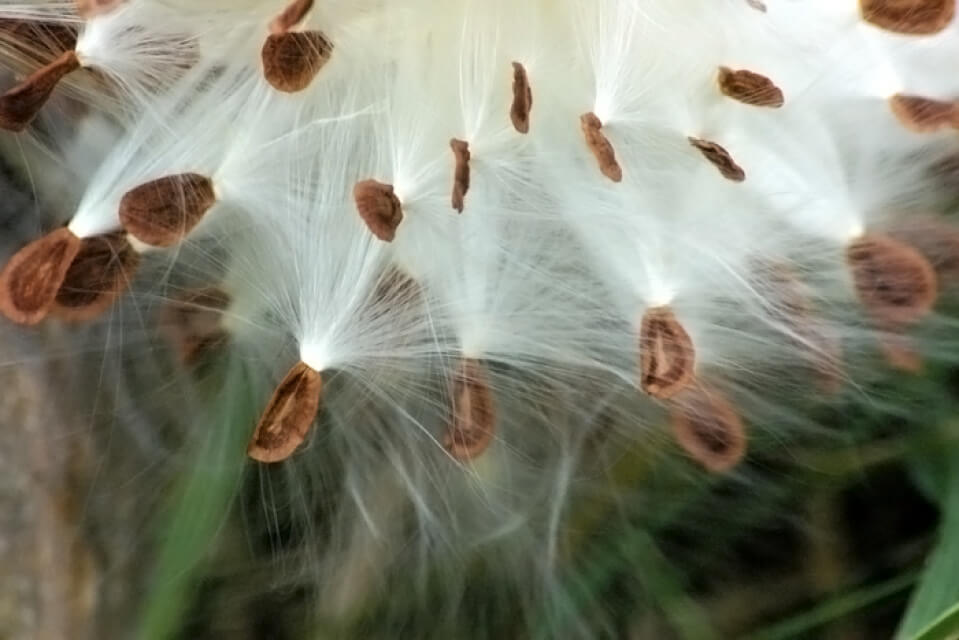
Since I would rather the books become available again, I will re-tell the story Walker and various Anishinaabe storytellers give about how butterflies were created.  It makes no pretense at being as good or thorough as they might tell it, but I hope you will remember it when you see a butterfly and do what you can to support their habitat.  Next autumn remember the value of Milkweed when you see its seeds with their fluffy "parachutes."  The National Wildlife Federation will give you more information on how you can do this and ways to Garden for Wildlife with ideas that can work even in urban and suburban yards.  Get FREE milkweed seeds at LiveMonarch.com along with growing instructions and other activities and resources.

Long ago, it is said by the Anishinaabe, the First People from here in Michigan and around the Great Lakes, that after the Great Spirit had created the world, he looked around with pleasure.  Birds, Fish and other creatures were colorful and useful.  Then he looked at the mountains of the world.  He loved them, too, but knew the People might not appreciate them.  To get the People to enter them, he decided to make rocks of many colors, some of those rocks even sparkled.  It was as if the mountains held rainbows!  He knew the People would discover the stones and then would dig for them.  That was good, but he decided not to keep all the rocks hidden in the mountains.  Scattering rocks around would let children discover them, even without going inside a mountain.  This was no sooner done than Zhaawani Noodin, the South Wind, blew in, singing of trees, birds, and flowers in the spring and summer.  Hearing that song, the Great Spirit tossed the colorful stones into the air, asking the South Wind to carry them to the People.  Those colorful rocks developed wings and fluttered away.  Today we enjoy their beautiful wings knowing that even in their beauty they help pollinate the flowers and other plants wherever they visit. 
Photo by Cindy Gustafson on Pexels.com
Today may be "Blursday", but I like a quote I saw about the current time which said it's end will be like a rainbow that follows a storm.  May this help encourage you to make every day Earth Day and also carry out the purpose of Arbor Day by planting trees which hold the soil (Arbor Day was started to prevent soil erosion, among other things) and do an incredible job to help bring oxygen and reduce pollution.  Already the pollution level is being noticed as reduced by all of us who Shelter in Place.

Saturday, April 18, 2020

Shelter in Place - week 4 / Miller - Trapping the Plague - Keeping the Public in Public Domain

Plagues and pestilences have happened throughout history.  The quote “Those who forget history are condemned to repeat it” is attributed to the American philosopher George Santayana and it can be accurately quoted as “Those who cannot remember the past are condemned to repeat it” as stated in his work, The Life of Reason: Reason in Common Sense.  I went looking for stories and, other than the very dark "Masque of the Red Death" by Edgar Allen Poe, it was interesting how little I could find and, of course, even less that was Public Domain.

I was able to find an interesting story from an area that fits the title of the Undiscovered Scotland website.  Cromarty has a landlocked harbor that had industrial factories for brewing, iron, lace, cloth, and rope until road and rail routes passed it by, leaving a conservation site and what Encyclopedia Britannica describes as "perhaps the best preserved 18th-century town in the Highlands."  Cromarty remembers its most famous citizen, Hugh Miller, with two buildings.  The National Trust for Scotland operates his birthplace, the only thatched cottage in the town, as a museum and there's also the Hugh Miller Institute which Undiscovered Scotland calls "a grand, if a little out of place, library presented to the town by the Carnegie Institute in 1903."

Hugh Miller is described by Wikipedia as "a self-taught Scottish geologist and writer, folklorist[1] and an evangelical Christian.[2]"   Let's leave his geological writings to the scientist and look at the first book he ever wrote, Scenes and Legends of the North of Scotland, or The Traditional History of Cromarty.  It's easy to picture his tale of the central part of the church-yard of the little Scottish Highland town of Nigg (current population said to be 156).  The town is small, but the Wikipedia article about it opens with:
Nigg (from the Scottish Gaelic: An Neag meaning "the notch", referring to a feature of the hills above the parish church) is a village and parish in Easter Ross, administered by The Highland Council. It lies on the north shore of the entrance to the Cromarty Firth.
This is 2d attempt at posting Wikimedia Commons photo
Nigg Old Church and churchyard.
Rosskmaxwell - Own work

 Nigg Old Church

The present parish church is an 18th-century building on an early Christian site dating back to at least the 8th century. The Nigg Stone, one of the most elaborate stone monuments of early medieval western Europe,[1] is preserved in a room at the west end of the church. This late 8th century Pictish cross-slab formerly stood in the churchyard, but was moved indoors for preservation in recent years.
The nearby manse is one of the oldest to survive in Scotland, dating back to the first half of the 17th century. It is now privately owned and no longer used as the parish minister's residence.
Nigg Old has its odd and curious features. In the churchyard is the Cholera Stone, dating from the cholera epidemic of 1832. One of the elders, on coming out of the church, saw a cloud of vapour hovering above the ground. He believed it to be a cloud of cholera, threw a blanket or cloth over it and placed this large stone on top to keep it from escaping. And inside the church, according to one tradition, the beadle (church officer) allowed an illicit still to be kept in the space under the pulpit.[2]
Aye, that's the Scottish tradition or folklore for you.  But Nigg is right across the bay from Miller's larger hometown of Cromarty (population 719 to 730 depending on your source) on an area called "the Black Isle."   Wikipedia's Nigg article also says:
The Nigg to Cromarty ferry route is often called The King’s Ferry – the route taken by King James IV of Scotland when on pilgrimage to the shrine of St Duthac at Tain, doing so at least 18 times in the years between 1493 to 1513.[3]
It is the only ferry service from the Black Isle. The ferry crosses the entrance to the Cromarty Firth, one of the finest natural harbours in Europe and also an area rich in wildlife and world-famous for its dolphin population.[4]
Hugh Miller was both interested in science and folklore so his book gives you a larger picture of how the protected harbor played a role in the early 19th century Cholera epidemic from quarantine to its spread, with that interesting tale of its capture in Nigg on the third page.  There's more, though and it provides some interesting incidents -- especially if you "read between the lines", so don't just skim to that third page.


It's interesting that Persia, now called Iran, and Russia are mentioned.  This time Iran was heavily hit early because a trader apparently carried Coronavirus, Covid-19 back from China, while Russia has sealed its country off as best it could.

Would that we could somehow trap the current plague in a bag.  Until then I hope you take this bit of advice from the authors site, promo.authorsxp.com :

Readers...Self-Quarantining Since 750 B.C.

******************
This is part of a series of postings of stories under the category, "Keeping the Public in Public Domain."  The idea behind Public Domain was to preserve our cultural heritage after the authors and their immediate heirs were compensated.  I feel strongly current copyright law delays this intent on works of the 20th century.  My own library of folklore includes so many books within the Public Domain I decided to share stories from them.  I hope you enjoy discovering new stories.  


At the same time, my own involvement in storytelling regularly creates projects requiring research as part of my sharing stories with an audience.  Whenever that research needs to be shown here, the publishing of Public Domain stories will not occur that week.  This is a return to my regular posting of a research project here.  (Don't worry, this isn't dry research, my research is always geared towards future storytelling to an audience.)  Response has convinced me that "Keeping the Public in Public Domain" should continue along with my other postings as often as I can manage it.
Other Public Domain story resources I recommend-
  • There are many online resources for Public Domain stories, maybe none for folklore is as ambitious as fellow storyteller, Yoel Perez's database, Yashpeh, the International Folktales Collection.  I have long recommended it and continue to do so.  He has loaded Stith Thompson's Motif Index into his server as a database so you can search the whole 6 volumes for whatever word or expression you like by pressing one key. http://folkmasa.org/motiv/motif.htm
  • You may have noticed I'm no longer certain Dr. Perez has the largest database, although his offering the Motif Index certainly qualifies for those of us seeking specific types of stories.  There's another site, FairyTalez claiming to be the largest, with "over 2000 fairy tales, folktales, and fables" and they are "fully optimized for phones, tablets, and PCs", free and presented without ads.

    Between those two sites, there is much for story-lovers, but as they say in infomercials, "Wait, there's more!"
The email list for storytellers, Storytell, discussed Online Story Sources and came up with these additional suggestions:            
         - David K. Brown - http://people.ucalgary.ca/~dkbrown/stories.html
         - Richard Martin - http://www.tellatale.eu/tales_page.html
         - Spirit of Trees - http://spiritoftrees.org/featured-folktales
         - Story-Lovers - http://www.story-lovers.com/ is now only accessible through the Wayback Machine, described below, but Jackie Baldwin's wonderful site lives on there, fully searchable manually (the Google search doesn't work), at https://archive.org/ .  It's not easy, but go to Story-lovers.com snapshot for October 22 2016  and you can click on SOS: Searching Out Stories to scroll down through the many story topics and click on the story topic that interests you.
       - World of Tales - http://www.worldoftales.com/ 
           - Zalka Csenge Virag - http://multicoloreddiary.blogspot.com doesn't give the actual stories, but her recommendations, working her way through each country on a continent, give excellent ideas for finding new books and stories to love and tell.
     
You're going to find many of the links on these sites have gone down, BUT go to the Internet Archive Wayback Machine to find some of these old links.  Tim's site, for example, is so huge probably updating it would be a full-time job.  In the case of Story-Lovers, it's great that Jackie Baldwin set it up to stay online as long as it did after she could no longer maintain it.  Possibly searches maintained it.  Unfortunately Storytell list member, Papa Joe is on both Tim Sheppard's site and Story-Lovers, but he no longer maintains his old Papa Joe's Traveling Storytelling Show website and his Library (something you want to see!) is now only on the Wayback Machine.  It took some patience working back through claims of snapshots but finally in December of 2006 it appears!


Saturday, April 11, 2020

Shelter in Place - week 3 / The Easter Story (NOT Public Domain, but...)

from OldDesignShop.com/

I remember my father was a small business owner who followed the principle of two things never discussed beyond the family, Politics and Religion.  Considering the way the United States has become extremely divided to the point where either topic might end a relationship, I can understand his point.  At the same time, I have enjoyed telling stories to Jewish groups, also at the Islamic Center here in Dearborn, and to many groups related to my own Christianity.  I would like to hope that on one of the two days when it is said even non-practicing Christians attend church, I could post the links that take you to the Easter story.  The source is certainly Public Domain, but ...)

At a time like this, Easter Bunnies, Chicks et al seem like stories for another time.  Using the Public Domain Bible would usually mean the very traditional, but less contemporary language of something like the King James version.  There are so many versions and translations.  Back in roughly the final quarter of the 20th century the New International Version was published by the New York Bible Society (now Biblica), bringing together more than one hundred scholars working from the best available Hebrew, Aramaic, and Greek texts to create an English translation that was contemporary.  I want to give thanks to the Grand Rapids, Michigan company, Zondervan and Biblica for permission to offer the N.I.V. version online.  

The story was told originally by four authors, Matthew, Mark, Luke, and John and then continued in the book of Acts.  If you go to that online link for the N.I.V. version online you can search for yourself these chapters and verses (put them in their Search Box, one author at a time, the way I list them for the least amount of confusion or use the links I've provided for each):
John 19:16-42; John 20; John 21

This Easter is going to be different from any we've ever experienced.  Stay home, stay well, but why not also read what Easter really is all about?

Until next week, or as some of us would say, "God willing", or as it is also said, "Insha Allah"  which reminds me of a Hodja tale, so maybe that viewpoint will be told next week.  We'll see. 


Saturday, April 4, 2020

Shelter in Place - week 2: Cornplanter/Canfield - The Origin of the Violet - Keeping the Public in Public Domain

Last week I showed my "Beast" a.k.a. "Malamutt", but, now that grass is again started to grow, he's also a "Malamoot" enjoying the pleasure of something fresh and growing.  Similarly, since walking him is allowed under Shelter in Place, I've seen something else that is wild, starting to grow, and that people can eat . . . violets.  What you didn't know that?  Grab a copy of Stalking the Wild Asparagus by that long ago forager, Euell Gibbons.  That was the first of his efforts towards showing the bounty of wild plants that grow without people doing anything more than knowing what is edible.  I learned long ago that violets taste like the sweetest of lettuce.  Can't say I ever went to the bother of harvesting those flowers and making jam from it, but was delighted to see them popping up at the edge of wooded areas.  If you decide to try them, be sure you don't take them roots and all so they can recover.

Just as those dog walks and food are needed, stories are, too.  Earlier this year on February 1, 2020 a story, "The First Winter", from The Legends of the Iroquois, officially listed as being written by William W. Canfield, but he attributes the source to "The Cornplanter", a Seneca chief who died in 1836.  We certainly hope Winter (and our reason for Shelter in Place) is going to end as soon as possible.  From that same book comes today's story about "The Origin of the Violet."

The story includes a young Iroquois warrior falling in love with a maiden from an enemy tribe.  Right about there I can just picture the story being told backed by the Native American flute.  Back in December of 2016 I devoted three weeks to the Native American flute.  It traditionally is believed to have originated as a means of courting, so I can picture it for part of this story, but the story is filled with adventure and so much more.  The Native American flute may have started with courting, but what it can play is limited only by the person playing it, so the other parts can give the animals, battles, and elements I don't want to give away.  Let the story form a soundtrack in your mind, changing as the story changes.

For a graphic to open the story, I want to add this page from a 1906 dictionary owned by Julie J. who offers many wonderful Public Domain images on her website.  This graphic from her https://olddesignshop.com gives flowers for every month.  March is the violet and I did indeed start seeing it on March 30th and April's showers will help them grow.
I'm sure you always wash your produce, but doing it in vinegar is both cleansing and a bit of salad dressing.  Now may this bit of spring brighten your own time to Shelter in Place.
Also from https://olddesignshop.com
******************
This is part of a series of postings of stories under the category, "Keeping the Public in Public Domain."  The idea behind Public Domain was to preserve our cultural heritage after the authors and their immediate heirs were compensated.  I feel strongly current copyright law delays this intent on works of the 20th century.  My own library of folklore includes so many books within the Public Domain I decided to share stories from them.  I hope you enjoy discovering new stories.  


At the same time, my own involvement in storytelling regularly creates projects requiring research as part of my sharing stories with an audience.  Whenever that research needs to be shown here, the publishing of Public Domain stories will not occur that week.  This is a return to my regular posting of a research project here.  (Don't worry, this isn't dry research, my research is always geared towards future storytelling to an audience.)  Response has convinced me that "Keeping the Public in Public Domain" should continue along with my other postings as often as I can manage it.
Other Public Domain story resources I recommend-
  • There are many online resources for Public Domain stories, maybe none for folklore is as ambitious as fellow storyteller, Yoel Perez's database, Yashpeh, the International Folktales Collection.  I have long recommended it and continue to do so.  He has loaded Stith Thompson's Motif Index into his server as a database so you can search the whole 6 volumes for whatever word or expression you like by pressing one key. http://folkmasa.org/motiv/motif.htm
  • You may have noticed I'm no longer certain Dr. Perez has the largest database, although his offering the Motif Index certainly qualifies for those of us seeking specific types of stories.  There's another site, FairyTalez claiming to be the largest, with "over 2000 fairy tales, folktales, and fables" and they are "fully optimized for phones, tablets, and PCs", free and presented without ads.

    Between those two sites, there is much for story-lovers, but as they say in infomercials, "Wait, there's more!"
The email list for storytellers, Storytell, discussed Online Story Sources and came up with these additional suggestions:            
         - David K. Brown - http://people.ucalgary.ca/~dkbrown/stories.html
         - Richard Martin - http://www.tellatale.eu/tales_page.html
         - Spirit of Trees - http://spiritoftrees.org/featured-folktales
         - Story-Lovers - http://www.story-lovers.com/ is now only accessible through the Wayback Machine, described below, but Jackie Baldwin's wonderful site lives on there, fully searchable manually (the Google search doesn't work), at https://archive.org/ .  It's not easy, but go to Story-lovers.com snapshot for October 22 2016  and you can click on SOS: Searching Out Stories to scroll down through the many story topics and click on the story topic that interests you.
       - World of Tales - http://www.worldoftales.com/ 
           - Zalka Csenge Virag - http://multicoloreddiary.blogspot.com doesn't give the actual stories, but her recommendations, working her way through each country on a continent, give excellent ideas for finding new books and stories to love and tell.
     
You're going to find many of the links on these sites have gone down, BUT go to the Internet Archive Wayback Machine to find some of these old links.  Tim's site, for example, is so huge probably updating it would be a full-time job.  In the case of Story-Lovers, it's great that Jackie Baldwin set it up to stay online as long as it did after she could no longer maintain it.  Possibly searches maintained it.  Unfortunately Storytell list member, Papa Joe is on both Tim Sheppard's site and Story-Lovers, but he no longer maintains his old Papa Joe's Traveling Storytelling Show website and his Library (something you want to see!) is now only on the Wayback Machine.  It took some patience working back through claims of snapshots but finally in December of 2006 it appears!
    Somebody as of this writing whose stories can still be found by his website is the late Chuck Larkin - http://chucklarkin.com/stories.html.  I prefer to list these sites by their complete address so they can be found by the Wayback Machine, a.k.a. Archive.org, when that becomes the only way to find them.
You can see why I recommend these to you. Have fun discovering even more stories!