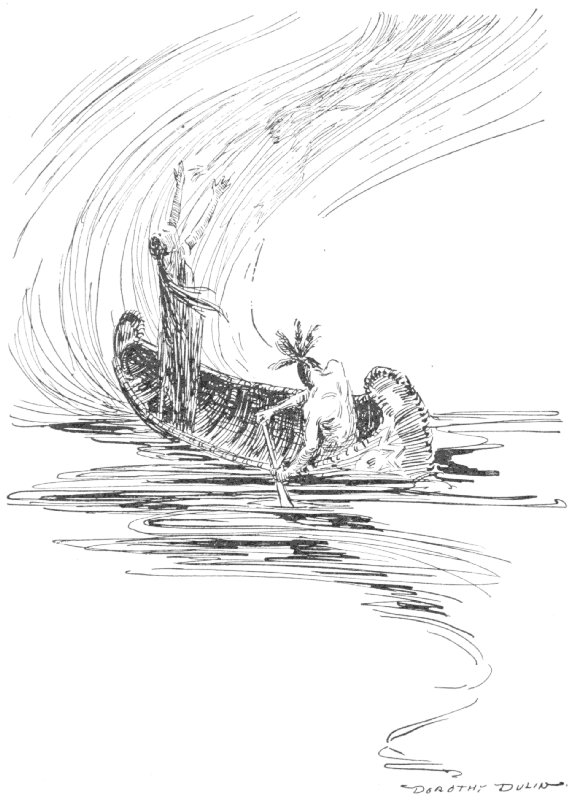
I'm posting today's story early as Saturday I will be telling stories of Holidays Around the World at Pere Marquette District Library in Clare at the time I usually publicize my blog.
There are so many holidays and stories within those holidays I must give their stories fairly briefly. One of those stories is how we came to associate mistletoe with this time of year.
Many books tell this Norse mythological tale. I've tried to find one that stays fairly concise. Mara L. Pratt came very close to that in her
Legends of Norseland , which is liberally illustrated by A. Chase. Even at that I must add a brief bit at the end to tie the mistletoe legend together with an explanation about kissing under the mistletoe.
One quick note on names in the story, most people write Loki instead of Loke. Baldur is sometimes written Balder, but that might be mistaken for a head without hair! Also female names often have an "a" on the end.
THE DYING BALDUR.
Ages upon ages had rolled away. And now the day of
sorrow, which always Odin had known must come, drew near.
Already the god of song had gone with his beautiful wife
Idun down into the dark valley of death; and there was a new strange
rustle among the leaves of Ygdrasil, like the rustling of leaves that
were dead.
Odin’s face grew sad; and, try as he would, he
could not join with the happy gods about him in their joys and festal
games.
“Odin,” said Frigg one day, “tell me
what grieves thee; what weighs thee down and puts such sadness into
thine eyes and heart.”
“Baldur himself shall tell you all,”
answered Odin sadly.
Then Baldur seated himself in the midst of the gods and
said: “Always, since Odin drank at the Well of Wisdom, and
learned the secrets of the past and of the future, has he known that a
time would come when the light must go out from Baldur’s eyes;
and he, although a god, must go down into the dark valley. Now that
time draws near. Already have Brage and Idun gone from us; and with
them have gone song and youth. Soon will Baldur go, and with him must
go the light and warmth he has always been so glad to bring to Asgard
and to Midgard both.”
“O Baldur! Baldur! Baldur! My Child! my child! my
child!” cried Frigg. “This cannot be! this shall not be! I
will go down from Asgard. I will go up and down the earth, and every
rock and tree and plant shall pledge themselves to do no harm to
thee.”
“Dear mother Frigg,” sighed Baldur,
“you cannot change what is foretold. From the beginning of time
this was decreed, that one day the light should go out from heaven and
the twilight of the gods should fall.”
There was a long silence in the hall of Asgard. No god
had courage to speak. Their hearts were heavy, and they had no wish to
speak.
The sun sank behind the western hills. Its rich sunset
glow spread over the golden city and over the beautiful earth below.
Then darkness followed slowly, slowly creeping, creeping on, up the mountain side, across the
summit, until even the shining city stood dark and shadowy beneath the
gathering twilight.
“Like this, some day, the twilight will fall upon
our city,” said Odin; “and it will never, never rise
again.”
The mother heart of Frigg would not accept even
Odin’s word. And when the sun’s first rays shot up above
the far-off hills, Frigg stole forth from Asgard down the rainbow
bridge to Midgard.
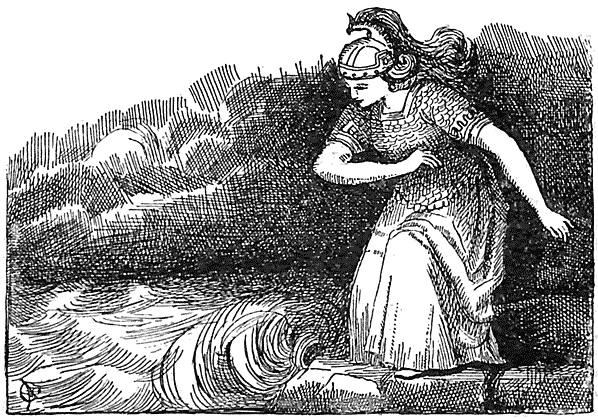
To every lake, and river, and sea, she hurried, and
said: “Promise me, O waters, that Baldur’s light shall
never go out because of you.”
“We promise,” the waters answered. And Frigg
hurried on to the metals. “Promise me, O metals, that
Baldur’s light shall never go out because of you.”
“We promise,” answered the metals. And Frigg
hurried on to the minerals. “Promise me, O minerals,” she
said, “that Baldur’s light shall never go out because of
you.”
“We promise,” answered the minerals. And
Frigg hurried on to the fire, the earth, the stones, the trees, the
shrubs, the grasses, the birds, the beasts, the reptiles; and even to the abode of pale disease she went. Of each she
asked the same earnest, anxious question; and from each she received
the same kind, honest answer.
As the sun sank behind the high peaks of the Frost
giants’ homes, Frigg, radiant and happy, her eyes bright and her
heart alive with hope, sped up the rainbow bridge. Triumphant, she
hurried into the great hall to Odin and Baldur.
“Be happy again, O Odin! Be happy again, O Baldur!
There is no danger, no sorrow to come to us from anything in the earth
or under the earth. For every tree has promised me; and every rock and
every metal; every animal and every bird. Even the waters and the fire
have promised that never harm through them shall come to
Baldur.”
But, alas, for poor Frigg. One little weed, a wee little weed, hidden beneath a rock,
she had overlooked. Loke, who had followed closely upon her in all her
wanderings through the day, had not failed to notice this oversight of
Frigg’s. His wicked face shone with glee. His eyes gleamed; and
as the radiant Frigg sped up the rainbow bridge, he hurried away to his
home among the Frost giants to tell them of the little weed which, by
and by, should work such harm to Baldur, in shutting out his life and
light from Asgard and the earth.
The ages rolled on. Every one in Asgard, save Odin, had
long ago thrown off the shadow of fear. “No harm can come to
Baldur,” they would say; and all save Odin believed it.
But a day came when Odin, looking down into the home of
the dead, saw there the [spirits moving about, hastening
hither and thither.
“Something is happening there in the pale
valley,” said Odin. “They are preparing for the coming of
another shade. And it must be some great one who is to come. See how
great the preparation is they make.”
“We prepare for the coming of Baldur,”
answered the shades as Odin came upon them, busy in their work.
“We prepare a throne for Baldur. We prepare a throne for
Baldur.”
“For Baldur?” asked Odin, his heart sinking.
“For Baldur!” chanted the shades. “For Baldur! Baldur
cometh! Baldur cometh!”
And Odin, his godlike heart faint and sick at the
thought, turned away and went slowly up the rainbow bridge.
There, in the great garden of the gods, he found Thor
and Baldur and their brother
Hodor playing at tests of
strength. Behind Hodor, invisible, stood Loke. In his hand he held a
spear.
“Shame upon you, Hodor,” whispered Loke,
“that you, the strong and mighty Hodor, cannot overcome Baldur in
a test of strength. Baldur may be beautiful and sunny, and he is a
great joy to the world; that we know. But what is he compared with
Hodor for strength?”
“But the spears will not touch him. See how they
glance away. Indeed it is true: Light cannot be pierced.”
answered Hodor, good-naturedly.
“Take this spear,” said Loke, quietly.
“It is less clumsy than those you throw.”
Hodor took it, never thinking of any harm. Alas for
Baldur and Asgard and all the happy smiling Earth! It was a spear
tipped with the mistletoe—the one plant that Frigg had failed to find. The one plant that had
not promised to do no harm to Baldur.
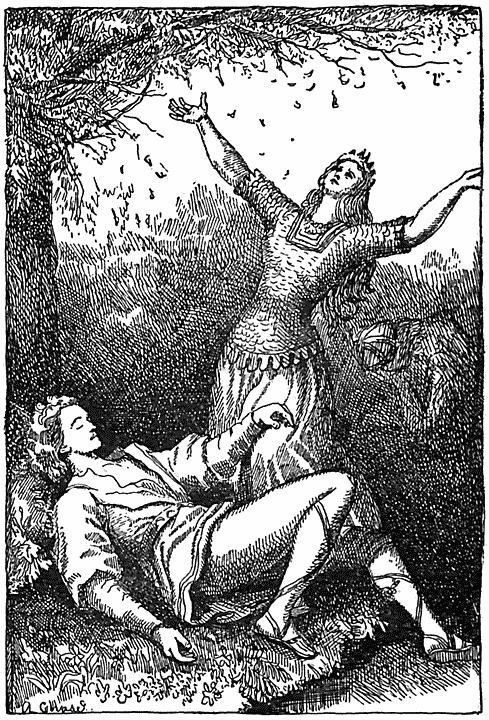
Quickly the spear flew through the air. One second, and
Baldur the Summer Spirit, Baldur the Light of the Earth
fell—dead.
“O, Asgard! Baldur is dead!” groaned Odin.
“O Asgard, Asgard! Baldur is dead!”
Hodor, Thor, the gods, one and all, stood pale and
white. A terrible fear settled over their faces. They shook with
terror.
And even as they stood there, speechless in their grief,
a twilight dimness began to fall lightly, lightly over all. The shining
pavements grew less bright; the blue of the great arch overhead
deepened; and in the valleys of Midgard there were long black shadows.
Baldur was dead. The light had failed. The golden age was at an end.
Now, even the gods must die.
***
The shortest explanation of mistletoe and kissing is given in this "AI Overview"
Mistletoe is featured in many
mythologies and has been associated with a variety of meanings,
including fertility, love, and peace: Norse mythology
In
this myth, the god Loki tricked the god Hodur into killing
Baldur, the god's twin brother, with an arrow made from mistletoe. Frigga, the mother of Baldur and Hodur, wept tears that turned into mistletoe berries. Mistletoe
became a symbol of love and peace in Scandinavia, and the custom of
calling a truce under mistletoe may have originated from this myth.
Remember not to eat the berries as they are poisonous! So keep them away from children -- another good reason to hang them high and out of reach. May you stay around mistletoe, kissing or not, with plenty of love and peace for the holidays.
*****
This is part of a
series of postings of stories under the category, “Keeping the
Public in Public Domain.” The idea behind Public Domain was to
preserve our cultural heritage after the authors and their immediate
heirs were compensated. I feel strongly current copyright law delays
this intent on works of the 20th century. My own library
of folklore includes so many books within the Public Domain I decided
to share stories from them. I hope you enjoy discovering them.
At
the same time, my own involvement in storytelling regularly creates
projects requiring research as part of my sharing stories with an
audience. Whenever that research needs to be shown here, the
publishing of Public Domain stories will not occur that week.
This is a return to my regular posting of a research project here.
(Don't worry, this isn't dry research, my research is always geared
towards future storytelling to an audience.) Response has
convinced me that "Keeping the Public in Public Domain"
should continue along with my other postings as often as I can manage
it.
See the sidebar for other Public
Domain story resources I recommend on the page “PublicDomain Story Resources."