Tell me if you have a topic you'd like to see. (Contact: LoiS-sez@LoiS-sez.com .)
Please also let others know about this site.

Friday, September 12, 2025

Brayman - Adventure with Pirates - Keeping the Public in Public Domain

AARGH! It's time for this year's story for the International Talk Like A Pirate Day. 

You can sing along with co-creators Baur and Summers and syndicated humor columnist Dave Barry (whose promotion really publicized Talk Like a Pirate Day) on their "Drunken Sailor" Sing Along A-Go-Go video.[6] Beyond that, Michigan filk musician Tom Smith wrote the original "Talk Like a Pirate Day" song in 2003.

Of course the holiday demands finding a pirate story and that can be a bit like "walking the plank."

James O. Brayman calls himself the editor  of Thrilling Adventures by Land and Sea which he goes on to add "BEING REMARKABLE HISTORICAL FACTS, GATHERED FROM AUTHENTIC SOURCES." What those sources might be is never given, but his Preface gives a clue to what interested him and, he trusted, his readers:  

There is in the adventures of the daring and heroic, something that interests all. There is a charm about them which, while it partakes of the nature of Romance, does not exercise the same influence upon the mind or heart. When there are noble purposes and noble ends connected with them, they excite in the mind of the reader, noble impulses.

There are many stories in the book, but, of course, "Adventure with Pirates" caught my eye. Its tale of resourcefulness in danger is enjoyable. The most difficult thing about it is the need for a bit of explanation of nautical terms to landlubbers. "Grapling" is a grappling iron, "a hooked iron used for grappling and holding fast a vessel or other object" and it's fastened to a rope connecting two ships or a ship and an object. A Spar is any pole used to support sails (mast, boom, gaff). A Gaff is the angled spar that forms the top edge (head) of a gaff sail. The Halyard is the rope (line) that hoists a sail or a spar. 

This AI illustration of a sail might help. 

Now to hear the tale of an old Maine fisherman and his four sons forced to outwit a pirate.

ADVENTURE WITH PIRATES.

There lived, not many years ago, on the eastern shore of Mt. Desert--a large island off the coast of Maine--an old fisherman, by the name of Jedediah Spinnet, who owned a schooner of some hundred tons burden, in which he, together with some four stout sons, was wont to go, about once a year, to the Grand Banks, for the purpose of catching codfish. The old man had five things, upon the peculiar merits of which he loved to boast--his schooner, "Betsy Jenkins," and his four sons. The four sons were all their father represented them to be, and no one ever doubted his word, when he said that their like was not to be found for fifty miles around. The oldest was thirty-two, while the youngest had just completed his twenty-sixth year, and they answered to the names of Seth, Andrew, John, and Samuel.

One morning a stranger called upon Jedediah to engage him to take to Havana some iron machinery belonging to steam engines for sugar plantations. The terms were soon agreed upon, and the old man and his sons immediately set about putting the machinery on board; that accomplished, they set sail for Havana, with a fair wind, and for several days proceeded on their course without any adventure of any kind. One morning, however, a vessel was descried off their starboard quarter, which, after some hesitation, the old man pronounced a pirate. There was not much time allowed them for doubting, for the vessel soon saluted them with a very agreeable whizzing of an eighteen pound shot under the stern.

"That means for us to heave to," remarked the old man.

"Then I guess we'd better do it hadn't we?" said Seth.

"Of course."

Accordingly, the Betsy Jenkins was brought up into the wind, and her main-boom hauled over to windward.

"Now boys," said the old man, as soon as the schooner came to a stand, "all we can do is to be as cool as possible, and to trust to fortune. There is no way to escape that I can see now; but, perhaps, if we are civil, they will take such stuff as they want, then let us go. At any rate there is no use crying about it, for it can't be helped. Now get your pistols, and see that they are surely loaded, and have your knives ready, but be sure and hide them, so that the pirates shall see no show of resistance. In a few moments all the arms which the schooner afforded, with the exception of one or two old muskets, were secured about the persons of our Down Easters, and they quietly awaited the coming of the schooner.

"One word more, boys," said the old man, just as the pirate came round under the stern.

"Now watch every movement I make, and be ready to jump the moment I speak."

As Captain Spinnet ceased speaking, the pirate luffed under the fisherman's lee-quarter, and, in a moment more, the latter's deck was graced with the presence of a dozen as savage-looking mortals as eyes ever rested upon.

"Are you the captain of this vessel," demanded the leader of the boarders, as he approached the old man.

"Yes sir."

"What is your cargo?"

"Machinery for ingines."

"Nothing else?" asked the pirate with a searching look.

At this moment, Captain Spinnet's eye caught what looked like a sail off to the southward and eastward, but no sign betrayed the discovery, and, while a brilliant idea shot through his mind, he hesitatingly replied:

"Well, there is a leetle something else."

"Ha! and what is it?"

"Why, sir, perhaps I hadn't ought to tell," said Captain Spinnet, counterfeiting the most extreme perturbation. "You see, 'twas given to me as a sort of trust, an' 't wouldn't be right for me to give up. You can take any thing else you please, for I s'pose I can't help myself."

"You are an honest codger, at any rate," said the pirate; "but, if you would live ten minutes longer, just tell me what you've got on board, and exactly where it lays."

The sight of the cocked pistol brought the old man to his senses, and, in a deprecating tone, he muttered:

"Don't kill me, sir, don't, I'll tell you all. We have got forty thousand silver dollars nailed up in boxes and stowed away under some of the boxes just forward of the cabin bulkhead, but Mr. Defoe didn't suspect that any body would have thought of looking for it there."

"Perhaps so," chuckled the pirate, while his eyes sparkled with delight. And then, turning to his own vessel, he ordered all but three of his men to jump on board the Yankee.

In a few moments the pirates had taken off the hatches, and, in their haste to get at the "silver dollars," they forgot all else; but not so with Spinnet; he had his wits at work, and no sooner had the last of the villains disappeared below the hatchway, than he turned to his boys.

"Now, boys, for our lives. Seth, you clap your knife across the fore throat and peak halyards; and you, John, cut the main. Be quick now, an' the moment you've done it, jump aboard the pirate. Andrew and Sam, you cast off the pirate's graplings; an' then you jump--then we'll walk into them three chaps aboard the clipper. Now for it."

No sooner were the last words out of the old man's mouth, than his sons did exactly as they had been directed. The fore and main halyards were cut, and the two graplings cast off at the same instant, and, as the heavy gaffs came rattling down, our five heroes leaped on board the pirate. The moment the clipper felt at liberty, her head swung off, and, before the astonished buccaneers could gain the decks of the fisherman, their own vessel was a cable's length to leeward, sweeping gracefully away before the wind, while the three men left in charge were easily secured.

"Halloa, there!" shouted Captain Spinnet, as the luckless pirates crowded around the lee gangway of their prize, "when you find them silver dollars, just let us know, will you?"

Half a dozen pistol shots was all the answer the old man got, but they did him no harm; and, crowding up all sail, he made for the vessel he had discovered, which lay dead to leeward of him, and which he made out to be a large ship. The clipper cut through the water like a dolphin, and, in a remarkably short space of time, Spinnet luffed up under the ship's stern, and explained all that had happened. The ship proved to be an East Indiaman, bound for Charleston, having, all told, thirty men on board, twenty of whom at once jumped into the clipper and offered their services in helping to take the pirate.

Before dark, Captain Spinnet was once more within hailing distance of his own vessel, and raising a trumpet to his mouth, he shouted:

"Schooner ahoy! Will you quietly surrender yourselves prisoners, if we come on board!"

"Come and try it!" returned the pirate captain, as he brandished his cutlass above his head in a threatening manner, which seemed to indicate that he would fight to the last.

But that was his last moment, for Seth was crouched below the bulwarks, taking deliberate aim along the barrel of a heavy rifle, and, as the bloody villain was in the act of turning to his men, the sharp crack of Seth Spinnet's weapon rang its fatal death-peal, and the next moment the captain fell back into the arms of his men, with a brace of bullets in his heart.

"Now," shouted the old man, as he leveled the long pivot gun, and seized a lighted match, "I'll give you just five minutes to make your minds up in, and, if you don't surrender, I'll blow every one of you into the other world."

The death of their captain, and, withal the sight of the pivot gun--its peculiar properties they knew full well--brought the pirates to their senses, and they threw down their weapons, and agreed to give themselves up.

In two days from that time, Captain Spinnet delivered his cargo safely in Havana, gave the pirates into the hands of the civil authorities, and delivered the clipper up to the government, in return for which, he received a sum of money sufficient for an independence during the remainder of his life, as well as a very handsome medal from the government.

****

While Brayman doesn't bother to give his sources, I like that he says they are "REMARKABLE HISTORICAL FACTS, GATHERED FROM AUTHENTIC SOURCES." Of course those sources are all long gone, so if it's a "fish tale" there's no one around now to deny it.  It might even be possible that up around Mt. Desert--a large island off the coast of Maine -- folks still talk about an old fisherman by the name of Jedediah Spinnet, I think he deserves to be remembered.

****************************

This is part of a series of postings of stories under the category, “Keeping the Public in Public Domain.” The idea behind Public Domain was to preserve our cultural heritage after the authors and their immediate heirs were compensated. I feel strongly current copyright law delays this intent on works of the 20th century. My own library of folklore includes so many books within the Public Domain I decided to share stories from them. I hope you enjoy discovering them.

At the same time, my own involvement in storytelling regularly creates projects requiring research as part of my sharing stories with an audience.  Whenever that research needs to be shown here, the publishing of Public Domain stories will not occur that week.  This is a return to my regular posting of a research project here.  (Don't worry, this isn't dry research, my research is always geared towards future storytelling to an audience.)  Response has convinced me that "Keeping the Public in Public Domain" should continue along with my other postings as often as I can manage it.

See the sidebar for other Public Domain story resources I recommend on the page “Public Domain Story Resources."


Friday, September 5, 2025

Babbitt - The Penny-Wise Monkey - Keeping the Public in Public Domaihn

Like many with a bit of change in my pocket, I've been thinking about the coming demise of the penny. Then I found this 


kenr2155
To give credit to the artist I tried to find a bit more about The Unknown Punster. It looks as if he (Ken R 2155) hangs out on Pinterest. 

I sometimes change the common saying that puns are the lowest form of humor. Puns are the LoiS form of humor!

Possibly I should join The Unknown Punster's 1,500 followers.  

So many sayings about pennies have been part of our culture. Looking through folk literature I found a very appropriate (and timely!) story that fits the "penny wise/pound foolish" idea. Will future translations from the Sanskrit need to change the title?

THE PENNY-WISE MONKEY

Once upon a time the king of a large and rich country gathered together his army to take a faraway little country. The king and his soldiers marched all morning long and then went into camp in the forest.

When they fed the horses they gave them some peas to eat. One of the Monkeys living in the forest saw the peas and jumped down to get some of them. He filled his mouth and hands with them, and up into the tree he went again, and sat down to eat the peas.

As he sat there eating the peas, one pea fell from his hand to the ground. At once the greedy Monkey dropped all the peas he had in his hands, and ran down to hunt for the lost pea. But he could not find that one pea. He climbed up into his tree again, and sat still looking very glum. "To get more, I threw away what I had," he said to himself.

The king had watched the Monkey, and he said to himself: "I will not be like this foolish Monkey, who lost much to gain a little. I will go back to my own country and enjoy what I now have."

So he and his men marched back home. 

***

Ellen C. Babbitt's More Jataka Tales was the source of that and her first book of Jataka Tales with her translation from the Sanskrit of early Buddhist fables is equally good. 

Her Foreword to the second book gives even more background: The Jataka tales, regarded as historic in the Third Century B. C., are the oldest collection of folk-lore extant. They come down to us from that dim far-off time when our forebears told tales around the same hearth fire on the roof of the world. Professor Rhys Davids speaks of them as "a priceless record of the childhood of our race. The same stories are found in Greek, Latin, Arabic, Persian, and in most European languages. The Greek versions of the Jataka tales were adapted and ascribed to the famous storyteller, Aesop, and under his name handed down as a continual feast for the children in the West,--tales first invented to please and instruct our far-off cousins in the East." Here East, though East, meets West!  

Whether it's a penny or inflated to a nickel for your thoughts, it's a story with wisdom worth sharing. 

******************

This is part of a series of postings of stories under the category, “Keeping the Public in Public Domain.” The idea behind Public Domain was to preserve our cultural heritage after the authors and their immediate heirs were compensated. I feel strongly current copyright law delays this intent on works of the 20th century. My own library of folklore includes so many books within the Public Domain I decided to share stories from them. I hope you enjoy discovering them.

At the same time, my own involvement in storytelling regularly creates projects requiring research as part of my sharing stories with an audience.  Whenever that research needs to be shown here, the publishing of Public Domain stories will not occur that week.  This is a return to my regular posting of a research project here.  (Don't worry, this isn't dry research, my research is always geared towards future storytelling to an audience.)  Response has convinced me that "Keeping the Public in Public Domain" should continue along with my other postings as often as I can manage it.

See the sidebar for other Public Domain story resources I recommend on the page “Public Domain Story Resources."


Friday, August 29, 2025

Vernon Jones/Aesop - The Father and His Daughters - Keeping the Public in Public Domain

It's Labor Day Weekend with surprisingly good weather predicted. This past week thus predicteth the Old Farmers' Almanac for 2025-26:

The Farmers' Almanac's 2025-26 Winter Outlook calls for "chill, snow, repeat" across the country.Farmers' Almanac 

Here in the Great Lakes region - including Michigan - and other areas of the Midwest we “are set for a classic winter wonderland.” The weather is expected to be very cold and snowy.

RELATED: Michigan winter outlook: NOAA predicts wetter, whiter conditions for southern regions

Winter officially begins with the solstice on Dec. 21, but snow could arrive as early as September in some areas of the country. Nationwide, the coldest times, as usual, are expected in mid-January and mid-February, saying a " significant cold snap in mid-January will keep most shivering. Winter’s wrath continues with another pronounced cold spell predicted for mid-February." As for snow: The Great Lakes, Ohio Valley, and North Central states are set for a classic winter wonderland.

The Almanac's long-range forecasts began over 200 years ago using a formula "set forth back in 1818, but also accounts for fluctuations in the environment on Earth, as well as solar activity (sunspots), the motion of the Moon, and other proprietary factors." They also do an annual review of accuracy and was fairly accurate even if La Niña did make last winter wetter.

All of this made me wonder what story might be appropriate. Aesop, once again, has a short bit of  wisdom. There are many editions, but Aesop's Fables; A New Translation by V.S. Vernon Jones does an easy look at weather and maybe a bit more.

THE FATHER AND HIS DAUGHTERS

A Man had two Daughters, one of whom he gave in marriage to a gardener, and the other to a potter. After a time he thought he would go and see how they were getting on; and first he went to the gardener's wife. He asked her how she was, and how things were going with herself and her husband. She replied that on the whole they were doing very well: "But," she continued, "I do wish we could have some good heavy rain: the garden wants it badly." Then he went on to the potter's wife and made the same inquiries of her. She replied that she and her husband had nothing to complain of: "But," she went on, "I do wish we could have some nice dry weather, to dry the pottery." Her Father looked at her with a humorous expression on his face. "You want dry weather," he said, "and your sister wants rain. I was going to ask in my prayers that your wishes should be granted; but now it strikes me I had better not refer to the subject."

***

If you want to know a bit more, V.S. stands for Vernon Stanley Vernon-Jones and talking about Aesop's Fables Wikipedia states: 

Notable early 20th century editions include V.S. Vernon Jones' new translation of the fables accompanied by the pictures of Arthur Rackham (London, 1912)[97] and in the US Aesop for Children (Chicago, 1919), illustrated by Milo Winter.[98]

This story doesn't  receive an illustration by Rackham, but the general opinion from the time of the book's publication is his translation is highly regarded for preserving the timeless moral clarity of the fables. Rackham's illustrations have kept it popular.

May your storytelling weather be fine!

************** 

This is part of a series of postings of stories under the category, “Keeping the Public in Public Domain.” The idea behind Public Domain was to preserve our cultural heritage after the authors and their immediate heirs were compensated. I feel strongly current copyright law delays this intent on works of the 20th century. My own library of folklore includes so many books within the Public Domain I decided to share stories from them. I hope you enjoy discovering them.

At the same time, my own involvement in storytelling regularly creates projects requiring research as part of my sharing stories with an audience.  Whenever that research needs to be shown here, the publishing of Public Domain stories will not occur that week.  This is a return to my regular posting of a research project here.  (Don't worry, this isn't dry research, my research is always geared towards future storytelling to an audience.)  Response has convinced me that "Keeping the Public in Public Domain" should continue along with my other postings as often as I can manage it.

See the sidebar for other Public Domain story resources I recommend on the page “Public Domain Story Resources."


Friday, August 22, 2025

Gruelle - A Change of Coats - Keeping the Public in Public Domain

It seems incredible, but I've actually seen leaves saying the change to autumn is near! John Barton Gruelle or Johnny Gruelle, is best known as the creator of Raggedy Ann and Andy, even though his career as a syndicated cartoonist and author/illustrator included much more. I mention this because his story of "A Change of Coats" came up when I went looking into the subject of change. It's in his 1919 book, Friendly Fairies. 

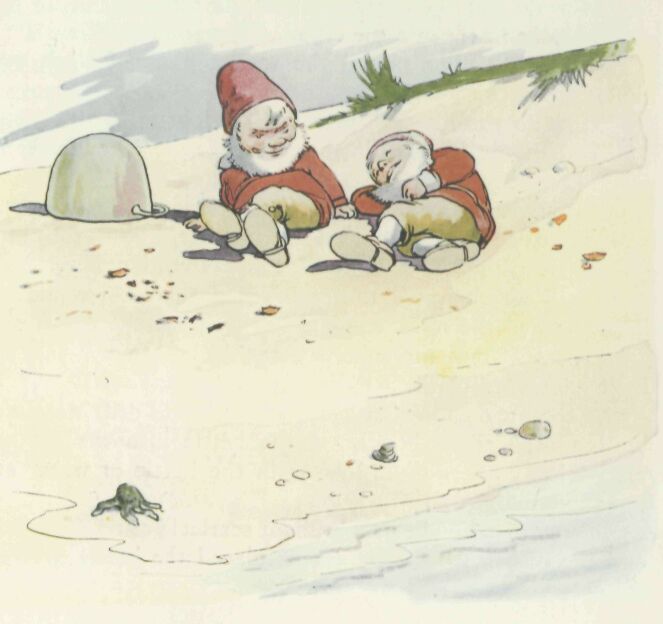
Of course it can be told as is -- although I'd  hope you would show his delightful gnomes afterwards. Another way I could see telling it is with the Crab and Lobster as stick puppets, a kettle (real or otherwise) with different colors of fabric. You might also talk a bit afterwards about Gruelle's famous Raggedy Ann and Andy.

A CHANGE OF COATS

Two mischievous little gnomes were walking along the beach one day and as they came to a pile of rocks they heard voices. One of the little gnomes put his finger to his lips for silence and peeped cautiously around the largest stone. There he saw a crab and a lobster sitting upon a bunch of sea-weed in the sunshine.


The other little gnome tip-toed up and joined his brother and when they had listened a while they winked at each other and quietly walked back to the beach. After whispering together a moment one of the little gnomes ran up the beach and over a sand dune.

The other gnome again crept up behind the large stone and listened to the lobster and the crab.

"Yes," said the crab, "I agree with you, Mr. Lobster! While our coats are just a plain green they are still quite beautiful!"

"Ah! You speak the truth, Friend Crab," the lobster replied, "Green is a lovely color and I am very glad that we are not purple!"

"I am very glad that we are green, too." the crab said, "Just suppose we were colored blue! I know I should not be able to stand it! Would you, Friend Lobster?'

"No indeed!" the lobster cried, "Nor would I care to change to any other color, would you, Friend Crab!" "It is nice to be satisfied! Isn't it, Friend Lobster?"

"Yes! Especially when we are as satisfied as we are!" The lobster answered.

The little gnome listening behind the large stone winked at himself and smiled. He knew the lobster and the crab would give anything if they were of a different color, for he could tell by their conversation they were dissatisfied with their green coats.

Soon the other little gnome appeared over the sand dunes carrying a large kettle, and when he got to a spot on the beach where the crab and the lobster could see and hear him he began shouting in a sing-song manner: "Old clothes changed to new! Old clothes changed to new! Old clothes changed to new!"


"Pooh!" said the lobster. "Who is foolish enough to wish to change their natural coats?"

"Hmm!" said the crab as he sidled towards the beach. "Let's go over and talk with him, anyway, and ask him if anyone ever changes the color of their clothes. Not that I wish to change my lovely green coat, you understand, but—"

"It would be interesting to hear about it, anyway!" the lobster replied, as he crawled after the crab.

The little gnome with the large kettle sat upon the beach and pretended he did not see the crab and lobster, but continued crying: "Old coats changed to new! Green ones changed to red! Old coat changed to new! Old coats changed to new!"

When the crab and the lobster came up quite near the little gnome pulled a number of pieces of colored cloth from his pocket and placed them upon the sand.

"How pretty!" said the crab.

"Very lovely!" said the lobster.

"Do you wish your coats changed in color?" asked the little gnome.

"Ah, no, thank you!" the two hypocrites said. "We were just looking around a bit!"

"Well, I am glad to have your company," said the little gnome as he took a piece of scarlet cloth and laid it over the lobster's back.

"How do you like that?" he asked of the crab.

"It looks fine!" said the crab. "Try it on me!"

The little gnome placed the scarlet piece of cloth over the crab's back.

"How do you like it?" he asked the lobster.

"Did I look that well in that color?" asked the lobster by way of reply.

"I think both of you will look far better if you let me change you to scarlet. It's in far better taste, too!" the little gnome added, pinching himself to keep from laughing.

"Shall we change?" the crab asked the lobster and the lobster asked the crab.

"You will find the color a great deal warmer," said the little gnome. "Green is decidedly cold, you know!"

So the little gnome gathered an armful of drift-wood and built a fire. Then he dipped the kettle into the sea and placed the crab and the lobster in the kettle of water and put the lid on.

"Be sure and make us a brilliant scarlet!" cried the lobster and the crab, as the little gnome placed the kettle over the fire. An hour later the two little gnomes lay upon their backs upon the sand and yawned contentedly, their little round stomachs almost bursting their belts. Near them was the upturned kettle, and scattered all about them on the sand were lovely pieces of scarlet lobster and crab shells.

"It's funny," one little gnome said drowsily, "how one sometimes will become dissatisfied with the way he was made by Mother Nature and try to improve upon her work! It usually leads to misfortune."


065 (37K)


"Yes, that is true," the other little gnome replied, "We should be satisfied and contented just as we are!"

"Well, I for one am satisfied!" the little gnome said, stroking his fat stomach.

"So am I!" his brother laughed.

 ************************** 

This is part of a series of postings of stories under the category, “Keeping the Public in Public Domain.” The idea behind Public Domain was to preserve our cultural heritage after the authors and their immediate heirs were compensated. I feel strongly current copyright law delays this intent on works of the 20th century. My own library of folklore includes so many books within the Public Domain I decided to share stories from them. I hope you enjoy discovering them.

At the same time, my own involvement in storytelling regularly creates projects requiring research as part of my sharing stories with an audience.  Whenever that research needs to be shown here, the publishing of Public Domain stories will not occur that week.  This is a return to my regular posting of a research project here.  (Don't worry, this isn't dry research, my research is always geared towards future storytelling to an audience.)  Response has convinced me that "Keeping the Public in Public Domain" should continue along with my other postings as often as I can manage it.

See the sidebar for other Public Domain story resources I recommend on the page “Public Domain Story Resources."


Friday, August 15, 2025

Bilenko - Misery - Keeping the Public in Public Domain

Anatole Bilenko selected and translated Ukrainian Folk Tales and a story near the book's end, "Misery" seems appropriate.

 
I don't believe in mixing my political opinions with my work, but in this case after all the misery that Vladimir Putin has caused Ukraine, I pray and wish that fairy tales come true. 
 
****************** 

This is part of a series of postings of stories under the category, “Keeping the Public in Public Domain.” The idea behind Public Domain was to preserve our cultural heritage after the authors and their immediate heirs were compensated. I feel strongly current copyright law delays this intent on works of the 20th century. My own library of folklore includes so many books within the Public Domain I decided to share stories from them. I hope you enjoy discovering them.

At the same time, my own involvement in storytelling regularly creates projects requiring research as part of my sharing stories with an audience.  Whenever that research needs to be shown here, the publishing of Public Domain stories will not occur that week.  This is a return to my regular posting of a research project here.  (Don't worry, this isn't dry research, my research is always geared towards future storytelling to an audience.)  Response has convinced me that "Keeping the Public in Public Domain" should continue along with my other postings as often as I can manage it.

See the sidebar for other Public Domain story resources I recommend on the page “Public Domain Story Resources."


Friday, August 8, 2025

Retelling the Legend of the Thistle Saving Scotland from Viking Attack

https://img.freepik.com

While at the 176th annual St. Andrews Society of Detroit Highland Games I heard a Scottish legend I'm told is quite well-known. It came because I was talking about the fact that the thistle is Scotland's national flower and emblem. 

Here's a very brief form of the story:

In the mid‑13th century (1263), Vikings under King Haakon IV attempted a nighttime surprise attack near Largs, Ayrshire. They removed their boots to move more quietly. One barefoot Norseman accidentally stepped on a Scottish thistle—its sharp spikes caused him to cry out. The Scots woke, rallied, and defeated the Vikings. 

The version I heard said the Scots intentionally settled in a place where the Vikings would have to pass.

There are many versions of the story and especially about the Battle of Largs, including a narrative poem by John Galt and also The Norwegian Account of Haco's Expedition Against Scotland, A.D. MCCLXIII by Rev. James Johnstone, a historical account translated from Old Icelandic texts and often reprinted or compiled in 19th‑century books.There's even The Order of the Thistle, whose own roots are full of the labyrinth of legend.

There are two sources I like the best:

  1.  Wikipedia article on the Thistle, drop down to Culture and it's all about Symbolism and the Scottish Thistle
  2. Scotclans.org article on The Scottish Thistle which is well-fleshed out without being too much for re-telling. 

While strolling the vendors I saw a men's t-shirt about the "services" a Viking provides. I prowled online and couldn't find it, but did find these two that are fun and possibly worth considering in view of the legend of the thistle.


There's a lo-o-o-omg link for that on Etsy.com, but just go to Etsy and search Viking World Tour. What I like about it is that, while its first countries are England, Wales, France, and Ireland, I notice Scotland is NOT there!


This second shirt is also fun although the script isn't always easy.

Temu.com has it as Men's Viking Laws & Rules Graphic T-Shirt.


 Have fun with the legend and remember the reason why the Thistle is so important to Scotland.

Friday, August 1, 2025

P.V. Ramaswami Raju - The Fawn and the Little Tiger

Fables were an ancient form of teaching using stories. While many are by well known fabulists, I've been unable to learn anything about P.V. Ramaswami Raju. His book Indian Fables dates back to 1887, relatively new for a collection of fables. In the Preface Sir William P. Andrew states:

 Of these a few have long had a standing in the literature of India, though in a slightly different garb. The rest may be said to have been derived from original sources.

During the past two years these Fables, with illustrations, have been before the public in the columns of The Leisure Hour. 

The book is also for sale at Yesterdays Classics , who describe it as:

 An appealing collection of more than a hundred Indian fables that are delightful as well as short, pithy, and ingenious. Each fable has its separate moral in prose or rhyme; these are often epigrams of the shrewdest kind, full of wit and subtlety. Most of these fables are likely to be new to the majority of readers.

I chose "The Fawn and the Tiger" to fit this past week's Global Tiger Day mascot. The photo is available at World Wildlife.org where you can upload it as computer wallpaper. There are other mature tigers there, but this little guy was my choice and certainly fits today's story. How often I've heard people wish they could pet baby tigers, lion or bear cubs! "The Fawn and the Little Tiger" is a warning. 


Beyond that story and the tiger cub photo, World Wildlife posted this earlier this week on Monday: 

Did you know that every part of the tiger—from whisker to tail—has been found in the illegal wildlife trade? Poaching is one of the biggest threats to tigers in the wild—and many other species. These beautiful animals won't survive without our help.

Tomorrow is Global Tiger Day, and we're hoping to find 500 people who will create a safer world for wildlife with a very meaningful gift. Can we count on you?

Symbolically adopt a tiger with a monthly donation to protect nature and help us reach our goal.

****************** 

This is part of a series of postings of stories under the category, “Keeping the Public in Public Domain.” The idea behind Public Domain was to preserve our cultural heritage after the authors and their immediate heirs were compensated. I feel strongly current copyright law delays this intent on works of the 20th century. My own library of folklore includes so many books within the Public Domain I decided to share stories from them. I hope you enjoy discovering them.

At the same time, my own involvement in storytelling regularly creates projects requiring research as part of my sharing stories with an audience.  Whenever that research needs to be shown here, the publishing of Public Domain stories will not occur that week.  This is a return to my regular posting of a research project here.  (Don't worry, this isn't dry research, my research is always geared towards future storytelling to an audience.)  Response has convinced me that "Keeping the Public in Public Domain" should continue along with my other postings as often as I can manage it.

See the sidebar for other Public Domain story resources I recommend on the page “Public Domain Story Resources."