Tell me if you have a topic you'd like to see. (Contact: LoiS-sez@LoiS-sez.com .)
Please also let others know about this site.

Wednesday, February 22, 2012

February 26 is “Tell a Fairy Tale Day" or Do You Tell Fairy Tales?

Painting - by Edward Robert Hughes
You can buy this at Allposters.com
I was asked, "Do you tell Fairy Tales?"  
My answer: Definitely.

I tell "stories from around the world and back through time."  The second part of that includes my various historical reenactment programs.  This question fits into much of the first part of my storytelling mission.

At the risk of becoming a "blahblah" blog of opinions, I want to consider the role of fairy tales and folktales in storytelling.

One of the Tuatha De Danann from http://al-tirnanog.blogspot.com/
When I talk about "stories from around the world" it does not mean all those are exclusively fairy tales. Technically fairy tales are wonder tales: stories of magic, of happenings and creatures beyond the ordinary.  I prefer to call books in the Dewey Decimal Classification of "398s" "folk tales" even though Harry Potter made magical elements more popular. The "wonder" tale with its magical elements doesn't suit some listeners, but need not eliminate all folktales. Using the term "fairy tale", too often listeners pictured and rejected tiny girls with wings and a magic wand.  (How different from the powerful denizens of Tir Na nOg!) It also conjured up stories where all "lived happily ever after", unlike reality.  Yet that very ending may explain our need for fairy tales!  Some listeners rejecting fairy tales often accept American tall tales and spooky stories from anywhere. Tir Na nOg points to the fun of exposing groups to Celtic tales where fairies are anything but tiny. Tolkien's elves and dwarves were nourished in such ancient traditions and many modern fantasy writers clearly drank from the same fountains.  If Tolkien sources interest you, go to Sources of Lord of the Rings which is part of the huge Internet Sacred Text Archive.  Despite using exclusively female illustrations, the Wikipedia article, "Fairy" gives a good introduction to the wealth of fairy lore and variety of personalities. The Discussion tab broadens the topic, showing it's international aspects. 

Folklore is an important aspect of our own culture and of other lands.  Nations and ethnic groups have a folklore that can help us understand each other better.  It needs to be brought to as many people as possible.  If ever I doubted how little folklore is known, I just recall when a local television station had a reading program where kids were supposed to read in various categories, including Fairy Tales.  That's when I realized even the parents didn't know what a Fairy Tale was.  One mother asked if Beatrix Potter's Peter Rabbit was a fairy tale!


Probably the most accurate and broadest name would be Traditional Tale, which certainly includes material told by adults, but eliminates literary tales like either Potter, Beatrix or Harry.  If I want to tell a story with a Disney version or even some other version fairly well known, but I'm telling a variant, I let my listeners know this will sound a bit familiar, but to listen for the parts that are different. Fractured tales are popular now, but it pays to be sure the group knows the original or they won't appreciate it and catch the changes.

I like the comparison of a folktale to a stone smoothed by many people handling it over the years. Folktales have been polished to their essentials by years of telling.  This is why, when teaching storytelling, I suggest people start out with short folktales. 

If that's the case, why are personal tales so popular in festivals and story slams?  Are they better suited to adult audiences?

To understand, look at how U.S. storytelling festivals changed over the years.  At the beginning of storytelling festivals you could tape the stories since all were traditional tales.  Gradually performers personalized stories with music and other ways of making a story "their own", then began selling their tapes, so we were told not to record performances. Next came tellers of personal stories.  You might refer to something happening to a particular storyteller, BUT it was untrue, as well as unethical, to retell the story and claim such things happened to yourself and not the original storyteller.

The relatively short time permitted in story slam performance is also better suited to anecdotes.

A storytelling friend in Bristol, Tim Sheppard, talks about how in the U.K. storytellers tend to carry on the oral tradition by repeating the old tales.  He also says those carrying on the oral tradition are appalled or amazed at the way in the U.S. we tell people they have to take a tale, change it to make it your own, or to take several versions of it and craft a new version.  He has two sections about traditional stories: Traditional Storytelling and then The Cultural Traditions of Storytelling in his huge website of Storytelling Resources for Storytellers.

In my own view, our litigious society here in the U.S. has led to fear retelling the very folk literature able to help us understand other cultures.  Is it any wonder many cultures don't want their tales told except by storytellers steeped in the culture they are representing, if a teller is going to change it that much?

Perhaps Tim also mentioned a better way when he said: that doesn't tend to mean actually changing the tale. It means bringing the tale to life and inhabiting it, so that it's an authentic expression from the heart. It's just that all that can be done without interfering with the tale.

In my own consideration of all this, I believe copyright limitations and a desire to stand out from other tellers led to so many personal stories.  Some storytellers question if it might also have something to do with the American psyche? Perhaps, but major tellers who give personal tales usually weave humor into their stories if they want to keep me listening for very many stories.  I question the durability of most of these stories lasting long enough for anyone to remember them when they finally become old enough to reach Public Domain.

Just as pop culture, like the Harry Potter saga, has started to accept fairy tales, some storytellers have started to stand up for the fairy tale.  Not all storytellers approve of the rejection of fairy tales.  A great place to catch storytellers at play with the concept is The Fairy Tale Lobby. Questions and characters there might even get you thinking about how fairy tales still belong in publications, conferences, festivals and the repertoire of storytellers, whether professional or amateur.  After all, the root of the word "amateur" is "love." 


I believe there's still a need for folk literature, including the fairy tale.  If people don't know their own culture with its folktales and don't learn the folklore of other cultures, we will degenerate into a land of the mass media and misunderstand anyone who isn't the same.

Thank you for considering all of this.  I hope you, too, will Tell A Fairy Tale, and not just on February 26.  I also warn you to read this discussion only once or twice.  Feel free to tell others, but be careful as John D. Batten warned on August 29, 1891:

Hmmmm.  There are many Battens, including ancestors of mine, but it's a story that might put you to sleep like that warning.
LoiS(tepping down from my soapbox, but not from telling traditional tales)

P.S. Looks like there may be other ideas to add as we near the 26th.  Just saw this and think it deserves adding, 8 Reasons Why Fairy Tales Are Essential to Childhood .  Additionally fellow storyteller and friend, Karen Chace's blog, "Celebrate with tell a fairy tale day!", gives a wonderful assortment of links to tales, curriculum ideas, and crafts.  She kindly just linked to this blog, but her "heads up" back on January 31 gave me a nudge to add this extra blog article since I usually stick to publishing just once a month. 

I've long loved the Einstein quote mentioned in the "8 Reasons" . . .
“If you want your children to be intelligent, read them fairy tales. If you want them to be more intelligent, read them more fairy tales.” 
― Albert Einstein
Because I think this is truly important, other articles on this important topic coming my way may also be added.  Then again, it may need an additional article here.  Just can't get enough of these.


Tuesday, January 31, 2012

Another look at "The Underground Railroad Didn't Run on Tracks (UGRR)"

That was about a post from last year, on the Underground Railroad.  Click on that hotlink to see that earlier post.  (Did you also notice the site's address now is http://www.StorytellingResearchLois.com -- but the old address also works.)

This topic is large and definitely worth reviewing further, this time with a focus on Michigan's role in the Underground Railroad -- often abbreviated UGRR.  Michigan split up the former Department of History, Arts and Libraries, with the historical work moved to the Department of Natural Resources.  The Historical Center archives the historical materials moved from the former department.  Find online from 2000 to 2004 a newspaper, "Michigan Time Traveler", for children with accompanying teacher guides.  There are two issues specifically about the UGRR.
Adam Crosswhite
  • The Underground Railroad and Teacher's Guide. - This highlights Cass County's Ramptown and the Crosswhite Family rescue by the citizens of Marshall, MI.  Here is more about the "Crosswhite Affair" including a lesson plan on it.  Similarly both the UGRR and the Crosswhites are covered in this issue for children of "The Mitten", published by "Michigan History" magazine.
  • The Blackburns Escape and Teacher's Guide - Thorton (not Thornton) and Lucie Blackburn escaped slavery to settle in Detroit, but when they were spotted here in Michigan they were captured, tried, and scheduled to return to Kentucky.  African Americans helped them escape to Windsor where Canada rejected demands for their return. 
There's also a section called Freedom Trail Lessons  and just as with the two previous Teacher's Guides, there are uses beyond the classroom.

In Vandalia, MI they're uncovering proof of Young's Prairie, an early to mid-1800s Quaker offer of farmland and safety to runaways.


To learn of the very real incidents of free African Americans being sold into slavery, go to either the 1893, volume 22, of the Michigan Pioneer and Historical Collections or to the online text and search using your own computer's search feature (not the one offered on the site) for Malinda Paris.  The memorial of her by the people of St. Clair tells of a family repeatedly sold into slavery even though they were legally free.
Laura Smith Haviland
Elizabeth Margaret Chandler
Early leaders of the Abolition movement here in Michigan were Quakers Laura Smith Haviland, along with friend and neighbor, Elizabeth Margaret Chandler.  They were seen as "radical abolitionists" by the majority of Quakers in the late 1830s, so they joined with the northern Methodists who were also devoted to anti-slavery efforts. 


(Liberetta Lerich Green, whom I portray, grew up in such a Methodist family.)

**** UPDATE
I've just discovered, after "finishing" this post a wonderful C-Span video of Kimberley Davis-Tranumn talking about "Aunt Laura" and the active role Lenawee County played in the UGRR.  Go to  C-Span Video Library for her well-researched and inspirational video.

Friend to the Havilands and the Lerichs was well-known UGRR conductor and speaker,
Sojourner Truth, who settled in Battle Creek, MI.  As noted in my earlier post, that is also the home of the Sojourner Truth Institute as well as this statue honoring her.  Much has been written about her including this issue for children of "The Mitten", published by "Michigan History" magazine.  Battle Creek was a good spot for her as it was another Michigan location prominent in abolition and the UGRR thanks to Erastus Hussey's political efforts and publishing the abolitionist "Michigan Liberty Press."

Tour online a site in Schoolcraft, MI estimated to have sheltered 1,000 to 1,500 by yet more Quakers, Dr. Nathan Thomas and his wife Pamela Brown Thomas. 
Detroit Historical Museum's "Doorway to Freedom" current exhibit shows sites associated with the UGRR in Detroit including the Finney House barn (in use from 1833) where Liberetta overheard her father and Reverend Charles C. Foote discussing runaways there in danger of discovery.  Peter Lerich promptly told his wife he was leaving for a "load of plaster" in Detroit after he found Liberetta listening.

In Detroit George DeBaptiste and the Second Baptist Church of Detroit provided sanctuary and transportation to Canada.  DeBaptiste also helped organize the 1st Michigan Colored Volunteer Infantry Regiment, later known officially as the 102nd Regiment United States Colored Troops.  It's interesting to show the role of disease in the civil war, with 6 killed in action, 5 more of wounds, but 129 died of disease. After the war he returned to successful business life and continued advocacy for black rights including the 15th amendment which gave African Americans the right to vote.

It's always hard to bring such a large topic to a close.  A fellow librarian once said about me, "You can take the librarian out of the library, but you can't take the library out of the librarian."  As a result I want to recommend a book to help you find much more than I have space to mention here.  Carol E. Mull's The Underground Railroad in Michigan has been described as "the first comprehensive exploration of abolitionism and the network of escape from slavery in the state."  Ms. Mull is a founding member and current chair of the Michigan Freedom Trail Commission.


****UPDATE

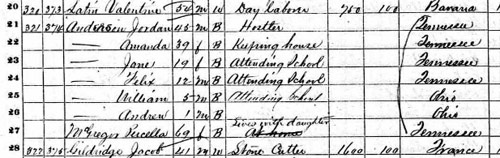
I can't resist this interesting UPDATE.  I just read "To my old master" , a fascinating and, yes, funny letter by Jordan Anderson.  It responds to a letter by Colonel P.H. Anderson of Big Spring, Tennessee, to his former slave, requesting he come back to work on the colonel's farm.  While Jordan Anderson took his family to Dayton, Ohio, and this month's post looks specifically at the Underground Railroad in Michigan, it is a delightful way to look at the later life of many who came from similar backgrounds to benefit from the Underground Railroad and emancipation.