Tell me if you have a topic you'd like to see. (Contact: LoiS-sez@LoiS-sez.com .)
Please also let others know about this site.

Sunday, January 12, 2014

"Crockett" - Two Stories - Keeping the Public in Public Domain

Who the heck was Davy Crockett if we can't accept Hollywood's version?

As usual we can find a Wikipedia article on Davy Crockett, but it doesn't capture the reason the man was popular in his own time, nor what value may exist in learning more about a man who, as Wikipedia put it: David "Davy" Crockett (August 17, 1786 – March 6, 1836) was a 19th-century American folk hero, frontiersman, soldier and politician.

He was mainly self-taught or at least had little time in school.  His military experience gave him the title of Colonel, but his actual fighting experience was far from outstanding.  As a politician he didn't always win elections, although certainly not for lack of effort.  His championing of frontier life for all and his ability to tell a wild anecdote about himself, however, was where he hacked out a place for himself more durable than any log cabin.

Politicians today could easily admire his ability to create an image, but they might do better to appreciate how Crockett's dedication to causes made him fight with the same kind of fierceness attributed to him fighting wild animals.

That sort of image-building and fighting spirit comes out strongly on the first page of his autobiography, A Narrative of the Life of David Crockett, Written by Himself (even though Kentucky congressman, Thomas Chilton, did the writing to get it recorded).  On the title page he says: I leave this rule for when I'm dead,  Be always sure you're right -- THEN GO AHEAD!  That is signed, THE AUTHOR.  The unnamed book Crockett protested in the preface is The Life and Adventures of Colonel David Crockett of West Tennessee.  Yet Michael A. Lofaro, in his introduction to today's book, The Tall Tales of Davy Crockett; The Second Nashville Series of Crockett Almanacs 1839-1841, says "Although Crockett pleaded ignorance as to the identity of the author of this book, it was surely he who provided the bulk of the biographical data to his friend, Clarke."   As Famous Literary Hoaxes (Part Two) points out Crockett always used his anecdotal reputation, but the myths got out of hand, sometimes damaging his career or at least profiting others unscrupulously.

I struggled with that same quandry looking at The Tall Tales of Davy Crockett; The Second Nashville Series of Crockett Almanacs 1839-184l.  Did I have the right to republish the tales?  Yes, they date back to the 19th century, but I strongly recommend Lofaro's work.  When the University of Tennessee Press published it in 1987 he was the Associate Professor of English at the University of Tennessee (now professor) and I highly recommend his analysis of these almanacs.  He's a recognized expert on both Crockett and Daniel Boone.  Looking at the almanacs themselves, I wondered if they deserved republishing.  Some language is far from politically correct, but it does reflect the views of the day.  That same language attempts to reproduce the backwoods way Crockett talked.  It also claims to be published by Crockett's fictitious English friend, Ben Harding, and clearly came after Crockett's death at the Alamo.  The almanacs claim to be either among the memoirs left behind or possibly by him as a captive in Mexican salt mines.  Those claims also could be called a tall tale, but the almanacs, beyond the required astronomical facts, were obviously overdone for sheer entertainment.

Obviously I, too, find value in the tales.  

Why? 

They are part of the foundation of American tall tales.  Professor Lofaro also has a more recent work I'm eager to read: Davy Crockett's Riproarious Shemale and Sentimental Sisters: Women's Tall Tales from the Crocket Almanacs (1835-1856) published by Stackpole Books in 2001.  I saw a hint of it in the Second Nashville Series.

The almanacs have interesting full-page illustrations that don't look like Hollywood costuming of Crockett.
From the cover of  The Crockett Almanac 1841
Crockett's youngest child recalled the legendary coonskin cap was worn as Davy went off to the Alamo to safeguard his beloved frontier for settlers.  Just as Crockett often dressed differently than we expect, the raccoon tail in the illustrations looks like it's attached to what might have been his militia uniform hat.  The paperback binding made it difficult to show that hat, other illustrations, some of the typical almanac astronomical data, and the way the stories were sometimes segmented.  This page from the 1839 almanac gives two stories, including a bit about his wife, all on one page.  It also mentions one of his dogs, Grizzle.   

The dialect doesn't read easily, but the almanacs give an interesting opportunity to hear language accepted as coming from the frontier population.  Having just gone through a week of sub-zero temperatures, I love the opening of it being "so cold I was afeared to open my mouth, lest I should freeze my tongue."  The spelling reminds me of 19th century correspondence.  Noah Webster's dictionaries eventually were recognized as a standard for literate spelling, but the creator of the Crockett Almanacs wanted to give the impression of originating with a self-taught backwoodsman.  Certainly David Crockett, the congressman, was all of that and also an innovator in stretching his adventures into tall tales.  Storytellers can thank him for his role in creating this type of storytelling literature.

Undated engraving by Asher Brown Durand of David Crockett
While mulling over the decision to print or not print this bit from the almanacs, I've also been working on this year's multi-state Summer Reading Program.  My focus will be The Sky's the Limit with Star and Sky Stories That Fizz, Boom and Sizzle.  (Yes, that's a long title, but the multi-state theme is "Fizz, Boom, Read!")  I've told various astronomy stories for years, but I wanted to be sure and include comets.  Not an easy topic to find in folklore until I found . . . in Irwin Shapiro's Tall Tales of America, "Davy Crockett, The Yaller Blossom o' the Forest."  

At this time when we're still ending the Christmas season by talking of the Wise Men following a star, this bit of storytelling history, too, seemed like a sign that deserves pursuing!

*****************
This is part of a series of postings of stories under the category, "Keeping the Public in Public Domain."  The idea behind Public Domain was to preserve our cultural heritage after the authors and their immediate heirs were compensated.  I feel strongly current copyright law delays this intent on works of the 20th century.  I hope you enjoy discovering new stories. 

At the same time, I've returned to involvement in projects requiring research as part of my sharing stories with an audience.  Whenever that research needs to be shown here, the publishing of Public Domain stories will not occur that week.  This is a return to my normal monthly posting of a research project here.  Response has convinced me that "Keeping the Public in Public Domain" should continue along with my monthly postings as often as I can manage it. 


Sunday, January 5, 2014

Crane - "Catherine and Her Fate" - Keeping the Public in Public Domain


Imagine being given the choice: When would you rather enjoy your life, in youth or in old age?  That’s the choice in today’s story.  


Blogger has been difficult to get on lately and then a bit "wonky" even then.  Since public domain stories have automatically entered old age, today I started right away with the story in hopes of good fortune.  Now I can give "The rest of the story" about Thomas Frederick Crane who created this look into Italian Popular Tales. 

One of the founders of the Journal of American Folklore, Thomas Frederick Crane, was one of those multi-talented folks who was a lawyer, then became the librarian for the newly founded Cornell University before teaching French, Italian, Spanish, and medieval literature there, next becoming dean of the Arts College and later acting president for Cornell. 


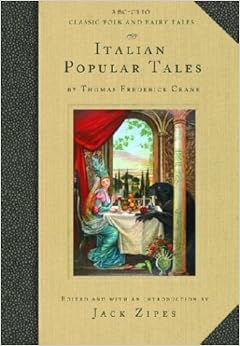
His Italian Popular Tales was an introduction to English speaking readers of folktales, including many stories in the long-published children’s magazine, St. Nicholas Magazine.  Online, stories from the book without the detailed notes, commentary and indexing can be found at SurLaLune Fairy Tales.   For a more complete online experience,Project Gutenberg gives the entire volume with its 36 fairy tales, 6 “stories of Oriental origin” (Crane loved pointing to the way stories no matter how unique, are linked to many others from around the world), 23 “legends and ghost stories” (an odd combination of tales about saints and other Biblical figures with ghost stories), 14 “nursery tales” – always a designation of stories for young children, 19 jests or amusing stories, plus the previously mentioned notes, commentary and indexing.   

If you go to the SurLaLune site you will see that two reissues have been published, each with editing and introduction by Jack Zipes.


With so much to choose from I found myself drawn to today’s tale because the character was named Catherine.  Metro Detroit area Italian-American storyteller, Loretta Vitek, tells an Italian story of “Catherine the Wise.”  I’ve grown to love it and wondered if this was another version of it.  It wasn’t, but Crane's Catherine certainly made her own choices.   


By the way a great version of that Catherine’s story is in Italo Calvino’s excellent Italian Folktales, published in 1956, but first translated into English in 1980.  Calvino also gives good notes, but, as you might expect, all sources are in Italian.


Until the next post, “Buona fortuna” and if you can’t have that may you make “Buone scelte” (good choices.)
*****************
This is part of a series of postings of stories under the category, "Keeping the Public in Public Domain."  The idea behind Public Domain was to preserve our cultural heritage after the authors and their immediate heirs were compensated.  I feel strongly current copyright law delays this intent on works of the 20th century.  I hope you enjoy discovering new stories. 

At the same time, I've returned to involvement in projects requiring research as part of my sharing stories with an audience.  Whenever that research needs to be shown here, the publishing of Public Domain stories will not occur that week.  This is a return to my normal monthly posting of a research project here.  Response has convinced me that "Keeping the Public in Public Domain" should continue along with my monthly postings as often as I can manage it.  


Saturday, December 28, 2013

Deihl - The Three Bells - Keeping the Public in Public Domain

New Year brings resolutions to do better.  This New Year's story fits that resolution by showing the importance of attitude.


I confess the title of this book, Holiday-Time Stories, was what talked me into buying it.  So many times storytelling programs are scheduled for a holiday celebration.  This little book was written by Edna Groff Deihl.  I can find nothing by or about her even though the book lists three other volumes by her.  Surely this is a perfect reason for Keeping the Public in Public Domain and I can only hope her books are digitally archived in the future.  The illustrator, Genevieve Fusch Samsel, was similarly not found on the internet at this time.  The illustration by Samsel says this is "The End."  Possibly it is for 2013, but trust we will meet again in 2014 online or in person.
******************
This is part of a series of postings of stories under the category, "Keeping the Public in Public Domain."  The idea behind Public Domain was to preserve our cultural heritage after the authors and their immediate heirs were compensated.  I feel strongly current copyright law delays this intent on works of the 20th century.  I hope you enjoy discovering new stories. 

At the same time, I've returned to involvement in projects requiring research as part of my sharing stories with an audience.  Whenever that research needs to be shown here, the publishing of Public Domain stories will not occur that week.  This is a return to my normal monthly posting of a research project here.  Response has convinced me that "Keeping the Public in Public Domain" should continue along with my monthly postings as often as I can manage it.  

Saturday, December 21, 2013

de Bosschere - The Rich Woman and the Poor Woman - Keeping the Public in Public Domain

Back on July 10 of this year I posted a story from Jean de Bosschere's book, Christmas Tales of Flanders.  At the time I noted the book's title was misleading as the book is not about Christmas.  The first story in the book, however, is set at Christmas.


As De Bosschere notes, many of the stories in the book "are found in a different guise in the legends of other nations."  This was a classic tale of two motifs: J 2073.1 Wise and foolish wish: keep doing all day what you begin AND Q1.1 Gods (saints) in disguise reward hospitality and punish inhospitality.  If you are unfamiliar with the idea of motifs and want to tell stories, I heartily recommend you go to the three-part series here by Wendy Welch on March 17, 18, 19, 2013.  For other Flemish folktales, some of which are definitely Christmas tales, I repeat a recommendation of a little known anthology by Mount Clemens organist, August R. Maekelberghe.  He died shortly before I went to work at the Mount Clemens Public Library, but thanks to Isabel Miller, we have his wonderful retellings of his birthplace's folktales in the book, Flemish Folktales.  She published it for him shortly after his death. She gave me permission to freely tell from it, but I don't feel comfortable reprinting it here.  For even more Flemish folklore, and well told, it's a book worth seeking out and your borrowing it will keep it alive in library collections.  When books aren't borrowed, they are discarded.  Certainly that would be a poor fate for future readers.  It's in that spirit that Keeping the Public in Public Domain began.
****************
This is part of a series of postings of stories under the category, "Keeping the Public in Public Domain."  The idea behind Public Domain was to preserve our cultural heritage after the authors and their immediate heirs were compensated.  I feel strongly current copyright law delays this intent on works of the 20th century.  I hope you enjoy discovering new stories. 

At the same time, I've returned to involvement in projects requiring research as part of my sharing stories with an audience.  Whenever that research needs to be shown here, the publishing of Public Domain stories will not occur that week.  This is a return to my normal monthly posting of a research project here.  Response has convinced me that "Keeping the Public in Public Domain" should continue along with my monthly postings as often as I can manage it.   


Thursday, December 12, 2013

Happy Belated Birthday, St. Nick!

'Twas the day after St. Nicholas Day when I did a program as "The Hired Girl" on Victorian Christmas only to have an attendee give me "the facts" about Saint Nicholas.  I was sooo happy that, while I mentioned the saint, I didn't dwell on his history since it didn't fit the topic.  Didn't find what he said matched what I'd heard, but came home to fact check.

Surprisingly many of my high school classmates were mentioning that December 6 was celebrated as his feast day. 

WELL!  That did it, I had to see what facts are recorded as well as the legends.

First of all he goes by many names, according to Saints.Sqpn.com:
  • Nicholas of Bari
  • Nicholas of Lpnenskij
  • Nicholas of Lipno
  • Nicholas of Sarajskij
  • Nicholas the Miracle Worker
  • Klaus….
  • Mikulas….
  • Nikolai….
  • Nicolaas….
  • Nicolas….
  • Niklaas….
  • Niklas….
  • Nikolaus….
  • Santa Claus


But that's nothing compared to the 90 groups listed there claiming him as their patron -- including Butchers, Bakers and Candle Makers as well as the three countries, Germany, Greece, and Russia and the 80 towns (throughout Europe and one in the Palestinian Christian town of Beit Jala, ).


Taking the saint out of his stained glass and finding facts agreed upon by all sources is much trickier.  (Catholic Online says, "he is said to have been represented by Christian artists more frequently than any saint except our Lady.")  Unfortunately they quote Butler's Lives of the Saints, a 30 year work putting into four volumes the massive 68 volume Acta Santorum.  I say unfortunately because a lot of legend and unverified statements are included in telling of a saint for whom much may be inferred, but little proven.  The Acta and Lives at least mention the sources start in the mid-ninth and early tenth centuries.  

Since St. Nicholas was born in the third century, and it is reported he died on December 6 in mid-fourth century (the years vary, but that date returns often), there's a long gap before recording his life. As the Catholic Encyclopedia put it, "Though he is one of the most popular saints in the Greek as well as the Latin Church, there is scarcely anything historically certain about him except that he was Bishop of Myra in the fourth century."
The original tomb of St. Nicholas at the basilica in Myra.
Myra (now Demre) was a major city in Lycia, but to put that in modern terms, it's now in the Anatolian province of Turkey. His birth is also probably in the same region as Butler claims, "All accounts agree that he was a native of Patara, in Lycia."  That's only three miles from Myra.  The area was Greek during his lifetime.  He was buried in his cathedral there until 1087.  Then his "translation" occurred.  I put that in quotes as it's a matter of opinion why his relics were moved to Bari, Italy.  The link I gave you has a detailed (and from the viewpoint of the Basilica of St. Nicholas in Bari) says his removal came after a papal vision to preserve him from Turks  taking over the area, destroying Christian churches and objects.  Its being a contest with Venice and protested by the citizens of Myra makes it an action-packed story of its own.  Readers of the Ellis Peters medieval mystery series about Brother Cadfael can appreciate it based on the first book in that series, A Morbid Taste for Bones.

I found it interesting that Wikipedia notes: There are numerous variations of this account. In some versions those taking the relics are characterized as thieves or pirates, in others they are said to have taken them in response to a vision wherein Saint Nicholas himself appeared and commanded that his relics be moved in order to preserve them from the impending Muslim conquest. Currently at Bari, there are two churches at his shrine, one Roman Catholic and one Orthodox.

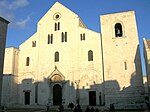
Basilica di San Nicola in Bari, Italy
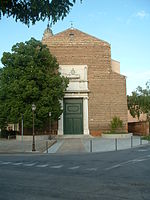
San Nicolò al Lido (Venice)
Unfortunately those variations aren't footnoted.  The source I gave before Wikipedia is clearly on the side of a vision.  Wikipedia does a good job of pointing out the relics are proven to be in both Bari and Venice, while Myra tells of continued production from the sarcophagus of "a clear watery liquid which smells like rose water, called manna (or myrrh), which is believed by the faithful to possess miraculous powers."  Sounds like St. Nicholas indeed is like Santa Claus in being several places at once so everyone benefits.

While we're discussing Legends, there are plenty to go around.

  • Our tradition of a Christmas stocking supposedly started when the kindly Nicholas heard a poor man's three virgin daughters had no dowry and otherwise would be forced into a life of prostitution to survive.  On three separate nights he stopped by their home tossing a stocking filled with gold over their house wall so they each were able to marry.  (The three gold balls symbolizing a pawnshop also originated with those balls of gold.)
  • Talking about pawnshops makes me think of another legend where he talked thieves into turning from a life of crime after their mothers prayed for them to change.
  • More in dispute is whether he brought 3 children back to life after they were killed by an inn-keeper and pickled in brine.  Some say the "children" were seminary students.  Sounds like Sweeney Todd!
  • Yet when a famine struck he multiplied grain.
  • Sailors have him as a patron and supposedly as a young man he made a pilgrimage to the holy land and, on his return, calmed a terrible storm that threatened to sink his ship.  This led to the custom of wishing "May St. Nicholas hold the tiller."
  • Another legend I enjoyed at Orthodox America has him as a devout young priest when the Archbishop of Myra died. "The other bishops, as well as the priests and people of the town, gathered to choose a successor. They couldn't decide who should be their new archbishop. They kept a vigil and prayed all night long in the cathedral, begging God to guide them. God revealed to one of the bishops that the first priest to enter the church in the morning should be chosen as the new archbishop. At sunrise, a simple priest, Father Nicholas, came quietly into the cathedral to say his morning prayers. In this way the Lord God revealed His choice for archbishop."
  • A miscellany of ideas about him has him fasting on Wednesdays and Fridays, some would start this even as a nursing baby!; orphaned, but wealthy, so he started young to be generous; raised by his uncle also named Nicholas who was the bishop of Patara; imprisoned for a time by the Roman emperor Diocletian in the last persecution of the church then released by the emperor Constantine; some put him at the first Council of Nicaea even though he's not among the official lists of attendees, but definitely opposing Arianism.
There's a saying that what's important in our lives is "what we do between the dashes" of our birth and death.  What happened between his dashes is the stuff of legend...Oh goodie! says the storyteller in me.  Oh rats! says the fact-checker.

If you want to check the many places I went, there are too many to list here, but you might start at dmoz, the open directory project.  

For fun, go to the St. Nicholas Center and also CatholicCulture.org and HubPages for St. Nicholas traditions from around the world, activities, crafts, recipes, games, and, of course, stories and more.  Google Images has many of those pictures of St. Nicholas and also offers many coloring pages.

Did my program attendee's facts turn up?  No, but I'm so glad I checked as I found the wealth and generosity of St. Nicholas continues.