Tell me if you have a topic you'd like to see. (Contact: LoiS-sez@LoiS-sez.com .)
Please also let others know about this site.

Thursday, November 3, 2011

Nocturnal Animals "Own the Night"

The Collaborative Summer Library theme for the 2012 reading program is "Own the Night" and nocturnal animals are a natural connection for both libraries and naturalists.  This summer I will tell tales of nocturnal animals found here in Michigan, but these stories come from all around the world.

Why?

My mission in storytelling is to increase understanding through stories from around the world and back through time. 

To help you discover and understand how nocturnal animals Own the Night! here are some online resources.  (There are different nocturnal creatures in different parts of the world and, while my stories come from all over, I chose sites tending to focus on our own area.  This helps your young readers and listeners better understand the nocturnal animals already around them.)

Google gives these as "Top references for nocturnal animals"  OwlBatRaccoonSkunkOpossumCatHedgehogBadger, and Firefly, but don't stop there! Other possible creatures include mouse, fox, wolf, coyote, moth, tree frog, cockroach, and I'd certainly add the Unofficial Michigan State Bird, the Mosquito!

FACTS


  • List of nocturnal animals -- This international listing upfront declares it's incomplete, but you can click on any animal for a Wikipedia article. 
  • Nocturnality -- Yet another Wikipedia article, this one shows why nocturnal creatures benefit from this adaptation.
  • Homeschool Share on nocturnal animals -- This is both an overview and has a special featuring of owls and bats.
  • Nocturnal Habits of Nighttime Animals -- Specific to Michigan, this looks at flying squirrels, whippoorwills, tree frogs, and great horned owls.  So that's why those crows I saw made such a fuss!
STORIES
  • Franklin and His Night Friend -- Picture book favorite character, Franklin, makes friends with a bat.
  • Nocturnal Animals poems -- These are not stories, but poems, especially about owls and bats.  (Thank heavens for the Wayback Machine's archiving the internet!)
  • Story-Lovers S.O.S. -- Searching Out Stories lists books, online stories, and much more.  Drop down to section 2 "Animals, Birds, Amphibians, Fish and Insects" and search by specific nocturnal animal.
CRAFTS
MUSIC
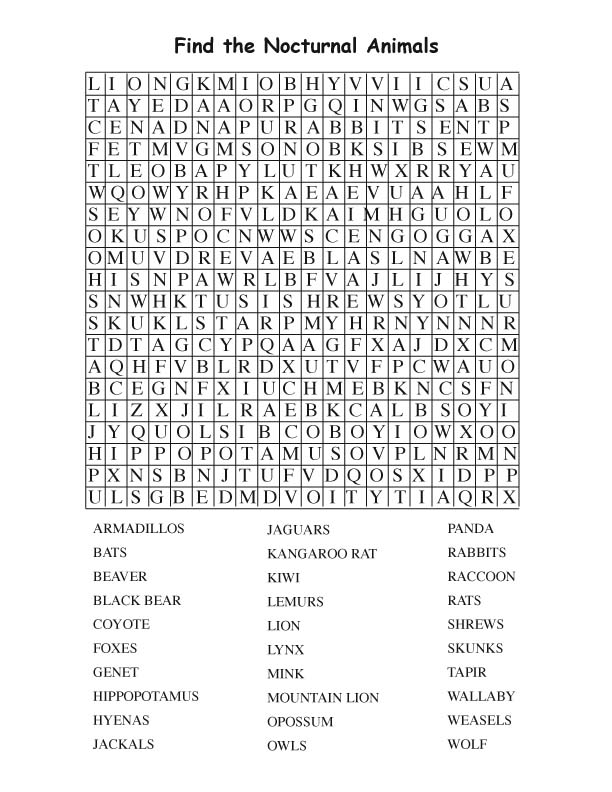
GAMES
    image
  • Amsel, Sheri. “Word Searches and Crossword Puzzles.” Nocturnal Animal Word Search (Older Readers). Exploring Nature Educational Resource. © 2005 - 2011. November 2, 2011.
CURRICULUM IDEAS
Teachers aren't the only ones who can use these ideas.  Scan for good ideas to use also in libraries and nature centers.


"EVERYTHING UNDER THE MOON!"


Isn't it wonderful when you can recycle your programs?  Children's programs for preschoolers used 4 years ago can return and be used again with a whole new audience of preschoolers.  In 2008 Who's Awake at Night? was the theme for the Michigan Reads program.  The Michigan Reads pdf provides recommendations for books, crafts, music, games, fingerplays, and coloring sheets to help you plan your Summer Reading program to Own the Night..

Wednesday, October 19, 2011

Civil War Music

There's an excellent group, the Fifth Michigan Regiment Band performing the songs of the era, but what if you want to know or use some songs yourself?  First of all music from Civil War days are safely in Public Domain, so you are free to perform them without fear of royalties.  Using a recorded version, however, would be something you should work out permission with the artist performing it, although schools, libraries, and other nonprofit educational settings may be covered by Fair Use.

A popular composer of the times was Stephen Foster.  As Wikipedia notes, he was:  the pre-eminent songwriter in the United States of the 19th century. His songs — such as "Oh! Susanna", "Camptown Races", "Old Folks at Home" ("Swanee River"), "Hard Times Come Again No More", "My Old Kentucky Home", "Old Black Joe", "Jeanie with the Light Brown Hair", and "Beautiful Dreamer" — remain popular over 150 years after their composition. 

If you want to set a mood of the Civil War days, this composer who died at the start of 1864 is an easy choice, especially if you include minstrel shows set in the pre-war South, but are not looking for patriotic war songs.  Actual songs about the Civil War, however, are definitely not a part of his work.

In contrast to the blackface minstrel shows, a whole group of gospel songs seemed innocent, but were often coded to give messages about the Underground Railroad.  Several sites discuss this:
  •  Negrospirituals.com/
  •  Owen Sound's Black History - Songs of Freedom (gives 5 songs, but many would eliminate Follow the Drinking Gourd and say it is about the Underground Railroad, but came after slavery ended)
  • Spiritual (music) even cautions that the whole idea of coded messages lacks primary support material.  That lack of primary support material isn't surprising, but the case of Follow the Drinking Gourd and the popularity of the Fisk Jubilee Singers after the War means this is an area, at least, where you should check carefully to be sure of the dates of any song.

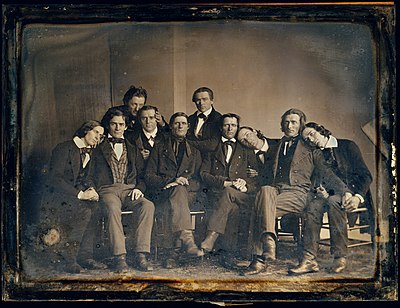
A photograph of the Hutchinson brothers. Jesse, Jr., (third from the left) is standing with a hand on a brother's head.  Thanks to George Fullerton of Goffstown, New Hampshire, for this image of the Hutchinson family.

There are online articles about the Hutchinson Family Singers and at Wikipedia.org. (Be sure to read the Discussion following the Wikipedia article for added information.) They started 20 years before the war with such controversial topics as abolition, temperance, and women's rights, even traveling with Frederick Douglass through England in 1845 and performed in prisons and almshouses.  The abolition of slavery led them to write many songs and support the election of Abraham Lincoln.  A perfect example of this is their use of the well-known folksong "Old Rosin the Beau."  Jesse Hutchinson wrote to it the lyrics for the abolition song,"Roll on the Liberty Ball", and later the subsequent Civil War song, "Lincoln and Liberty, Too", putting a developmental spin on how the war came about.  Find the words at Roll on the Liberty Ball. and Lincoln and Liberty, Too .

Altogether there were 13 Hutchinson Family Singers and by 1859 they split into two groups each called the Hutchinson Family Singers.  They popularized "The Battle Cry of Freedom",  (the Confederates took that song and wrote their own lyrics, too), "Tenting on the Old Camp Ground" and other songs.  "The Battle Cry of Freedom" has many citations on YouTube and Google as does "Tenting on the Old Camp Ground"

Isaac and William Lerich
There's more to the Hutchinson Family story, but I've found the two songs I use give shape to a story not as tidy as fiction. As noted in other posts at my website, http://www.LoiS-sez.com/Historical.html, music ties together lives and events as dramatic as fiction, but less easily organized.  "Roll on the Liberty Ball" is used for my Underground Railroad program about the Lerich family, based upon oral history.  For the Civil War I use "Lincoln and Liberty, Too" plus excerpts from letters by or sometimes about the two sons, Will and Isaac,  who joined the "Fighting Fifth" Infantry of Michigan during the War of Rebellion, as it was called here in the North at that time.


Other songs can be found in the Fifth Michigan Regiment Band's bibliography.

Here are some sources I found useful, many are also on the Fifth Michigan Regiment Band's bibliography.  

* Crawford, Richard, The Civil War Songbook, Dover Publications, Inc., New York, 1977.

* Currie, Stephen, Music in the Civil War, Betterway Books, Cincinnati, 1992.

* Glass, Paul, Singing Soldiers, Da Capo Press, Inc., New York, 1968.

* Hill, Lois, Poems and Songs of the Civil War, Fairfax Press, New York, 1990.

* Jackson, Richard, Stephen Foster Song Book, Dover Publications, Inc., New York, 1974.

* Krythe, Maymie R., Sampler of American Songs, Harper & Row Publishers, New York, 1969.

* McNeil, Keith and Rusty, Civil War Songbook; with Historical Commentary, WEM Records, Riverside, CA, 1999.

* Raph, Theodore, American Song Treasury, The, Dover Publications, Inc., Mineola, NY, 1964.

* Silber, Irwin, Songs of the Civil War, Dover Publications, Inc., New York, 1995.

* Silverman, Jerry, Ballads & Songs of the Civil War, Mel Bay Publications, Inc., Pacific, MO, 1993.
If you are looking for stories behind a dozen songs, Silverman also wrote Songs and Stories of the Civil War, Twenty-First Century Books, Brookfield, CT, 2002.

I omit recordings as they are more difficult to guarantee availability, format, and the ability to interlibrary loan.  These books give the music in print to permit performance.

LoiS(inging "For Lincoln and Liberty, Too")


Friday, September 30, 2011

Now for something just for fun!

Remember the old "How many ... does it take to change a lightbulb?" jokes? 

I wrote this in reply to a challenge on the international email list for storytellers, Storytell , about taking storytellers changing the lightbulb and turning it into a story.  This uses many a time-honored folktale element and also looks ahead to Halloween.

,
This is LoiS with her international storyteller sisters, including Csenge Zalka from Hungary.  (Left to right: Erika Todd of MI; LoiS; Csenge Zalka; Nicole Hofeldt of MN; Danielle Todd of MI -- taken at Northlands in WI, 2008)
Storytellers are a family no matter where we are.
Enjoy the tale!

Once upon a time, long ago, but not so long ago that there wasn't electricity, there was a lightbulb.  A lightbulb that all agreed needed changing, but ALAS! nobody felt like changing it.  A summons was sent out throughout the land of stories about changing this lightbulb promising riches & fame to whomever would dare to change this lightbulb.  Many, oh so many considered it, but gave it up as unworthy of their time and effort. Would this lightbulb ever be changed?

In a distant and far away corner the challenge was heard by a storyteller, the youngest in a family of storytellers.  "I'll go!", volunteered the youngest child, but everybody else in the family laughed for they knew this young storyteller had barely learned to tell a fable, much less change a lightbulb through the power of storytelling.

Despite the derision of brother and sister storytellers, the youngest storyteller set out on the long journey with barely a crust of bread & a bottle of water for sustenance.  Along the way the young storyteller came upon an old woman, who asked, "Could you spare me some of your food?"

"Yes, certainly," agreed the young storyteller, "but while you eat it you must promise to listen to my tale about the changing of the lightbulb."

Hours later the old woman begged to have the story stop and, when the young storyteller insisted there was still more to the story, she gave a magic potion that she promised would bring success if drunk upon seeing the lightbulb.  Remembering that the gifts of elders often made all the difference in stories, the young storyteller stopped to thank the old woman. The instant the young storyteller stopped to get a breath and thank the old woman, she vanished.  (Obviously grateful to have escaped!)

On the young storyteller travelled until at last the lightbulb was in view. A crowd had gathered nearby, telling ghost stories in the dark, convinced that light would never return.  The young storyteller felt the attraction of the ghost stories and was about to weaken, already planning to tell some stories that were only told at home in the far away land from which the young teller had come.  The audience turned and looked at the youngest storyteller.  How often they had wished for new stories and young storytellers!

Just then the young storyteller remembered the potion the old woman had so generously provided.  A sip, a gulp and it was drained.  Instantly the fog cleared in the brain of the young storyteller.  The mission to change the lightbulb was recalled and quickly the bulb was grasped.  A few twists and the bulb was unscrewed.  The replacement bulb was laying there and just as quickly screwed in.  The young storyteller bowed to the crowd, but they all started to go away, muttering about the futility of telling ghost stories in such bright light.

Fame and riches might go to someone bold enough to remember that their mission was to change a lightbulb, but ALAS! if that person hopes to become a storyteller, it is hard to gain an audience for ghost stories that end unhappily ever after.  Ah, but of course, "That's another story..."

Happy telling to you, too!

Wednesday, September 7, 2011

When Disaster Strikes...One Year Later

I've been uncertain when to post this as I know those who most need it probably can't go online.  It's the anniversary of our house flood last year, but it looks puny compared to the flooding, fire, and other disasters I hope are not affecting you or your family.  Whether it's us or others we know, I hope a multi-part series I put on my blog last year helps. 
The series opened saying:

When Disaster Strikes First Aid Kit


November is a month dominated by the Thanksgiving holiday.  What do you do when circumstances make it hard to be thankful?

Whether it's worry over health of your own or someone you love, a disaster, the irritation and difficulties of dealing with construction, whatever has you Coping with Chaos, this month I want to create a First Aid Kit for whenever you may need it.  This is a bit more personal than I expect most posts here, as my own personal need caused me to create this month's topic. 

Blogs crazy format puts the most recent information first, so http://www.storytellingresearchlois.com/search/label/disaster has a webliography/bibliography of resources, but it also includes ideas and suggestions gathered from my storytelling family. 
I'm finally forcing myself and Tom to finish our paperwork.  We delayed touching it and I'm hopeful it's not too late.  Dealing with it was incredibly demoralizing.  Even a year later it hurts to see book titles, for example, of what was lost.  A year later we wondered if ever again we might return to anything awful when absent from home.  If I've any recommendations after a year, it's get your paperwork done as fast as you can.  Things have been forgotten we should have listed, but not the pain.  We hope now it will start to ease.
LoiS(torytelling business and other things always seemed more important than facing this)

Friday, August 19, 2011

Third Most Used Language in the U.S. -- American Sign Language

Our family began signing long ago because my older daughter is severely hard of hearing.    To spread interest and beginning knowledge of the third most used language in the U.S., I sometimes tell stories in voice and sign language simultaneously.  Additionally I offer a program called a Playful Introduction to Sign Language.

If you wish to go further in learning it, I recommend:
  • Start at the library for books and videos for all ages and even in Spanish.  For the most items, search the catalog under keywords "signing" and "sign language."  American Sign Language (abbreviated ASL) is the official name, but using "sign language" as keywords retrieves more titles, including ASL.  "Baby Sign" is more complicated, the most popular subject headings are: "nonverbal communication in infants"; "interpersonal communication in infants"; "interpersonal communication in children"; and "language acquisition--parent participation."
  • Online YouTube has many videos.  "Deaf" covers many cultural issues, but again "sign language" opens the most items. Note the source as there are sign languages and even fingerspelling all over the world different from the U.S.  My daughter loves to compare the sign languages of different countries! Claude O. Proctor shows this in his Signing in Fourteen Languages : A Multilingual Dictionary of 2,500 American Sign Language Words and his earlier NTC's Multilingual Dictionary of American Sign Language.  Both include fingerspelling charts.  Similar to spoken English regional accents, some signs vary throughout the U.S.  
  • Have fun learning sign language!  A handy one-stop online source is Harris Communications.  They sell puzzle books such as the two for the classic book, Joy of Signing, lots of flash cards, many games, a magnetic poetry sign language kit, and, in their Books and Multimedia -- Teaching Resources section (but also available at Amazon and elsewhere), American Sign Language Clip and Create 5 CD-ROM

    American Sign Language Clip and Create 5 CD-ROM
    This fifth version of American Sign Language Clip and Create includes nearly 5,555 clipart signs for making crossword puzzles, posters, banners, postcards and more.

  • ASLPro was created for teachers, but includes quizzes and related products.
  • As with any language, practice is essential.  Partner with a fellow student or someone who grew up with the language.  Recently I was signing songs at the back of my church for my own understanding and practice.  A man in the final row told me he had deaf parents, but now has no opportunity to use ASL and has forgotten how to speak it.  How sad! 
  • The logo at the top of this blog issue came from eHow.com's article, "How to Learn ASL Fast."  That logo often is used by a location offering services to the deaf.  The article includes other online resources in their sidebars.  Their articles and videos are free, but the section called "Related Ads" leads to commercial sites.
  •                             
I probably also should mention Tell the World; Storytelling Across Language Barriers, compiled and edited by Margaret Read MacDonald.  I wrote an article in the book, "Telling with Sign Language Translation."


Signed communication is a continuum stretching from informal mime when necessary; through Pidgin Sign which adapts signing to an English word order, especially when both talking and signing simultaneously; through Signed English created to help deaf children learn English grammar and parts of speech in an educational setting; to American Sign Language with its own grammar and is the standard for interpreter certification.  Just as variations in signs exist, so can the communication style, although ASL generally has become the standard.

Remember communication is what it's all about in this practical and beautiful language used by so many people.
My signing puppet, Ivan, signs "Friend"

Friday, July 22, 2011

Oral Literacy Starts with Storytelling

This month's post started after I was contacted by a teacher in Egypt working with new mothers.  I've changed it a bit to fit (mainly) U.S. readers -- teachers, librarians, and parents -- interested in starting children on the road to oral literacy.

One of the best aids to literacy is the use of "nursery rhymes."  There are short simple rhymes meant for very young children in many languages.  I know such rhymes exist in Spanish and Chinese, but I've no idea if there's anything comparable in the children's literature of other cultures.  I expect there is as such verbal play is important for toddlers.  The benefit of such rhymes has less to do with story and more to do with predictability of the rhyme and the creative use of language.  
Dr. Betsy Diamant Cohen,  http://www.mgol.org/ , offers ideas on the many ways to use nursery rhymes.  She travels a good deal, but you can email her at info@mgol.org or call  443-928-3915.  She's a very creative educator used to working with parents and teachers of preschool children.  There are various resources on her website and she has an occasional e-newsletter.

After such rhymes, I like to make up stories telling more about what may have happened before, during, or after the rhyme.  A similar resource might be songs meant for young children.  As the children get a bit older, they can help make up such stories.  L. Frank Baum, the author of the Oz books, did a similar book, Mother Goose in Prose.  It's interesting to see another side of his creativity.

When teaching storytelling I find many beginners do well with these steps I learned years ago in Wordweaving training as a simple way to learn stories quickly and easily.  As a children's librarian I needed to learn new programs with several stories weekly.

1. Select a story you want to tell.
2. Learn the structure and block the story.
3. Visualize the settings and characters.
4. See the action as if you’re watching a silent movie.
5. Tell the story aloud, using your voice to project the images you visualized.
6. Learn the story by heart, not word for word.
7.  Practice telling the story until it comes naturally.
#2 mentions learning the structure of a story and "blocking" it.  You may think of this as "outlining" the minimum things that must happen.  Some people like to make a visual outline or "storyboard" by folding a paper in 1/2 lengthwise, then take the folded paper and fold it twice again so it has a total of 6 boxes.  (It forms 2 columns of 3 boxes each.)  Drawing stick figures of what happens in the 6 boxes gives a visual outline of the story which helps, too.

I found this idea from storyteller, Caren Niele, a bit ironic for a class in Egypt to use.  English speaking students love to use acronyms to help learn and remember concepts.  In the National Storytelling Network's small (80 pages) inexpensive ($5 US) book, A Beginner's Guide to Storytelling, in the segment called "Developing Your Story" she uses the acronym "CAMELS."  It stands for: Characters -- getting to understand the characters in a story and beyond the story; Audience -- tailoring your telling to your listeners; Message -- the purpose of the story; Energy -- matching it to your listeners; Language -- repetition, opening and closing of a story, and other important or unusual words; Setting. 
Some of her method was covered also in the Wordweaving steps, but they all combine to add a special flavor to a story.
Margaret Read MacDonald's book, The Parent's Guide to Storytelling; How to Make Up New Stories and Retell Old Favorites, would be useful for students as a textbook.  I also have heard good things about Sean Buvala's, Daddyteller, but haven't read it myself.  I know Sean and trust him.  He's passionate about getting fathers to feel at home with storytelling, but I expect much of what he says would also work for mothers.  There are other books for parents as their children get older, especially when they are school age, but those 2 would be a good starting point for telling to the youngest.
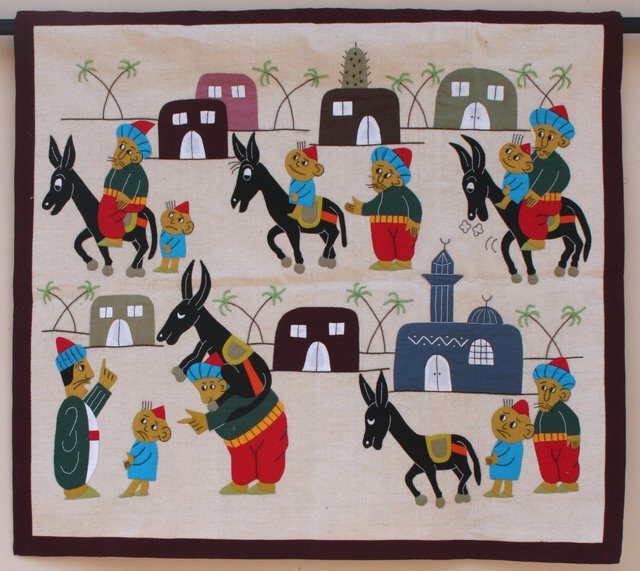
From http://jennybowker.blogspot.com/2007/10/goha-and-donkey-walk.html
Students should think back to simple folktales recalled from childhood.  Those stories especially need to be passed along for cultural literacy.  In talking about Egypt, my personal favorites are stories about Goha in Egypt as well as those with his other names in other countries.  They teach while having humor.  On the internet many sites re-tell some of the simplest most basic tales from around the world.  Some have various versions differing from country to country, but keep their underlying plot and theme, changing only enough to fit the culture of their homelands.  The Egyptian Cinderella story of Rhodopis is a good example of this.  It also is fun to take a basic story and make it an Egyptian story where there wasn't one before.

Here's a page, Parent Connection (on The Story Connection), which explains both why parents should tell stories and gives a few tips for storytelling.  At the bottom of the page Dianne De Las Casas gives both websites and a bibliography.  Some of this is aimed at much older children, but your students will be able to grow in their storytelling with the other resources.

***
That's a lot to absorb, so I'll stop there.  Please stay in touch and let me know what you might like to discuss after this.

Sunday, June 19, 2011

Michigan's "Fighting Fifth" Civil War Infantry

Sometimes a single blog can't begin to cover all the research involved in my programs.  I'm deeply grateful to the descendants of Liberetta Lerich Green who "adopted" me for my programs reenacting her life and telling of the Lerichs.  Her parents, Peter and Sarah Lerich ran an Underground Railroad Station under the noses of their unsuspecting children.  Eventually Liberetta and her brother, Will, discovered the secret.  Both Will and Isaac enlisted in Michigan's 5th Infantry when the War of Rebellion started.  (It wasn't called the Civil War at that time and indeed it's true to say there was nothing civil about that war!)

Many of the family letters are on file at the Bentley Historical Library, including from the Civil War years. I plan to post my transcriptions of those letters from or about Will and Isaac.  In the meantime I've just begun a separate blog, Michigan's "Fighting Fifth" Civil War Infantry of Detroit newspaper accounts, posting articles at the same pace as they would have appeared 150 years ago.

No book exists only about the 5th Infantry, but they definitely deserve one.  They were also 5th in Union infantry deaths, with a record including some of these places where they fought:
Pohick Church,Va.Yorktown,Va.Williamsburg,Va.
Fair Oaks,Va.Peach Orchard,Va.Glendale,Va.
Malvern Hill,Va.Bull Run,Va.Groveton,Va.
Chantilly,Va.Fredricksburg,Va.The Cedars,Va.
Chancellorsville,Va.Gettysburg,Pa.Wapping Heights,Va.
Auburn Heights,Va.Kelly's Ford,Va.Locust Grove,Va.
Mine Run,Va.Wilderness,Va.Todd's Tavern,Va.
Po River,Va.Spottsylvania,Va.North Anna River,Va.
Tolopotomy,Va.Cold Harbor,Va.Petersburg,Va.
Deep Bottom,Va.Strawberry Plains,Tn.Poplar Springs,Va.
Boydton Road,Va.Hatcher's Run,Va.Saylers Creek,Va.
New Store, Va.Appomatox Court House
One man in three died, but if Will and Isaac were the two who didn't, each spent time enjoying Southern prison hospitality, as well as each being partially crippled, and prematurely dying 20 years after the war as a result of their injuries.


These online sources show why President Lincoln said "Thank God for Michigan!"
  • The classic book is Michigan in the Civil War compiled by Robertson of the Adjutant General's Department.  Google Books makes it available or go to Ed Hazel's reprint of the book to read it page by page.  His site has 56 pages on the 5th, but also his tagging makes its searchable.  His site, The American Civil War explores Michigan’s role in the civil war and his Civil War Resources page gives an interesting webliography on the war overall.
  • For something completely different and entertaining, the Fifth Michigan Regiment Band takes you back to the music of those days and the group's performances pass along historical information beyond just the Fifth.  Their page of Bibliographical Information in the History section is a treat!  So are their performances, so if they come to your area be sure and attend.
That wraps up the online resources, but there's still more to be researched as easily seen in a scan of Clarke Historical Library's listing of unpublished Civil War personal narratives.
For descendants and others interested in this important regiment, it shows there's still more than enough material to create a full-length book.  In the meantime I'll continue to give Liberetta's view from the Michigan homefront.  For more information on that and other historical programs, go to my website's page on historical programs

****************************************************************
UPDATE
I wasn't going to try and post general Civil War information, but Michigan Civil War Sesquicentennial History Partners is our state's partnership with its Civil War Sesquicentennial Committee and Civil War History Partners Steering Group to promote the commeration of Michigan's role in the war.  You can find events, resources, and contacts for all aspects of our state's involvement in what was at the time called the War of Rebellion.