An old British music hall song,
"With Her Head Tucked Underneath Her Arm" introduced me to the ghost of Anne Boleyn as sung (without the "th" in "With") by
Stanley Holloway, best known nowadays for his delightful Alfie Doolittle in My Fair Lady. Tonight (3/18/16) and tomorrow are the final performances of Anne of the Thousand Days by
Pontiac Theatre IV and, while I really would love to have you come, I know many reading this aren't near enough. For lovers of spooky stories I promised to tell about England's most frequently seen ghost, sometimes seen with and sometimes without her head since she was executed by beheading.
The play, Anne of the Thousand Days, brings to life what led up to that execution.
Local friends, I hope to see you at the Michigan School for the Arts at 819 Golf in Pontiac. All
performances begin at 8:00 pm. Ticket prices are $10.00 for adults and
$8.00 for seniors and students.
O.k. commercial message ended (although it is a lot of fun to get cast and audience together afterwards!) and on to the various "spook spottings."
For those of you who put down paranormal claims, in Britain it's been said that any ghostly vision in a period dress is credited as Anne. Fine, but the ghost has been reported at sites important to the life of the dead queen. On the anniversary of her beheading she was seen at her believed birthplace, Blickling Hall in Norfolk. The most literary description of her ghostly appearances come from Norfolk author, Neil Storey, who has written roughly 30 books including the Grim Almanac series and, if you care to go and see for yourself,
A Ghost Hunter's Guide to Norfolk. I love his description of the anniversary haunting:
Well on that driveway over there at twelve midnight, her carriage is
said to clatter down there pulled by headless horses, driven by headless
horsemen and sat on the back seat bathed in a violet light is Anne
Boleyn, her neck a raw stump and her head rattling around on her lap.
Anne’s brother George is also said to return. He was executed a few
days before Anne, on the charge of committing incest with his sister.
He is said to return to the house being dragged by horses, whilst neatly
cradling his head in his arms. Another local variant has the driver be Anne's father, Thomas Boleyn, who let Henry have both his daughters, Anne and, before her, her sister, Mary. Thomas supposedly wildly drives the carriage pulled by headless horses and it's pursued by the headless George and blue devils, because Thomas is cursed for a thousand years to make this drive.
Here's
ITV News in Anglia's article and video from 2014 to give you a visual taste as people gather on the anniversary.
Did you catch that Anne hasn't been seen there in recent times, but the sound of those ghostly horses and the carriage has been heard in the 20th century? Oh, Anne, are you losing your connection to earth? Maybe you now begin to feel no further need to remain here with so many people paying attention?

On the same date she's also been seen at Salle (pronounced Saul) Church where legend says she was reburied under a plain unmarked black marble slab. There are five such slabs and the church refuses to disinter those slabs. The church does have a Boleyn family connection as it has 15
th century brasses dedicated to its
patrons, including Geoffrey Boleyn and his wife (1440) who were Anne
Boleyn’s paternal great-grandparents.
An interesting incident there happened to best-selling novelist, Norah Lofts, who is also Norfolk local and she wrote a great deal about the Tudors, including Anne. The aged church sexton said he didn't believe in the haunting and even spent an anniversary night there without seeing her. Then he went on to describe what
did happen. A black hare appeared. Not wanting it to make a mess, he tried to catch it, falling on the corner of the baptismal font. By the time he was up again, the hare was gone and, although he checked carefully, he could find no way in or out of the church. One of the charges, besides adultery, incest, and conspiracy against the king was witchcraft. I don't believe for a second Anne was a witch, but if you did, that black rabbit would be called her familiar.
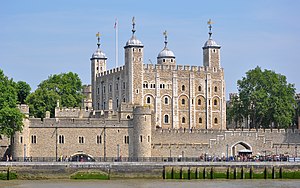
In contrast to the Salle Church legend, when Queen Victoria ordered the Chapel Royal for the Tower of London be refurbished, 1500 corpses were found. Among them, when the altar stone in St. Peter Ad Vincula
was lifted, three female beheaded skeletons were found. Only three queens
were buried there, Anne, Catherine Howard and Jane Grey. Queen Victoria ordered the remains of all
the royals executed at the Tower be exhumed and reburied under the
altar. The
skeletons were identified as a female in her mid twenties and two females in their teens. Catherine Howard was only nineteen and Jane
Grey sixteen when executed. Anne was in her mid-thirties. It's interesting to note that one of the people who supposedly moved
Anne's body to Salle Church, Sir Thomas Wyatt, later wrote,
"God
provided for her corpse sacred burial, even in a place as it were
consecrate to innocence"...hardly a description of the Tower of London. Isn't it a pity DNA identification didn't exist in Victorian times?
 |
| The Mistletoe Bough |
Bringing up Queen Victoria’s reign, I love telling about Victorian Christmas customs, including their telling of scary ghost stories including telling the spooky tale of the Mistletoe Bride. Last December I gave the text of
The Mistletoe Bough poem by Thomas Haynes Bayly. It supposedly took place at yet another place, Marwell Hall, where Anne's ghost has been spotted as well as her rival and successor, Jane Seymour, who supposedly married king Henry there in secret after the hall was given to her brother, Henry Seymour. Here's a webpage about
Marwell Hall that even gives an early silent film inspired by Bayly's ballad. Frankly I don't see a reason for Anne to want to visit Marwell Hall. As a result I don't tell about Jane there. Looking online, however, I have found claims she haunts the Yew Walk behind the hall, plotting her revenge on Jane.
In contrast, I do tell about Anne's ghost at Christmas returning to her family home of
Hever Castle where she grew up and later Henry courted her. Those courting spots where she's been seen as a ghostly figure in white include a great oak tree and in the rose garden. Other locations there have her seen coming to the castle on a bridge over the River Eden, sometimes tossing a sprig of holly into the river. Still nobody reported seeing her there when the castle was used in the filming of Anne of the Thousand Days with Genevieve Bujold and Richard Burton. To visit the castle, you must cross the drawbridge over the moat and Christmas has the most frequently reported viewing. She has been seen inside,too. The online version of the British newspaper, The Daily Mail, gives a tourist's
photo of what it calls a "ghoulish hand" pointing at the chimney of the ornate fireplace in the dimly lit living room. The tourist had no prior belief in ghosts and only saw the hand when he later checked his photos.
There are other locations mentioned, but before ending the tour of where her ghost has been reported, we must return to that song mentioned in the opening. It was probably inspired by an actual court martial in 1864. A Tower guard was accused of falling asleep, but in his defense he reported seeing her headless ghost, charging at it with his rifle's bayonet, and, when he went right through the spectre, he fainted. Fortunately there were two witnesses to verify his story, one was Major General J.D. Dundas who saw it from the window of his quarters.
To read a bit more about these and other places where Anne's ghost is claimed to have appeared try:
You might want a taste of some Tudor reading. Try the
Tudor book reviews from the Anne Boleyn Files including this one about a book by Norfolk historian turned storyteller, Dave Tongue.
I like that the reviewer catches his ability to stay entertaining while maintaining accuracy. Among other things, Clair said:
Tudor Tales is a blend of history and stories: a blend of
entertaining stories from the Tudor period – many of which had me
chuckling to myself – and Dave’s explanation of the historical context,
the historical sources and historical examples to tie in with the
stories. For example, in his introduction to the tale “Of the
gentlewoman who had the last word”, Dave explains about slander cases
which were brought before the consistory courts and gives real life
examples – fascinating!
You’ll be pleased to know that Dave has modernised the stories,
changing the spellings and punctuation to make them easier to read and
understand today, without losing their historical flavour or magic. Dave
writes “Because many of the tales were drawn from oral culture and told
aloud in Tudor times, I have attempted to give a feel of the telling in
my versions” and I would say that his attempts have been successful. I
just hope that the History Press turns this into an audio book with Dave
narrating these wonderful tales, that would be perfect!
It also was favorably reviewed by Carl Merry for Storylines - the UK Society for Storytelling Magazine. Fortunately for those of us not in the U.K.,
Amazon currently offers both Kindle and hardcover versions.
I confess to becoming interested in Anne and find curiosity for things Tudoriffic. (Yes, that's my own word creation.) Will I ever get a chance to do more than tell about her Christmas returning to Hever Castle? I don't know, but I agree with Maxwell Anderson putting these words in Henry's mouth when the ghost of Anne Boleyn appears to him.
No doubt I'll sometimes see you when I'm alone.
 |
| Pontiac Theatre IV cover by Tiffany Lamb |
|
Whenever I'm weary
and the old ways and days come back to me,
and the things you said.
But it will wear out, will erase
like a path nobody walks on.--Why do you smile?
--I can hear you saying, "Nothing's ever forgiven,
nothing's ever forgotten or erased,--
nothing can ever be put back the way it was.
The limb that was cut from Rome won't graft
to that trunk again."
What we were will be permanent in England;
It may be then what we were will be permanent in me.
It may be all other women will be shadows
and I'll be angered ,
and turn from one white face to another,
striking left and right like an angry snake
spewing venom,
striking down,
till I'm old and drained of venom.
It may be I shall seek you forever down the long corridors of air,
finding them empty, hearing only echoes.
It would have been easier to forget you living
than to forget you dead.
Next week I'll return at my usual Saturday time. Right now I plan an Easter story here for my popular Keeping the Public in Public Domain series. Whether chilling you with ghost stories or something for your holidays, I enjoy giving a taste of what's possible with my storytelling.