Tell me if you have a topic you'd like to see. (Contact: LoiS-sez@LoiS-sez.com .)
Please also let others know about this site.

Friday, April 15, 2022

Lang - The Child Who Came from an Egg - Keeping the Public in Public Domain

VintageFindsbySherry
Serendipity means unexpected good fortune and often searches for stories prove serendipitous, finding a story different from the original plan.  Today's story started for me with my first sight of a few wild violets on a woodland hike that seemed like spring was still not ready to appear.  Then I looked for illustrations and found violets often on Easter greetings and on eggs like this one on Etsy.  It was one of three different hand-painted eggs with violets at VintageFindsbySherry, but certainly not the only source for such an item as there were others if you search "Easter +violets".  

Eggs are indeed symbolic of Easter with the idea of both new life and the life that breaks out of it paralleling the empty tomb.  Violets are one of the first flowers of spring, so I can see how they came to be together.

My own real serendipity came when I went looking for a book called Flower Legends.  Gutenberg.org didn't have it, but I prowled each of the books it produced for stories about violets.  Among the books was The Violet Fairy Book edited by Andrew Lang.  He dedicated the book to Violet Myers without saying more about her.  The book was one of many in his Rainbow of Fairy Books grouped under a color name.  In the Wikipedia article about Andrew Lang after talking about the first in the series, The Blue Fairy Book, the following appears:

This was followed by many other collections of fairy tales, collectively known as Andrew Lang's Fairy Books despite most of the work for them being done by his wife Leonora Blanche Alleyne and a team of mostly female assistants.[7][8] In the preface of the Lilac Fairy Book he credits his wife with translating and transcribing most of the stories in the collections.[9]

Portrait in the collection of U. of St. Andrews
Those footnotes are worth pursuing, but in the Preface of The Violet Fairy Book he names the translators of six of the stories and then says "Mrs. Lang did the rest."  He only lists himself as Editor and says the book is "By Various", possibly crediting both the original authors and the translators.  I strongly recommend the Wikipedia article about her.  "Nora" Lang's abilities, including her multi-lingual skills, remind me of the saying in the music world, "Anonymous was a woman."  Actually once before I wrote about her here, but I also see I have nine articles with a label for Andrew.  The Langs initially only planned to produce the one fairy book, but its popularity shifted opinion at a time when fairy tales had been judged "unsuitable for children and unworthy of critical analysis."


Today's story was among the tales in The Violet Fairy Book  Nora translated and transcribed.  The title and dedication are the book's only mention of violets and, while it's not about Easter, I want to share it because it's about an unusual egg, definitely strikes me as having a woman's touch, and is a classic, but too little known fairy tale.

THE CHILD WHO CAME FROM AN EGG

Once upon a time there lived a queen whose heart was sore because she had no children. She was sad enough when her husband was at home with her, but when he was away she would see nobody, but sat and wept all day long.

Now it happened that a war broke out with the king of a neighbouring country, and the queen was left in the palace alone.

She was so unhappy that she felt as if the walls would stifle her, so she wandered out into the garden, and threw herself down on a grassy bank, under the shade of a lime tree. She had been there for some time, when a rustle among the leaves caused her to look up, and she saw an old woman limping on her crutches towards the stream that flowed through the grounds.

When she had quenched her thirst, she came straight up to the queen, and said to her: ‘Do not take it evil, noble lady, that I dare to speak to you, and do not be afraid of me, for it may be that I shall bring you good luck.’

The queen looked at her doubtfully, and answered: ‘You do not seem as if you had been very lucky yourself, or to have much good fortune to spare for anyone else.’

‘Under rough bark lies smooth wood and sweet kernel,’ replied the old woman. ‘Let me see your hand, that I may read the future.’

The queen held out her hand, and the old woman examined its lines closely. Then she said, ‘Your heart is heavy with two sorrows, one old and one new. The new sorrow is for your husband, who is fighting far away from you; but, believe me, he is well, and will soon bring you joyful news. But your other sorrow is much older than this. Your happiness is spoilt because you have no children.’ At these words the queen became scarlet, and tried to draw away her hand, but the old woman said:

‘Have a little patience, for there are some things I want to see more clearly.’

‘But who are you?’ asked the queen, ‘for you seem to be able to read my heart.’

‘Never mind my name,’ answered she, ‘but rejoice that it is permitted to me to show you a way to lessen your grief. You must, however, promise to do exactly what I tell you, if any good is to come of it.’

‘Oh, I will obey you exactly,’ cried the queen, ‘and if you can help me you shall have in return anything you ask for.’

The old woman stood thinking for a little: then she drew something from the folds of her dress, and, undoing a number of wrappings, brought out a tiny basket made of birch-bark. She held it out to the queen, saying, ‘In the basket you will find a bird’s egg. This you must be careful to keep in a warm place for three months, when it will turn into a doll. Lay the doll in a basket lined with soft wool, and leave it alone, for it will not need any food, and by-and-by you will find it has grown to be the size of a baby. Then you will have a baby of your own, and you must put it by the side of the other child, and bring your husband to see his son and daughter. The boy you will bring up yourself, but you must entrust the little girl to a nurse. When the time comes to have them christened you will invite me to be godmother to the princess, and this is how you must send the invitation. Hidden in the cradle, you will find a goose’s wing: throw this out of the window, and I will be with you directly; but be sure you tell no one of all the things that have befallen you.’

The queen was about to reply, but the old woman was already limping away, and before she had gone two steps she had turned into a young girl, who moved so quickly that she seemed rather to fly than to walk. The queen, watching this transformation, could hardly believe her eyes, and would have taken it all for a dream, had it not been for the basket which she held in her hand. Feeling a different being from the poor sad woman who had wandered into the garden so short a time before, she hastened to her room, and felt carefully in the basket for the egg. There it was, a tiny thing of soft blue with little green spots, and she took it out and kept it in her bosom, which was the warmest place she could think of.

A fortnight after the old woman had paid her visit, the king came home, having conquered his enemies. At this proof that the old woman had spoken truth, the queen’s heart bounded, for she now had fresh hopes that the rest of the prophecy might be fulfilled.

She cherished the basket and the egg as her chiefest treasures, and had a golden case made for the basket, so that when the time came to lay the egg in it, it might not risk any harm.

Three months passed, and, as the old woman had bidden her, the queen took the egg from her bosom, and laid it snugly amidst the warm woollen folds. The next morning she went to look at it, and the first thing she saw was the broken eggshell, and a little doll lying among the pieces. Then she felt happy at last, and leaving the doll in peace to grow, waited, as she had been told, for a baby of her own to lay beside it.

In course of time, this came also, and the queen took the little girl out of the basket, and placed it with her son in a golden cradle which glittered with precious stones. Next she sent for the king, who nearly went mad with joy at the sight of the children.

Soon there came a day when the whole court was ordered to be present at the christening of the royal babies, and when all was ready the queen softly opened the window a little, and let the goose wing fly out. The guests were coming thick and fast, when suddenly there drove up a splendid coach drawn by six cream-coloured horses, and out of it stepped a young lady dressed in garments that shone like the sun. Her face could not be seen, for a veil covered her head, but as she came up to the place where the queen was standing with the babies she drew the veil aside, and everyone was dazzled with her beauty. She took the little girl in her arms, and holding it up before the assembled company announced that henceforward it would be known by the name of Dotterine—a name which no one understood but the queen, who knew that the baby had come from the yolk of an egg. The boy was called Willem.

After the feast was over and the guests were going away, the godmother laid the baby in the cradle, and said to the queen, ‘Whenever the baby goes to sleep, be sure you lay the basket beside her, and leave the eggshells in it. As long as you do that, no evil can come to her; so guard this treasure as the apple of your eye, and teach your daughter to do so likewise.’ Then, kissing the baby three times, she mounted her coach and drove away.

The children throve well, and Dotterine’s nurse loved her as if she were the baby’s real mother. Every day the little girl seemed to grow prettier, and people used to say she would soon be as beautiful as her godmother, but no one knew, except the nurse, that at night, when the child slept, a strange and lovely lady bent over her. At length she told the queen what she had seen, but they determined to keep it as a secret between themselves.

The twins were by this time nearly two years old, when the queen was taken suddenly ill. All the best doctors in the country were sent for, but it was no use, for there is no cure for death. The queen knew she was dying, and sent for Dotterine and her nurse, who had now become her lady-in-waiting. To her, as her most faithful servant, she gave the lucky basket in charge, and besought her to treasure it carefully. ‘When my daughter,’ said the queen, ‘is ten years old, you are to hand it over to her, but warn her solemnly that her whole future happiness depends on the way she guards it. About my son, I have no fears. He is the heir of the kingdom, and his father will look after him.’ The lady-in-waiting promised to carry out the queen’s directions, and above all to keep the affair a secret. And that same morning the queen died.

After some years the king married again, but he did not love his second wife as he had done his first, and had only married her for reasons of ambition. She hated her step-children, and the king, seeing this, kept them out of the way, under the care of Dotterine’s old nurse. But if they ever strayed across the path of the queen, she would kick them out of her sight like dogs.

On Dotterine’s tenth birthday her nurse handed her over the cradle, and repeated to her her mother’s dying words; but the child was too young to understand the value of such a gift, and at first thought little about it.

Two more years slipped by, when one day during the king’s absence the stepmother found Dotterine sitting under a lime tree. She fell as usual into a passion, and beat the child so badly that Dotterine went staggering to her own room. Her nurse was not there, but suddenly, as she stood weeping, her eyes fell upon the golden case in which lay the precious basket. She thought it might contain something to amuse her, and looked eagerly inside, but nothing was there save a handful of wool and two empty eggshells. Very much disappointed, she lifted the wool, and there lay the goose’s wing. ‘What old rubbish,’ said the child to herself, and, turning, threw the wing out of the open window.

In a moment a beautiful lady stood beside her. ‘Do not be afraid,’ said the lady, stroking Dotterine’s head. ‘I am your godmother, and have come to pay you a visit. Your red eyes tell me that you are unhappy. I know that your stepmother is very unkind to you, but be brave and patient, and better days will come. She will have no power over you when you are grown up, and no one else can hurt you either, if only you are careful never to part from your basket, or to lose the eggshells that are in it. Make a silken case for the little basket, and hide it away in your dress night and day and you will be safe from your stepmother and anyone that tries to harm you. But if you should happen to find yourself in any difficulty, and cannot tell what to do, take the goose’s wing from the basket, and throw it out of the window, and in a moment I will come to help you. Now come into the garden, that I may talk to you under the lime trees, where no one can hear us.’

They had so much to say to each other, that the sun was already setting when the godmother had ended all the good advice she wished to give the child, and saw it was time for her to be going. ‘Hand me the basket,’ said she, ‘for you must have some supper. I cannot let you go hungry to bed.’

Then, bending over the basket, she whispered some magic words, and instantly a table covered with fruits and cakes stood on the ground before them. When they had finished eating, the godmother led the child back, and on the way taught her the words she must say to the basket when she wanted it to give her something.

In a few years more, Dotterine was a grown-up young lady, and those who saw her thought that the world did not contain so lovely a girl.

About this time a terrible war broke out, and the king and his army were beaten back and back, till at length they had to retire into the town, and make ready for a siege. It lasted so long that food began to fail, and even in the palace there was not enough to eat.

So one morning Dotterine, who had had neither supper nor breakfast, and was feeling very hungry, let her wing fly away. She was so weak and miserable, that directly her godmother appeared she burst into tears, and could not speak for some time.

‘Do not cry so, dear child,’ said the godmother. ‘I will carry you away from all this, but the others I must leave to take their chance.’ Then, bidding Dotterine follow her, she passed through the gates of the town, and through the army outside, and nobody stopped them, or seemed to see them.

The next day the town surrendered, and the king and all his courtiers were taken prisoners, but in the confusion his son managed to make his escape. The queen had already met her death from a spear carelessly thrown.

As soon as Dotterine and her godmother were clear of the enemy, Dotterine took off her own clothes, and put on those of a peasant, and in order to disguise her better her godmother changed her face completely. ‘When better times come,’ her protectress said cheerfully, ‘and you want to look like yourself again, you have only to whisper the words I have taught you into the basket, and say you would like to have your own face once more, and it will be all right in a moment. But you will have to endure a little longer yet.’ Then, warning her once more to take care of the basket, the lady bade the girl farewell.

For many days Dotterine wandered from one place to another without finding shelter, and though the food which she got from the basket prevented her from starving, she was glad enough to take service in a peasant’s house till brighter days dawned. At first the work she had to do seemed very difficult, but either she was wonderfully quick in learning, or else the basket may have secretly helped her. Anyhow at the end of three days she could do everything as well as if she had cleaned pots and swept rooms all her life.

One morning Dotterine was busy scouring a wooden tub, when a noble lady happened to pass through the village. The girl’s bright face as she stood in the front of the door with her tub attracted the lady, and she stopped and called the girl to come and speak to her.

‘Would you not like to come and enter my service?’ she asked.

‘Very much,’ replied Dotterine, ‘if my present mistress will allow me.’

‘Oh, I will settle that,’ answered the lady; and so she did, and the same day they set out for the lady’s house, Dotterine sitting beside the coachman.

Six months went by, and then came the joyful news that the king’s son had collected an army and had defeated the usurper who had taken his father’s place, but at the same moment Dotterine learned that the old king had died in captivity. The girl wept bitterly for his loss, but in secrecy, as she had told her mistress nothing about her past life.

At the end of a year of mourning, the young king let it be known that he intended to marry, and commanded all the maidens in the kingdom to come to a feast, so that he might choose a wife from among them. For weeks all the mothers and all the daughters in the land were busy preparing beautiful dresses and trying new ways of putting up their hair, and the three lovely daughters of Dotterine’s mistress were as much excited as the rest. The girl was clever with her fingers, and was occupied all day with getting ready their smart clothes, but at night when she went to bed she always dreamed that her godmother bent over her and said, ‘Dress your young ladies for the feast, and when they have started follow them yourself. Nobody will be so fine as you.’

When the great day came, Dotterine could hardly contain herself, and when she had dressed her young mistresses and seen them depart with their mother she flung herself on her bed, and burst into tears. Then she seemed to hear a voice whisper to her, ‘Look in your basket, and you will find in it everything that you need.’

Dotterine did not want to be told twice! Up she jumped, seized her basket, and repeated the magic words, and behold! there lay a dress on the bed, shining as a star. She put it on with fingers that trembled with joy, and, looking in the glass, was struck dumb at her own beauty. She went downstairs, and in front of the door stood a fine carriage, into which she stepped and was driven away like the wind.

The king’s palace was a long way off, yet it seemed only a few minutes before Dotterine drew up at the great gates. She was just going to alight, when she suddenly remembered she had left her basket behind her. What was she to do? Go back and fetch it, lest some ill-fortune should befall her, or enter the palace and trust to chance that nothing evil would happen? But before she could decide, a little swallow flew up with the basket in its beak, and the girl was happy again.

The feast was already at its height, and the hall was brilliant with youth and beauty, when the door was flung wide and Dotterine entered, making all the other maidens look pale and dim beside her. Their hopes faded as they gazed, but their mothers whispered together, saying, ‘Surely this is our lost princess!’

The young king did not know her again, but he never left her side nor took his eyes from her. And at midnight a strange thing happened. A thick cloud suddenly filled the hall, so that for a moment all was dark. Then the mist suddenly grew bright, and Dotterine’s godmother was seen standing there.

‘This,’ she said, turning to the king, ‘is the girl whom you have always believed to be your sister, and who vanished during the siege. She is not your sister at all, but the daughter of the king of a neighbouring country, who was given to your mother to bring up, to save her from the hands of a wizard.’

Then she vanished, and was never seen again, nor the wonder-working basket either; but now that Dotterine’s troubles were over she could get on without them, and she and the young king lived happily together till the end of their days.

(Ehstnische Marchen.) 

Pysanky Ukrainian Easter Eggs

That picture's caption is a link to a brief explanation and background on the Ukrainian tradition of Pysanky, talking about it as a tourist item in Ukraine's safer times.  There are brief introductions to making Pysanky online as "beginner simple pysanky designs" or "step by step beginner easy pysanky designs", but I'd recommend going to your library's online catalog and putting in the keyword "pysanky" for both books about creating them and picture books about them.

May the peace and new life of Easter come to you in a serendipitous way.

*****************


This is part of a series of postings of stories under the category, "Keeping the Public in Public Domain."  The idea behind Public Domain was to preserve our cultural heritage after the authors and their immediate heirs were compensated.  I feel strongly current copyright law delays this intent on works of the 20th century.  My own library of folklore includes so many books within the Public Domain I decided to share stories from them.  I hope you enjoy discovering new stories.  


At the same time, my own involvement in storytelling regularly creates projects requiring research as part of my sharing stories with an audience.  Whenever that research needs to be shown here, the publishing of Public Domain stories will not occur that week.  This is a return to my regular posting of a research project here.  (Don't worry, this isn't dry research, my research is always geared towards future storytelling to an audience.)  Response has convinced me that "Keeping the Public in Public Domain" should continue along with my other postings as often as I can manage it.
Other Public Domain story resources I recommend-
  • There are many online resources for Public Domain stories, maybe none for folklore is as ambitious as fellow storyteller, Yoel Perez's database, Yashpeh, the International Folktales Collection.  I have long recommended it and continue to do so.  He has loaded Stith Thompson's Motif Index into his server as a database so you can search the whole 6 volumes for whatever word or expression you like by pressing one key. http://folkmasa.org/motiv/motif.htm
  • You may have noticed I'm no longer certain Dr. Perez has the largest database, although his offering the Motif Index certainly qualifies for those of us seeking specific types of stories.  There's another site, FairyTalez claiming to be the largest, with "over 2000 fairy tales, folktales, and fables" and they are "fully optimized for phones, tablets, and PCs", free and presented without ads.

    Between those two sites, there is much for story-lovers, but as they say in infomercials, "Wait, there's more!"
The email list for storytellers, Storytell, discussed Online Story Sources and came up with these additional suggestions:            
         - David K. Brown - http://people.ucalgary.ca/~dkbrown/stories.html
         - Richard Martin - http://www.tellatale.eu/tales_page.html
         - Spirit of Trees - http://spiritoftrees.org/featured-folktales
         - Story-Lovers - http://www.story-lovers.com/ is now only accessible through the Wayback Machine, described below, but the late Jackie Baldwin's wonderful site lives on there, fully searchable manually (the Google search doesn't work), at https://archive.org/ .  It's not easy, but go to Story-lovers.com snapshot for October 22 2016  and you can click on SOS: Searching Out Stories to scroll down through the many story topics and click on the story topic that interests you.
       - World of Tales - http://www.worldoftales.com/ 
           - Zalka Csenge Virag - http://multicoloreddiary.blogspot.com doesn't give the actual stories, but her recommendations, working her way through each country on a continent, give excellent ideas for finding new books and stories to love and tell.
     
You're going to find many of the links on these sites have gone down, BUT go to the Internet Archive Wayback Machine to find some of these old links.  Tim's site, for example, is so huge probably updating it would be a full-time job.  In the case of Story-Lovers, it's great that Jackie Baldwin set it up to stay online as long as it did after she could no longer maintain it.  Possibly searches maintained it.  Unfortunately Storytell list member, Papa Joe is on both Tim Sheppard's site and Story-Lovers, but he no longer maintains his old Papa Joe's Traveling Storytelling Show website and his Library (something you want to see!) is now only on the Wayback Machine.  It took some patience working back through claims of snapshots but finally in December of 2006 it appears!
    Somebody as of this writing whose stories can still be found by his website is the late Chuck Larkin - http://chucklarkin.com/stories.html.  I prefer to list these sites by their complete address so they can be found by the Wayback Machine, a.k.a. Archive.org, when that becomes the only way to find them.
You can see why I recommend these to you. Have fun discovering even more stories!


Friday, April 8, 2022

Parker - How the Conifers Flaunt the Promise of Spring - Keeping the Public in Public Domain

Anthropologist and museum director, Arthur C. Parker, was from an important Seneca family on his father's side and wrote over the years about the Seneca along with the rest of the Iroquois Confederacy.  He was one of the founders of the Society of American Indians, the first national organization run by and for Native Americans and it also aimed to "educate the public about Native Americans."  I have long enjoyed three of his books, Seneca Myths & Folk Tales and Skunny Wundy; Seneca Indian Tales (both now in Public Domain); and Rumbling Wings and Other Indian Tales (which won't yet enter Public Domain for another two years).  As a children's librarian I first discovered him through his highly approachable Skunny Wundy, and think of it and today's story as I watch my oak trees begin to bud.  I also find it an interesting allegory of resistance to what seems like overwhelming attack.

Photo by Ira Huz on Unsplash

I confess it, I hate seeing the oak's brown leaves of winter, so while this gives the hope of spring, the story also explains their drab, stubborn leaves that cling through that long season.


I found myself wondering about the Tamarack.  There are various Michigan places named Tamarack, including the Tamarack District Library in Lakeview, Michigan, where I've presented two of my historical programs.  But I wasn't sure I knew what a Tamarack looked like.  It's always good research to start with the simple overview on Wikipedia.  There I learned it was also called a larch and the wood is so good for making snowshoes that "The word akemantak is an Algonquian name for the species and means 'wood used for snowshoes'."  Looking at the article's photos I still didn't know enough to identify it, although I began to realize it may be more often grown north of my metro Detroit location.  The Arborsmith LTD's tree of the month article was far more helpful, showing it in spring, telling of its color change in autumn, and a photo of it bare in winter in addition to explaining more about the tree.  

A further resource is "Get to Know Your Buds" from the Overton Park Conservancy.

Personally I'm delighted to see my oak trees budding and find the story of the two trees also a good allegory with the resilience of the Oak showing its determination to withstand attacks.

Overton Park photo of Red Oak buds
******************
This is part of a series of postings of stories under the category, "Keeping the Public in Public Domain."  The idea behind Public Domain was to preserve our cultural heritage after the authors and their immediate heirs were compensated.  I feel strongly current copyright law delays this intent on works of the 20th century.  My own library of folklore includes so many books within the Public Domain I decided to share stories from them.  I hope you enjoy discovering new stories.  


At the same time, my own involvement in storytelling regularly creates projects requiring research as part of my sharing stories with an audience.  Whenever that research needs to be shown here, the publishing of Public Domain stories will not occur that week.  This is a return to my regular posting of a research project here.  (Don't worry, this isn't dry research, my research is always geared towards future storytelling to an audience.)  Response has convinced me that "Keeping the Public in Public Domain" should continue along with my other postings as often as I can manage it.
Other Public Domain story resources I recommend-
  • There are many online resources for Public Domain stories, maybe none for folklore is as ambitious as fellow storyteller, Yoel Perez's database, Yashpeh, the International Folktales Collection.  I have long recommended it and continue to do so.  He has loaded Stith Thompson's Motif Index into his server as a database so you can search the whole 6 volumes for whatever word or expression you like by pressing one key. http://folkmasa.org/motiv/motif.htm
  • You may have noticed I'm no longer certain Dr. Perez has the largest database, although his offering the Motif Index certainly qualifies for those of us seeking specific types of stories.  There's another site, FairyTalez claiming to be the largest, with "over 2000 fairy tales, folktales, and fables" and they are "fully optimized for phones, tablets, and PCs", free and presented without ads.

    Between those two sites, there is much for story-lovers, but as they say in infomercials, "Wait, there's more!"
The email list for storytellers, Storytell, discussed Online Story Sources and came up with these additional suggestions:            
         - David K. Brown - http://people.ucalgary.ca/~dkbrown/stories.html
         - Richard Martin - http://www.tellatale.eu/tales_page.html
         - Spirit of Trees - http://spiritoftrees.org/featured-folktales
         - Story-Lovers - http://www.story-lovers.com/ is now only accessible through the Wayback Machine, described below, but the late Jackie Baldwin's wonderful site lives on there, fully searchable manually (the Google search doesn't work), at https://archive.org/ .  It's not easy, but go to Story-lovers.com snapshot for October 22 2016  and you can click on SOS: Searching Out Stories to scroll down through the many story topics and click on the story topic that interests you.
       - World of Tales - http://www.worldoftales.com/ 
           - Zalka Csenge Virag - http://multicoloreddiary.blogspot.com doesn't give the actual stories, but her recommendations, working her way through each country on a continent, give excellent ideas for finding new books and stories to love and tell.
     
You're going to find many of the links on these sites have gone down, BUT go to the Internet Archive Wayback Machine to find some of these old links.  Tim's site, for example, is so huge probably updating it would be a full-time job.  In the case of Story-Lovers, it's great that Jackie Baldwin set it up to stay online as long as it did after she could no longer maintain it.  Possibly searches maintained it.  Unfortunately Storytell list member, Papa Joe is on both Tim Sheppard's site and Story-Lovers, but he no longer maintains his old Papa Joe's Traveling Storytelling Show website and his Library (something you want to see!) is now only on the Wayback Machine.  It took some patience working back through claims of snapshots but finally in December of 2006 it appears!
    Somebody as of this writing whose stories can still be found by his website is the late Chuck Larkin - http://chucklarkin.com/stories.html.  I prefer to list these sites by their complete address so they can be found by the Wayback Machine, a.k.a. Archive.org, when that becomes the only way to find them.
You can see why I recommend these to you. Have fun discovering even more stories!

Friday, April 1, 2022

Mermaid Song for Summer

This summer many libraries will be using the ocean-related Collaborative Summer Library Program theme.  This lets me use a program that has long been popular, the Storytelling Cruise Around the World.  My puppy puppet, Buzz, is already practicing his part . . . you guessed it, the Dog Paddle!

GRRRrrrr!

O.k. he does do a bit more because I like to include the audience in my program.  Each child receives a raffle-style ticket and I let Buzz draw out a ticket between stories for a chance to choose a water-related joke or riddle.  When it's a riddle, the ticket holder can try to answer it and, if unsuccessful, choose someone else to try before letting the whole audience guess.  

I'm happy with the stories I use as they have been popular with such varied audiences from the Jackson StoryFest to the Detroit Institute of Arts and at libraries and schools.  Because they are mainly stories using audience participation, it keeps the program interactive even without the raffle tickets.  Now bringing the program out after not telling it for a while, I re-evaluated everything.  Yes, I was happy with it until I realized it had no music!  Oh well, I told myself it wasn't necessary until . . . 

Earlier this week on Storytell, the email discussion list I've often mentioned, storyteller Pat Nease offered a mermaid song parody.  She graciously consented to let me post it here for all to sing.  Pat said it was inspired by 

"a book by Lucille Colandro titled 'There was an Old Mermaid Who Swallowed a Shark!' I thought it such a clever idea, but the book goes from large to small and I prefer the small to large arrangement, plus I needed an ending.  So I wrote my own (I'll do a brief food chain with my listeners so they'll know what krill is.)"  

 
I worried about posting it here, but even Colandro's series admits it and each of her other beginning readers in the series use the traditional song, "There was an old lady who swallowed a fly."  That series is good silly fun that sometimes uses the original song idea of an "old lady", but some others have an old pirate, an old astronaut, or an old scientist, as well as great variety in the objects swallowed.  The fun of the series is increased even more with illustrations by Jared Lee, which also help reading beginners figure out the objects swallowed.

Here's Pat's parody and then at the end, for those like me who want to play an instrument while singing, I'll give the chords rather than interrupt her lyrics.

There Was an Old Mermaid


There was an old Mermaid who swallowed some Krill.

Oh, what a thrill, to swallow that krill.  She might be ill.


There was an old Mermaid who swallowed some shrimp.

She looked like a blimp, she ate so much shrimp!

She swallowed the shrimp to play with the krill,

Oh, what a thrill, to swallow that krill.  She might be ill.


There was an old Mermaid who swallowed a sea star.

She had to swim far, to swallow that star.

She swallowed the star to light up the shrimp,

She swallowed the shrimp to play with the krill,

Oh, what a thrill, to swallow that krill.  She might be ill.


There was an old Mermaid who swallowed a crab.

It was real tough to grab, but she swallowed that crab.

She swallowed the crab to pinch the star,

She swallowed the star to light up the shrimp,

She swallowed the shrimp to play with the krill,

Oh, what a thrill, to swallow that krill.  She might be ill.


There was an old Mermaid who swallowed a fish.

A tropical fish, that was her wish.

She swallowed the fish to tease the crab,

She swallowed the crab to pinch the star,

She swallowed the star to light up the shrimp,

She swallowed the shrimp to play with the krill,

Oh, what a thrill, to swallow that krill.  She might be ill.


There was an old Mermaid who swallowed an eel

She let out a squeal when she swallowed that eel.

She swallowed the eel to dance with the fish,

She swallowed the fish to tease the crab,

She swallowed the crab to pinch the star,

She swallowed the star to light up the shrimp,

She swallowed the shrimp to play with the krill,

Oh, what a thrill, to swallow that krill.  She might be ill.


There was an old Mermaid who swallowed a squid.

That’s what she did, she swallowed a squid.

She swallowed the squid to tickle the eel,

She swallowed the eel to dance with the fish,

She swallowed the fish to tease the crab,

She swallowed the crab to pinch the star,

She swallowed the star to light up the shrimp,

She swallowed the shrimp to play with the krill,

Oh, what a thrill, to swallow that krill.  She might be ill.


There was an old Mermaid who swallowed a shark.

Well, it was dark when she swallowed that shark.

She swallowed the shark to catch the squid,

She swallowed the squid to tickle the eel,

She swallowed the eel to dance with the fish,

She swallowed the fish to tease the crab,

She swallowed the crab to pinch the star,

She swallowed the star to light up the shrimp,

She swallowed the shrimp to play with the krill,

Oh, what a thrill, to swallow that krill.  She might be ill.


There was an old Mermaid who swallowed a whale.

And that, my friends, is the end of this tale.

The whale prevails.


For those of you playing chords, the first line is always a G; the second line is A for the first phrase and D for the second phrase.  From there on for each ending it's D for "she might be", ending with G for "ill." As repetition starts in the following verses, just keep playing a G chord as the mermaid swallows more and more, each time ending in (A) Oh what a thrill, (D) To swallow that krill. (D) She might be (G) ill.


It's worth suggesting to your audiences they should join in as much as they can manage to remember.  It can be a great challenge for you and them!


May you and your audiences swallow up this bit of silliness, some stories, and a lot of summer reading!


Friday, March 25, 2022

Lang - The War of the Wolf and the Fox - Keeping the Public in Public Domain

Wish the reality of war among people was as easily resolved as this story from Andrew Lang in his Green Fairy Book.  First let's catch the story and then a bit of discussion follows.

THE WAR OF THE WOLF AND THE FOX

There was once upon a time a man and his wife who had an old cat and an old dog. One day the man, whose name was Simon, said to his wife, whose name was Susan, 'Why should we keep our old cat any longer? She never catches any mice now-a-days, and is so useless that I have made up my mind to drown her.'

But his wife replied, 'Don't do that, for I'm sure she could still catch mice.'

'Rubbish,' said Simon. 'The mice might dance on her and she would never catch one. I've quite made up my mind that the next time I see her, I shall put her in the water.'

Susan was very unhappy when she heard this, and so was the cat, who had been listening to the conversation behind the stove. When Simon went off to his work, the poor cat miawed so pitifully, and looked up so pathetically into Susan's face, that the woman quickly opened the door and said, 'Fly for your life, my poor little beast, and get well away from here before your master returns.'

The cat took her advice, and ran as quickly as her poor old legs would carry her into the wood, and when Simon came home, his wife told him that the cat had vanished.

'So much the better for her,' said Simon. 'And now we have got rid of her, we must consider what we are to do with the old dog. He is quite deaf and blind, and invariably barks when there is no need, and makes no sound when there is. I think the best thing I can do with him is to hang him.'

But soft-hearted Susan replied, 'Please don't do so; he's surely not so useless as all that.'

'Don't be foolish,' said her husband. 'The courtyard might be full of thieves and he'd never discover it. No, the first time I see him, it's all up with him, I can tell you.'

Susan was very unhappy at his words, and so was the dog, who was lying in the corner of the room and had heard everything. As soon as Simon had gone to his work, he stood up and howled so touchingly that Susan quickly opened the door, and said 'Fly for your life, poor beast, before your master gets home.' And the dog ran into the wood with his tail between his legs.

When her husband returned, his wife told him that the dog had disappeared.

'That's lucky for him,' said Simon, but Susan sighed, for she had been very fond of the poor creature.

Now it happened that the cat and dog met each other on their travels, and though they had not been the best of friends at home, they were quite glad to meet among strangers. They sat down under a holly tree and both poured forth their woes.

Presently a fox passed by, and seeing the pair sitting together in a disconsolate fashion, he asked them why they sat there, and what they were grumbling about.

The cat replied, 'I have caught many a mouse in my day, but now that I am old and past work, my master wants to drown me.'

And the dog said, 'Many a night have I watched and guarded my master's house, and now that I am old and deaf, he wants to hang me.'

The fox answered, 'That's the way of the world. But I'll help you to get back into your master's favour, only you must first help me in my own troubles.'

They promised to do their best, and the fox continued, 'The wolf has declared war against me, and is at this moment marching to meet me in company with the bear and the wild boar, and to-morrow there will be a fierce battle between us.'

'All right,' said the dog and the cat, 'we will stand by you, and if we are killed, it is at any rate better to die on the field of battle than to perish ignobly at home,' and they shook paws and concluded the bargain. The fox sent word to the wolf to meet him at a certain place, and the three set forth to encounter him and his friends.

The wolf, the bear, and the wild boar arrived on the spot first, and when they had waited some time for the fox, the dog, and the cat, the bear said, 'I'll climb up into the oak tree, and look if I can see them coming.'

The first time he looked round he said, 'I can see nothing,' and the second time he looked round he said, 'I can still see nothing.' But the third time he said, 'I see a mighty army in the distance, and one of the warriors has the biggest lance you ever saw!'

This was the cat, who was marching along with her tail erect.

And so they laughed and jeered, and it was so hot that the bear said, 'The enemy won't be here at this rate for many hours to come, so I'll just curl myself up in the fork of the tree and have a little sleep.'

And the wolf lay down under the oak, and the wild boar buried himself in some straw, so that nothing was seen of him but one ear.

And while they were lying there, the fox, the cat and the dog arrived. When the cat saw the wild boar's ear, she pounced upon it, thinking it was a mouse in the straw.

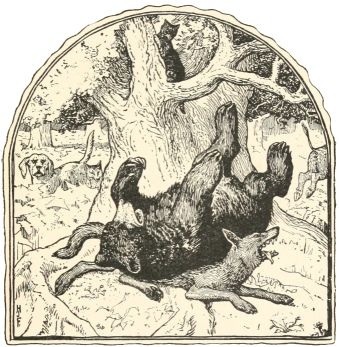
The wild boar got up in a dreadful fright, gave one loud grunt and disappeared into the wood. But the cat was even more startled than the boar, and, spitting with terror, she scrambled up into the fork of the tree, and as it happened right into the bear's face. Now it was the bear's turn to be alarmed, and with a mighty growl he jumped down from the oak and fell right on the top of the wolf and killed him as dead as a stone.

illustration by H. J. Ford

On their way home from the war the fox caught a score of mice, and when they reached Simon's cottage he put them all on the stove and said to the cat, 'Now go and fetch one mouse after the other, and lay them down before your master.'

'All right,' said the cat, and did exactly as the fox told her.

When Susan saw this she said to her husband, 'Just look, here is our old cat back again, and see what a lot of mice she has caught.'

'Wonders will never cease,' cried Simon. 'I certainly never thought the old cat would ever catch another mouse.'

But Susan answered, 'There, you see, I always said our cat was a most excellent creature—but you men always think you know best.'

In the meantime the fox said to the dog, 'Our friend Simon has just killed a pig; when it gets a little darker, you must go into the courtyard and bark with all your might.'

'All right,' said the dog, and as soon as it grew dusk he began to bark loudly.

Susan, who heard him first, said to her husband, 'Our dog must have come back, for I hear him barking lustily. Do go out and see what's the matter; perhaps thieves may be stealing our sausages.'

But Simon answered, 'The foolish brute is as deaf as a post and is always barking at nothing,' and he refused to get up.

The next morning Susan got up early to go to church at the neighbouring town, and she thought she would take some sausages to her aunt who lived there. But when she went to her larder, she found all the sausages gone, and a great hole in the floor. She called out to her husband, 'I was perfectly right. Thieves have been here last night, and they have not left a single sausage. Oh! if you had only got up when I asked you to!'

Then Simon scratched his head and said, 'I can't understand it at all. I certainly never believed the old dog was so quick at hearing.'

But Susan replied, 'I always told you our old dog was the best dog in the world—but as usual you thought you knew so much better. Men are the same all the world over.'

And the fox scored a point too, for he had carried away the sausages himself!

******

Yes, modern warfare is way beyond this story.  It begins like many other tales in a wish to eliminate unproductive animals.  Frankly that happens in agriculture and even zoos.  There's also a bit of sly showing this woman in the story knowing better than the man.  (Guess who probably told this story through the centuries?)  The clumsiness of the opponents of the fox, dog, and cat are handled with a bit of slapstick humor, but what is the final effect upon the listener?  Does the story offer a parallel to our world?  As I said in the opening, " Wish the reality of war among people was as easily resolved as this story."  Might it encourage people, however, fighting against seemingly overwhelming odds?  

As we look at the news, we know the conflicts aren't settled as easily.  The anthology came out in 1906, before even "The War to End All Wars" as the third in the series of fairy books with a color in the title.  Lang, at the time, believed it would be the last.  Fortunately he didn't stop there.  What kept them coming?   Stories like this create a background of hope.  Also it is worth looking for ways even powerful bullies can be defeated. 

 ********************

Friday, March 18, 2022

Bain - The Origin of the Mole - Keeping the Public in Public Domain

https://upload.wikimedia.org/wikipedia/commons/4/44/Kret_mole.jpg 
This Sunday is the offiffiffic'al start of Spring.  It's even starting to feel a bit like Spring in the metro Detroit area!  I like to say Spring is the time of year when a little hard work pays off in a lot of hard work later.  Living in an area where we sit on acreage, I'm not inclined to get overly worked up about having a beautiful lawn.  It's probably just as well for the sake of our area wildlife.  Our tractor is larger than a garden tractor, as those weren't up to the job of mowing the sections we mow.  When mowing it's common to find dirt tunnels made by moles.  If this was suburbia maybe that would bother me, but I'm able to have a "live and let live" attitude enjoying the rare sighting of their soft furry bodies.  (My dog has other ideas!)

Recently I introduced the Ukrainian folktales found in R. Nisbet Bain's Cossack Fairy Tales and Folk Tales, the only English language collection of Ukrainian folklore in Public Domain.  The story is small, like a mole, and I'm sure we could personify the "rich man" and the "poor man" having the "field in common" with current events.  I have more about moles after the story.

THE ORIGIN OF THE MOLE

Once upon a time a rich man and a poor man had a field in common, and they sowed it with the same seed at the same time. But God prospered the poor man’s labour and made his seed to grow, but the rich man’s seed did not grow. Then the rich man claimed that part of the field where the grain had sprung up, and said to the poor man, “Look now! ’tis my seed that has prospered, and not thine!” The poor man protested, but the rich man would not listen, but said to him, “If thou wilt not believe me, then, poor man, come into the field quite early to-morrow morning, before dawn, and God shall judge betwixt us.”

Then the poor man went home. But the rich man dug a deep trench in the poor man’s part of the field and placed his son in it, and said to him, “Look now, my son; when I come hither to-morrow morning and ask whose field this is, say that it is not the poor man’s, but the rich man’s.”

Then he well covered up his son with straw, and departed to his own house.

In the morning all the people assembled together and went to the field, and the rich man cried, “Speak, O God! whose field is this, the rich man’s or the poor man’s?”

“The rich man’s, the rich man’s,” cried a voice from the midst of the field.

But the Lord Himself was among the people gathered together there, and He said, “Listen not to that voice, for the field is verily the poor man’s.”

Then the Lord told all the people how the matter went, and then He said to the son of the rich man,

“Stay where thou art, and sit beneath the earth all thy days, so long as the sun is in the sky.”

So the rich man’s son became a mole on the spot, and that is why the mole always flies the light of day.

*********

That reminds me of the two New Testament stories of the sower and the other about weeds.  Beyond that I found two sites about moles that might help to know more about them.  Live Science tells facts about them I find more interesting than the standard Wikipedia reference given at the start of today's blog.  For those considering them pests, MyMove.com's pest control section offers "How to Get Rid of Moles and Keep Them Away for Good."  I especially applaud their recommendations as being both non-poisonous and using household items.  Remember neighborhood cats, dogs, and other animals might eat a poisoned mole and also be affected.  


Now for something completely different (shades of Monty Python!) here's a site that's fun for drawing.  https://www.wedrawanimals.com/how-to-draw-a-cute-mole/ gives more moles than just this mole and is also worth prowling for even more easy drawing.

That site might give you other animals to draw and include when you tell stories.  I hope you feel ready to Spring into action.  It's certainly the time when animals are coming back into our neighborhoods.  Let's enjoy the transition and hope Spring really is here with all the welcome changes from Winter.

*****************

This is part of a series of postings of stories under the category, "Keeping the Public in Public Domain."  The idea behind Public Domain was to preserve our cultural heritage after the authors and their immediate heirs were compensated.  I feel strongly current copyright law delays this intent on works of the 20th century.  My own library of folklore includes so many books within the Public Domain I decided to share stories from them.  I hope you enjoy discovering new stories.  


At the same time, my own involvement in storytelling regularly creates projects requiring research as part of my sharing stories with an audience.  Whenever that research needs to be shown here, the publishing of Public Domain stories will not occur that week.  This is a return to my regular posting of a research project here.  (Don't worry, this isn't dry research, my research is always geared towards future storytelling to an audience.)  Response has convinced me that "Keeping the Public in Public Domain" should continue along with my other postings as often as I can manage it.
Other Public Domain story resources I recommend-
  • There are many online resources for Public Domain stories, maybe none for folklore is as ambitious as fellow storyteller, Yoel Perez's database, Yashpeh, the International Folktales Collection.  I have long recommended it and continue to do so.  He has loaded Stith Thompson's Motif Index into his server as a database so you can search the whole 6 volumes for whatever word or expression you like by pressing one key. http://folkmasa.org/motiv/motif.htm
  • You may have noticed I'm no longer certain Dr. Perez has the largest database, although his offering the Motif Index certainly qualifies for those of us seeking specific types of stories.  There's another site, FairyTalez claiming to be the largest, with "over 2000 fairy tales, folktales, and fables" and they are "fully optimized for phones, tablets, and PCs", free and presented without ads.

    Between those two sites, there is much for story-lovers, but as they say in infomercials, "Wait, there's more!"
The email list for storytellers, Storytell, discussed Online Story Sources and came up with these additional suggestions:            
         - David K. Brown - http://people.ucalgary.ca/~dkbrown/stories.html
         - Richard Martin - http://www.tellatale.eu/tales_page.html
         - Spirit of Trees - http://spiritoftrees.org/featured-folktales
         - Story-Lovers - http://www.story-lovers.com/ is now only accessible through the Wayback Machine, described below, but the late Jackie Baldwin's wonderful site lives on there, fully searchable manually (the Google search doesn't work), at https://archive.org/ .  It's not easy, but go to Story-lovers.com snapshot for October 22 2016  and you can click on SOS: Searching Out Stories to scroll down through the many story topics and click on the story topic that interests you.
       - World of Tales - http://www.worldoftales.com/ 
           - Zalka Csenge Virag - http://multicoloreddiary.blogspot.com doesn't give the actual stories, but her recommendations, working her way through each country on a continent, give excellent ideas for finding new books and stories to love and tell.
     
You're going to find many of the links on these sites have gone down, BUT go to the Internet Archive Wayback Machine to find some of these old links.  Tim's site, for example, is so huge probably updating it would be a full-time job.  In the case of Story-Lovers, it's great that Jackie Baldwin set it up to stay online as long as it did after she could no longer maintain it.  Possibly searches maintained it.  Unfortunately Storytell list member, Papa Joe is on both Tim Sheppard's site and Story-Lovers, but he no longer maintains his old Papa Joe's Traveling Storytelling Show website and his Library (something you want to see!) is now only on the Wayback Machine.  It took some patience working back through claims of snapshots but finally in December of 2006 it appears!
    Somebody as of this writing whose stories can still be found by his website is the late Chuck Larkin - http://chucklarkin.com/stories.html.  I prefer to list these sites by their complete address so they can be found by the Wayback Machine, a.k.a. Archive.org, when that becomes the only way to find them.
You can see why I recommend these to you. Have fun discovering even more stories!


Friday, March 11, 2022

Colum - The King of the Birds - Keeping the Public in Public Domain

I'm torn between wanting to feature Irish material before next week's St. Patrick's Day and remain with resources related to the current Ukrainian invasion by Russia.  Today's story is an Irish story told by Padriac Colum in The Boy Who Knew What the Birds Said .  I hope it's prophetic of the Ukrainian people managing to use their wits and limited resources to fight back against what would seem the obvious ruler over them and other countries.

(There's a bit of a "frame" before the story begins.  It starts after the dividing line.)

The King of the Birds

The thirteen little wrens sat on the Apple-yard wall in the King's Garden and their mother was there to teach them to fly. One called them the little wrens, but really each one was as big as their mother. She had a tail, however, that was most cunningly cocked and they had no tails, and the consequence was that when they made their little flights they always went sideways. Moreover, their beaks were still yellow and wide and open and this is always a sign of the young bird.

"All I ask of you," said the mother, "is that when you go into the World you remember that you are the Children of the King of the Birds."

"Now why does our Mother call us the Children of the King of the Birds?" said one little wren to the other. "I think we're really very small. And I think our Mother is very small. And there's our Father behind that ivy-leaf and he's very small too."

"And wherever you go, be sure to conduct yourselves like the Children of the King of the Birds," said the Mother.

"It's because we were reared in such a fine nest," said another little wren. "No other birds in the world had ever a finer nest than we have had. That's the reason we're called the Children of the King of the Birds."

"Men call the Wren the King of the Birds," said the Father Wren, as he flew up on a tree, "and surely men ought to know who is the King of the Birds."

"Why do men call the Wren the King of the Birds?" said the little wrens.

"I will tell you," said the Mother. "As we fly from the wall to the tree, and from the tree back to the wall, I will tell you why men honor the wren as the King of the Birds."

She spent a whole day telling the little wrens the story and the Boy Who Knew What the Birds Said was there, and he heard the whole of it.—


The King of the Hither-side of the Mountain conquered the two villages of Half-a-Loaf and Windy-Gap, and the very day he conquered he ordered the two Headmen to come before him.

"You two Headmen are to see that your villages, Half-a-Loaf and Windy-Gap, send me my rightful tribute," said the King to them.

"There isn't much we can send...." said the Headman of Half-a-Loaf.

"A string of salmon," said the Headman of Windy-Gap.

"A basket of plover's eggs," said the Headman of Half-a-Loaf.

"No," said the King, "the tribute that each of your villages must send me is the King of the Birds."

The two Headmen went back to their villages, and that very day each told at the council what tribute the King had ordered them to send. "The King of the Birds," said the people of Half-a-Loaf, "that's the Eagle surely." "The King of the Birds," said the people of Windy-Gap. "What Bird might that be? We'll have to give thought to this."

The people of Windy-Gap thought about it and thought about it, but the people of Half-a-Loaf declared there was no doubt at all about it—the Eagle was the King of the Birds. And while the people of Windy-Gap were thinking and pondering the people of Half-a-Loaf were sending their young men off to catch an eagle.

But an eagle is a hard fowl to catch, and the people of Half-a-Loaf found they had to send all of their young men out and to send them out every day. And the young men climbed high hills and stony ditches, and they searched the east and they hunted the west; they went out at sunrise and they came back at sunset, but never an eagle did they bring with them.

"It may be that the Eagle is the King of the Birds," said the people of Windy-Gap, "but we had better consider it."

They thought about it from sunrise to sunset; they thought about it while they plowed their fields and sowed them, while they spun their cloth and made their coats, while they mended their nets and mended their shoes, while they thatched their roofs and planted their apple-trees.

And in Half-a-Loaf there was few left to plow the fields and sow them, to spin cloth and to make coats, to mend nets and to mend shoes, to thatch roofs and to plant apple-trees—there was few left to do these things for all the young men were out on the mountain hunting for an eagle.

"The people of Windy-Gap will be ruined," said the people of Half-a-Loaf, "they have done nothing yet to catch the Eagle. When the King gets no tribute from them he'll come down and sell them and their village. Call the young men back that have gone into the fields to work and send them up the mountain again."

At last the people of Half-a-Loaf caught their Eagle—a great golden Eagle he was. They built for him a shed and they fed him on what lambs they had that year.

"We're safe anyway," said the people of Half-a-Loaf, "but the unfortunate folk in Windy-Gap have lost their chance. They'll not have time to catch an eagle now."

The time was coming near when the two villages would have to send their tribute to the King.

"We have our Eagle," said the people of Half-a-Loaf, "But O, Bad Fortune! we have hardly a crop growing. This will be a hard year for us—we haven't lambs to grow into sheep even."

"We have our crops," said the people of Windy-Gap, "but, Bad Cess to it! What are we to do about paying our tribute to the King?"

And still they couldn't decide whether it was the Eagle or the Cuckoo or the Woodpecker that was King of the Birds. They were still considering it when the King's Messenger came to bid them come with their tribute to the King's Castle.

What were the people of Windy-Gap to do? They searched round and about but no bird at all could they find. And then as he was being marched off the Headman put his hand under the thatch of his house and took out a Wren that was sheltering there. He put the Wren under his hat and went off with the King's Messenger.

And there, before him on the way to the King's Castle was the Headman of Half-a-Loaf. The riders of the village were with him and they bore their golden Eagle most triumphantly.

"Give to my Falconer the King of the Birds," said the King.

The Headman of Half-a-Loaf presented the Eagle.

"It is well," said the King, "and where have you," said he to the Headman of Windy-Gap, "bestowed the King of the Birds?"

The Headman put his hand under his hat and handed over the Wren to the King's Falconer.

"Tush," said the King, "Why do you call this the King of the Birds?"

The Headman of Windy-Gap was going to say "Because his family is great," but he said instead "Because he flies the highest, my lord."

"If it be truth it's unknown to me," said the King, "but it shall be tried out."

Then said he to the Royal Falconer, "Let the Eagle and the Wren soar together. And when the Eagle outsoars the Wren it shall be proved that the Headman of Windy-Gap is a catiff, and his village and everyone in it will be sold to the Saracens. But if it so happens that the Wren outsoars the Eagle, the tribute sent from the village of Windy-Gap must be accepted."

The Eagle and the Wren rose from the same perch and soared up together. Up and up the Eagle went. "So far my father went, but I shall go farther," said the Eagle. Higher and higher he rose. "So far my grandfather went but I shall go farther." Farther and farther he soared. "So far went my great-grandfather, and no eagle again will fly so high." His wings were stiff and tired. "No bird will ever out-soar this flight of mine," said the Eagle.

He went to close his wings so that he might rest them as he went down. But as he did the Wren came from under his wings.

Up went the Wren, down went the Eagle. Up and up went the Wren. He had been resting while the Eagle had been flying, and now he was able to soar past the point the Eagle had reached at his dead-best.

"No bird will ever out-soar this flight of mine," said the Eagle. 


The Eagle flew down and lighted on the Falconer's perch. "Has he flown high, Falconer?" asked the King. "No bird has flown so high," said the Falconer. "By the rime on his wings he has gone into the line of frost."

"The Eagle is King of the Birds and no one can deny it," said the King. "The village of Windy-Gap has not sent me my tribute."

"Mercy," said the Headman of Windy-Gap.

"The village and all in it shall be sold to the Saracens," said the King.

Just then the Wren came down and lighted on the perch beside the Eagle. "Where did the Wren fly to?" said the King. "By my glove," said the Falconer "he soared past the line of frost, and went into the line of snow, for what's on his feathers is a drop of snow."

"The Wren is King of the Birds," said the Headman of Windy-Gap.

"Yes, King of the Birds," said the King, "and, therefore, my lawful tribute."

And so, for ever after the villages sent to the King, not an Eagle, but a Wren as tribute. And in no village ever after were the lands unplowed and the fields unsown, the cloth unspun and the coats not made, the roofs unthatched and the apple-trees unplanted. And in every village in the hollow and on the height the people shouted for the Wren—"The Wren, the Wren, the King of all Birds."

*************************

May the present situation change so once again the lands are being plowed (Ukraine has long been the bread basket of Europe and beyond), the fields sown, the cloth spun and coats made, the roofs thatched (and the incredible amount of reconstruction needed), and apple trees and other trees replanted.

For those seeking a picture book version, Jane Goodall created a fable based on her remembrance of a story she and her sister heard nightly.  She doesn't name the book where it was found and probably no longer recalls it.  The incident of the wren hiding in the eagle's wing occurs, but it occurs because there's a contest among the birds.  She uses the fable format to illustrate the idea of teamwork and need for everyone to have a little help now and then.  

Was it the same story?  Did her memory shape her view of it?

Similarly I could swear there's a Native American version, but couldn't find it.

Among storytellers the question of "should we state the moral at the end of a fable or not" is often discussed.  Goodall clearly believes it should, although the Horn Book review faults her for the book being "heavy on message."  The explanation storytellers often give for NOT stating a conclusion to a story is it can and should mean many different things to the many different members of your audience.  Teachers can check this, if they wish, by offering a story and then asking students what the story might be trying to teach.  In a discussion it might become obvious we all hear what we need or want to hear.

Similarly there are many views of the current invasion.  I pray it ends well and actually has an ending since it's stirring up events dating back to times many believed were settled.

*********************


This is part of a series of postings of stories under the category, "Keeping the Public in Public Domain."  The idea behind Public Domain was to preserve our cultural heritage after the authors and their immediate heirs were compensated.  I feel strongly current copyright law delays this intent on works of the 20th century.  My own library of folklore includes so many books within the Public Domain I decided to share stories from them.  I hope you enjoy discovering new stories.  


At the same time, my own involvement in storytelling regularly creates projects requiring research as part of my sharing stories with an audience.  Whenever that research needs to be shown here, the publishing of Public Domain stories will not occur that week.  This is a return to my regular posting of a research project here.  (Don't worry, this isn't dry research, my research is always geared towards future storytelling to an audience.)  Response has convinced me that "Keeping the Public in Public Domain" should continue along with my other postings as often as I can manage it.
Other Public Domain story resources I recommend-
  • There are many online resources for Public Domain stories, maybe none for folklore is as ambitious as fellow storyteller, Yoel Perez's database, Yashpeh, the International Folktales Collection.  I have long recommended it and continue to do so.  He has loaded Stith Thompson's Motif Index into his server as a database so you can search the whole 6 volumes for whatever word or expression you like by pressing one key. http://folkmasa.org/motiv/motif.htm
  • You may have noticed I'm no longer certain Dr. Perez has the largest database, although his offering the Motif Index certainly qualifies for those of us seeking specific types of stories.  There's another site, FairyTalez claiming to be the largest, with "over 2000 fairy tales, folktales, and fables" and they are "fully optimized for phones, tablets, and PCs", free and presented without ads.

    Between those two sites, there is much for story-lovers, but as they say in infomercials, "Wait, there's more!"
The email list for storytellers, Storytell, discussed Online Story Sources and came up with these additional suggestions:            
         - David K. Brown - http://people.ucalgary.ca/~dkbrown/stories.html
         - Richard Martin - http://www.tellatale.eu/tales_page.html
         - Spirit of Trees - http://spiritoftrees.org/featured-folktales
         - Story-Lovers - http://www.story-lovers.com/ is now only accessible through the Wayback Machine, described below, but the late Jackie Baldwin's wonderful site lives on there, fully searchable manually (the Google search doesn't work), at https://archive.org/ .  It's not easy, but go to Story-lovers.com snapshot for October 22 2016  and you can click on SOS: Searching Out Stories to scroll down through the many story topics and click on the story topic that interests you.
       - World of Tales - http://www.worldoftales.com/ 
           - Zalka Csenge Virag - http://multicoloreddiary.blogspot.com doesn't give the actual stories, but her recommendations, working her way through each country on a continent, give excellent ideas for finding new books and stories to love and tell.
     
You're going to find many of the links on these sites have gone down, BUT go to the Internet Archive Wayback Machine to find some of these old links.  Tim's site, for example, is so huge probably updating it would be a full-time job.  In the case of Story-Lovers, it's great that Jackie Baldwin set it up to stay online as long as it did after she could no longer maintain it.  Possibly searches maintained it.  Unfortunately Storytell list member, Papa Joe is on both Tim Sheppard's site and Story-Lovers, but he no longer maintains his old Papa Joe's Traveling Storytelling Show website and his Library (something you want to see!) is now only on the Wayback Machine.  It took some patience working back through claims of snapshots but finally in December of 2006 it appears!
    Somebody as of this writing whose stories can still be found by his website is the late Chuck Larkin - http://chucklarkin.com/stories.html.  I prefer to list these sites by their complete address so they can be found by the Wayback Machine, a.k.a. Archive.org, when that becomes the only way to find them.
You can see why I recommend these to you. Have fun discovering even more stories!