The Wee Bairns area will re-open next week on August 5 at the 174th St. Andrew's Society of Detroit Highland Games. Their stated purpose is
St. Andrew’s Society of Detroit
recognizes that children are our future. To help bring our heritage to
them, our Highland Games created an area specially designed for
them, Wee Bairns.
Wee Bairns events allow children to gain an understanding of our heritage while having fun.
This is their listing on Michigan Storytelling, the monthly website I manage listing Michigan's storytelling activities.
August 5, 11:00 a.m.-3:00 p.m. EDT
(Live Event)
St. Andrew's Society of Detroit and North Oakland County Storytellers
(NOCS) welcome children to the Wee Bairns area of the 174th annual
Highland Games for stories of Scottish heritage. Contact the Society at
(248) 526-1849 for more information or go to the
Wee Bairns section of the Highland Games information at <
https://highlandgames.com/wee-bairns/> . The event is at 20501
Newburgh Rd. at Greenmead Historical Park in Livonia. Advance Games
tickets are available online. Online and tickets purchased at the gate
for the day are $20. Children 12 and under are admitted
free.
I'm pleased that once again I can be one of the storytellers providing "a wee tour of Scotland."
One of those traditional tales I do not intend to tell is the origin of our well-known Gingerbread Boy. It's a type of tale called a "Chain Story" because of the way it is structured. Following that link there are activities using this structure to teach predictability and storytelling.
Why wouldn't I tell this story?
There are so many words and professions needing explanation it would slow the story down, starting with "What is a bannock in Scotland?" which Wikipedia explains. I sometimes say I treat my family like gods...Burnt Offerings. I don't feel ready to serve my attempts at making a bannock, but could have handouts with recipes. There are many online. https://www.cookingnook.com/recipe/bannock/ promises an easy version. As you might expect, there are probably as many variations as there are those who bake or fry a bannock.
No, what stops me is the very intent of the Wee Bairns as there are all manner of occupations, done in traditional ways each deserving explanation. Even the author uses footnotes for two of the terms, sending the reader to a glossary. That means the author gives you the option of going to the Glossary. I'm going to give the same option to online explanations by adding links to four words I believe need explanations. As links they are a different color easily giving the option.
Why not offer handouts and explanations? They slow down the story at an event meant to emphasize entertainment and is for children of all ages. I'm giving it here both to announce the coming event and for the reader to decide how they want to pursue the story. (By the way a board book exists -- by its nature meant for the youngest children. The visual offers the option to understand much better than mere words, but, of course, is not Public Domain.)
.jpg) |
Cover by Nour Salem for board book by Elizabeth W. Grierson
|
This is the story from Elizabeth Grierson's 1910 book of THE SCOTTISH FAIRY BOOK found on Project Gutenberg. (I recommend her Preface and many of the well-known tales in the book.)
THE WEE BANNOCK
"Some tell about their sweethearts,
How they tirled them to the winnock,
But I'll tell you a bonnie tale
About a guid oatmeal bannock."
There was once an old man and his wife, who lived in a dear little
cottage by the side of a burn. They were a very canty and contented
couple, for they had enough to live on, and enough to do. Indeed, they
considered themselves quite rich, for, besides their cottage and their
garden, they possessed two sleek cows, five hens and a cock, an old cat,
and two kittens.
The old man spent his time looking after the cows, and the hens, and the
garden; while the old woman kept herself busy spinning.
One day, just after breakfast, the old woman thought that she would like
an oatmeal bannock for her supper that evening, so she took down her
bakeboard, and put on her girdle, and baked a couple of fine cakes, and
when they were ready she put them down before the fire to harden.
While they were toasting, her husband came in from the byre, and sat
down to take a rest in his great arm-chair. Presently his eyes fell on
the bannocks, and, as they looked very good, he broke one through the
middle and began to eat it.
When the other bannock saw this it determined that it should not have
the same fate, so it ran across the kitchen and out of the door as fast
as it could. And when the old woman saw it disappearing, she ran after
it as fast as her legs would carry her, holding her spindle in one hand
and her distaff in the other.
But she was old, and the bannock was young, and it ran faster than she
did, and escaped over the hill behind the house. It ran, and it ran, and
it ran, until it came to a large newly thatched cottage, and, as the
door was open, it took refuge inside, and ran right across the floor to
a blazing fire, which was burning in the first room that it came to.
Now, it chanced that this house belonged to a tailor, and he and his two
apprentices were sitting cross-legged on the top of a big table by the
window, sewing away with all their might, while the tailor's wife was
sitting beside the fire carding lint.
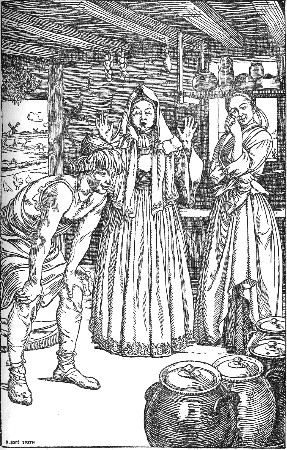
When the wee bannock came trundling across the floor, all three tailors
got such a fright that they jumped down from the table and hid behind
the Master Tailor's wife.
"Hoot," she said, "what a set of cowards ye be! 'Tis but a nice wee
bannock. Get hold of it and divide it between you, and I'll fetch you
all a drink of milk."
So she jumped up with her lint and her lint cards, and the tailor jumped
up with his great shears, and one apprentice grasped the line measure,
while another took up the saucer full of pins; and they all tried to
catch the wee bannock. But it dodged them round and round the fire, and
at last it got safely out of the door and ran down the road, with one of
the apprentices after it, who tried to snip it in two with his shears.
It ran too quickly for him, however, and at last he stopped and went
back to the house, while the wee bannock ran on until it came to a tiny
cottage by the roadside. It trundled in at the door, and there was a
weaver sitting at his loom, with his wife beside him, winding a clue of yarn.
"What's that, Tibby?" said the weaver, with a start as the little cake
flew past him.
"Oh!" cried she in delight, jumping to her feet, "'tis a wee bannock. I
wonder where it came from?"
"Dinna bother your head about that, Tibby," said her man, "but grip it,
my woman, grip it."
But it was not so easy to get hold of the wee bannock. It was in vain
that the Goodwife threw her clue at it, and that the Goodman tried to
chase it into a corner and knock it down with his shuttle. It dodged,
and turned, and twisted, like a thing bewitched, till at last it flew
out at the door again, and vanished down the hill, "for all the
world," as the old woman said, "like a new tarred sheep, or a daft cow."
In the next house that it came to it found the Goodwife in the kitchen,
kirning. She had just filled her kirn, and there was still some cream
standing in the bottom of her cream jar.
"Come away, little bannock," she cried when she saw it. "Thou art come
in just the nick of time, for I am beginning to feel hungry, and I'll
have cakes and cream for my dinner."
But the wee bannock hopped round to the other side of the kirn, and the
Goodwife after it. And she was in such a hurry that she nearly upset the
kirn; and by the time that she had put it right again, the wee bannock
was out at the door and half-way down the brae to the mill.
The miller was sifting meal in the trough, but he straightened himself
up when he saw the little cake.
"It's a sign of plenty when bannocks are running about with no one to
look after them," he said; "but I like bannocks and cheese, so just come
in, and I will give thee a night's lodging."
But the little bannock had no wish to be eaten up by the miller, so it
turned and ran out of the mill, and the miller was so busy that he did
not trouble himself to run after it.
After this it ran on, and on, and on, till it came to the smithy, and
it popped in there to see what it could see.
The smith was busy at the anvil making horse-shoe nails, but he looked
up as the wee bannock entered.
"If there be one thing I am fond of, it is a glass of ale and a
well-toasted cake," he cried. "So come inbye here, and welcome to ye."
But as soon as the little bannock heard of the ale, it turned and ran
out of the smithy as fast as it could, and the disappointed smith picked
up his hammer and ran after it. And when he saw that he could not catch
it, he flung his heavy hammer at it, in the hope of knocking it down,
but, luckily for the little cake, he missed his aim.
After this the bannock came to a farmhouse, with a great stack of peats
standing at the back of it. In it went, and ran to the fireside. In this
house the master had all the lint spread out on the floor, and was
cloving[1] it with an iron rod, while the mistress was heckling[2] what
he had already cloven.
"Oh, Janet," cried the Goodman in surprise, "here comes in a little
bannock. It looks rare and good to eat. I'll have one half of it."
"And I'll have the other half," cried the Goodwife. "Hit it over the
back with your cloving-stick, Sandy, and knock it down. Quick, or it
will be out at the door again."
But the bannock played "jook-about," and dodged behind a chair. "Hoot!"
cried Janet contemptuously, for she thought that her husband might
easily have hit it, and she threw her heckle at it.
But the heckle missed it, just as her husband's cloving-rod had done,
for it played "jook-about" again, and flew out of the house.
This time it ran up a burnside till it came to a little cottage standing
among the heather.
Here the Goodwife was making porridge for the supper in a pot over the
fire, and her husband was sitting in a corner plaiting ropes of straw
with which to tie up the cow.
"Oh, Jock! come here, come here," cried the Goodwife. "Thou art aye
crying for a little bannock for thy supper; come here, histie, quick,
and help me to catch it."
"Ay, ay," assented Jock, jumping to his feet and hurrying across the
little room. "But where is it? I cannot see it."
"There, man, there," cried his wife, "under that chair. Run thou to that
side; I will keep to this."
So Jock ran into the dark corner behind the chair; but, in his hurry, he
tripped and fell, and the wee bannock jumped over him and flew laughing
out at the door.
Through the whins and up the hillside it ran, and over the top of the
hill, to a shepherd's cottage on the other side.
The inmates were just sitting down to their porridge, and the Goodwife
was scraping the pan.
"Save us and help us," she exclaimed, stopping with the spoon half-way
to her mouth. "There's a wee bannock come in to warm itself at our
fireside."
"Sneck the door," cried the husband, "and we'll try to catch it. It
would come in handy after the porridge."
But the bannock did not wait until the door was sneckit. It turned and
ran as fast as it could, and the shepherd and his wife and all the
bairns ran after it, with their spoons in their hands, in hopes of
catching it.
And when the shepherd saw that it could run faster than they could, he
threw his bonnet at it, and almost struck it; but it escaped all these
dangers, and soon it came to another house, where the folk were just
going to bed.
The Goodman was half undressed, and the Goodwife was raking the cinders
carefully out of the fire.
"What's that?" said he, "for the bowl of brose that I had at supper-time
wasna' very big."
"Catch it, then," answered his wife, "and I'll have a bit, too. Quick!
quick! Throw your coat over it or it will be away."
So the Goodman threw his coat right on the top of the little bannock,
and almost managed to smother it; but it struggled bravely, and got
out, breathless and hot, from under it. Then it ran out into the grey
light again, for night was beginning to fall, and the Goodman ran out
after it, without his coat. He chased it and chased it through the
stackyard and across a field, and in amongst a fine patch of whins. Then
he lost it; and, as he was feeling cold without his coat, he went home.
As for the poor little bannock, it thought that it would creep under a
whin bush and lie there till morning, but it was so dark that it never
saw that there was a fox's hole there. So it fell down the fox's hole,
and the fox was very glad to see it, for he had had no food for two
days.
"Oh, welcome, welcome," he cried; and he snapped it through the middle
with his teeth, and that was the end of the poor wee bannock.
And if a moral be wanted for this tale, here it is: That people should
never be too uplifted or too cast down over anything, for all the good
folk in the story thought that they were going to get the bannock, and,
lo and behold! the fox got it after all.
Footnotes to the glossary
1 - Cloving separating lint from its stalk
2 - Heckle to comb
***
Our Gingerbread Boy versions clearly descends from this Scottish story. There have been an even dozen stories before this with the label of Scottish folklore. This makes the 13th with my own decision and rationale as to why I won't tell it. . . with the possible exception of in a classroom seeking in-depth look into Scottish folklore and occupations of the past.
***************************
This
is part of a series of postings of stories under the category,
"Keeping the Public in Public Domain." The idea
behind Public Domain was to preserve our cultural heritage after the
authors and their immediate heirs were compensated. I feel
strongly current copyright law delays this intent on works of the
20th century. My
own library of folklore includes so many books within the Public
Domain I decided to share stories from them. I hope you enjoy
discovering new stories.

At
the same time, my own involvement in storytelling regularly creates
projects requiring research as part of my sharing stories with an
audience. Whenever that research needs to be shown here, the publishing
of Public Domain stories will not occur that week. This is a return to
my regular posting of a research project here. (Don't worry, this
isn't dry research, my research is always geared towards future
storytelling to an audience.) Response has convinced me that "Keeping
the Public in Public Domain" should continue along with my other
postings as often as I can manage it.
Other
Public Domain story resources I recommend-
There
are many online resources for Public Domain stories, maybe none for
folklore is as ambitious as fellow storyteller, Yoel Perez's
database, Yashpeh,
the International Folktales Collection. I have long
recommended it and continue to do so. He has loaded
Stith Thompson's Motif Index into his server as a database so
you can search the whole 6 volumes for whatever word or expression
you like by pressing one key. http://folkmasa.org/motiv/motif.htm
You may have noticed I'm no
longer certain Dr. Perez has the largest database, although his
offering the Motif Index certainly qualifies for those of us seeking
specific types of stories. There's another site, FairyTalez
claiming to be the largest, with "over 2000 fairy tales,
folktales, and fables" and they are "fully optimized for
phones, tablets, and PCs", free and presented without ads.
Between those two sites, there
is much for story-lovers, but as they say in infomercials, "Wait,
there's more!"
The
email list for storytellers, Storytell,
discussed Online Story Sources and came up with these additional
suggestions:
-
Story-Lovers - http://www.story-lovers.com/ is now only accessible
through the Wayback Machine, described below, but the late Jackie Baldwin's
wonderful site lives on there, fully searchable manually (the Google
search doesn't work), at https://archive.org/ . It's not easy, but go to Story-lovers.com snapshot for December 22 2016 and you can click on SOS: Searching Out Stories to scroll down through the many story topics and click on the story topic that interests you.
- Zalka Csenge Virag - http://multicoloreddiary.blogspot.com
doesn't give the actual stories, but her recommendations, working her
way through each country on a continent, give excellent ideas for
finding new books and stories to love and tell.
You're
going to find many of the links on these sites have gone down, BUT
go to the Internet Archive
Wayback Machine to find some of these old links. Tim's
site, for example, is so huge probably updating it would be a
full-time job. In the case of Story-Lovers, it's great that
Jackie Baldwin set it up to stay online as long as it did after she
could no longer maintain it. Possibly searches maintained it.
Unfortunately Storytell list member, Papa Joe is on both Tim
Sheppard's site and Story-Lovers, but he no longer maintains his old
Papa Joe's Traveling Storytelling Show website and his Library
(something you want to see!) is now only on the Wayback Machine. It
took some patience working back through claims of snapshots but finally
in December of 2006 it appears!
Somebody
as of this writing whose stories can still be found by his website
is the late Chuck Larkin - http://chucklarkin.com/stories.html.
I prefer to list these sites by their complete address so they can
be found by the Wayback Machine, a.k.a. Archive.org, when that
becomes the only way to find them.
You
can see why I recommend these to you.
Have fun
discovering even more stories


.jpg)


.jpg)

.jpg)