Tell me if you have a topic you'd like to see. (Contact: LoiS-sez@LoiS-sez.com .)
Please also let others know about this site.

Friday, July 29, 2022

The Highland Games + Johnny Gloke - Joseph Jacobs - Keeping the Public in Public Domain


The Wee Bairns area of the 173rd Highland Games of the St. Andrews Society of Detroit is returning!  It was missing at the 2020 and 2021 Highland Games due to Covid concerns.  It's always in a big open area at Greenmead Historical Village in Livonia so its elimination was surprising.  The intent behind the Wee Bairns area is bringing an understanding of Scottish heritage to children with fun events tailored to them.  

While North Oakland County Storytellers no longer hold meetings, some of us treasure our Scottish heritage and have told stories in the Wee Bairns area for a great many years.  Once again from 10 to 3 on Saturday, August 6, N.O.C.S. will bring it to listeners.  Ten of those stories can be found here under the heading of Scottish Folklore.  That reflects only some of the long history of participation there.  It goes back even further than is shown here.

Today's story comes from Joseph Jacobs, More English Fairy Tales, but don't let that title fool you as Jacobs definitely includes Scottish material.  You may jump down to the story, but if that English connection troubles you, read his discussion of this as part of his Preface to the book: 

Then as to using tales in Lowland Scotch, whereat a Saturday Reviewer, whose identity and fatherland were not difficult to guess, was so shocked. Scots a dialect of English! Scots tales the same as English! Horror and Philistinism! was the Reviewer's outcry. Matter of fact is my reply, which will only confirm him, I fear, in his convictions. Yet I appeal to him, why make a difference between tales told on different sides of the Border? A tale told in Durham or Cumberland in a dialect which only Dr. Murray could distinguish from Lowland Scotch, would on all hands be allowed to be "English." The same tale told a few miles farther North, why should we refuse it the same qualification? A tale in Henderson is English: why not a tale in Chambers, the majority of whose tales are to be found also south of the Tweed?

The truth is, my folk-lore friends and my Saturday Reviewer differ with me on the important problem of the origin of folk-tales. They think that a tale probably originated where it was found. They therefore attribute more importance than I to the exact form in which it is found and restrict it to the locality of birth. I consider the probability to lie in an origin elsewhere: I think it more likely than not that any tale found in a place was rather brought there than born there. I have discussed this matter elsewhere[1] with all the solemnity its importance deserves, and cannot attempt further to defend my position here. But even the reader innocent of folk-lore can see that, holding these views, I do not attribute much anthropological value to tales whose origin is probably foreign, and am certainly not likely to make a hard-and-fast division between tales of the North Countrie and those told across the Border.

[1] See "The Science of Folk Tales and the Problem of Diffusion" in Transactions of the International Folk-Lore Congress, 1891.

Don't know if you bothered to read all of that, but here's "Johnny Gloke" which will start out sounding rather familiar.  I'll give Jacobs' brief Notes and References after it.

Johnny Gloke

Johnny Gloke was a tailor by trade, but like a man of spirit he grew tired of his tailoring, and wished to follow some other path that would lead to honour and fame. But he did not know what to do at first to gain fame and fortune, so for a time he was fonder of basking idly in the sun than in plying the needle and scissors. One warm day as he was enjoying his ease, he was annoyed by the flies alighting on his bare ankles. He brought his hand down on them with force and killed a goodly number of them. On counting the victims of his valour, he was overjoyed at his success; his heart rose to the doing of great deeds, and he gave vent to his feelings in the saying:—

"Well done! Johnny Gloke,
Kilt fifty flies at one stroke."

His resolution was now taken to cut out his path to fortune and honour. So he took down from its resting-place a rusty old sword that had belonged to some of his forebears, and set out in search of adventures. After travelling a long way, he came to a country that was much troubled by two giants, whom no one was bold enough to meet, and strong enough to overcome. He was soon told of the giants, and learned that the King of the country had offered a great reward and the hand of his daughter in marriage to the man who should rid his land of this scourge. John's heart rose to the deed, and he offered himself for the service. The great haunt of the giants was a wood, and John set out with his old sword to perform his task. When he reached the wood, he laid himself down to think what course he would follow, for he knew how weak he was compared to those he had undertaken to kill. He had not waited long, when he saw them coming with a waggon to fetch wood for fuel. My! they were big ones, with huge heads and long tusks for teeth. Johnny hid himself in the hollow of a tree, thinking only of his own safety. Feeling himself safe, he peeped out of his hiding-place, and watched the two at work. Thus watching he formed his plan of action. He picked up a pebble, threw it with force at one of them, and struck him a sharp blow on the head. The giant in his pain turned at once on his companion, and blamed him in strong words for hitting him. The other denied in anger that he had thrown the pebble. John now saw himself on the high way to gain his reward and the hand of the King's daughter. He kept still, and carefully watched for an opportunity of striking another blow. He soon found it, and right against the giant's head went another pebble. The injured giant fell on his companion in fury, and the two belaboured each other till they were utterly tired out. They sat down on a log to breathe, rest, and recover themselves.
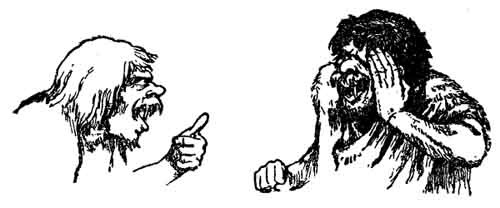
"...the two belaboured each other till they were utterly tired out."

While sitting, one of them said, "Well, all the King's army was not able to take us, but I fear an old woman with a rope's end would be too much for us now."

"If that be so," said Johnny Gloke, as he sprang, bold as a lion, from his hiding-place, "What do you say to Johnny Gloke with his old roosty sword?" So saying he fell upon them, cut off their heads, and returned in triumph. He received the King's daughter in marriage and for a time lived in peace and happiness. He never told the mode he followed in his dealing with the giants.

Some time after a rebellion broke out among the subjects of his father-in-law. John, on the strength of his former valiant deed, was chosen to quell the rebellion. His heart sank within him, but he could not refuse, and so lose his great name. He was mounted on the fiercest horse that ever saw sun or wind, and set out on his desperate task. He was not accustomed to ride on horseback, and he soon lost all control of his steed. It galloped off at full speed, in the direction of the rebel army. In its wild career it passed under the gallows that stood by the wayside. The gallows was somewhat old and frail, and down it fell on the horse's neck. Still the horse made no stop, but always forward at furious speed towards the rebels. On seeing this strange sight approaching towards them at such a speed they were seized with terror, and cried out to one another, "There comes Johnny Gloke that killed the two giants with the gallows on his horse's neck to hang us all." They broke their ranks, fled in dismay, and never stopped till they reached their homes. Thus was Johnny Gloke a second time victorious. So in due time he came to the throne and lived a long, happy, and good life as king.

***

I'm sure you recognized that story under a different name.  Jacobs addresses that: 

  JOHNNY GLOKE

Source.—Contributed by Mr. W. Gregor to Folk-Lore Journal, vii. I have rechristened "Johnny Glaik" for the sake of the rhyme, and anglicised the few Scotticisms.

Parallels.—This is clearly The Valiant Tailor of the Grimms: "x at a blow" has been bibliographised. (See my List of Incidents in Trans. Folk-Lore Congress, 1892, sub voce.)

Remarks.—How The Valiant Tailor got to Aberdeen one cannot tell, though the resemblance is close enough to suggest a direct "lifting" from some English version of Grimm's Goblins. At the same time it must be remembered that Jack the Giant Killer (see Notes on No. xix.) contains some of the incidents of The Valiant Tailor.

 Hope to see you and Nessie at the Highland Games next week on August 6.


 ****************

This is part of a series of postings of stories under the category, "Keeping the Public in Public Domain."  The idea behind Public Domain was to preserve our cultural heritage after the authors and their immediate heirs were compensated.  I feel strongly current copyright law delays this intent on works of the 20th century.  My own library of folklore includes so many books within the Public Domain I decided to share stories from them.  I hope you enjoy discovering new stories.  


At the same time, my own involvement in storytelling regularly creates projects requiring research as part of my sharing stories with an audience.  Whenever that research needs to be shown here, the publishing of Public Domain stories will not occur that week.  This is a return to my regular posting of a research project here.  (Don't worry, this isn't dry research, my research is always geared towards future storytelling to an audience.)  Response has convinced me that "Keeping the Public in Public Domain" should continue along with my other postings as often as I can manage it.

Other Public Domain story resources I recommend-

  • There are many online resources for Public Domain stories, maybe none for folklore is as ambitious as fellow storyteller, Yoel Perez's database, Yashpeh, the International Folktales Collection.  I have long recommended it and continue to do so.  He has loaded Stith Thompson's Motif Index into his server as a database so you can search the whole 6 volumes for whatever word or expression you like by pressing one key. http://folkmasa.org/motiv/motif.htm

  • You may have noticed I'm no longer certain Dr. Perez has the largest database, although his offering the Motif Index certainly qualifies for those of us seeking specific types of stories.  There's another site, FairyTalez claiming to be the largest, with "over 2000 fairy tales, folktales, and fables" and they are "fully optimized for phones, tablets, and PCs", free and presented without ads.
    Between those two sites, there is much for story-lovers, but as they say in infomercials, "Wait, there's more!"

The email list for storytellers, Storytell, discussed Online Story Sources and came up with these additional suggestions:        

         - David K. Brown - http://people.ucalgary.ca/~dkbrown/stories.html

         - Richard Martin - http://www.tellatale.eu/tales_page.html

         - Spirit of Trees - http://spiritoftrees.org/featured-folktales

         - Story-Lovers - http://www.story-lovers.com/ is now only accessible through the Wayback Machine, described below, but the late Jackie Baldwin's wonderful site lives on there, fully searchable manually (the Google search doesn't work), at https://archive.org/ .  It's not easy, but go to Story-lovers.com snapshot for October 22 2016  and you can click on SOS: Searching Out Stories to scroll down through the many story topics and click on the story topic that interests you.

       - World of Tales - http://www.worldoftales.com/ 

 
           - Zalka Csenge Virag - http://multicoloreddiary.blogspot.com doesn't give the actual stories, but her recommendations, working her way through each country on a continent, give excellent ideas for finding new books and stories to love and tell.

     
You're going to find many of the links on these sites have gone down, BUT go to the Internet Archive Wayback Machine to find some of these old links.  Tim's site, for example, is so huge probably updating it would be a full-time job.  In the case of Story-Lovers, it's great that Jackie Baldwin set it up to stay online as long as it did after she could no longer maintain it.  Possibly searches maintained it.  Unfortunately Storytell list member, Papa Joe is on both Tim Sheppard's site and Story-Lovers, but he no longer maintains his old Papa Joe's Traveling Storytelling Show website and his Library (something you want to see!) is now only on the Wayback Machine.  It took some patience working back through claims of snapshots but finally in December of 2006 it appears!

    Somebody as of this writing whose stories can still be found by his website is the late Chuck Larkin - http://chucklarkin.com/stories.html.  I prefer to list these sites by their complete address so they can be found by the Wayback Machine, a.k.a. Archive.org, when that becomes the only way to find them.

You can see why I recommend these to you. 

Have fun discovering even more stories

Friday, July 22, 2022

Last week I mentioned the late and truly great storyteller, Chuck Larkin.  Chuck died April 18, 2003 and if there's any way he can tell stories in "the Great Beyond", I'm sure he's doing it.  Fortunately his family has decided to pay and keep his website online at http://chucklarkin.com/index.html.  


Rather than hunt up the page on the Wayback Machine filled with his traditional stories, the site lets you download Christmas Traditional Stories from the Southeast (Chuck was deeply rooted in Georgia); Fish Tales, tall tales about fish and the people who chase them; Halloween Stories, scary stories about haints, ghosts and things-that-go-bump-in-the-night (including my absolute favorite, "Mary Culhaine"); Hunting for Tall Tales, a collection of tall tales about hunters, dogs and critters who outwit them; a short play for storytellers titled "I Don't Tell Lies"; Short and Tall Tales, he says they are very, very short tall tales; and then Tall Tall Tales, traditional tall tales and stories; The Marriage of Sir Gawain and Lady Ragnell, a pre-Christian saga adapted from a mid-15th century poem fragment and from listening to other variants of this legend from a number of storyteller; and The Hunt,  An Irish Celtic tale about Fianna Warriors.


Since Tall Tales were Chuck's specialty I decided to post two of his "very, very short tales" that seem appropriate at this time when farmers have been planting and harvesting, the weather is extra hot, and roads everywhere seem under construction.  

Short and Tall Tales

Traditional Stories from the Website of Bluegrass Storyteller, Chuck Larkin

My Father’s Brother’s Family and Ridge Farming

The first time I ever visited Georgia was in Habersham County. Uncle John and Aunt Irene had a ridge farm in the Georgia mountains. You may never have seen a ridge farm or if you did you may not have realized how they farm the ridges. You can’t use a tractor. It would roll over on you the first time you tried to turn a row. Folks use mules for the ploughing, planting, weeding and harvesting. Not my Uncle John, he was a gentleman farmer. He raised razorback hogs, a mountain species of the wild piney wood rooters. The mountain variety have long back legs and long ear lobes with holes in the bottom of the ear lobes. The first time I saw one I thought they wore ear bobs in their ear holes. They are ugly. Their heads look like their necks had barfed. One fell into the pond up in front of the farm house. They had that 550-pound hog out of the water in about five minutes. Aunt Irene told me they had to scum ugly off that pond for a year.

My Uncle John raised that species of mountain, razorback hogs, because of the long back legs. The hogs could root right up the side of a ridge turn around, tuck them long back legs into their ear holes and slide right back down the root path. Then they would turn right around and root their way back up the ridge. When it was time to plant, Uncle John tied little disks on the hogs’ tails. Disks look like Frisbees and they break up clods of fresh turned dirt. Uncle John would throw table scraps out over the ridge and at dusk turns the hogs loose. By morning the hogs would have rooted and disked the whole side of the ridge. Uncle John would sit on his rocking chair on his back porch with a bag of seed grain and his sling shot and plant the side of the ridge.

When the harvest was ready all he had to do was hit the side of the ridge with a two-by-four piece of wood, wham bam! All the vegetables would roll down off the ridge to the catch fence. I mean that does make farming a whole lot easier.

Uncle John never had to worry about drought and lack of rain like other farmers did. Across the top of the ridge he would always plant three rows of onions and potatoes mixed together. He surely was a smart farmer to have worked this out. You see if you mix the onions and potatoes together at the top of the ridge the onions would make the tater eyes weep and keep the whole side of the ridge irrigated.

The only mistake Uncle John ever made was the summer he planted some of those hot, hot, hot Mexican jalapeno peppers along the catch fence. When those fiery, hot peppers got ripe, they put off an incredible amount of seething heat that just rolled up the side of the ridge. Well that summer, so happened to be a summer so hot that I’ve watched stumps in the pasture tear themselves out of the ground and on their roots crawl underneath the trees to cool off. I have even seen the shade in the middle of the day creep under the trees to cool off. Hot and Dry! We had the Health Department out to spray the fish in the cat fish pond for ticks. The fish would come out of the pond around noon each day and swim around in the dust to keep away from the boiling water. Well to make a long story short let me tell you what happened. I know you may not believe this but I do not have any reason to lie to you. Oh I might tell you something seven or eight different ways but I wouldn’t lie. On the hottest day you could imagine coupled with the scorching heat waves coming off those Jalapeno peppers and rolling up the ridge a 465 pound hog got into the middle of the ridge field and flat out melted! That’s a fact. Though I admit some might tend to argue but I was there and I seen it for myself. The only thing Uncle John harvested from that ridge field was french fried potatoes, onion rings and the first sweet fried corn ever to be sent to market.

Well they’re all retired now. Besides farming Uncle John took up road building part time. Lots of folks from Florida came up into the mountains to build retirement homes at the top of the ridges. There was a need for road building and Uncle John figured out how he could under bid his competition. He made a ton of money. It was the experience of his cousin Rutledge that gave him the idea.

AND THAT’S A TRUE STORY

Hot Pepper Postcard on Zazzle.com

 
 Road Building

It was this experience that Rutledge had from earning money using the unusual ability of his farm stock that got my uncle John to thinking. He was able to underbid all the other road builders in the mountains by using the unusual ability of his mountain species of razor back hogs.

After Uncle John got a road building contract for one of the ridges he would take a four foot long pointed stick and a small, hard rubber headed mallet. Then he drove a series of holes about a foot or so deep sygoglin up the side of the ridge where the road was going to go. Each hole he filled with shucked corn, about one inch deep. Last, he would haul his hogs to the beginning of the trail and turn them loose without any supper. The hungry hogs would smell the corn and root down and then sideways to the next hole filled with some corn until they had rooted a road right up the ridge, switchbacks and all. All Uncle John had to do was grade the road and throw down some gravel. He got so rich he was able to park a Leer Jet on cement blocks in his front yard.

AND THAT’S A TRUE STORY

https://www.trafficsafetystore.com


All of Chuck's stories end with this permission:

These are very short traditional stories collected and adapted for telling by Bluegrass Storyteller, Chuck Larkin. 

Permission to use, revise and tell the stories from this manuscript is granted to the storytelling public. 
 
 
As I mentioned last week, Tall Tales use what you know as fact and then S-T-R-E-T-C-H it!  Chuck was well aware of the traditions and had a lot of fun with it.  His website is a gold mine worth digging up this type of story.  Feel free to try your hand at it. 

Friday, July 15, 2022

Creating "True" Stories with Mary Garrett

There's always been storytelling within families and now with contests like "The Moth" there are many stories told supposedly based in truth.  It's not uncommon for a storyteller to be asked "Is that true?"  Truth and "what really happened" can be two very separate things.  Last week I posted a skunk story which drew a similar story from fellow storyteller, Mary Garrett.  Of course almost any story about a skunk is going to include their special "gift" of their sprayed scent.  Mary's does, too, but look at how she shapes it as a family story.  Afterwards I plan to look at a whole different technique she uses with a traditional story.

Under the Chicken House

Sam Meets the Striped Kitty Cat     by “Daddy John” Fussner

Mary (at the time of this story) in the dog house
 

One day in late February the sun was shining bright, and the wind was blowing from the south.  There was a promise of spring in the air.  It was warm for late February.  Several red birds could be seen around Dough Doughy’s house, along with a dozen or so robins.  The sparrows were already thinking of building nests, though it was much too early to start.  About a hundred pigeons were sunning themselves on the south side of the barn roof.  There were dark pigeons, white pigeons, old, young, all colors and ages.

Way down in the pasture near the woods, a few deer were grazing on the green grass between the patches of snow.  Near the brier patch, old and young male and female rabbits were busy stuffing themselves with tender green grass and the young shoots of plants making an early growth.  Many little field mice were out looking for food, for they were very hungry after the last cold spell.

Chatty the squirrel lay sunning himself on the big limb of the old oak tree near the creek.  In the creek could be seen little fish looking for food, bigger fish looking for little fish, and the biggest fish looking for all of them.  Tommy Turtle was slowly swimming around, looking for just anything at all to eat.

Out in the barn, the mice that can always be found in barns were very busy scampering around, looking for stray bits of grain that many have been dropped and keeping an eye open for bits of paper, string, or anything else that would make a warm nest warmer.  Dough Doughy had left the door open so that the warm, fresh air could dry out the barn.

Under the chicken house lived a cute little animal.  She wasn’t very big, and her coat was black except for the white stripes down her back.  She had lived under the chicken house all her life, and she wasn’t afraid of anything in the barnyard.  She would walk under the six big horses much as if their legs were tree trunks.  Dogs worried her not.  They would only try to catch her once.  After that they stayed well away, leaving when she walked near.

She didn’t bother the chickens, except to take an egg once in a while to make her coat shine.  Dough Doughy didn’t mind, for he often fed eggs to his six big horses to make their coats shine.  The only things that tried to get away when she arrived, but didn’t often succeed, were the mice and the very few rats that lived in the barn.  Some of the wiser mice lived in the barn to a ripe old age.  The rats, however, never lasted over a week.   Rats and mice were Petunia’s main food, and with her around, Dough Doughy had few problems.

The warm weather brought Petunia out from her nice dry nest.  She was as hungry as all the other wild citizens of the farm.  She had already eaten everything around the chicken house.  The food Dough Doughy set out for her was filling, but she was a little tired of it; so she was off to the barn.

Petunia hadn’t been to the barn in three weeks; so the mice were playing all over the place.  Petunia entered the open door, stopped, and looked around.  Boy, oh boy!  What a sight for a hungry skunk!  Way, way over near the far end, fully forty feet away, was a big rat, chewing on a bag of feed.  In between Petunia and the rat were about a half dozen mice.

What should she do?  Should she catch a small mouse that she was sure of, or try for the rat, which was forty feet away, but only six feet from his hole in the wall and safety?  What do you think?  Well, sir, almost faster than the eye could follow, Petunia streaked across the forty feet.  Before the rat knew she was coming, it was too late.  Mr. Rat made a fine meal for Petunia.

After a big meal, most animals like to sleep, and Petunia was no different.  She slowly walked out to the chicken house and was soon fast asleep in the sun.  She had been napping for about an hour when she was awakened by a dog barking.  Opening her eyes and springing to her feet, she saw Sam.  He would lunge forward barking loudly and then back off.  He repeated this over and over.  Petunia couldn’t retreat to her den under the chicken house, because Sam was between her and the entrance.

Petunia didn’t want any trouble; so she backed off toward the barn.  Sam kept coming after her, barking every step of the way.  He didn’t know anything about skunks, but he was about to find out.  Petunia reached the barn, still slowly backing away from Sam, when she realized that Sam wasn’t going to stop making a pest of himself.  She turned and ran as fast as she could.  Sam was doing a good job of keeping up with her as they raced across the pasture.

Dough Doughy was out in the pasture rounding up the horses, and he saw Sam chasing Petunia.  “Well, well,” he thought, “Sam is about to learn another lesson the hard way.  He will be a mighty lonely dog before this is over.”

Petunia reached the fence and raced under it and on into the woods, where she holed up in a hollow tree.  The hole was near the ground, but too small for Sam.  Petunia knew she would be safe from harm.  Poor Sam reached the fence and rolled head over tail, unable to stop.  He then had to hunt for a hole under the fence large enough for him to go through.  He soon found the hollow tree where Petunia was holed up.  He barked, he scratched at the hole, and he stuck his head in; he did everything he could to get Petunia.

Soon, enough was enough, and any more was too much.  Petunia turned her tail toward Sam, up went the flag, and out shot the gas, hitting Sam in the face and front.  Sam let out a howl you could hear for a mile or more.  He rolled in the dirt and rubbed his head on the ground, trying to clear his eyes.  After a while, he could see well enough to go home.  Yelping every step of the way, he reached home in record time.

Dough Doughy had waited out by the barn after he drove the horses in.  He listened to Sam as he made his way to the hollow tree.  Dough Doughy knew just what was going on every minute of the time.  When Petunia threw the charge of gas from the glands under her tail,  Dough Doughy heard Sam yelp, and he knew what to do.  Going into the barn, he opened the door in a little cabinet and took out a bottle of medicine for Sam’s eyes.  He then went to the brooder house, where the baby chicks are kept, and filled a big tub with warm water.

Soon Sam was home, his eyes were taken care of, and he had been given a hot bath, a good drying off, a warm bed in the brooder house, a hot meal, and plenty of time to think about chasing striped kitty cats.  For about a month, no one came near Sam except to bring him his food.

More of Dad’s stories at https://storytellermary.wordpress.com/category/stories/daddy-john-stories/

***

You may have noticed I left Mary's name on this.  She has crafted quite a few of her father's stories, or "Daddy John" stories.  Her homepage, https://storytellermary.wordpress.com/, mentions yet another page with her CDs and down at the bottom of that page are books of both "Daddy John" and old time tall tales of "Uncle John."  Along the way in some of her blog articles and stories she credits being mentored by a storyteller I correctly called "a National Treasure", Chuck Larkin.  I'm grateful his website, http://chucklarkin.com/, is still up as it includes a page overflowing with traditional stories and his specialty, tall tales.  In preparing today's article I learned that Chuck's family pays the cost of maintaining it.  I thank them.  Mary thanked Chuck for helping her gather (I'd say begin to gather) her father's bedtime stories into book format.  The "Uncle John" stories are also her father's stories, but Chuck further helped her clarify the tall tales, told with dialect, were a whole 'nother thing and deserve pointing to their tall tale origin.

I found some of those tall tales when I asked "Why was your father called 'Dough Doughy'?" 

This was her answer:

Dough Doughy by “Daddy John” Fussner

Long, long ago, there lived at the edge of the Land of Make Believe an old woman and her husband, an old man.  Living there at the edge of the Land of Make Believe was very lonely.

One day the old lady, Ma as she was called, was making doughnuts, and as she rolled out the dough, she thought of how nice it would be if she had some little children running around the house.  All of her children had long ago grown up and moved away, and her grandchildren lived so far away that she never saw them.  Just for fun, she cut a little boy out of the dough and fried him with the doughnuts.  Oh, he turned out so fine, fat and golden brown.  He looked so nice that Ma and Pa, her husband, decided not to eat him.

That night, the good old witch that lived on the big hill between the Land of Make Believe and Holiday Valley came sailing by on her broom.  Seeing the little doughboy on the kitchen table, she zoomed in for a closer look.  As she was standing there, she saw the little old woman’s dream.  The little old woman was dreaming that the boy was a real live boy and that she was making him a new suit of clothes.

“Well, well,” said the old witch to Midnight, her cat, “Let’s see what the old man is dreaming about.”  Then she had a look at his dream.

What do you thinking he was dreaming about?  He was dreaming that he was going fishing and that the little dough boy was a real live boy and was going along.  The old Witch stood there awhile, thinking.  Finally, she said, “Why not!”  Waving her magic broom, she said, “Get up, you lazy loafer,” to the little doughboy.

Do you think he did? Yes, he got up fast.

“That’s better,” said the old witch.  “Now, you listen to me and pay attention, because I’m only going to say this once.

“After I leave, you will go back to sleep.  You won’t wake up until the old ones sit down to breakfast.  You will then wake up slowly so as not to startle them, and you will show them that you are alive.  If, after a while, they believe in the Land of Make believe, you can go forth and find some of your friends. If they don’t believe, they are to know nothing of this, and after a while, I will come and take you with me.  If that happens, they will think that it was all a dream and they will never know that you were here.”  With that, she waved her broom, putting the boy to sleep.  Then swiftly, swiftly away she zoomed on her broom.

Everything worked out fine, and the old man and old woman had a little boy to keep them company.  What do I mean by had?  Well, I mean that since that was a long time ago, the little boy has grown up to a man named Dough Doughy, but as we are still back at the time of Dough Doughy’s birth, let’s get back to the story.

After a few weeks, the old man and lady decided to make another little doughboy.  The little old woman rolled out the dough and cut out another little boy, hoping that he, too, would come to life.  However, as the doughboy was lying on the table waiting for his turn to be cooked, Pa got hungry. No, he didn’t eat the doughboy. Instead he made himself a rye bread and Limburger cheese sandwich.  Pa didn’t notice when he dropped some of the cheese on the doughboy and neither did Ma; so she cooked him, cheese and all.

Well, Limburger cheese is the strongest cheese of all; so this brother for Dough Doughy was really strong.  Therefore, he was named Samson.  You will be hearing a lot about them from time to time.  Now, however, it is time for bed; so say your prayers and go to sleep.

***

I bet you recognized that as Mary's family's version of a story that goes by many names, Gingerbread Boy or Man, Hoecake, the Runaway Pancake, and even Frank Baum, when not writing about The Wizard of Oz, wrote about John Dough!  Nothing says a story has to be factual.  Tall tales delight in starting with what seems ordinary and then s-t-r-e-t-c-h-e-s those facts.  In the bedtime stories  of Daddy John, like the story of Sam meeting a skunk, that doesn't keeping it from being "true."

Mary lives in St. Peters, Missouri and has long been active in my hometown of the St. Louis area.  I asked her what would be her favorite picture of herself.  She chose this from "Our Renaissance Faire is held in Wentzville, in Rotary Park. (Where we once were trapped by sudden flooding and had to be rescued by fire fighters who set up a rope to hold onto as they walked us through rushing waters . . . but that's another story)."

She added, "All those littles are now taller than I am."

Let's here it for audiences that keep on growing and for stories that pop up, grow, travel and change.

Friday, July 8, 2022

Linderman - How the Skunk Helped the Coyote - Keeping the Public in Public Domain

Driving this past week I found reason to sing "Dead Skunk in the Middle of the Road."  The chorus repeats the title three times ending with "Stinking to high heaven."  Skunks rely on their smelly defense and have no reason to think cars won't see them and leave them alone.  They leave their burrows now that the weather is warmer and trot around in the dark.  Whether you see them or not, you sure might smell them.

This sent me hunting skunk stories.  I found a good one that even includes coyote and wolf from Frank Bird Linderman.  I also found quite a few crafts related to skunks, including puppets to help tell the story.

I'll give more about that after the story which comes from Indian Old-Man Stories; More Sparks from War Eagle's Lodge Fire.  It's the sequel to Indian Why Stories: Sparks from War Eagle's Lodge-Fire found at Project Gutenberg.  The story opens with the War Eagle frame, but really begins with "Once, long ago."

Photo by Bryan Padron on Unsplash.com


https://www.vector4free.com/free-vectors/skunk

Nowadays Frank Linderman would be called an activist for Native Americans.  Besides political activism he wrote and collected their stories.  He wrote as much in a letter to a friend, "I feel it a duty to, in some way, preserve the old West, especially Montana, in printer's ink, and if I can only accomplish a small part of that, I shall die contented."  Besides biographies and other works he produced six collections of tales like today's story.  Most can be borrowed from the Internet Archive.  Just this year his Kootenai Why Stories became public domain.  I hate waiting six more years for Old Man Coyote (Crow) (1932).  It can be "borrowed" online at the Archive, but I must wait to post it here.

Beyond the stories there are some great skunk crafts. 

https://thetucsonpuppetlady.com/skunk-craft-activities/

The Tucson Puppet Lady has a free pattern for a felt skunk hand puppet and her site has other skunk activities as part of her blog.  She also has a large selection of free paper bag puppet patterns.  In addition she sells patterns for felt puppets, animal and people.  The people are "Muppet" style people which are excellent, although I would suggest substituting vinyl for the mouth as felt there wears out very quickly.  Like felt, vinyl doesn't have a problem with the edges needing the extra work of most fabrics.

Another excellent site, especially for Early Childhood needs, is Simplemomproject.com.  

The skunks are cute and would work for a paper bag puppet, stick puppet, or finger puppet (that one is mounted on a toilet paper roll.  Her Cut&Paste section is packed with a huge number of animals.  She also has ways to use crafts to help little children learn their letters.  As a preschool mom, she's right on target for others using crafts with young children.

That should help you tell the story, just avoid the real skunks.  My dogs over the years have been dowsed in both homemade and commercial de-skunk solutions.  While it may make them almost scent-free, the smell always returns in rainy weather until it finally either wears away or you become "nose blind."

******************

This is part of a series of postings of stories under the category, "Keeping the Public in Public Domain."  The idea behind Public Domain was to preserve our cultural heritage after the authors and their immediate heirs were compensated.  I feel strongly current copyright law delays this intent on works of the 20th century.  My own library of folklore includes so many books within the Public Domain I decided to share stories from them.  I hope you enjoy discovering new stories.  


At the same time, my own involvement in storytelling regularly creates projects requiring research as part of my sharing stories with an audience.  Whenever that research needs to be shown here, the publishing of Public Domain stories will not occur that week.  This is a return to my regular posting of a research project here.  (Don't worry, this isn't dry research, my research is always geared towards future storytelling to an audience.)  Response has convinced me that "Keeping the Public in Public Domain" should continue along with my other postings as often as I can manage it.

Other Public Domain story resources I recommend-

  • There are many online resources for Public Domain stories, maybe none for folklore is as ambitious as fellow storyteller, Yoel Perez's database, Yashpeh, the International Folktales Collection.  I have long recommended it and continue to do so.  He has loaded Stith Thompson's Motif Index into his server as a database so you can search the whole 6 volumes for whatever word or expression you like by pressing one key. http://folkmasa.org/motiv/motif.htm

  • You may have noticed I'm no longer certain Dr. Perez has the largest database, although his offering the Motif Index certainly qualifies for those of us seeking specific types of stories.  There's another site, FairyTalez claiming to be the largest, with "over 2000 fairy tales, folktales, and fables" and they are "fully optimized for phones, tablets, and PCs", free and presented without ads.
    Between those two sites, there is much for story-lovers, but as they say in infomercials, "Wait, there's more!"

The email list for storytellers, Storytell, discussed Online Story Sources and came up with these additional suggestions:        

         - David K. Brown - http://people.ucalgary.ca/~dkbrown/stories.html

         - Richard Martin - http://www.tellatale.eu/tales_page.html

         - Spirit of Trees - http://spiritoftrees.org/featured-folktales

         - Story-Lovers - http://www.story-lovers.com/ is now only accessible through the Wayback Machine, described below, but the late Jackie Baldwin's wonderful site lives on there, fully searchable manually (the Google search doesn't work), at https://archive.org/ .  It's not easy, but go to Story-lovers.com snapshot for October 22 2016  and you can click on SOS: Searching Out Stories to scroll down through the many story topics and click on the story topic that interests you.

       - World of Tales - http://www.worldoftales.com/ 

 
           - Zalka Csenge Virag - http://multicoloreddiary.blogspot.com doesn't give the actual stories, but her recommendations, working her way through each country on a continent, give excellent ideas for finding new books and stories to love and tell.

     
You're going to find many of the links on these sites have gone down, BUT go to the Internet Archive Wayback Machine to find some of these old links.  Tim's site, for example, is so huge probably updating it would be a full-time job.  In the case of Story-Lovers, it's great that Jackie Baldwin set it up to stay online as long as it did after she could no longer maintain it.  Possibly searches maintained it.  Unfortunately Storytell list member, Papa Joe is on both Tim Sheppard's site and Story-Lovers, but he no longer maintains his old Papa Joe's Traveling Storytelling Show website and his Library (something you want to see!) is now only on the Wayback Machine.  It took some patience working back through claims of snapshots but finally in December of 2006 it appears!

    Somebody as of this writing whose stories can still be found by his website is the late Chuck Larkin - http://chucklarkin.com/stories.html.  I prefer to list these sites by their complete address so they can be found by the Wayback Machine, a.k.a. Archive.org, when that becomes the only way to find them.

You can see why I recommend these to you. 

Have fun discovering even more stories

Friday, July 1, 2022

Priscilla Howe - Nasruddin Hodja Is Warmed by Moonbeams


Today's story is NOT Public Domain.  It's graciously been shared by friend and storytelling colleague, Priscilla Howe and her publisher, Parkhurst Brothers.  

It's no secret I'm a HUGE fan of Hodja stories, publishing about him seven times before this.  Sometimes he may have another name, like Goha in Egypt or the Mullah in Iran, but this trickster or "wise fool" is popular throughout the Middle East and beyond.  Priscilla had the wonderful experience of spending five months in Bulgaria on a Fulbright Scholarship collecting their folklore, which is little known in English-language folklore resources.  I asked if there was any way to share something from her book, Clever, Kind, Tricky & Sly.  This story is the result.  I'll say more after it.  We'll leave the bragging to the Hodja.

Nasruddin Hodja Is Warmed by Moonbeams

One day in the village square, Nasruddin Hodja was bragging about how easily he could stand the cold. “I’m so tough, I could sleep in that tree tonight with no blanket, no fire, nothing to warm me but the clothes I’m wearing now.”

The villagers laughed. “We bet you can’t, Hodja, you’re just talking.”

“A bet? You’re on. Tonight, I’ll sleep in the tree.”

He climbed the tree that evening and slept all night on a wide branch. In the morning, the villagers were surprised.

“How did you manage?”

“Easy, I just watched the full moon.”

“Ha! You lose the bet! You had the warmth of moonbeams!”

The next week, the Hodja invited all of those who had bet against him to dinner at his house. This was a rare occasion, as the Hodja was usually reluctant to feed so many friends. Everyone came, crowding into the Hodja’s house. They waited and waited for the meal to be served, but they couldn’t even smell food cooking.

After an hour, one spoke up, “Hodja, did you invite us for a meal? Will there be food?”

“Oh, yes, I’m cooking the rice now. Let us check on it.” They went to the kitchen, where there was an enormous iron pot of water, with maybe twenty rice grains in the bottom, hung over a small candle.

“Hodja! That candle will never heat the water!”

“Right. And moonbeams never warmed a man in a tree on a cold winter’s night.”

Storyteller's Note: I know this story best as a tale from Ethiopia called Fire on the Mountain, in which a poor man watches a fire on a distant mountain to keep himself warm all night.

From Clever, Kind, Tricky, and Sly: A Bulgarian Folktale Sampler by Priscilla Howe. Parkhurst Brothers Publishers, 2021. Available at bookshop.org, Amazon and by special order from your favorite independent bookstore (bookshop.org supports indie shops).

Oh, Priscilla!  Here in the extreme heat of this summer it's great to enjoy that look back at the difficulty of getting warm in winter.

Like Priscilla, I remember the Ethiopian version, but also recall this popular story idea in the book, Once the Hodja, by Alice Geer Kelsey.  From start to finish Kelsey has the flame of a candle keep him going, making this Bulgarian moonbeam version slightly different.  Stories travel and those differences are delightful!

I was going to tell more about Priscilla, but her website (I'll repeat the link, https://www.priscillahowe.com/) does such a great job of it.  Let me just say, if ever I wanted a mentor, I'd try to catch her when she's away from her home in Kansas, possibly before going out to tell internationally in one of fourteen countries.  Aside from being talented and an unstoppable bundle of fun, she's great with puppets, too.  Her blog comes close to feeling like a bit of time to chat together about such things over coffee at the kitchen table.  Her workshops are even more filled with her experience and that fun.

It's worth noting that the second half of Clever, Kind, Tricky, and Sly: A Bulgarian Folktale Sampler has tales about the Bulgarian trickster, "Clever Peter."  He's unique to Bulgarian folklore, poking his wit against the rich and self-important.  That misleading peasant is not as foolish as he wants to appear.  He's also not to be confused with the BBC show of the same name.  The book even includes a Bulgarian version of Cinderella, lots of source notes with ideas for your own storytelling, and that favorite author, "Minnie Moore."  (Aaargh!  pun alert!)  Take a look at the book's reviews to tempt you even further.

I also want to promote Priscilla's publisher, Parkhurst Brothers.  The company has a wide catalog, but I especially appreciate its large Storytelling section filled with stories and insight into storytelling.  It's president, Ted Parkhurst, has returned to his roots right here in Marion, Michigan.  While storytelling is not all he publishes, his support of the storytelling world is long and thorough.  As he said in his LinkedIn profile: We believe the storytelling community will grow in size and influence over the next generation, and we are doing our part to make that happen. 

With storytellers like Priscilla and supporters like Ted, it can't be otherwise.

Friday, June 24, 2022

Simon Brooks - The State of Mind

Today's blog is for performers, teachers, librarians, and parents about a situation we all should know about and be prepared to handle.  

Fellow storyteller out in the New England area, Simon Brooks, has expanded an article I saw initially on Storytell (email list for storytellers).  I said I planned to share it with fellow performers for Michigan Arts Access which brings the arts to people of all ages with disabilities as I knew we would soon be gathering to prepare for returning to classrooms that were affected by the pandemic.  Even beyond that I see a far wider need and asked him if he would let me reprint it here.  We also talked about how it related to an earlier blog article, from April Fools Day! of this year, that he wrote and it seemed to contradict it a bit.  The result has graciously been given for me to show here.  Simon even says it's a ten minute read.  They will be well spent!

The State of Mind

This is a ten minute read about what I am seeing going back in-person, into schools and other community events.

Back in April 2022, as you may or may not have read, I had what I felt was my first real gig back in-person for a long time. It was certainly the first time since March 2020 where I was not 20 feet from the first row. It was certainly the first time since March 2020 where most folks were maskless and I was not wearing a mask, or a face shield. It was the first time I had had three large presentations to different groups of kids since the pandemic began. There was this wonderful, euphoric feeling of togetherness. It felt like a normal presentation – well three! The kids had been prepped on behaviour, there was some silliness, as it was the first event at the school with “an outsider” since March 2020, and it all felt wonderful and thrilling!

Since then, I have done a number of other first events as a visiting guest. Some have gone really well, others have been a little challenging. I am writing this because there are some folks, some performers out there who have not physically visited, in-person, a venue since March 2020, and things, I believe, have changed since then.

The amount of time people have been actively engaged in technology since the pandemic began – screen time, the amount of time people have been distracted by virtual meetings and calls, children who need help, and not being able to go outside and play to a large degree, has been huge, and at the end of the day many of us just vegged in front of a box or device. This has had a severe effect on not just kids, but everyone. I think we need to participate in a lot less digital engagement. AND I THINK WE NEED TO ADDRESS THIS WITH PARENTS AND CARE GIVERS WHEN WE HAVE ACCESS TO THEM! We need to take time out for ourselves as humans, to disengage from digital content and seriously get back to analogue.

I am not a Luddite! I am NOT calling for people to throw out their devices, or run into schools and businesses and destroy computers and the like! I am suggesting that we step away from them for a while, go on a digital vacation, to some degree! Put devices in a time-out box!

I have been in schools on and off since the pandemic began, and since the beginning of 2022, have been regularly back in, in-person and I am seeing a difference in child behavior. This is at the elementary level, and middle school level. I am also seeing this with my own high school aged daughter and her friends - she is 17 and will start her final year of high school at the end of the summer. When I originally posted this as a letter to listservs I am on, I have heard back from others, including Milbre Burch who said: “I’ve seen what you describe from first graders to Masters students.”

I have presented Gilgamesh to sixth graders at a local school many times prior to 2019. The kids were spellbound by the story (and hopefully the telling). I presented it (at the same school) virtually, via streaming media during COVID. Because it was streamed, I have no real idea of how students were engaged those two years.

This April of 2022, I took Gilgamesh back to the school, in-person, in front of 6th graders. Same school with the same teachers, although in a different space. The reception was totally different. Lack of focus, getting up, whispering to friends next to each other were all happening which never happened in 2019 and the years prior to that. I had worked on Gilgamesh, probably more this year than in the past, and put a lot more work into being as engaging as possible, both with physicality and with word choices. And dramatic action! What I found was that the 'same' 6th grade students were behaving like 4th graders.

This is not my only experience this year. I have been into a number of schools, and performed at community events and found, to more or less a similar extent, children, students especially in elementary and middle school, have little attention span at all. I put a lot of this down to being remote for two years; having parents working from home, trying to work and engage the kids, and help them where possible. I imagine there was a lot of  - go play on your device, go watch a movie. Being stuck indoors for much of the first year, there was little play, little reading, just a lot of screen time. Habit forming, addictive screen time.

 By doing what we do, analogue storytelling in front of warm bodies, we need to start with shorter stories, build up to longer ones, get the span of attention longer, larger, more resilient. The attention muscle has atrophied! It needs retraining. I believe we need to tell folks to read to their kids more often. Start with short stories, get into longer ones, combine stories. Heck, read them anything they will listen to. Discuss things with them. Get magazines like the Smithsonian or National Geographic and find articles to engage the kids, Mountain Bike Action magazine - anything! I think we need to be like that - try on multiple different fronts to engage young people, and retrain adults, quite possibly, based on a recent experience!

 As storytellers, I feel this year, we need to be far more "accepting", maybe tolerant, way more patient with young people. It's Not Their Fault. We will, in my experience thus far, need to take more deep breaths, show patience, and try to work to gather them into the stories we tell, like a blanket on a cold day. From what I have seen this might be tough, and also not needed everywhere. We do need to be the fireplace where young people can gaze and lose themselves to their imaginations (which are being stripped from them by technology). They need to learn (for the little ones) or relearn (for the older ones) that the imagination is a wonderful (and much needed) tool and place. We need parents to realize that reading to kids, telling them stories, is so, so important right now. The tv and devices need to be Put Away. A return to analogue. And when we face children, young people this summer at libraries and camps, etc., we need to give them space and be tolerant of their behaviour, and guide them back gently.

Karen Chace on a 12-week class she led this year (and has led in the past many times): “Was every student difficult? No, but the vast majority had trouble listening, attending to their work, many were even disruptive during the interactive games, and practice time outside of class was fairly non-existent.”

And I have also experienced some wonderful interactions with students. In fact, last week I did three presentations at a large school (5 – 6 year-olds, 7 – 8 year-olds, and the last group 9–10 year-olds). The smallest group I had had around 65 kids in it, the others much larger. With each group I set expectations. The first two groups were amazing – wonderful, we had a lot of fun. The 4th and 5th graders (9 - 10 year-olds) were challenged in their ability to concentrate or sit still, or even listen. At one point in a story Goldilocks ran into the bedroom, landed on a really hard bed and cried out: “Crud! That really hurt!” Some of the kids, I think mis-hearing my British voice, told me I couldn’t use that word. So I said, Goldilocks ran into the room, and landed on the really hard bed crying out: “Bother!” Again, the kids called out, “You can’t say that!” So, I did the same thing again and again substituting the ‘bad’ word until I was using words like ‘shoe,’ ‘saucepans,’ and ‘fish hook’ until we agreed on: ‘Oh, oops-ee-daisy!’ and moved on. This took up about four minutes of the story as the kids cried out and then settled down before starting over again. This I would expect from 2nd graders, not from too-cool-for-cucumbers 4th and 5th grade students. And it was fine. I tried other things in another story when one of the characters was granted a wish. I asked the kids (by raising their hands) what they might wish for. I used every trick in the book to engage on a more personal level and used some tricks that came to me, spur of the moment! They settled in, but it took time.

Like Karen, I had to have a serious talk with one of the kids (Karen had three and she eventually called the parents during her 12-week program). I rarely do this, and hate having to do this, but sometimes it is needed. Again, I don’t believe it’s the fault of the child.

 This brings me to another point! At another gig with very little, delightful pre-school kids with wonderful parents and staff, I had some issues. It was a special event and held outdoors. It was hot and sunny, and I was placed in a pavilion, and invited kids and parents into the shade with me throughout my set. Some of the kids later joined me, but it got a little wild. Some kids walked about the space, some came and sat next to my feet, and one little girl for a while stood between my feet and rested her elbows on my knees and rested her chin in her hands as I told a story. Engaging the other children, and the parents continued, and after the story some of the kids went back to their parents. Some kids were whispered to, others were not. Those who were not whispered to came back and goofed about a bit on the pavilion platform.

 When I finished and was packing up, a mother came over with her daughter. I thought we were going to have a nice little chat about stories, and by the look on the girl’s face, she though the same thing, but the mother then told her daughter to apologize to me for mis-behaving. This was a parent who had said nothing to their child during the performance, in fact I wasn’t sure if she was the mother until that moment. The look in the girl’s eyes changed and I thought she was going to cry. I felt pretty annoyed myself. The parent had done nothing to educate her daughter, and her girl was just being a little preschooler – being who she was supposed to be. I felt the parent was the one who should have been apologizing. I said pretty much, just that – the girl was being a little kid, that’s all. No harm done. And that kids need good role models, they need guidance as to how to behave, especially when it might be their first sort of experience like this. I gave lots of smiles to both of them and hope the point was made.

 Parents might need reminding that we, the performers, are not their children’s care providers. That care providers need to keep a check on their wee ones, that their wee ones might not know how to behave, but they, as parents, should be able to remember! I try to make light of a lot of this sort of thing and chalk it up to experience, and learn from it. We might have to tell parents that more than ever their children need active attention from them.

The kids have been through a lot, and I am sure many of these children have not escaped seeing or hearing about the horrific news about shootings. They are daily. Some are worse than others. There is so much division in the country, I am sure children feel that anxiety coming off parents and other adults around them. Kids sense a lot. We have to cut slack, as I said, breathe deeper, be more forgiving and supportive.

Again, from Karen Chace: “The principal was very aware of the problems and agreed the vast majority of students at the school were affected by the lack of social contact during the pandemic.” They are craving for contact, for attention. And it’s not all bad out there, as I said. We just need to be aware of the audience’s needs, and limitations. It is a changed world. As Fran Stallings wrote about her first time out in-person with children (K-2): “…they were great. Nobody moved, except with my gestures. Whew!! Teachers were dumbfounded. I credited the stories (with active participation tapping off excess energy). I’m glad we all survived together! Summer reading programs, with a wide range of ages and distractions, are a different challenge!”

And I Know we will rise to it. Milbre Burch again: “There’s a lot of work ahead, not all of it the kind you get paid for. Let’s all hold hands and jump!” Welcome to the new times ahead. Have fun out there and Love Your Audience.

Peace,

Simon

Odds Bodkin, Karen Pillsworth, and myself in the before time!