Tell me if you have a topic you'd like to see. (Contact: LoiS-sez@LoiS-sez.com .)
Please also let others know about this site.

Saturday, December 19, 2015

Howells - Christmas Every Day - Keeping the Public in Public Domain


William Dean Howells, who wrote today's story for Victorian readers, was a most unlikely candidate to write a fantasy about what would happen if a child's wish for Christmas Every Day came true.  I'll say more about him and why his works are important, but only after giving you this story.  Today's tale was written as a story within a story.  If you want that "story frame" also, go to http://public.wsu.edu/~campbelld/wdh/xmaseday.html, but for actually telling it I prefer to stick with just the story itself, so I removed the comments back and forth between the child and her father telling the story.  I think it stands quite well on its own.  While the presents may have changed, the idea behind what might happen if we had Christmas Every Day can be re-told even today. 

Christmas Every Day
 Once there was a little girl who liked Christmas so much that she wanted it to be Christmas every day in the year, and as soon as Thanksgiving was over she began to send postcards to the old Christmas Fairy to ask if she mightn't have it.  But the old Fairy never answered, and after a while the little girl found out that the Fairy wouldn't notice anything but real letters sealed outside with a monogram -- or your initial, anyway.  So, then, she began to send letters, and just the day before Christmas, she got a letter from the Fairy, saying she might have it Christmas every day for a year, and then they would see about having it longer.

The little girl was excited already, preparing for the old-fashioned, once-a-year Christmas that was coming the next day.  So she resolved to keep the Fairy's promise to herself and surprise everybody with it as it kept coming true, but then it slipped out of her mind altogether.

She had a splendid Christmas.  She went to bed early, so as to let Santa Claus fill the stockings, and in the morning she was up the first of anybody and found hers all lumpy with packages of candy, and oranges and grapes, and rubber balls, and all kinds of small presents.  Then she waited until the rest of the family was up, and she burst into the library to look at the large presents laid out on the library table -- books, and boxes of stationery, and dolls, and little stoves, and dozens of handkerchiefs, and inkstands, and skates, and photograph frames, and boxes of watercolors, and dolls' houses -- and the big Christmas tree, lighted and standing in the middle.

She had a splendid Christmas all day.  She ate so much candy that she did not want any breakfast, and the whole forenoon the presents kept pouring in that had not been delivered the night before, and she went round giving the presents she had got for other people, and came home and ate turkey and cranberry for dinner, and plum pudding and nuts and raisins and oranges, and then went out and coasted, and came in with a stomachache crying, and her papa said he would see if his house was turned into that sort of fool's paradise another year, and they had a light supper, and pretty early everybody went to bed cross.

The little girl slept very heavily and very late, but she was awakened at last by the other children dancing around her bed with their stockings full of presents in their hands.  "Christmas!  Christmas!  Christmas!" they all shouted.

"Nonsense!  It was Christmas yesterday," said the little girl, rubbing her eyes sleepily.

Her brothers and sisters just laughed.  "We don't know about that.  It's Christmas today, anyway.  You come into the library and see."

Then all at once it flashed on the little girl that the Fairy was keeping her promise, and her year of Christmases was beginning.  She was dreadfully sleepy, but she sprang up and darted into the library.  There it was again!  Books, and boxes of stationary, and dolls, and so on.

There was the Christmas tree blazing away, and the family picking out their presents, and her father looking perfectly puzzled, and her mother ready to cry.  "I'm sure I don't see how I'm to dispose of all these things," said her mother, and her father said it seemed to him they had had something just like it the day before, but he supposed he must have dreamed it.  This struck the little girl as the best kind of joke, and so she ate so much candy she didn't want any breakfast, and went round carrying presents, and had turkey and cranberry for dinner, and then went out and coasted, and came in with a stomachache crying.

Now, the next day, it was the same thing over again, but everybody getting crosser, and at the end of a week's time so many people had lost their tempers that you could pick up lost tempers anywhere, they perfectly strewed the ground.  Even when people tried to recover their tempers they usually got somebody else's, and it made the most dreadful mix.

The little girl began to get frightened, keeping the secret all to herself, she wanted to tell her mother, but she didn't dare to, and she was ashamed to ask the Fairy to take back her gift, it seemed ungrateful and ill-bred.  So it went on and on, and it was Christmas on St. Valentine's Day and Washington's Birthday, just the same as any day, and it didn't even skip the First of April, though everything was counterfeit that day, and that was some relief.

After a while turkeys got to be awfully scarce, selling for about a thousand dollars apiece.  They got to passing off almost anything for turkeys -- even half-grown hummingbirds.  And cranberries -- well they asked a diamond apiece for cranberries.  All the woods and orchards were cut down for Christmas trees.  After a while they had to make Christmas trees out of rags, because people got so poor, buying presents for one another, that they couldn't get any new clothes, and they just wore their old ones to tatters.  They got so poor that everybody had to go to the poorhouse, except the confectioners, and the storekeepers, and the book-sellers, and they all got so rich and proud that they would hardly wait upon a person when he came to buy.  It was perfectly shameful!

After it had gone on about three or four months, the little girl, whenever she came into the room in the morning and saw those great ugly, lumpy stockings dangling at the fireplace, and the disgusting presents around everywhere, used to sit down and burst out crying.  In six months she was perfectly exhausted, she couldn't even cry anymore.

And how it was on the Fourth of July!  On the Fourth of July, the first boy in the United State woke up and found out his firecrackers and toy pistol and two-dollar collection of fireworks were nothing but sugar and candy painted up to look like fireworks.  Before ten o'clock every boy in the United States discovered that his July Fourth things had turned into Christmas things and was so mad.  The Fourth of July orations all turned into Christmas carols, and when anybody tried to read the Declaration of Independence, instead of saying, "When in the course of human events it becomes necessary," he was sure to sing, "God rest you merry gentlemen."  It was perfectly awful.

About the beginning of October the little girl took to sitting down on dolls wherever she found them -- she hated the sight of them so, and by Thanksgiving she just slammed her presents across the room.  By that time people didn't carry presents around nicely anymore.  They flung them over the fence or through the window, and, instead of taking great pains to write "For dear Papa," or "Mama" or "Brother" or "Sister," they used to write, "Take it, you horrid old thing!" and then go and bang it against the front door.

Nearly everybody had built barns to hold their presents, but pretty soon the barns overflowed, and then they used to to let them lie out in the rain, or anywhere.  Sometimes the police used to come and tell them to shovel their presents off the sidewalk or they would arrest them.

Before Thanksgiving came it had leaked out who had caused all these Christmases.  The little girl had suffered so much that she had talked about it in her sleep, and after that hardly anybody would play with her, because if it had not been for her greediness it wouldn't have happened.  And now, when it came Thanksgiving and she wanted them to go to church, and have turkey, and show their gratitude, they said that all the turkeys had been eaten for her old Christmas dinners and if she would stop the Christmases they would see about the gratitude.  And the very next day the little girl began sending letters to the Christmas Fairy, and then telegrams, to stop it.  But it didn't do any good, and then she got to calling at the Fairy's house, but the girl that came to the door always said, "Not at home," or "Engaged," or something like that, and so it went on till it came to the old once-a-year Christmas Eve.  The little girl fell asleep, and when she woke up in the morning -- it wasn't Christmas at last, and wasn't going to be, anymore.

Well, with no Christmas ever again, there was the greatest rejoicing all over the country.  People met together everywhere and kissed and cried for joy.  Carts went around and gathered up all the candy and raisins and nuts, and dumped them into the river, and it made the fish perfectly sick.  And the whole United States, as far out as Alaska, was one blaze of bonfires, where the children were burning up their presents of all kinds.  They had the greatest time!

The little girl went to thank the old Fairy because she had stopped its being Christmas, and she said she hoped the Fairy would keep her promise and see that Christmas never, never came again.  Then the Fairy frowned, and said that now the little girl was behaving just as greedily as ever, and she'd better look out.  This made the little girl think it all over carefully again, and she said she would be willing to have it Christmas about once in a thousand years, and then she said a hundred, and then she said ten, and at last she got down to one.  Then the Fairy said that was the good old way that had pleased people ever since Christmas began, and she was agreed.  Then the little girl said, "What're your shoes made of?"  And the Fairy said, "Leather."  And the little girl said, "Bargain's done forever," and skipped off, and hippity-hopped the whole way home, she was so glad.
Now about why I called William Dean Howells "a most unlikely candidate to write (today's) fantasy." 

Google his name and you will find this author of seventy books described as: an American realist author, literary critic, and playwright. Nicknamed "The Dean of American Letters", he was particularly known for his tenure as editor of the Atlantic Monthly; The most influential American novelist, editor, and critic of his generation;  a champion of French and Russian realistic writers and a brilliant advocate of the most controversial American writers of his own time; career spanned a period of radical change in American literature; as novelist, critic, and editor, he contributed greatly to those changes.

That's just the first page!

I particularly appreciate the comments of John W. Crowley, in his Georgetown University syllabus saying:
Students are usually unfamiliar with Howells and his central position in nineteenth-century American literature. If they have heard of him at all, they are likely to have picked up the (still) prevailing stereotype: that Howells was a genteel prude whose realism could not possibly be of any interest to contemporary readers. Another problem is that students are not often sensitive to quiet irony in what they read; they are not prepared to hear the subtle nuances in Howells's narrative voice--or to read between the lines in his treatment of sexuality, which he handled with Victorian decorum but did not avoid as a subject.

Lois: irony and subtle nuances, yes, but this story omits sexuality. I also appreciate Crowley pointing out:
Howells was acutely aware of the female dominance of the audience for fiction in the period. He clearly imagined that he was writing for women primarily and believed further that he had a moral responsibility not to offend the sensibilities of young women readers. Insofar as the current audience for literature has been "masculinized" by modernism, Howells's work may sound out of key in the same way that much women's fiction from the period does. In this sense, Howells is best understood as a "woman's" writer.

My own resources on Howells have been limited to the internet.   None of his many online biographies explain it: http://public.wsu.edu/~campbelld/howells/hbio.htmlhttp://www.online-literature.com/william-dean-howells/http://www.bartleby.com/187/9.htmlhttp://college.cengage.com/english/lauter/heath/4e/students/author_pages/late_nineteenth/howells_wi.htmlhttp://www.encyclopedia.com/topic/William_Dean_Howells.aspx; not even the Howells Society!  I wish the schedule for this blog, unlike when putting together a program, would allow me to borrow and check the books about him.  In wondering how he came to write it, I noticed he wrote it in 1892 as the title story for Christmas Every Day and Other Stories Told for Children and by then his youngest of three children was already twenty -- possibly written for grandchildren?  Howells was definitely prolific and this story, unlike his most famous novel, The Rise of Silas Lapham, seems at odds with the man "known to be the father of American realism, and a denouncer of the sentimental novel."

Whatever his inspiration, the story is deservedly well-known.  Whether told as he wrote it or if you chose to modernize it, it still has a sly lesson looking at holiday excess.

If you want a picture book version of the story, Meredith Johnson created one.

Next week is Christmas, but I want to close on the 26th with a classic Christmas "noodlehead" story of a family guaranteed to show they know how to screw up Christmas and yet they still manage to have everything work out. . . with the help of a "lady from Philadelphia."  (See if you can guess what I might be planning.)


This is part of a series of postings of stories under the category, "Keeping the Public in Public Domain."  The idea behind Public Domain was to preserve our cultural heritage after the authors and their immediate heirs were compensated.  I feel strongly current copyright law delays this intent on works of the 20th century.  My own library of folklore includes so many books within the Public Domain I decided to share stories from them.  I hope you enjoy discovering new stories.  


At the same time, my own involvement in storytelling regularly creates projects requiring research as part of my sharing stories with an audience.  Whenever that research needs to be shown here, the publishing of Public Domain stories will not occur that week.  This is a return to my regular posting of a research project here.  (Don't worry, this isn't dry research, my research is always geared towards future storytelling to an audience.)  Response has convinced me that "Keeping the Public in Public Domain" should continue along with my other postings as often as I can manage it.  
 

There are many online resources for Public Domain stories, none for folklore is as ambitious as fellow storyteller, Yoel Perez's database, Yashpeh, the International Folktales Collection.  I recommended it earlier and want to continue to do so.  He has just loaded Stith Thompson's Motif Index into his server as a database so one can search the whole 6 volumes for whatever word or expression he likes by pressing one key. http://folkmasa.org/motiv/motif.htm

Saturday, December 12, 2015

Thomas Haynes Bayly - The Mistletoe Bough - Keeping the Public in Public Domain

Today's story fits the Victorian, and even earlier, tradition of telling spooky stories.  Charles Dickens was far from the only author bring goosebumps to the holiday.  Back on October 17, 2013 here I devoted an entire article to Scary Ghost Stories for October, December, or Whenever.  At the time I mentioned on the My Merry Christmas network I posted this spooky ballad from 1830, The Mistletoe Bough, based on various traditional legends.

I don't recite the ballad as it is written, instead I tell the story, getting the audience to repeat the refrain.  It starts out a happy and merry chorus, changing as the tale evolves.  Because the link above takes you to where I posted it on MyMerryChristmas.com, I will give it here as I originally did it.

This is actually a ballad with lyrics by Thomas Haynes Bayly. I’ve never been able to find the music by Sir Henry Bishop, but I use the refrain for my own re-telling as it’s said to be based on a traditional legend.

The mistletoe hung in the castle hall,
The holly branch shone on the old oak wall;
And the baron’s retainers were blithe and gay,
And keeping their Christmas holiday.
The baron beheld with a father’s pride
His beautiful child, young Lovell’s bride;
While she with her bright eyes seemed to be
The star of the goodly company.
Oh, the mistletoe bough.

“I’m weary of dancing now,” she cried;
“Here, tarry a moment — I’ll hide, I’ll hide!
And, Lovell, be sure thou’rt first to trace
The clew to my secret lurking-place.”
Away she ran — and her friends began
Each tower to search, and each nook to scan;
And young Lovell cried, “O, where dost thou hide?
I’m lonesome without thee, my own dear bride.”
Oh, the mistletoe bough.

They sought her that night, and they sought her next day,
And they sought her in vain while a week passed away;
In the highest, the lowest, the loneliest spot,
Young Lovell sought wildly — but found her not.
And years flew by, and their grief at last
Was told as a sorrowful tale long past;
And when Lovell appeared the children cried,
“See! the old man weeps for his fairy bride.”
Oh, the mistletoe bough.

At length an oak chest, that had long lain hid,
Was found in the castle — they raised the lid,
And a skeleton form lay mouldering there
In the bridal wreath of that lady fair!
O, sad was her fate! — in sportive jest
She hid from her lord in the old oak chest.
It closed with a spring! — and, dreadful doom,
The bride lay clasped in her living tomb!
Oh, the mistletoe bough.
Oh, the mistletoe bough
.

I hope you got a bit of a shiver from that tale and enjoy telling it your own way.

Next week we'll choose something a bit livelier from Victorian Christmas tales.
******************
This is part of a series of postings of stories under the category, "Keeping the Public in Public Domain."  The idea behind Public Domain was to preserve our cultural heritage after the authors and their immediate heirs were compensated.  I feel strongly current copyright law delays this intent on works of the 20th century.  My own library of folklore includes so many books within the Public Domain I decided to share stories from them.  I hope you enjoy discovering new stories.  


At the same time, my own involvement in storytelling regularly creates projects requiring research as part of my sharing stories with an audience.  Whenever that research needs to be shown here, the publishing of Public Domain stories will not occur that week.  This is a return to my regular posting of a research project here.  (Don't worry, this isn't dry research, my research is always geared towards future storytelling to an audience.)  Response has convinced me that "Keeping the Public in Public Domain" should continue along with my other postings as often as I can manage it.  


There are many online resources for Public Domain stories, none for folklore is as ambitious as fellow storyteller, Yoel Perez's database, Yashpeh, the International Folktales Collection.  I recommended it earlier and want to continue to do so.  He has just loaded Stith Thompson's Motif Index into his server as a database so one can search the whole 6 volumes for whatever word or expression he likes by pressing one key. http://folkmasa.org/motiv/motif.htm

He also loaded to his server the doctorate thesis of Prof. Dov Noy (Neunan) "Motif-index of Talmudic-Midrahic literature" Indiana University, 1954, as a PDF file.
in the hope that some of you would make use of it.

You can see why that is a site I recommend to you.

Have fun discovering even more stories!

Saturday, December 5, 2015

Jackson - Christmas Tree for Cats - Keeping the Public in Public Domain


While I do regular Christmas programs, too, I love doing Victorian Christmas programs as The Hired Girl.  The end of the 19th and start of the 20th century gave us lovely Christmas traditions.  Adult parties enjoy stepping back in time to a gentler age.  Even then people were starting to buy their presents a bit, but so much was family-centered and originated at home.  

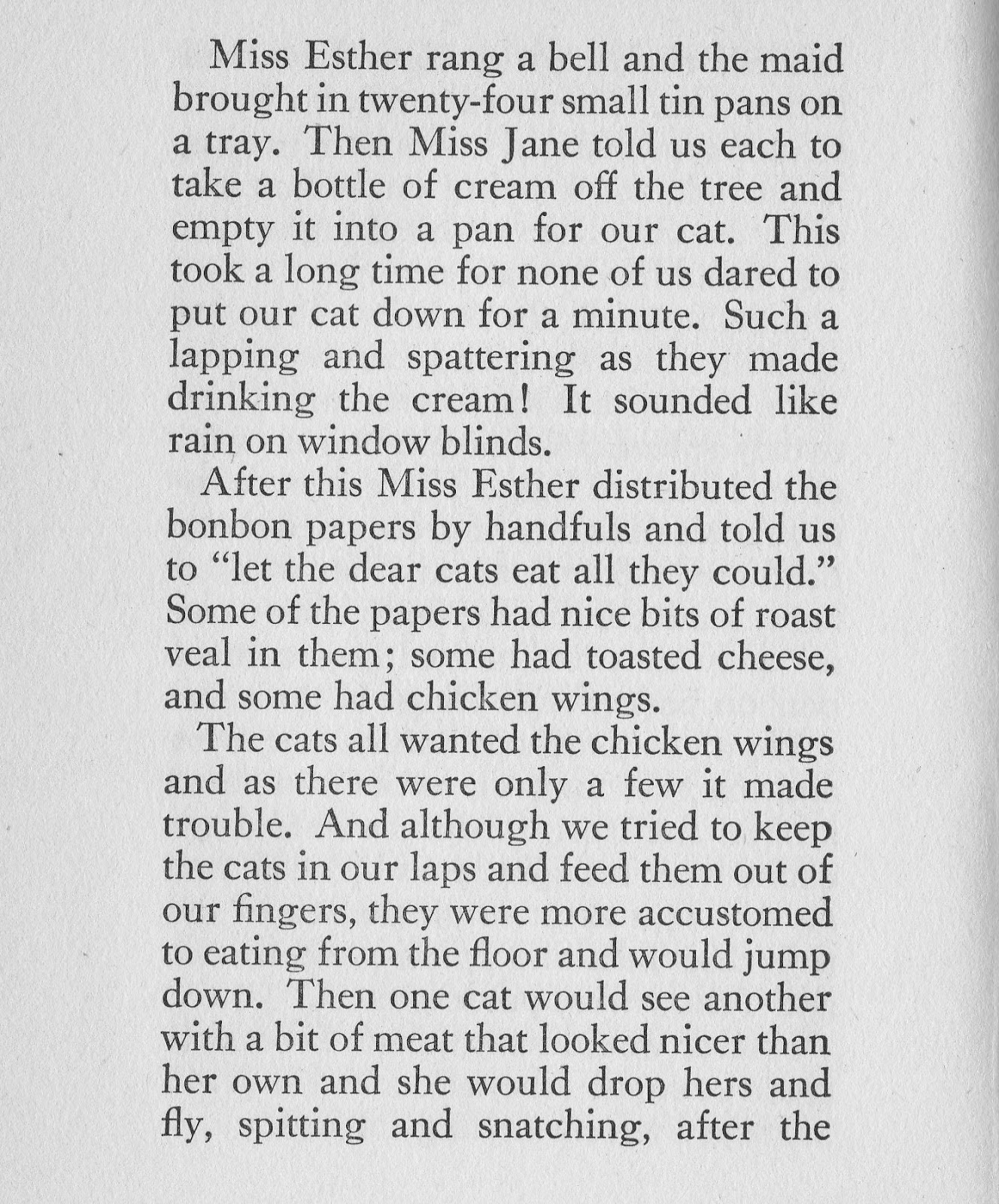
In readying myself, I searched my past articles here with the label Victorian Christmas and started clicking on links. I found myself hating the way blogs start with the latest on a topic, working through posts until eventually you reach the earliest material.  Some of those links are no longer correct.  Of all of them, the one about the Christmas network, My Merry Christmas, was my biggest disappointment.  I had spent time typing up some of my favorite Public Domain material (not even scanning it!).  That site has always been a bit quirky for finding stories and many of the links I posted earlier don't work.  Unfortunately I mentioned starting with my much-loved Helen Hunt Jackson's unusual memory of "A Christmas Tree for Cats", but it's gone!  As a result, and because this month, too, will find me on the road a lot, I plan to keep those wonderful Victorian stories right here, starting with that very tale.

By the way, the author, Helen Hunt Jackson, was best known for the novel, Ramona, which drew attention to the mistreatment of California's Native Americans.  "Christmas Tree for Cats" was published (and recommended) in many ways, but you will find an expanded version was published in 1876 in her Bits of Talk, in Verse and Prose, for Young Folks .  (That's a Google scan of the book and insists on going to page 25.  Above the page, go to the tab that says Page 25 and click the down arrow; that brings up the Table of Contents; click on "A Christmas Tree for Cats", Page 18 to read a longer version of the story from the beginning.)

A Christmas Tree for Cats


I hope that story leaves you purring for more.  I can't wait, I'll be telling some, including this story, this coming Sunday for a private party.  At least this took you to a very special party in your imagination.  Next week will bring another.
******************
This is part of a series of postings of stories under the category, "Keeping the Public in Public Domain."  The idea behind Public Domain was to preserve our cultural heritage after the authors and their immediate heirs were compensated.  I feel strongly current copyright law delays this intent on works of the 20th century.  My own library of folklore includes so many books within the Public Domain I decided to share stories from them.  I hope you enjoy discovering new stories.  


At the same time, my own involvement in storytelling regularly creates projects requiring research as part of my sharing stories with an audience.  Whenever that research needs to be shown here, the publishing of Public Domain stories will not occur that week.  This is a return to my regular posting of a research project here.  (Don't worry, this isn't dry research, my research is always geared towards future storytelling to an audience.)  Response has convinced me that "Keeping the Public in Public Domain" should continue along with my other postings as often as I can manage it.  


There are many online resources for Public Domain stories, none for folklore is as ambitious as fellow storyteller, Yoel Perez's database, Yashpeh, the International Folktales Collection.  I recommended it earlier and want to continue to do so.  He has just loaded Stith Thompson's Motif Index into his server as a database so one can search the whole 6 volumes for whatever word or expression he likes by pressing one key. http://folkmasa.org/motiv/motif.htm

He also loaded to his server the doctorate thesis of Prof. Dov Noy (Neunan) "Motif-index of Talmudic-Midrahic literature" Indiana University, 1954, as a PDF file.
in the hope that some of you would make use of it.

You can see why that is a site I recommend to you.

Have fun discovering even more stories!

Saturday, November 28, 2015

Lang - Wali Dad, the Simple-Hearted - Keeping the Public in Public Domain

Today I want people to know the story which inspired this entire month of tales about gratitude, "Wali Dad, the Simple-Hearted."  For those who love to compare and contrast versions, there are two lovely picture book editions. 


That second version is also available as a Reader's Theater script or you may find it in Aaron Shepard's collection of such scripts in his
Here's the contents for that book:
"The Adventures of Mouse Deer" (Indonesia)
"The Calabash Kids" (Tanzania)
"The Hidden One" (Native America)
"The Boy Who Wanted the Willies" (Europe)
"The Princess Mouse" (Finland)
"The Legend of Slappy Hooper" (U.S.)
"The Gifts of Wali Dad" (India, Pakistan)
"The Baker's Dozen" (U.S.)
"Master Maid" (Norway)
"The Magic Brocade" (China)
"Forty Fortunes" (Iran)
"Master Man" (Nigeria)
"Savitri" (India)
"The Enchanted Storks" (Iraq)
"The Crystal Heart" (Vietnam)
"The Sea King's Daughter" (Russia)
There's also another place for ideas on performing the story at Tell It My Way
But each of those is a retelling.  As Aaron Shepard notes: This is a retelling of the “Story of Wali Dâd the Simple-hearted,” found in Andrew Lang’s Brown Fairy Book (1904). The tale was given to Lang by a Major Campbell—a British army officer stationed in India’s Punjab—who heard it from “an Indian.” Since the Punjab was later split between India and Pakistan, I have thought it best to attribute the tale to both countries. The dominant influences of the story are Islamic and Zoroastrian rather than Hindu.

I want you to know the original as collected by Andrew Lang.
Illustrated by H.J. Ford

My own copy is not up to the rigors of scanning, but the story can be found online and I'd really hate for you to miss it.  Here's the text, minus the book's original illustration, from Lit2Go.  (Lit2Go also gives two activities, one mathematical and one outlining the cause and effect of each action within the story as it is part of the Educational Technology Clearinghouse which supports K-12 education.)

I am, however, scanning that original illustration because the Peris -- and Wali Dad -- should be seen -- along with Aaron's explanation of them.  His own research tells us "Peris are an import from Persian mythology. Originally considered evil, their image changed gradually to benevolent beings akin to fairies or angels. It is said they feed only on the odor of perfume."  Mmmm, how sweet an idea!


Both Aaron Shepard and Lit2Go remind you the story comes from Lang's The Brown Fairy Book.  You may notice that's a Dover Publications book cover.  At one time they published the entire "Rainbow series" by Lang.  Unfortunately they now only offer some of the series and the Brown Fairy Book is not one of them.  For affordable hard copies of what they still provide, go to Dover Publications books by Andrew Lang  where the good news is they have even more than just the Rainbow series, as they include such books as Lang's Arabian Nights Entertainments.  For an online copy of the whole book, thank heavens for Project Gutenberg, who have some other unusual Lang books as well as, so far, ten of the twelve Rainbow -- as of this writing omitting Orange and Lilac.  For a full list of contents, go to Wikipedia's article on Andrew Lang's Fairy Books to find all the stories in these wonderful books which Lang produced between 1889 and 1910.

Now for a bit of a personal suggestion on the telling of this story.  The story is fairly long, 3,522 words according to Lit2Go or 10 pages of text + illustration in my copy.  Dear Wali manages quite a few gifts on his limited budget.  (Just shows how much good we all can do!)  That Lit2Go activity about each action's cause and effect is a great tool to have near the teller, or at least keep a list of the gifts.

Here are a few interesting additional tidbits I discovered.
  • Wikipedia's article on the meaning of the Arabic word "Wali" tells us the word means "custodian", "protector", "helper", etc., but the most common meaning of the word is that of a Muslim saint or holy person.  Wali Dad certainly fits that in the story.  
  • Rudyard Kipling uses the name in his short story, "On the City Wall."
  • There actually is a city in Pakistan called Wali Dad.  Here in the U.S. it's the start of our winter, but there Weather.com gives this week's forecast as in the 80s and sunny.
Here in the United States, whether sunny or not, the fourth Thursday in November has been declared Thanksgiving Day.  Recently people seem to want to call it Turkey Day, after the most common dish eaten and now I've seen one commercial trying to call it Thanks Getting Day!  I absolutely never plan to shop on Thanksgiving Day.  It's a day to celebrate with your family and think about the many reasons you may have for gratitude.  I hope this month's stories have given you ways to enjoy and tell about your gratitude.  As today's story shows, this isn't limited by religion, and Keeping the Public in Public Domain isn't limited in time, we all have such reasons if we only look.
*************
This is part of a series of postings of stories under the category, "Keeping the Public in Public Domain."  The idea behind Public Domain was to preserve our cultural heritage after the authors and their immediate heirs were compensated.  I feel strongly current copyright law delays this intent on works of the 20th century.  My own library of folklore includes so many books within the Public Domain I decided to share stories from them.  I hope you enjoy discovering new stories.  


At the same time, my own involvement in storytelling regularly creates projects requiring research as part of my sharing stories with an audience.  Whenever that research needs to be shown here, the publishing of Public Domain stories will not occur that week.  This is a return to my regular posting of a research project here.  (Don't worry, this isn't dry research, my research is always geared towards future storytelling to an audience.)  Response has convinced me that "Keeping the Public in Public Domain" should continue along with my other postings as often as I can manage it.  


There are many online resources for Public Domain stories, none for folklore is as ambitious as fellow storyteller, Yoel Perez's database, Yashpeh, the International Folktales Collection.  I recommended it earlier and want to continue to do so.  He has just loaded Stith Thompson's Motif Index into his server as a database so one can search the whole 6 volumes for whatever word or expression he likes by pressing one key. http://folkmasa.org/motiv/motif.htm

He also loaded to his server the doctorate thesis of Prof. Dov Noy (Neunan) "Motif-index of Talmudic-Midrahic literature" Indiana University, 1954, as a PDF file.
in the hope that some of you would make use of it.

You can see why that is a site I recommend to you.

Have fun discovering even more stories!

Saturday, November 21, 2015

Afanas'ev - At the Behest of the Pike - Keeping the Public in Public Domain

Depending on how you transliterate the Cyrillic, today's story is by Alexander Afanasev or Aleksandr Afanas'ev.  Either way he's the main collector of Russian Folklore with Wikipedia telling us he published roughly 600 stories, one of the world's largest folktale collections.  He started as a librarian for 13 years at the Archives of Moscow, but was fired when his Russian Popular Religious Legends caused a scandal for its satirizing the Russian Orthodox clergy.  He was definitely not the stereotype of a librarian and, as the frequent phrase in pre-revolutionary Russian literature might say:  Бог знает (God knows), his starting the collecting of Russian folktales was needed.  Unfortunately, Бог знает what he needed was a job.  Censorship in Russia meant, after successfully publishing the сказки we translate as "fairy tales", his next type of tales meant he was considered blasphemous and much of his remaining writing was unpublishable in Russia.  (His Russian Forbidden Tales were published anonymously in Geneva, satirizing both the clergy and landowners.)  He didn't even live 10 years after his popular сказки were published.  Penniless, after selling his personal library, he died of tuberculosis at only 45.

Many of his stories were initially translated in 1916 by Leonard Arthur Magnus.  I sometimes say the summation of the Russian philosophical attitude is "Life is a dismal swamp."  Magnus summarized the difference of Russian folktales from that of the German tales as having an outlook "of a careful observer, who has become callous, because he is helpless" and further notes "the prevailing note is sadness; but there is no absence of humour; yet fun merely happens, and is inherent; there is no broad, boisterous fun."  He points out the absence of fairies, giants, gnomes and personifications of nature; but the inclusion of the supernatural with the witch and also the magician "Koschey the Deathless" (Lois: I love telling about the witch, Baba Yaga, & also Stravinsky's Firebird ballet from those tales about Koschei), the difference in Russian legends of the Russian peasant-style Christ and the Saints, plus the personification of Death and Sorrow.  Find his 1916 Russian Folk-Tales at Archive.org.  It's the Public Domain source of today's tale, but don't stop there.  The Pantheon Fairy Tale & Folklore Library has the 1945 Russian Fairy Tales translated by Norbert Guterman still under copyright.  It has far more stories than Magnus translated and the publisher points out about the series: The folkloric traditions of cultures throughout the world come brilliantly to life in these fairy tale and folk tale compilations by world-class scholars and anthropologists.  I recommend the series for a first stop in developing your own telling stories of the 17 cultures in their series.

One of my favorite tellable versions of Russian tales has been mentioned here before, Old Peter's Russian Tales by Arthur Ransome, take a look back by clicking that hotlink.  Checking the book for a Russian tale of gratitude or ingratitude, I found a Russian parallel of the well-known tale from the Brothers Grimm, "The Fisherman and His Wife" called "The Golden Fish."  I kept looking and went to Magnus because Ransome's story was quite long.

This introduction to today's tale has been long, too.  Afanasev's methods often gave more than one version of the same story.  Today's сказки is Afanas'ev via Magnus in a far different view of what might happen if you catch a magic fish.
That's about as close to "and they all lived happily ever after" as you might hope to find in a Russian tale.
******************
This is part of a series of postings of stories under the category, "Keeping the Public in Public Domain."  The idea behind Public Domain was to preserve our cultural heritage after the authors and their immediate heirs were compensated.  I feel strongly current copyright law delays this intent on works of the 20th century.  My own library of folklore includes so many books within the Public Domain I decided to share stories from them.  I hope you enjoy discovering new stories.  


At the same time, my own involvement in storytelling regularly creates projects requiring research as part of my sharing stories with an audience.  Whenever that research needs to be shown here, the publishing of Public Domain stories will not occur that week.  This is a return to my regular posting of a research project here.  (Don't worry, this isn't dry research, my research is always geared towards future storytelling to an audience.)  Response has convinced me that "Keeping the Public in Public Domain" should continue along with my other postings as often as I can manage it.  


There are many online resources for Public Domain stories, none for folklore is as ambitious as fellow storyteller, Yoel Perez's database, Yashpeh, the International Folktales Collection.  I recommended it earlier and want to continue to do so.  He has just loaded Stith Thompson's Motif Index into his server as a database so one can search the whole 6 volumes for whatever word or expression he likes by pressing one key. http://folkmasa.org/motiv/motif.htm

He also loaded to his server the doctorate thesis of Prof. Dov Noy (Neunan) "Motif-index of Talmudic-Midrahic literature" Indiana University, 1954, as a PDF file.
in the hope that some of you would make use of it.

You can see why that is a site I recommend to you.

Have fun discovering even more stories!

Saturday, November 14, 2015

Jacobs - Androcles and the Lion - Keeping the Public in Public Domain

This is also sometimes called Europa's Fairy Book
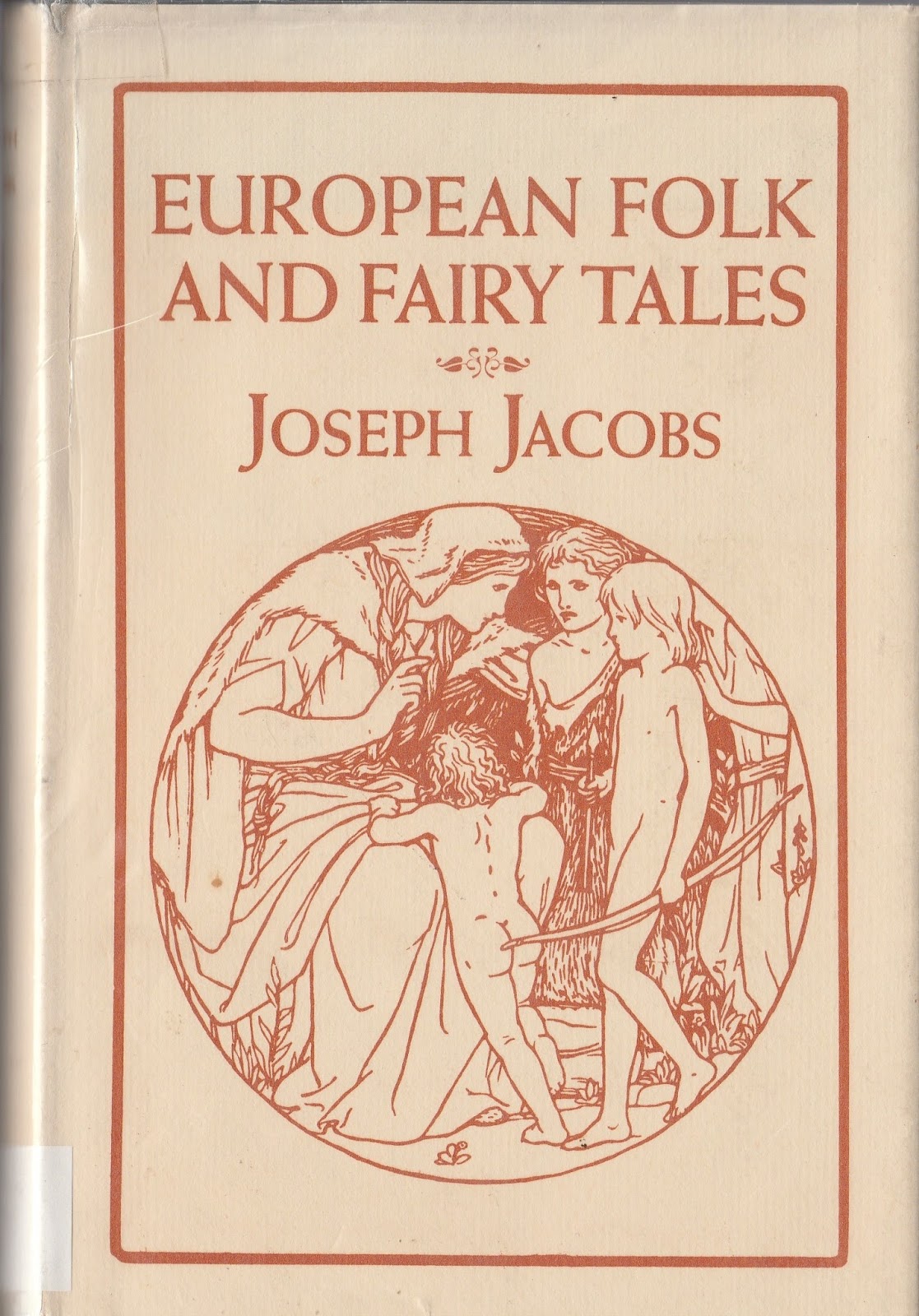
For the next three weeks I've selected stories appropriate for Thanksgiving storytelling. Chestnuts may sometimes be part of stuffing, so here's a non-edible Chestnut with a story so traditional it almost defines a Tale Type.  This definitely is the Stith Thompson Motif called The Grateful Animals.  The Aesop's fable about the Lion and the Mouse and the Jataka tale about a thorn removed from an elephant's foot are all related and show the way this story traveled to become part of what the noted folktale collector, Joseph Jacobs, saw as an important part of European traditional folklore.  While he was Australian, Jacobs is best known for his collections of English and Celtic folklore and I've earlier posted a little of his Aesop fables.  Here's the Wikipedia overview of him, but it doesn't begin to tell why his versions are still valued...they are flat out well told.  It's why I chose his version of Androcles and the Lion.

For five of his books,  Sur La Lune gives his text, but omits the illustrations by John D. Batten which fit the works so well.  (My family has Batten ancestors, so he may even be part of my ancestry, who knows?!?)

Beyond Sur La Lune try: The Earliest English Version of the Fables of Bidpai and the Fables of Aesop, which Wikipedia mentions, but that article omitted mentioning The Book of Wonder Voyages and The Most Delectable History of Reynard the Fox.  He wrote beyond folklore, but it's the focus here.

That's enough of an introduction.  The tale is blessedly succinct.


O.k. my only reservation is I'm not about to test the story with an actual lion, but poor Androcles had no choice.  Both he and the lion had plenty of reason for gratitude and Thanksgiving.

I called that story a Chestnut, but next week's story will be a distinctly Russian version of gratitude and thanksgiving from Afanasev.  I trust you'll be grateful to know it.
******************
This is part of a series of postings of stories under the category, "Keeping the Public in Public Domain."  The idea behind Public Domain was to preserve our cultural heritage after the authors and their immediate heirs were compensated.  I feel strongly current copyright law delays this intent on works of the 20th century.  My own library of folklore includes so many books within the Public Domain I decided to share stories from them.  I hope you enjoy discovering new stories.  


At the same time, my own involvement in storytelling regularly creates projects requiring research as part of my sharing stories with an audience.  Whenever that research needs to be shown here, the publishing of Public Domain stories will not occur that week.  This is a return to my regular posting of a research project here.  (Don't worry, this isn't dry research, my research is always geared towards future storytelling to an audience.)  Response has convinced me that "Keeping the Public in Public Domain" should continue along with my other postings as often as I can manage it.  


There are many online resources for Public Domain stories, none for folklore is as ambitious as fellow storyteller, Yoel Perez's database, Yashpeh, the International Folktales Collection.  I recommended it earlier and want to continue to do so.  He has just loaded Stith Thompson's Motif Index into his server as a database so one can search the whole 6 volumes for whatever word or expression he likes by pressing one key. http://folkmasa.org/motiv/motif.htm

He also loaded to his server the doctorate thesis of Prof. Dov Noy (Neunan) "Motif-index of Talmudic-Midrahic literature" Indiana University, 1954, as a PDF file.
in the hope that some of you would make use of it.

You can see why that is a site I recommend to you.

Have fun discovering even more stories!

Saturday, November 7, 2015

A Month of Gratitude

For November I need to work ahead a bit.  I have my usual wonderful assortment of work commitments, but also expect to spend some time in Chicago while my husband, Tom, stays home keeping the rest of things going.  A while back I asked my accountant if I should make him an official employee.  NO WAY!,  she said emphatically.  It's not worth the paperwork and other problems.  So my ever-loving Roadie often, but not always, comes along to my gigs, transporting me and other equipment and sometimes playing his banjo.

Tom loves his banjo and also loves adding it to some of my programs.  Something else about it that he loves is how he only started playing after we got married.  He guesses it was maybe 2006.  It's his first and only playing experience.  Back in his youth he loved folk music, especially the 5-string banjo playing by Dave Guard of the Kingston Trio.  When people say they wish they played an instrument, he points out how he's a Late Bloomer and they can bloom, too.  In my programs I pick on the poor banjo player, but Tom's playing has often been praised by my audiences.  He's a benefit not written into my contracts.  (He's a benefit in oh so many ways, but this blog is about storytelling.)

November is the month in the U.S. where we officially celebrate Thanksgiving.  In the past I posted two enjoyable Public Domain tales in recognition of it.  The first one, The Plaisham, is also good for Audience Participation.  It occurs to me that the word's pronunciation might be something you want to know.  The story makes it clear there is no such thing as a plaisham, so it's not surprising no pronunciation is found.  Long ago I learned there are differences in Irish dialects which may let you know the speaker's region.  They're mainly in three regions: Munster (Cork and Kerry), Connemara and Ulster (Donegal), but I appreciate An Gael, the online Irish language magazine's offering of a system and their saying:
if you've memorized this system and somebody says to you 'Your pronunciation is wrong, it should be said this way...,' don't worry about it.  Most likely they just haven't heard another dialect's way of pronouncing it...  
That came from their section on How To Pronounce Irish for Beginners.  From there you will learn to silence the "s" as the "h" is aspirated.  As for the "ai" you are told to "take your choice" of what I would call ah, long a, or long i.  I'm grateful for the internet's ability to put such answers right on my computer.  As for the husband in the story, he's got his own reasons to be grateful.

Talking about the second story, Madge Bigham's Little Wee Pumpkin's Thanksgiving,  I said: Don't let the overly cute "Wee" in the title turn you off.  It's a good story that might benefit from updating the name of the pumpkin in the title to something a bit less likely to draw unintended snickers.  That's what I said two years ago, but I'm now going to reverse myself.  This year's pumpkin crop has produced much smaller than normal pumpkins.  I'm even hearing canned pumpkin filling may have a shortage because it requires bigger pumpkins.  Aren't you grateful for the warning?  I'm grateful that it gives me a reason to produce a tiny pumpkin and explain the Celtic word "wee."

The queen in that illustration is saying "You must help me find the best pumpkin in all your patch."  While this might not be the best year for pumpkins, what the queen does with that Little Wee Pumpkin is indeed a heart-warming idea ending with a sick child's gratitude.

I'll be posting stories related to Thanksgiving or at least gratitude this month.  It would be a poor unhappy person indeed who couldn't find at least one reason for gratitude.  You don't have to wait until next week for something to stir up your gratitude.  There are always tons of self-help books.  A favorite author is Regina Brett, who also is available online in many ways to give you a variety of ways to read her.
 
Regina Brett and her books


She's a columnist for the Cleveland Plain Dealer and they post her weekly articles in a blog.  That's more current than her website's posting of her articles.  (Ah, yes, website's are always Under Construction because there's always more to do to update them.  I speak from personal experience and consider sites with the Under Construction sign a mark of being a newbie in website maintenance.)  Her site is a great starting point, though, to find out more about this award-winning, funny woman who was unlikely to become a writer, especially not of self-help books.  Her articles are regularly passed around the internet, including her most requested column which she updated in 2008 to Regina Brett's 45 life lessons and 5 to grow on.  Her first book's title came from the start of all this in a column her editor had to be convinced to publish, only to find a huge favorable response wanting even more.  She's been a Pulitzer Prize finalist more than once.  Don't think she's Pollyanna unaware of life's problems.  Among her many "life lessons", she's a cancer survivor and does a lot for people facing that diagnosis.  It's not the only reason I say she was unlikely to become a writer of self-help books, but I'll let you discover more.