Tell me if you have a topic you'd like to see. (Contact: LoiS-sez@LoiS-sez.com .)
Please also let others know about this site.

Friday, February 25, 2022

Bain - 3 Short Ukrainian (Cossack) Stories - Keeping the Public in Public Domain

The invasion of Ukraine and talk of its relationship to Russia made me recall a Ukraininan-American woman I enjoyed seeing at a library where I used to work.  She took Russian as her foreign language in college, but the professor was wise to her background and wouldn't let her "Russify" Ukrainian.  It was easy to relate to that difference when I once acquired a Bible I thought was in Russian to help me learn to read Russian.  It was in Ukrainian and useless for my purpose.  Found it a Ukrainian home.  

Hearing the Ukrainian capitol is called Kyiv and not Kiev made me think of those two incidents.  Wikipedia's article on the Ukrainian language began to show just how complicated their history and culture are.  I went looking for books of Ukrainian folklore I own, but none are in the Public Domain.  Looking on Project Gutenberg I was surprised to find the only folklore in English is by R. Nisbet Bain, whose book of Russian Fairy Tales is a source of Russian folklore I enjoy.  Not only that, but the Ukrainian folklore is in Cossack Fairy Tales and Folk Tales.  Bain was quite a linguist using over twenty languages.  (I drool and think about Lawrence Block's series about The Spy Who Could Not Sleep -- look it up and enjoy!)  Bain went from translating Russian to Ruthenian, which Wikipedia explains is the earlier name for Ukrainian.  The Cossacks are a vital part of Ukraine's history and culture which admittedly has been intertwined and at other  times separated from Russia.  I was surprised to see it included a NATO partnership back in 1994.  There's a reason it was long called "Little Russia."  Clearly there are ties and antagonisms which feel rather like a large family where much is shared, but also fights spring up from time to time.

Cossack Fairy Tales and Folk Tales has some interesting stories including some well worth saving for Halloween, but these three brief tales, for all their brevity give a view into Ukrainian spirit even when they seem at their most helpless.  The first is one of those cumulative tales rather like the old woman who must cross over a stile and her pig won't do it until she asks help from a long string of reluctant helpers.  (Joseph Jacobs' "Fire! Fire! Burn Stick!" is a good example.)  I love assigning members of the audience these "reluctant helpers" for some audience participation.  It also helps remember the long string of participants needed to accomplish a task.

There are many illustrations throughout the book by Bain's brother, Noel, but none for these short bits.  Here's a glimpse of his work from the title page. 

A pair of footnotes follow at the end of the three stories.  I'll also add "tussle with" could be substituted for "touzle" in "The Old Dog."

THE SPARROW AND THE BUSH


THE SPARROW AND THE BUSH

A sparrow once flew down upon a bush and said, “Little bush, give good little sparrow a swing.”––“I won’t!” said the little bush. Then the sparrow was angry, and went to the goat and said, “Goat, goat, nibble bush, bush won’t give good little sparrow a swing.”––“I won’t!” said the goat.––Then the sparrow went to the wolf and said, “Wolf, wolf, eat goat, goat won’t nibble bush, bush won’t give good little sparrow a swing.”––“I won’t!” said the wolf.––Then the sparrow went to the people and said, “Good people, kill wolf, wolf won’t eat goat, goat won’t nibble bush, bush won’t give good little sparrow a swing.”––“We won’t!” said the people.––Then the sparrow went to the Tartars and said, “Tartars, Tartars, slay people, people won’t kill wolf, wolf won’t eat goat, goat won’t nibble bush, bush won’t give good little sparrow a swing.”––But the Tartars said, “We won’t slay the people!” and the people said, “We won’t kill the wolf!” and the wolf said, “I won’t eat the goat!” and the goat said, “I won’t nibble the bush!” and the bush said, “I won’t give the good little sparrow a swing.”––“Go!” said the bush, “to the fire, for the Tartars won’t slay the people, and the people won’t kill the wolf, and the wolf won’t eat the goat, and the goat won’t nibble the bush, and the bush won’t give the dear little sparrow a swing.”––But the fire also said, “I won’t!” (they were all alike)––“go to the water,” said he.––So the sparrow went to the water and said, “Come water, quench fire, fire won’t burn Tartars, Tartars won’t slay people, people won’t kill wolf, wolf won’t eat goat, goat won’t nibble bush, bush won’t give good little sparrow a swing.”––But the water also said, “I won’t!” So the sparrow went to the ox and said, “Ox, ox, drink water, water won’t quench fire, fire won’t burn Tartars, Tartars won’t slay people, people won’t kill wolf, wolf won’t eat goat, goat won’t nibble bush, bush won’t give little sparrow a swing.”––“I won’t!” said the ox.––Then the sparrow went to the pole-axe and said, “Pole-axe, pole-axe, strike ox, ox won’t drink water, water won’t quench fire, fire won’t burn Tartars, Tartars won’t slay people, people won’t kill wolf, wolf won’t eat goat, goat won’t nibble bush, bush won’t give little sparrow a swing.”––“I won’t!” said the pole-axe.––So the sparrow went to the worms and said, “Worms, worms, gnaw pole-axe, pole-axe won’t strike ox, ox won’t drink water, water won’t quench fire, fire won’t burn Tartars, Tartars won’t slay people, people won’t kill wolf, wolf won’t eat goat, goat won’t nibble bush, bush won’t give little sparrow a swing.”––“We won’t!” said the worms.––Then the sparrow went to the hen and said, “Hen, hen, peck worms, worms won’t gnaw pole-axe, pole-axe won’t strike ox, ox won’t drink water, water won’t quench fire, fire won’t burn Tartars, Tartars won’t slay people, people won’t kill wolf, wolf won’t eat goat, goat won’t nibble bush, bush won’t give little sparrow a swing.”––“I won’t!” said the hen, “but go to the sparrow-hawk, he ought to give the first push, or why is he called the Pusher!”[14]––So the sparrow went to the sparrow-hawk and said, “Come, pusher, seize hen, hen won’t peck worms, worms won’t gnaw pole-axe, pole-axe won’t strike ox, ox won’t drink water, water won’t quench fire, fire won’t burn Tartars, Tartars won’t slay people, people won’t kill wolf, wolf won’t eat goat, goat won’t nibble bush, bush won’t give little sparrow a swing.”

Then the sparrow-hawk began to seize the hen, the hen began to peck the worms, the worms began to gnaw the pole-axe, the pole-axe began to hit the ox, the ox began to drink the water, the water began to quench the fire, the fire began to burn the Tartars, the Tartars began to slay the people, the people began to kill the wolf, the wolf began to eat the goat, the goat began to nibble the bush, and the bush cried out:

“Swing away, swing away, swi-i-i-i-ing!
Little daddy sparrow, have your fli-i-i-ing!
”


THE OLD DOG


THE OLD DOG

There was once a man who had a dog. While the dog was young he was made much of, but when he grew old he was driven out of doors. So he went and lay outside the fence, and a wolf came up to him and said, “Doggy, why so down in the mouth?”––“While I was young,” said the dog, “they made much of me; but now that I am old they beat me.” The wolf said, “I see thy master in the field; go after him, and perchance he’ll give thee something.”––“Nay,” said the dog, “they won’t even let me walk about the fields now, they only beat me.”––“Look now,” said the wolf, “I’m sorry, and will make things better for thee. Thy mistress, I see, has put her child down beneath that wagon. I’ll seize it, and make off with it. Run thou after me and bark, and though thou hast no teeth left, touzle me as much as thou canst, so that thy mistress may see it.”

So the wolf seized the child, and ran away with it, and the dog ran after him, and began to touzle him. His mistress saw it, and made after them with a harrow, crying at the same time, “Husband, husband! the wolf has got the child! Gabriel, Gabriel! don’t you see? The wolf has got the child!” Then the man chased the wolf, and got back the child. “Brave old dog!” said he; “you are old and toothless, and yet you can give help in time of need, and will not let your master’s child be stolen.” And henceforth the woman and her husband gave the old dog a large lump of bread every day.


THE FOX AND THE CAT


THE FOX AND THE CAT

In a certain forest there once lived a fox, and near to the fox lived a man who had a cat that had been a good mouser in its youth, but was now old and half blind. The man didn’t want puss any longer, but not liking to kill it, took it out into the forest and lost it there. Then the fox came up and said, “Why, Mr Shaggy Matthew! How d’ye do! What brings you here?”––“Alas!” said Pussy, “my master loved me as long as I could bite, but now that I can bite no longer and have left off catching mice––and I used to catch them finely once––he doesn’t like to kill me, but he has left me in the wood where I must perish miserably.”––“No, dear Pussy!” said the fox; “you leave it to me, and I’ll help you to get your daily bread.”––“You are very good, dear little sister foxey!” said the cat, and the fox built him a little shed with a garden round it to walk about in.

Now one day the hare came to steal the man’s cabbage. “Kreem-kreem-kreem!” he squeaked. But the cat popped his head out of the window, and when he saw the hare, he put up his back and stuck up his tail and said, “Ft-t-t-t-t-Frrrrrrr!” The hare was frightened and ran away and told the bear, the wolf, and the wild boar all about it. “Never mind,” said the bear, “I tell you what, we’ll all four give a banquet, and invite the fox and the cat, and do for the pair of them. Now, look here! I’ll steal the man’s mead; and you, Mr Wolf, steal his fat-pot; and you, Mr Wildboar, root up his fruit-trees; and you, Mr Bunny, go and invite the fox and the cat to dinner.”

So they made everything ready as the bear had said, and the hare ran off to invite the guests. He came beneath the window and said, “We invite your little ladyship Foxey-Woxey, together with Mr Shaggy Matthew, to dinner”––and back he ran again.––“But you should have told them to bring their spoons with them,” said the bear.––“Oh, what a head I’ve got! if I didn’t quite forget!” cried the hare, and back he went again, ran beneath the window and cried, “Mind you bring your spoons!”––“Very well,” said the fox.

So the cat and the fox went to the banquet, and when the cat saw the bacon, he put up his back and stuck out his tail, and cried, “Mee-oo, mee-oo!” with all his might. But they thought he said, “Ma-lo, ma-lo[15]!”––“What!” said the bear, who was hiding behind the beeches with the other beasts, “here have we four been getting together all we could, and this pig-faced cat calls it too little! What a monstrous cat he must be to have such an appetite!” So they were all four very frightened, and the bear ran up a tree, and the others hid where they could. But when the cat saw the boar’s bristles sticking out from behind the bushes he thought it was a mouse, and put up his back again and cried, “Ft! ft! ft! Frrrrrrr!” Then they were more frightened than ever. And the boar went into a bush still farther off, and the wolf went behind an oak, and the bear got down from the tree, and climbed up into a bigger one, and the hare ran right away.

But the cat remained in the midst of all the good things and ate away at the bacon, and the little fox gobbled up the honey, and they ate and ate till they couldn’t eat any more, and then they both went home licking their paws.


[14]

Shulyak means both sparrow-hawk and push.

[15]

What a little! What a little!

***

Looking at the many former countries gobbled up by the old Soviet Union, let's hope these "Cossacks" remain free to choose their own destiny. history, and culture.

Just found this link for resources to discuss the invasion of the Ukraine with young people, including military families.

********************

This is part of a series of postings of stories under the category, "Keeping the Public in Public Domain."  The idea behind Public Domain was to preserve our cultural heritage after the authors and their immediate heirs were compensated.  I feel strongly current copyright law delays this intent on works of the 20th century.  My own library of folklore includes so many books within the Public Domain I decided to share stories from them.  I hope you enjoy discovering new stories.  


At the same time, my own involvement in storytelling regularly creates projects requiring research as part of my sharing stories with an audience.  Whenever that research needs to be shown here, the publishing of Public Domain stories will not occur that week.  This is a return to my regular posting of a research project here.  (Don't worry, this isn't dry research, my research is always geared towards future storytelling to an audience.)  Response has convinced me that "Keeping the Public in Public Domain" should continue along with my other postings as often as I can manage it.
Other Public Domain story resources I recommend-
  • There are many online resources for Public Domain stories, maybe none for folklore is as ambitious as fellow storyteller, Yoel Perez's database, Yashpeh, the International Folktales Collection.  I have long recommended it and continue to do so.  He has loaded Stith Thompson's Motif Index into his server as a database so you can search the whole 6 volumes for whatever word or expression you like by pressing one key. http://folkmasa.org/motiv/motif.htm
  • You may have noticed I'm no longer certain Dr. Perez has the largest database, although his offering the Motif Index certainly qualifies for those of us seeking specific types of stories.  There's another site, FairyTalez claiming to be the largest, with "over 2000 fairy tales, folktales, and fables" and they are "fully optimized for phones, tablets, and PCs", free and presented without ads.

    Between those two sites, there is much for story-lovers, but as they say in infomercials, "Wait, there's more!"
The email list for storytellers, Storytell, discussed Online Story Sources and came up with these additional suggestions:            
         - David K. Brown - http://people.ucalgary.ca/~dkbrown/stories.html
         - Richard Martin - http://www.tellatale.eu/tales_page.html
         - Spirit of Trees - http://spiritoftrees.org/featured-folktales
         - Story-Lovers - http://www.story-lovers.com/ is now only accessible through the Wayback Machine, described below, but the late Jackie Baldwin's wonderful site lives on there, fully searchable manually (the Google search doesn't work), at https://archive.org/ .  It's not easy, but go to Story-lovers.com snapshot for October 22 2016  and you can click on SOS: Searching Out Stories to scroll down through the many story topics and click on the story topic that interests you.
       - World of Tales - http://www.worldoftales.com/ 
           - Zalka Csenge Virag - http://multicoloreddiary.blogspot.com doesn't give the actual stories, but her recommendations, working her way through each country on a continent, give excellent ideas for finding new books and stories to love and tell.
     
You're going to find many of the links on these sites have gone down, BUT go to the Internet Archive Wayback Machine to find some of these old links.  Tim's site, for example, is so huge probably updating it would be a full-time job.  In the case of Story-Lovers, it's great that Jackie Baldwin set it up to stay online as long as it did after she could no longer maintain it.  Possibly searches maintained it.  Unfortunately Storytell list member, Papa Joe is on both Tim Sheppard's site and Story-Lovers, but he no longer maintains his old Papa Joe's Traveling Storytelling Show website and his Library (something you want to see!) is now only on the Wayback Machine.  It took some patience working back through claims of snapshots but finally in December of 2006 it appears!
    Somebody as of this writing whose stories can still be found by his website is the late Chuck Larkin - http://chucklarkin.com/stories.html.  I prefer to list these sites by their complete address so they can be found by the Wayback Machine, a.k.a. Archive.org, when that becomes the only way to find them.
You can see why I recommend these to you. Have fun discovering even more stories!

Friday, February 18, 2022

Carrick - The Crab and the Jaguar - Keeping the Public in Public Domain

When technology works it's great, but when something goes wrong it can be disastrous!  In the middle of last month I discovered my website went down and even claimed it didn't have the security certificate scheduled to run through this week.  I've been with the same webhost for many years, so I gave them the benefit of extra time to correct the problem.  Eventually it became necessary to change webhosts.  That, too, took a while, but now once again https://www.Lois-sez.com is up and running properly.

I've no idea when this problem started, but am grateful that, once again, my website is up.  It was particularly ill-timed as this is the time when I started sending out my Summer Reading Program publicity.  I'm planning on a Storytelling Cruise Around the World.  This program has long been a favorite for schools, libraries, and even at the Detroit Institute of Arts.  

I also bring my puppy puppet sidekick, Buzz, dressed in his lifeguard shirt to help me with added audience participation. Buzz helps me by drawing the raffle-style tickets of audience attendees.  Together we have fun with water-related jokes and riddles.  (I freely confess to having roughly fourth grade humor.  For my international readers, that's roughly nine years old.)

The stories in the program travel from Alaska to Hawaii, Japan, Liberia, and then either Ireland for a mermaid tale or a form of the following South American story first found in English in Valery Carrick's Picture Folk-Tales.  (He also illustrated the story.)  I'll give a bit more about the story later.


Carrick doesn't give the source for this tale, but it is a variant of a South American type of story also often told by our own Native Americans.  I asked a Brazilian storytelling friend about the story and she recognized it, saying the jaguar is known for being very cruel.  She also said in Brazil it is called Onca (pronounced Own-suh).  I use that name when I tell it and confess my telling is closer to the version called "Little Crab and His Magic Eyes" (including having the vulture find blue berries) found in Margaret Read MacDonald's Twenty Tellable Tales.  I recommend the book highly.  

Both Carrick and MacDonald give some fish names that trip well on the tongue, but aren't accurate.  I'm going to switch to Trahira.  This is after following Carrick's information that the fish is the father of the Trahira fish. Trahira grow to approximately a yard long.  Additionally Trahira is one of the names of the Erythrindae family of Central and South American fish known for preying on other fish.  Holding my hands a yard apart and calling them the vicious Trahira fish seems to follow the story's intent.

Right now or in the summer, I'm sure we'd all love to take a warm water cruise around the world. 

**********************

This is part of a series of postings of stories under the category, "Keeping the Public in Public Domain."  The idea behind Public Domain was to preserve our cultural heritage after the authors and their immediate heirs were compensated.  I feel strongly current copyright law delays this intent on works of the 20th century.  My own library of folklore includes so many books within the Public Domain I decided to share stories from them.  I hope you enjoy discovering new stories.  


At the same time, my own involvement in storytelling regularly creates projects requiring research as part of my sharing stories with an audience.  Whenever that research needs to be shown here, the publishing of Public Domain stories will not occur that week.  This is a return to my regular posting of a research project here.  (Don't worry, this isn't dry research, my research is always geared towards future storytelling to an audience.)  Response has convinced me that "Keeping the Public in Public Domain" should continue along with my other postings as often as I can manage it.
Other Public Domain story resources I recommend-
  • There are many online resources for Public Domain stories, maybe none for folklore is as ambitious as fellow storyteller, Yoel Perez's database, Yashpeh, the International Folktales Collection.  I have long recommended it and continue to do so.  He has loaded Stith Thompson's Motif Index into his server as a database so you can search the whole 6 volumes for whatever word or expression you like by pressing one key. http://folkmasa.org/motiv/motif.htm
  • You may have noticed I'm no longer certain Dr. Perez has the largest database, although his offering the Motif Index certainly qualifies for those of us seeking specific types of stories.  There's another site, FairyTalez claiming to be the largest, with "over 2000 fairy tales, folktales, and fables" and they are "fully optimized for phones, tablets, and PCs", free and presented without ads.

    Between those two sites, there is much for story-lovers, but as they say in infomercials, "Wait, there's more!"
The email list for storytellers, Storytell, discussed Online Story Sources and came up with these additional suggestions:            
         - David K. Brown - http://people.ucalgary.ca/~dkbrown/stories.html
         - Richard Martin - http://www.tellatale.eu/tales_page.html
         - Spirit of Trees - http://spiritoftrees.org/featured-folktales
         - Story-Lovers - http://www.story-lovers.com/ is now only accessible through the Wayback Machine, described below, but the late Jackie Baldwin's wonderful site lives on there, fully searchable manually (the Google search doesn't work), at https://archive.org/ .  It's not easy, but go to Story-lovers.com snapshot for October 22 2016  and you can click on SOS: Searching Out Stories to scroll down through the many story topics and click on the story topic that interests you.
       - World of Tales - http://www.worldoftales.com/ 
           - Zalka Csenge Virag - http://multicoloreddiary.blogspot.com doesn't give the actual stories, but her recommendations, working her way through each country on a continent, give excellent ideas for finding new books and stories to love and tell.
     
You're going to find many of the links on these sites have gone down, BUT go to the Internet Archive Wayback Machine to find some of these old links.  Tim's site, for example, is so huge probably updating it would be a full-time job.  In the case of Story-Lovers, it's great that Jackie Baldwin set it up to stay online as long as it did after she could no longer maintain it.  Possibly searches maintained it.  Unfortunately Storytell list member, Papa Joe is on both Tim Sheppard's site and Story-Lovers, but he no longer maintains his old Papa Joe's Traveling Storytelling Show website and his Library (something you want to see!) is now only on the Wayback Machine.  It took some patience working back through claims of snapshots but finally in December of 2006 it appears!
    Somebody as of this writing whose stories can still be found by his website is the late Chuck Larkin - http://chucklarkin.com/stories.html.  I prefer to list these sites by their complete address so they can be found by the Wayback Machine, a.k.a. Archive.org, when that becomes the only way to find them.
You can see why I recommend these to you. Have fun discovering even more stories!


Friday, February 11, 2022

Humphrey - The Good Saint Valentine - Keeping the Public in Public Domain

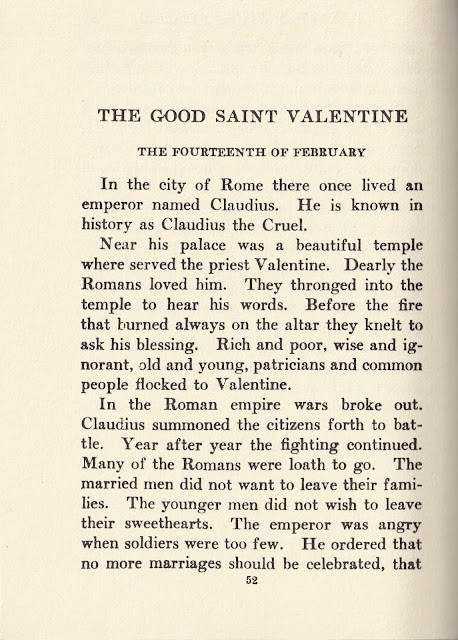
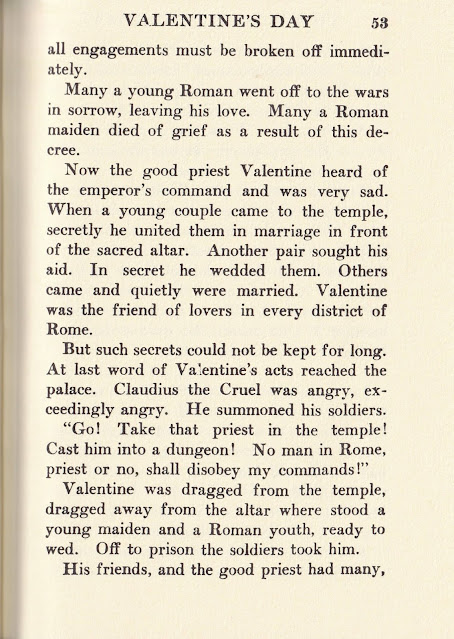
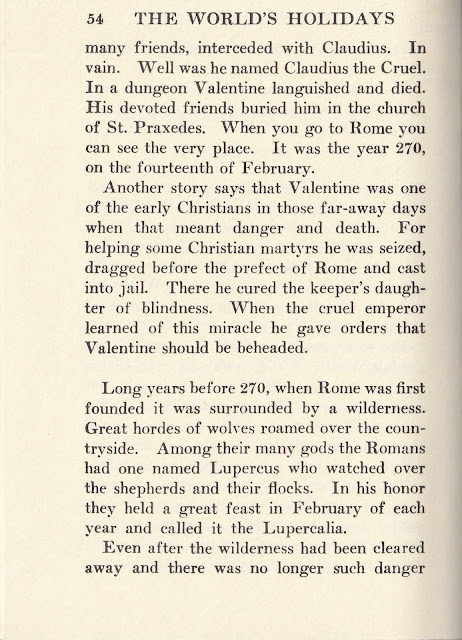
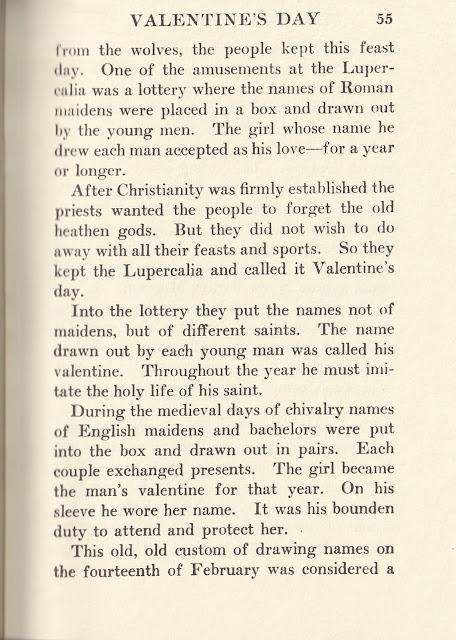
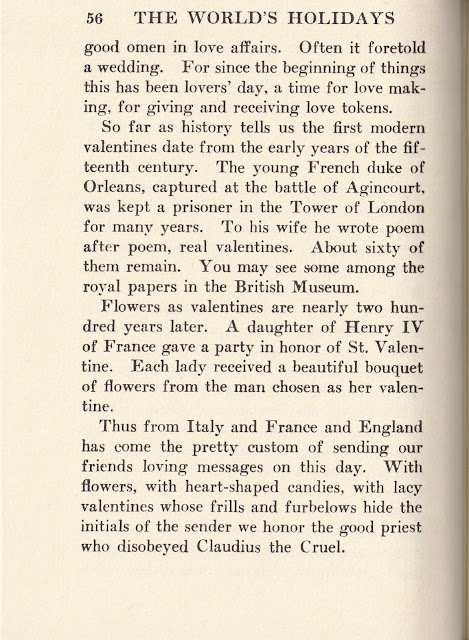
Legendary tales of saints in early Christian times are plentiful, but what is known about both Saint Valentine and the development of the holiday are fairly consistent.  Much less is known about today's author, Grace Humphrey, who published many books in the early 20th century.  Let's look at what she wrote first, plus a drawing of the youthful saint.  (No illustrations from early days exist.  Religious or stained glass versions make him look way older than I picture this man who valued love.  I chose another that's common, but also by the prolific "A. Nony Mous.")


Whether you like poems, flowers, or modern day cards and "sweets for the sweet", this gives you a bit of legendary background on a holiday that is certainly commercialized, but also would be popular even without buying a thing.

I mentioned at the beginning little is known about the author, Grace Humphrey.  Perhaps genealogical information could be found, but that lets us know only a facts view of a woman whose many works tried to present both what facts could be found AND some of the spirit of her subjects.  Her list of works at Goodreads lets me guess she was from Illinois with possibly eastern European roots.  In a day when book covers didn't carry author photos, she seems to have preferred to let her work speak for itself.

Speaking of her works, Stories of the World's Holidays, is on my shelf in a sturdy brown reprint from Gale Research.  They reprinted many early books of interest to storytellers, so if you see them, don't let the boring appearance stop you.

At one time while freelancing I worked for the local publisher, Gale, back then called Gale Research.  Like many publishers they've become part of a larger publisher, in this case Cengage.  Mergers happen and tax laws on a publisher's "backlist" all led to dropping their republishing old classics like today's book, Stories of the World's Holidays.  The Public Domain was enriched by those backlist classics.

***********************


This is part of a series of postings of stories under the category, "Keeping the Public in Public Domain."  The idea behind Public Domain was to preserve our cultural heritage after the authors and their immediate heirs were compensated.  I feel strongly current copyright law delays this intent on works of the 20th century.  My own library of folklore includes so many books within the Public Domain I decided to share stories from them.  I hope you enjoy discovering new stories.  


At the same time, my own involvement in storytelling regularly creates projects requiring research as part of my sharing stories with an audience.  Whenever that research needs to be shown here, the publishing of Public Domain stories will not occur that week.  This is a return to my regular posting of a research project here.  (Don't worry, this isn't dry research, my research is always geared towards future storytelling to an audience.)  Response has convinced me that "Keeping the Public in Public Domain" should continue along with my other postings as often as I can manage it.
Other Public Domain story resources I recommend-
  • There are many online resources for Public Domain stories, maybe none for folklore is as ambitious as fellow storyteller, Yoel Perez's database, Yashpeh, the International Folktales Collection.  I have long recommended it and continue to do so.  He has loaded Stith Thompson's Motif Index into his server as a database so you can search the whole 6 volumes for whatever word or expression you like by pressing one key. http://folkmasa.org/motiv/motif.htm
  • You may have noticed I'm no longer certain Dr. Perez has the largest database, although his offering the Motif Index certainly qualifies for those of us seeking specific types of stories.  There's another site, FairyTalez claiming to be the largest, with "over 2000 fairy tales, folktales, and fables" and they are "fully optimized for phones, tablets, and PCs", free and presented without ads.

    Between those two sites, there is much for story-lovers, but as they say in infomercials, "Wait, there's more!"
The email list for storytellers, Storytell, discussed Online Story Sources and came up with these additional suggestions:            
         - David K. Brown - http://people.ucalgary.ca/~dkbrown/stories.html
         - Richard Martin - http://www.tellatale.eu/tales_page.html
         - Spirit of Trees - http://spiritoftrees.org/featured-folktales
         - Story-Lovers - http://www.story-lovers.com/ is now only accessible through the Wayback Machine, described below, but the late Jackie Baldwin's wonderful site lives on there, fully searchable manually (the Google search doesn't work), at https://archive.org/ .  It's not easy, but go to Story-lovers.com snapshot for October 22 2016  and you can click on SOS: Searching Out Stories to scroll down through the many story topics and click on the story topic that interests you.
       - World of Tales - http://www.worldoftales.com/ 
           - Zalka Csenge Virag - http://multicoloreddiary.blogspot.com doesn't give the actual stories, but her recommendations, working her way through each country on a continent, give excellent ideas for finding new books and stories to love and tell.
     
You're going to find many of the links on these sites have gone down, BUT go to the Internet Archive Wayback Machine to find some of these old links.  Tim's site, for example, is so huge probably updating it would be a full-time job.  In the case of Story-Lovers, it's great that Jackie Baldwin set it up to stay online as long as it did after she could no longer maintain it.  Possibly searches maintained it.  Unfortunately Storytell list member, Papa Joe is on both Tim Sheppard's site and Story-Lovers, but he no longer maintains his old Papa Joe's Traveling Storytelling Show website and his Library (something you want to see!) is now only on the Wayback Machine.  It took some patience working back through claims of snapshots but finally in December of 2006 it appears!
    Somebody as of this writing whose stories can still be found by his website is the late Chuck Larkin - http://chucklarkin.com/stories.html.  I prefer to list these sites by their complete address so they can be found by the Wayback Machine, a.k.a. Archive.org, when that becomes the only way to find them.
You can see why I recommend these to you. Have fun discovering even more stories!

Friday, February 4, 2022

Mutt - The Gift of Father Frost - Keeping the Public in Public Domain

Current and last week's winter weather makes any check of a creature seeing its shadow unnecessary.  While we may long for warmth, most of North America knows we're in for more than just six weeks more winter.  

What would you give to be able to control the weather?

What would happen to you if you could control the weather?

Estonian folklore considered those questions and it's still fairly close to what might be expected now.

I'll tell a bit more about the source of this story after we enjoy it.


WELL!  Where's a good heat-sack when you need it?

This is from a delightful book of Estonian tales called Fairy Tales from Baltic Shores. 

There are various editions and covers, but as far as copyright searching could reveal, this 1930 book's copyright was never renewed.  The publisher, The Penn Publishing Company, the author, Eugenie Mutt, or the illustrator, Jeannette Berkowitz, all had the opportunity to renew the book and didn't.  Under the older 1909 copyright law it needed to be renewed 28 years after it had been published.  When that wasn't done, the book entered Public Domain at the renewal year. 

Here I could get on my soapbox and begin my rant about Sonny Bono singing "I Got You Babe" in the Great Beyond.  His constituents when he was in Congress included the Disney Studio, who were about to lose their royalties for the use of Mickey Mouse.  His Copyright Term Extension Act (known also as the Sonny Bono Act or the Mickey Mouse Protection Act) protected works from 1964 onward, getting our copyright law to cover works that had been renewed.  It's more complicated for those renewed works so I alway search 1963 and earlier, avoiding reproduction if renewed.  By the way "Mickey Mouse specifically, having first appeared in 1928, will enter the public domain in 2024[5] or afterward (depending on the date of the product)."  That's from the Wikipedia article hot-linked earlier in this paragraph.  I love the footnote to "Mickey's Headed to the Public Domain! But Will He Go Quietly? - Office of Copyright". Office of Copyright. October 17, 2014. Retrieved January 14, 2018.  Earlier this year we saw the copyright on Winnie-the-Pooh has expired this year.  I expect to see all manner of products using it, especially using E.H. Shepard's illustrations of the characters.  

Searching for the illustrator of this story, Jeannette Berkowitz, I'm only certain she illustrated a similar book The Penn Publishing Company didn't renew, Old Swedish Fairy Tales by Anna Wahlenberg.  (Note to self to consider it for this blog as I own the book.)  Additionally Berkowitz illustrated The Adventures of K'Ton Ton; A Little Jewish Tom Thumb.  It was published in 1935 as the "first major work of Jewish children's literature written in English."  For a glimpse of one story and a few other illustrations, Ariel S. Winter has posted "Ktonton Takes a Ride on a Runaway Trendel."  (Trendel is another spelling of the Hanukkah top more familiarly called a dreidel, but spelled many ways when it's transliterated).  Other than her work on those three books I'm uncertain about her, as the name Berkowitz is not easily verified to know more.


In contrast, how would you like the last name of Mutt as a child in school?  Fortunately that's Eugenie's married name and she's more easily located.  She was born in Tartu, Tartumaa county in eastern Estonia in 1892 as Jevgenia Parts, the daughter of Johann (Jaan) Parts and Sinaida Parts and had a brother named Paul.  I'm not sure when she married Viktor Johann Mutt, but they came to the U.S. in 1928 with their two sons, Oleg and Viktor.  I imagine they probably wished their father's name had been changed during immigration.  Beyond that she was one of four translators into English for The Piper:  A Selection of Estonian Fairy Tales compiled by Juri Talvet and published by the Estonian publisher, Tallinn Perioodika Publishers, in 1987.  By that time she had died in 1983, probably one of the reasons for four translators.  

While the country of Estonia is not as well-known as many other northern European countries, it has had a sizeable immigration history to the U.S., especially after World War II when 11,000 were allowed to immigrate and apply for citizenship as Russia claimed the country.  Today Estonia is once again independent and that's certainly an Estonian trait.  These descendants of the Vikings deserve to be better known. 

(https://clipartix.com)
*******************

This is part of a series of postings of stories under the category, "Keeping the Public in Public Domain."  The idea behind Public Domain was to preserve our cultural heritage after the authors and their immediate heirs were compensated.  I feel strongly current copyright law delays this intent on works of the 20th century.  My own library of folklore includes so many books within the Public Domain I decided to share stories from them.  I hope you enjoy discovering new stories.  


At the same time, my own involvement in storytelling regularly creates projects requiring research as part of my sharing stories with an audience.  Whenever that research needs to be shown here, the publishing of Public Domain stories will not occur that week.  This is a return to my regular posting of a research project here.  (Don't worry, this isn't dry research, my research is always geared towards future storytelling to an audience.)  Response has convinced me that "Keeping the Public in Public Domain" should continue along with my other postings as often as I can manage it.
Other Public Domain story resources I recommend-
  • There are many online resources for Public Domain stories, maybe none for folklore is as ambitious as fellow storyteller, Yoel Perez's database, Yashpeh, the International Folktales Collection.  I have long recommended it and continue to do so.  He has loaded Stith Thompson's Motif Index into his server as a database so you can search the whole 6 volumes for whatever word or expression you like by pressing one key. http://folkmasa.org/motiv/motif.htm
  • You may have noticed I'm no longer certain Dr. Perez has the largest database, although his offering the Motif Index certainly qualifies for those of us seeking specific types of stories.  There's another site, FairyTalez claiming to be the largest, with "over 2000 fairy tales, folktales, and fables" and they are "fully optimized for phones, tablets, and PCs", free and presented without ads.

    Between those two sites, there is much for story-lovers, but as they say in infomercials, "Wait, there's more!"
The email list for storytellers, Storytell, discussed Online Story Sources and came up with these additional suggestions:            
         - David K. Brown - http://people.ucalgary.ca/~dkbrown/stories.html
         - Richard Martin - http://www.tellatale.eu/tales_page.html
         - Spirit of Trees - http://spiritoftrees.org/featured-folktales
         - Story-Lovers - http://www.story-lovers.com/ is now only accessible through the Wayback Machine, described below, but the late Jackie Baldwin's wonderful site lives on there, fully searchable manually (the Google search doesn't work), at https://archive.org/ .  It's not easy, but go to Story-lovers.com snapshot for October 22 2016  and you can click on SOS: Searching Out Stories to scroll down through the many story topics and click on the story topic that interests you.
       - World of Tales - http://www.worldoftales.com/ 
           - Zalka Csenge Virag - http://multicoloreddiary.blogspot.com doesn't give the actual stories, but her recommendations, working her way through each country on a continent, give excellent ideas for finding new books and stories to love and tell.
     
You're going to find many of the links on these sites have gone down, BUT go to the Internet Archive Wayback Machine to find some of these old links.  Tim's site, for example, is so huge probably updating it would be a full-time job.  In the case of Story-Lovers, it's great that Jackie Baldwin set it up to stay online as long as it did after she could no longer maintain it.  Possibly searches maintained it.  Unfortunately Storytell list member, Papa Joe is on both Tim Sheppard's site and Story-Lovers, but he no longer maintains his old Papa Joe's Traveling Storytelling Show website and his Library (something you want to see!) is now only on the Wayback Machine.  It took some patience working back through claims of snapshots but finally in December of 2006 it appears!
    Somebody as of this writing whose stories can still be found by his website is the late Chuck Larkin - http://chucklarkin.com/stories.html.  I prefer to list these sites by their complete address so they can be found by the Wayback Machine, a.k.a. Archive.org, when that becomes the only way to find them.
You can see why I recommend these to you. Have fun discovering even more stories!


Friday, January 28, 2022

Steel - The Close Alliance - Keeping the Public in Public Domain

In the past I've listed the Lunar New Year as Chinese New Year as that is more familiar here in the U.S.  Actually many Asian countries celebrate at the same time.  In addition the spread of Covid19 may be linked to the celebration of it in China.  Let's not avoid this time of celebration, however you may wish to do it.  The Year of the Tiger starts on February 1st of this year.  That link lets you explore more about it, but there are so many wonderful stories about tigers, especially from India, that I want to start right away on one I found delightful.

The illustrator of this story, J. Lockwood Kipling, from Flora Annie Steel's Tales of the Punjab is mentioned in my first of two earlier posts by Steel as the father of Rudyard Kipling.  At the time I just used the label of Kipling to let me also use it for Rudyard.  Have yet to post anything by Rudyard, although I love his Just So Stories!  If you've never found a copy, preferably with good illustrations, go to your library or bookstore IMMEDIATELY!  In the meantime I've given J. Lockwood's Wikipedia link as he deserves your attention, too.  

My copy is a newer edition of Tales of the Punjab, but look at the glorious style of the original edition's binding.  No dust cover can compare.

I've also commented on the problem of copying many of my books and how I often use a Gutenberg edition.  Today's copy came from there, but it must have been from a time when illustrations were omitted and merely noted where they were in the text.  I've added them, giving them a bit more attention that way.

One last thing, it's often said that the moral of a story should be left unsaid, letting the audience decide what it is for each person.  The moral is stated here.  I'm going to give you a chance to think of your own before showing what Steel says it is.

Now for the story and don't let the subtitle, "A Tale of Woe" stop you for it can be rollicking good fun seeing what happens to the tiger.


THE CLOSE ALLIANCE

A TALE OF WOE

One day a farmer went with his bullocks to plough his field. He had just turned the first furrow, when a tiger walked up to him and said, 'Peace be with you, friend! How are you this fine morning?'

'The same to you, my lord, and I am pretty well, thank you!' returned the farmer, quaking with fear, but thinking it wisest to be polite.

'I am glad to hear it,' replied the tiger cheerfully, 'because
Providence has sent me to eat your two bullocks. You are a
God-fearing man, I know, so make haste and unyoke them.'

'My friend, are you sure you are not making a mistake?' asked the farmer, whose courage had returned now that he knew it was merely a question of gobbling up bullocks; 'because Providence sent me to plough this field, and, in order to plough, one must have oxen. Had you not better go and make further inquiries?'

'There is no occasion for delay, and I should be sorry to keep you waiting,' returned the tiger. 'If you'll unyoke the bullocks I'll be ready in a moment.' With that the savage creature fell to sharpening his teeth and claws in a very significant manner.

But the farmer begged and prayed that his oxen might not be eaten, and promised that if the tiger would spare them, he would give in exchange a fine fat young milch cow, which his wife had tied up in the yard at home.

To this the tiger agreed, and, taking the oxen with him, the farmer went sadly homewards. Seeing him return so early from the fields, his wife, who was a stirring, busy woman, called out, 'What! lazybones!—back already, and my work just beginning!'

Then the farmer explained how he had met the tiger, and how to save the bullocks he had promised the milch cow in exchange. At this the wife began to cry, saying, 'A likely story, indeed!—saving your stupid old bullocks at the expense of my beautiful cow! Where will the children get milk? and how can I cook my pottage and collops without butter?'

'All very fine, wife,' retorted the farmer, 'but how can we make bread without corn? and how can you have corn without bullocks to plough the fields? Pottage and collops are very nice, but it is better to do without milk and butter than without bread, so make haste and untie the cow.'

'You great gaby!' wept the wife, 'if you had an ounce of sense in your brain you'd think of some plan to get out of the scrape!'

'Think yourself!' cried the husband, in a rage.

'Very well!' returned the wife; 'but if I do the thinking you must obey orders; I can't do both. Go back to the tiger, and tell him the cow wouldn't come along with you, but that your wife is bringing it'

The farmer, who was a great coward, didn't half like the idea of going back empty-handed to the tiger, but as he could think of no other plan he did as he was bid, and found the beast still sharpening his teeth and claws for very hunger; and when he heard he had to wait still longer for his dinner, he began to prowl about, and lash his tail, and curl his whiskers, in a most terrible manner, causing the poor farmer's knees to knock together with terror.

Now, when the farmer had left the house, his wife went to the stable and saddled the pony; then she put on her husband's best clothes, tied the turban very high, so as to make her look as tall as possible, bestrode the pony, and set off to the field where the tiger was.

She rode along, swaggering and blustering, till she came to where the lane turned into the field, and then she called out, as bold as brass, 'Now, please the powers! I may find a tiger in this place; for I haven't tasted tiger's meat since yesterday, when, as luck would have it, I ate three for breakfast.'

Hearing these words, and seeing the speaker ride boldly at him, the tiger became so alarmed that he turned tail, and bolted into the forest, going away at such a headlong pace that he nearly overturned his own jackal; for tigers always have a jackal of their own, who, as it were, waits at table and clears away the bones.

'My lord! my lord!' cried the jackal, 'whither away so fast?'

'Run! run!' panted the tiger; 'there's the very devil of a horseman in yonder fields, who thinks nothing of eating three tigers for breakfast!'

At this the jackal sniggered in his sleeve. 'My dear lord,' said he, 'the sun has dazzled your eyes! That was no horseman, but only the farmer's wife dressed up as a man!'

'Are you quite sure?' asked the tiger, pausing.

'Quite sure, my lord,' repeated the jackal; 'and if your lordship's eyes had not been dazzled by—ahem!—the sun, your lordship would have seen her pigtail hanging down behind.'

'But you may be mistaken!' persisted the cowardly tiger; 'it was the very devil of a horseman to look at!'

'Who's afraid?' replied the brave jackal. 'Come! don't give up your dinner because of a woman!'

'But you may be bribed to betray me!' argued the tiger, who, like all cowards, was suspicious.

'Let us go together, then!' returned the gallant jackal.

'Nay! but you may take me there and then run away!' insisted the tiger cunningly.

'In that case, let us tie our tails together, and then I can't!' The jackal, you see, was determined not to be done out of his bones.

To this the tiger agreed, and having tied their tails together in a reef-knot, the pair set off arm-in-arm.

Now the farmer and his wife had remained in the field, laughing over the trick she had played on the tiger, when, lo and behold! what should they see but the gallant pair coming back ever so bravely, with their tails tied together.

'Run!' cried the farmer; 'we are lost! we are lost!'

'Nothing of the kind, you great gaby!' answered his wife coolly, 'if you will only stop that noise and be quiet. I can't hear myself speak!'

Then she waited till the pair were within hail, when she called out politely, 'How very kind of you, dear Mr. Jackal, to bring me such a nice fat tiger! I shan't be a moment finishing my share of him, and then you can have the bones.'

At these words the tiger became wild with fright, and, quite forgetting the jackal, and that reef-knot in their tails, he bolted away full tilt, dragging the jackal behind him. Bumpety, bump, bump, over the stones!—crash, scratch, patch, through the briars!

In vain the poor jackal howled and shrieked to the tiger to stop,—the noise behind him only frightened the coward more; and away he went, helter-skelter, hurry-scurry, over hill and dale, till he was nearly dead with fatigue, and the jackal was quite dead from bumps and bruises.

***

I said earlier I would give you a chance to think of your own moral.  Here's that original picture of the tiger to give you a moment to draw your own conclusion.

Now do you see why the tiger's portrait is encircled in tails?  In the original story it also formed the letter "O" for the opening words of "One day."

Here's the offiffiffic'al moral:

Moral

—Don't tie your tail to a coward's.

It's an interesting and good moral, but I bet you thought of something else.

May the Year of the Tiger be good to all of us, certainly better than happened to today's tiger, and have fun reading more stories!

***********

This is part of a series of postings of stories under the category, "Keeping the Public in Public Domain."  The idea behind Public Domain was to preserve our cultural heritage after the authors and their immediate heirs were compensated.  I feel strongly current copyright law delays this intent on works of the 20th century.  My own library of folklore includes so many books within the Public Domain I decided to share stories from them.  I hope you enjoy discovering new stories.  


At the same time, my own involvement in storytelling regularly creates projects requiring research as part of my sharing stories with an audience.  Whenever that research needs to be shown here, the publishing of Public Domain stories will not occur that week.  This is a return to my regular posting of a research project here.  (Don't worry, this isn't dry research, my research is always geared towards future storytelling to an audience.)  Response has convinced me that "Keeping the Public in Public Domain" should continue along with my other postings as often as I can manage it.
Other Public Domain story resources I recommend-
  • There are many online resources for Public Domain stories, maybe none for folklore is as ambitious as fellow storyteller, Yoel Perez's database, Yashpeh, the International Folktales Collection.  I have long recommended it and continue to do so.  He has loaded Stith Thompson's Motif Index into his server as a database so you can search the whole 6 volumes for whatever word or expression you like by pressing one key. http://folkmasa.org/motiv/motif.htm
  • You may have noticed I'm no longer certain Dr. Perez has the largest database, although his offering the Motif Index certainly qualifies for those of us seeking specific types of stories.  There's another site, FairyTalez claiming to be the largest, with "over 2000 fairy tales, folktales, and fables" and they are "fully optimized for phones, tablets, and PCs", free and presented without ads.

    Between those two sites, there is much for story-lovers, but as they say in infomercials, "Wait, there's more!"
The email list for storytellers, Storytell, discussed Online Story Sources and came up with these additional suggestions:            
         - David K. Brown - http://people.ucalgary.ca/~dkbrown/stories.html
         - Richard Martin - http://www.tellatale.eu/tales_page.html
         - Spirit of Trees - http://spiritoftrees.org/featured-folktales
         - Story-Lovers - http://www.story-lovers.com/ is now only accessible through the Wayback Machine, described below, but the late Jackie Baldwin's wonderful site lives on there, fully searchable manually (the Google search doesn't work), at https://archive.org/ .  It's not easy, but go to Story-lovers.com snapshot for October 22 2016  and you can click on SOS: Searching Out Stories to scroll down through the many story topics and click on the story topic that interests you.
       - World of Tales - http://www.worldoftales.com/ 
           - Zalka Csenge Virag - http://multicoloreddiary.blogspot.com doesn't give the actual stories, but her recommendations, working her way through each country on a continent, give excellent ideas for finding new books and stories to love and tell.
     
You're going to find many of the links on these sites have gone down, BUT go to the Internet Archive Wayback Machine to find some of these old links.  Tim's site, for example, is so huge probably updating it would be a full-time job.  In the case of Story-Lovers, it's great that Jackie Baldwin set it up to stay online as long as it did after she could no longer maintain it.  Possibly searches maintained it.  Unfortunately Storytell list member, Papa Joe is on both Tim Sheppard's site and Story-Lovers, but he no longer maintains his old Papa Joe's Traveling Storytelling Show website and his Library (something you want to see!) is now only on the Wayback Machine.  It took some patience working back through claims of snapshots but finally in December of 2006 it appears!
    Somebody as of this writing whose stories can still be found by his website is the late Chuck Larkin - http://chucklarkin.com/stories.html.  I prefer to list these sites by their complete address so they can be found by the Wayback Machine, a.k.a. Archive.org, when that becomes the only way to find them.
You can see why I recommend these to you. Have fun discovering even more stories!